


 Top Rated Course

We may not have the course you’re looking for. If you enquire or give us a call on +61 1-800-150644 and speak to our training experts, we may still be able to help with your training requirements.
What are Settlement Agreements? Key Facts You Should Know
Amelia Williams 16 July 2026A Settlement Agreement is a legal contract between an employer and an employee to resolve disputes or end employment on mutually agreed terms. It includes a financial payment in exchange for the employee waiving their right to legal claims. This helps both parties avoid lengthy tribunal processes and ensures a clean, confidential exit.

Training Outcomes Within Your Budget!
We ensure quality, budget-alignment, and timely delivery by our expert instructors.
Table of Contents
Every job has its ups and downs, and sometimes the relationship between an employer and an employee reaches a point where moving on is the best option. In such situations, it helps to have a structured way to part on good terms. This is where a Settlement Agreement comes in, often seen as a workplace peace treaty that allows both sides to walk away without conflict or legal battles.
It acts as a professional exit strategy, commonly used to resolve disputes, manage redundancies, or end contracts on agreed terms. In this blog, we will explain when you should consider one, how it differs from Non-disclosure Agreements (NDAs) and redundancy, and what benefits or risks to look out for. Let’s dive in!
Table of Contents
1) What is a Settlement Agreement?
2) How Does a Settlement Agreement Function?
3) What Should a Settlement Agreement Contain?
4) Why Do Employers use Settlement Agreements?
5) Essential Elements of a Settlement Agreement
6) What Influences the Value of a Settlement Payout?
7) Factors That May Affect a Dispute Settlement Payout
8) When Should a Settlement Agreement Be Used?
9) Advantages of Using Settlement Agreements
10) Settlement Agreement vs NDA: What’s the Difference?
11) Conclusion
What is a Settlement Agreement?
A Settlement Agreement is a legally binding contract between an employer and an employee to resolve a workplace dispute or end employment on agreed terms. It usually involves a financial payment or other benefits. In return, the employee agrees not to take legal action on the specific issues covered in the agreement.
This type of agreement is often used when both sides want to avoid the stress, cost, and publicity of going to an employment tribunal. For example, if a company is making staff redundant, they may offer a Settlement Agreement. The employee receives compensation and possibly a reference, while the employer gains the certainty that no legal claims will be brought.

How Does a Settlement Agreement Function?
A Settlement Agreement allows both the employer and employee to resolve a workplace dispute or end employment without going to a tribunal. Here are the main stages of how it functions
1) Proposal Stage: Usually initiated by the employer to resolve a dispute or end employment amicably.
2) Negotiation: Terms like compensation, notice period, references, and confidentiality are discussed.
3) Legal Advice: The employee must receive independent legal advice for the agreement to be valid.
4) Signing: Once both parties agree, the document is signed and becomes legally binding.
5) Implementation: The employer provides the agreed payments and terms, and the employee waives their right to take legal action related to their employment.
6) Confidential Closure: The agreement ensures a private, final resolution without involving a tribunal.
What Should a Settlement Agreement Contain?
A Settlement Agreement should clearly outline all terms agreed upon by both employer and employee. Key components typically include:
1) Reasons for the agreement like redundancy, dispute resolution
2) Termination date and final working day
3) Settlement payment amount and how it will be paid
4) Tax treatment of payments
5) Waiver of legal claims
6) Confidentiality clause
7) Reference provision (if any)
8) Non-disparagement clause
9) Legal adviser details
Why Do Employers Use Settlement Agreements?
Employers choose to use Settlement Agreements because they provide a safe and structured way to deal with workplace disputes or to bring employment to an end on agreed terms. Here are some of the main reasons employers rely on them:
1) Avoiding legal proceedings and related costs
2) Ensuring confidentiality of sensitive issues
3) Maintaining business reputation
4) Providing a quick and clean exit
5) Preventing future claims through legal waiver
Master the legal side of business with our Commercial Law Training – Join today!
Essential Elements of a Settlement Agreement
For a Settlement Agreement to be legally valid, it must include the following:
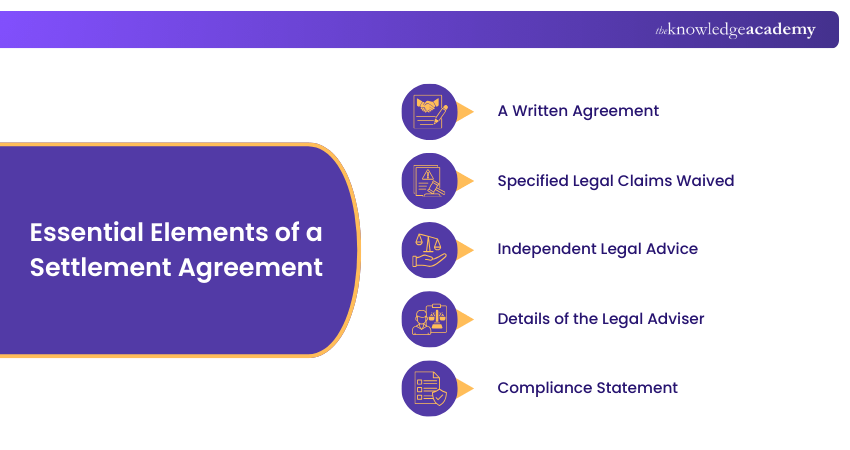
1) A written document clearly outlining all terms
2) Specific legal claims the employee agrees to waive
3) Confirmation the employee received independent legal advice
4) Details of the legal adviser and their insurance
5) A statement confirming the agreement meets legal conditions
What Influences the Value of a Settlement Payout?
Several factors influence how much an employee may receive in a settlement payout:
1) Length of Service: Longer service often results in higher payments.
2) Employee’s Salary and Benefits: Higher earners usually receive larger payouts.
3) Reason for Termination: If dismissal could lead to a tribunal claim, the offer may be higher.
4) Strength of Potential Legal Claims: Strong claims increase leverage.
5) Employer’s Desire for Confidentiality or Quick Resolution: Can lead to higher offers.
6) Employee’s Personal Circumstances: Health, age, and employability can affect payout value.
Factors That May Affect a Dispute Settlement Payout
When negotiating a Settlement Agreement, many factors come into play that can increase or decrease the final payout. Employers assess risk, legal exposure, and employee-specific circumstances to determine how much to offer. Here's a comprehensive explanation of each influencing factor:
1) Employee’s Age
Age can significantly impact future employment prospects. Older employees often face age-related barriers in the job market, making it harder to secure new roles. In cases where termination may be perceived as age-related discrimination, employers may offer a higher payout to mitigate legal risks and avoid tribunal claims under the Equality Act 2010.
Reduce workplace tension and conflict – Register for Employee Dispute Resolution Course today!
2) Annual Salary
Employees with higher salaries typically receive larger settlements because any loss of income will be more substantial. Employers calculate payouts based on monthly earnings, bonuses, and benefits like pensions or health insurance. High-income earners may also have stronger contracts, requiring more generous settlements to meet contractual obligations.
3) Employment Status
Permanent, full-time employees enjoy greater legal protections than temporary, part-time, freelance, or zero-hours workers. As a result, they often receive higher settlement offers. Employees with indefinite contracts may also be entitled to redundancy pay, accrued leave, and notice pay, all of which influence the final amount.
4) Outstanding Bonuses or Commissions
Unpaid performance-based incentives such as annual bonuses, commissions, or profit-sharing are often included in a settlement payout. If the employee has already met certain performance targets or is entitled to a bonus under their contract, this can significantly increase the overall settlement value.
5) Disability Status
Employees with a recognised disability under the Equality Act may receive higher settlements, especially if they believe their dismissal or treatment was linked to their condition. Disability discrimination claims carry serious legal consequences, including uncapped compensation for injury to feelings, loss of earnings, and personal distress.
6) Ongoing Disciplinary Action
If an employee is undergoing disciplinary procedures for misconduct or poor performance, their legal standing weakens. Employers may offer lower settlements in such cases, confident they could dismiss the employee fairly and lawfully without the risk of legal backlash.
7) Claims of Discrimination
Discrimination claims, whether related to gender, race, age, religion, or other protected characteristics pose serious legal and reputational risks to employers. To avoid public tribunal proceedings, companies often offer higher settlements, even when liability is uncertain, to protect their brand and employee relations.
8) Submitted Employment Tribunal Claim
If an employee has already filed a tribunal claim, it demonstrates a willingness to pursue legal action. Employers may offer a higher settlement at this stage to avoid ongoing legal costs, management time, and the risk of an unfavourable public ruling.
9) Filed Grievance
An internal grievance, if it highlights bullying, Workplace Harassment, or unfair treatment strengthens an employee’s position. If poorly handled, a grievance can expose employers to legal claims. To resolve matters swiftly and confidentially, higher payouts may be offered to prevent escalation.
10) Access to Legal Representation
Employees with legal advisers are generally better equipped to negotiate. Skilled solicitors can identify weaknesses in the employer’s case, pressure for better terms, and ensure no critical entitlements are missed. It results in more favourable settlements for the employee.
Boost compliance credibility and break corruption - Complete your Anti-Bribery and Corruption Training today!
11) Duration of Employment
Long-serving employees usually receive higher settlements due to their extended contribution and stronger legal entitlements. Length of service affects redundancy pay, notice period entitlements, and the perceived fairness of dismissal.
12. Notice Period Requirements
If the employer does not want the employee to work their notice period, they must offer payment in lieu. This amount is added to the settlement, increasing the total payout. Similarly, if the notice period is contractually long, it substantially affects the payout figure.
13) Company or Organisation Size
Larger organisations often have deeper pockets and more to lose in terms of reputation. They may offer more generous settlements to quickly resolve disputes and avoid internal or public scrutiny. Smaller businesses may be more limited financially but often seek to resolve matters quietly with fair offers.
14) Active Performance Improvement Plan (PIP)
If an employee is on a PIP for underperformance, it may suggest that termination was imminent. This can reduce their negotiation power and lead to lower offers, as the employer may claim the dismissal was performance-based and justified.
15) Public Sector Employment
Public sector bodies are typically restricted by transparency policies, spending rules, and oversight from government bodies or unions. As a result, settlement payouts in public roles often follow stricter guidelines and are less flexible, making large discretionary payments less likely.
16) Current Sick Leave
Employees on sick leave, particularly for work-related stress or mental health issues, may be in a stronger negotiating position. If medical evidence supports a link between their illness and the employer’s conduct, a higher settlement may be offered to avoid potential disability claims or reputational damage.
17) Whistleblowing Case
Employees who raise whistleblowing concerns are legally protected. If dismissal or mistreatment is linked to a protected disclosure, the risks for the employer are very high. To avoid a public legal battle, companies may offer substantial settlements.
When Should a Settlement Agreement Be Used?
A Settlement Agreement should be used when an employer and employee want to end their working relationship on mutually agreed terms. Common situations include redundancy, performance issues, workplace disputes, or misconduct claims.x
It is particularly helpful when both parties want to avoid lengthy disciplinary procedures or tribunal claims. The agreement provides a clean break and legal protection for both sides.
Navigate equality laws with confidence - Join our Direct And Indirect Discrimination Training now!
Advantages of Using Settlement Agreements
Here are the advantages of using Settlement Agreements:
1) Legal Clarity: Ensures all parties are clear about the terms of the separation.
2) Avoids Litigation: Reduces the risk of employment tribunal claims or legal disputes.
3) Confidentiality: Sensitive matters, including payments or grievances, are kept private.
4) Customisable Terms: Allows negotiation of pay, references, and non-compete clauses.
5) Quicker Resolution: Resolves matters faster than formal legal proceedings.
Settlement Agreement vs NDA: What’s the Difference?
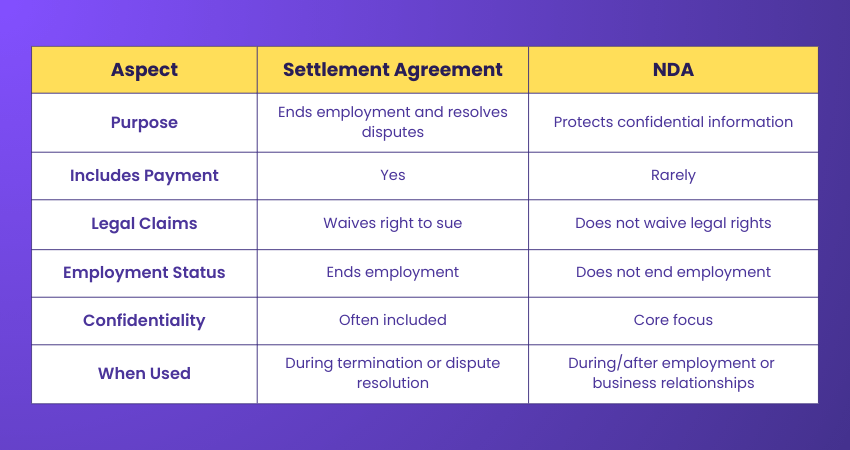
While both a Settlement Agreement and a Non-disclosure Agreement (NDA) can include confidentiality clauses, they serve different purposes. A Settlement Agreement ends an employment relationship and typically involves a financial settlement in exchange for waiving legal claims.
An NDA, on the other hand, is used to protect confidential information during or after employment, without necessarily ending the working relationship. In short, Settlement Agreements resolve disputes, while NDAs protect information.
Conclusion
A Settlement Agreement offers a dignified and legally sound way to end employment on mutually agreed terms. It avoids lengthy disputes, protects both parties, and ensures clarity during a transition. Whether you're an employer or employee, understanding its purpose, benefits, and differences from redundancy or NDAs can help you make informed, confident decisions in challenging situations.
Master handling workplace disputes and protect workplace rights - Start your Employment Law Courses today!
Frequently Asked Questions
Is a Settlement Agreement Better than Redundancy?

A Settlement Agreement can be better than redundancy if both parties seek a quicker, confidential, and mutually agreeable exit. It allows for negotiation of terms and prevents legal claims, unlike standard redundancy, which follows a fixed process and may lead to disputes if mishandled.
What are The Risks of a Settlement Agreement?
A Settlement Agreement can be better than redundancy if both parties seek a quicker, confidential, and mutually agreeable exit. It allows for negotiation of terms and prevents legal claims, unlike standard redundancy, which follows a fixed process and may lead to disputes if mishandled.

Amelia Williams


Senior Human Resources Consultant and Learning Specialist
Amelia Williams is a highly respected HR professional with over 12 years of experience in human capital management, talent development and workplace policy. She has worked across sectors including education, healthcare and corporate services, focusing on aligning people strategies with organisational goals. Amelia’s writing blends current HR trends with practical solutions for modern workplace challenges.


 If you wish to make any changes to your course, please


