


 Top Rated Course

We may not have the course you’re looking for. If you enquire or give us a call on +61 1-800-150644 and speak to our training experts, we may still be able to help with your training requirements.
Information Governance Principles: A Complete Guide
The Knowledge Academy 17 February 2026Dive into the essentials of Information Governance Principles with this all-encompassing blog. Grasp the intricacies of adhering to rules, managing risks, and unlocking value from your data. It’s your roadmap to harnessing information in today’s complex digital landscape. Read along to learn more about Information Governance.

Training Outcomes Within Your Budget!
We ensure quality, budget-alignment, and timely delivery by our expert instructors.
Table of Contents
Data is everywhere, and so is the need to manage it wisely. Mastering Information Governance Principles is more than a necessity—it’s a strategic imperative. This guide sheds light on the path to data mastery, ensuring that your organisation’s information doesn’t just serve its purpose but becomes a pivotal asset. It’s a step-by-step manual to elevate your data from mere bytes to a beacon of opportunity, empowering your business to reach new heights of efficiency and market leadership.
Table of Contents
1) What is Information Governance?
2) Why is Information Governance important?
3) Information Governance Principles
4) Advantages of Information Governance
5) Conclusion
What is Information Governance?
Information Governance embodies a comprehensive strategy to administer information through established controls, procedures, metrics, and designated responsibilities. It recognises information as a critical business asset, adapting to the evolving market dynamics.
Information Governance aims to ensure timely access to information, curtail storage expenses, uphold regulatory adherence, and refine management practices. This approach effectively handles unstructured and irregularly managed information, mitigating associated legal liabilities.

Why is Information Governance important?
Information systems that track individual identities, such as patient records, are invaluable for in-depth analysis and research. However, they must be managed cautiously to prevent unintended identification. The public expects their health data to be treated with the utmost care and sensitivity. Consequently, various legal stipulations and guidelines govern handling health and personal data.
The UK's primary legal framework is the EU General Data Protection Regulation (GDPR), which sets forth Europe’s data protection standards complemented by the UK Data Protection Act 2018. This Act modernises the UK’s data protection laws in alignment with the GDPR. The Information Commissioner’s Office (ICO) is tasked with enforcing these regulations within the UK.
Discover the most important IT Governance Interview Questions And Answers to boost your interview performance.
Information Governance Principles
The Eight Core Information Governance Principles help organisations manage their information effectively and responsibly. Here’s a brief overview of each principle:
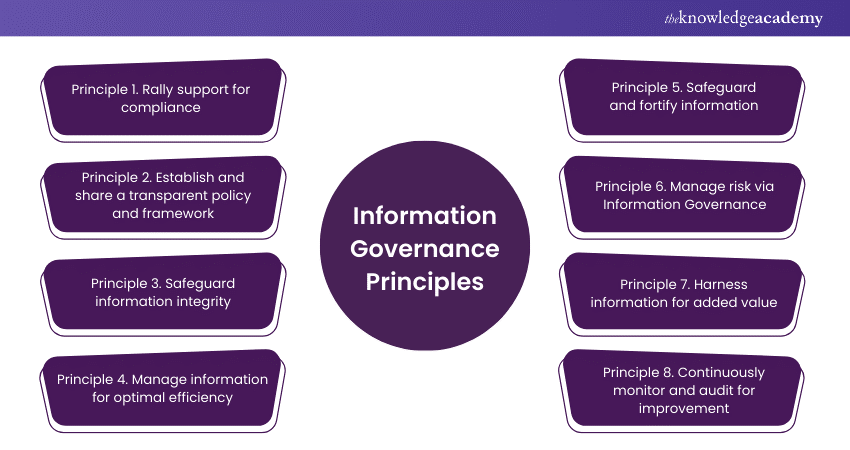
Principle 1. Rally support for compliance
Initiate leadership endorsement to effectively communicate the significance of Information Governance (IG) and the organisation’s aspirations and to spearhead the initiative across departments.
Engaging key stakeholders and personnel can help achieve comprehensive organisational backing. For instance, IT’s involvement is crucial for technology selection and Information Security, while the legal team aids in identifying pertinent policies and regulations. Records management experts contribute their deep understanding of systems like ECM, and business managers offer insights into their unit’s information handling. Equally important is the feedback from end-users, whose acceptance is vital for successful change management.
Principle 2. Establish and share a transparent policy and framework
A policy sets the organisational tone for IG, akin to a mission statement for Information Management (IM). It should delineate IM expectations, establish a foundational framework, highlight IG benefits, assign roles, and affirm compliance with business and legal standards.
An IG framework provides detailed standards, processes, and procedures for managing information assets within legal, regulatory, and business contexts, clarifying each employee’s duties. Policies should be comprehensive, encompassing social media, email, messaging apps, cloud services, and mobile devices.
For efficacy, senior leaders must consistently reinforce and communicate the IG policy and framework, fostering a culture that values and understands IM.
Principle 3. Safeguard information integrity
Information’s value lies in its accuracy, authenticity, and reliability. Upholding information integrity is essential, focusing on consistent information creation, retention, preservation, distribution, and tracking methods. Removing redundant, obsolete, or trivial data and maintaining document audit trails are key, aiding legal verifications and protecting against alteration claims. While technology is central to this principle, policies should also address information transfer protocols, physical document management, and changes in government machinery.
Principle 4. Manage information for optimal efficiency
Effective information management hinges on meticulous information control throughout its lifecycle, encompassing organisation, classification, retention, and disposal. Consider these strategic actions:
Integrate and semantically connect information within a repository, applying an organisation-wide comprehensive taxonomy or classification scheme, potentially revisiting your information architecture.
a) Establish uniform metadata standards, referencing the AGLS Metadata Standard and the Australian Government Recordkeeping Metadata Standard version 2.2 while ensuring ongoing relevance and compliance.
b) Adopt a retention and disposal schedule aligned with standards like Queensland’s GRDS, clearly specifying disposal or archival procedures.
c) Leverage technology judiciously in these tasks, carefully selecting and tailoring records management or ECM systems, considering the traits of an effective RMS.
d) Consolidate all repositories, such as email, cloud storage, and drives, manage them uniformly, or devise a content migration strategy.
Principle 5. Safeguard and fortify information
In an era of frequent security breaches, proactive Information Security measures are imperative. Implement robust encryption for devices, files, and digital storage, a practice common in leading organisations but less so in smaller entities. Plan for the protection of physical records against disasters like floods or fires.
Information privacy, closely related to security, necessitates preventive actions to protect personal and sensitive data. Determine access permissions for sensitive organisational information, devise protection against unauthorised access, and consider the implications for enterprise search and password protocols, a key aspect when discussing Data Governance vs Information Governance.
These refined principles aim to enhance the governance and security of your organisation’s information assets.
Principle 6. Manage risk via Information Governance
Organisations must understand potential threats to mitigate risks effectively. An Information Governance program should safeguard sensitive records and information, ensuring business continuity. It’s crucial to balance the retention and disposal of information, using defensible deletion to eliminate data that is no longer needed, thus reducing storage costs and legal liabilities.
Principle 7. Harness information for added value
Information should be treated as a valuable asset, with its worth and associated costs evaluated. Investing in technology and systems that leverage data analytics and sharing can provide a competitive edge and boost profitability. These tools can refine services, products, and operational efficiency, such as optimising logistics routes.
Principle 8. Continuously monitor and audit for improvement
Information Governance is an ongoing process that requires regular audits and reviews for success. Organisations should adapt to the business environment and technology changes, seeking employee feedback for enhancements. Regular audits, possibly with external specialists, will maintain compliance and ensure the IG policy is effectively communicated.
Be more mindful about your data privacy, sign up for our Data Privacy Awareness Course - register now.
Advantages of Information Governance
Here are some benefits of implementing a robust Information Governance (IG) plan:
a) Enhanced data security: An IG policy establishes a framework of rules, regulations, and standards that fortify the safety and security of organisational data, with expert teams like Casepoint guiding best practices.
b) Streamlined Data Management: A clear IG policy ensures that data is well-organised, classified, and protected, facilitating efficient access to historical and current data, thereby enabling data-driven decision-making and boosting employee productivity.
c) Optimised access and storage: IG delineates protocols for accessing information, reducing bureaucratic hurdles and promoting a more streamlined decision-making process.
d) Cost reduction and collaboration: A well-defined IG policy aids in discerning data storage practices, leading to cost savings and enhanced collaborative efforts.
e) Litigation cost savings: IG practices, particularly eDiscovery, significantly lower the expenses associated with legal proceedings by streamlining access to relevant information.
f) Elimination of data silos: IG eliminates data silos, ensuring that data is valuable throughout its lifecycle and contributes to informed business decisions.
g) Profitability enhancement: Proper organisation, categorisation, and accessibility standards for information can lead to increased profitability.
h) Risk Management: IG policies that classify data according to risk levels facilitate easier access and control, enhancing overall Risk Management.
These benefits underscore the importance of a comprehensive Information Governance strategy in modern organisational management.
Solve crimes with just your screen and keyboard. Sign up for our Computer Forensics Foundation Training - register now!
Conclusion
Information Governance Principles are the cornerstone for organisations to manage their data effectively and responsibly. By adhering to these principles, organisations can ensure that their information is accurate, accessible, compliant with regulations, and secure from threats. As we navigate an increasingly digital world, the importance of robust Information Governance cannot be overstated. It is a strategic asset and a critical component of operational integrity and Risk Management.
Build the best Network Security systems, sign up for our Network Defence Training -register now!
Frequently Asked Questions
How do Information Governance Principles impact data security?

They establish a framework that enhances data protection, reducing the risk of breaches and ensuring regulatory compliance.
Can small businesses benefit from Information Governance?
Absolutely. Even small businesses generate significant data; proper governance can streamline operations and drive growth.
What are the other resources and offers provided by The Knowledge Academy?
The Knowledge Academy takes global learning to new heights, offering over 3,000+ online courses across 490+ locations in 190+ countries. This expansive reach ensures accessibility and convenience for learners worldwide.
Alongside our diverse Online Course Catalogue, encompassing 17 major categories, we go the extra mile by providing a plethora of free educational Online Resources like Blogs, eBooks, Interview Questions and Videos. Tailoring learning experiences further, professionals can unlock greater value through a wide range of special discounts, seasonal deals, and Exclusive Offers.
What is the Knowledge Pass, and how does it work?
The Knowledge Academy’s Knowledge Pass, a prepaid voucher, adds another layer of flexibility, allowing course bookings over a 12-month period. Join us on a journey where education knows no bounds.
What are related CISM Training and blogs provided by The Knowledge Academy?
The Knowledge Academy offers various CISM Training, including CISM Certified Information Security Manager Course. This course caters to different skill levels, providing comprehensive insights into Best CISM Books.
Our IT Security & Data Protection Blogs cover a range of topics related to CISM, offering valuable resources, best practices, and industry insights. Whether you are a beginner or looking to advance your Security skills, The Knowledge Academy's diverse courses and informative blogs have got you covered.

The Knowledge Academy


Global Training Provider
The Knowledge Academy is a world-leading provider of professional training courses, offering globally recognised qualifications across a wide range of subjects. With expert trainers, up-to-date course material, and flexible learning options, we aim to empower professionals and organisations to achieve their goals through continuous learning.

Upcoming IT Security & Data Protection Resources Batches & Dates
Date
 CISA Certified Information Systems Auditor
CISA Certified Information Systems Auditor
Mon 15th Jun 2026
CISA Certified Information Systems Auditor
Mon 14th Sep 2026
CISA Certified Information Systems Auditor
Mon 14th Dec 2026

 If you wish to make any changes to your course, please


