


 Top Rated Course

We may not have the course you’re looking for. If you enquire or give us a call on +44 20 4538 6376 and speak to our training experts, we may still be able to help with your training requirements.
What is Business Process Management? A BPM Guide
James Smith 02 March 2026Business Process Management streamlines and improves repeatable workflows to boost efficiency, cut costs, enhance quality, and support strategic goals. It helps to deliver faster results, improve customer experience, and maintain better compliance. This enables organisations to stay flexible and drive operational success.

Training Outcomes Within Your Budget!
We ensure quality, budget-alignment, and timely delivery by our expert instructors.
Table of Contents

Every organisation requires their operations and processes to run seamlessly. At times, this becomes slow or outdated, which affects the entire workflow. Teams feel frustrated, customer experience delays and business growth takes a halt. This is why understanding What is Business Process Management is of utmost importance to keep up the efficiency and drive consistent business results.
In today’s dynamic world, companies need a clear way to monitor, improve and automate the way work gets done. This is why BPM is necessary to help businesses streamline operations, reduce errors and turbocharge productivity. In this blog, you will learn about What is Business Process Management, its benefits, processes, use cases, types and much more in detail.
Table of Contents
1) What Is Business Process Management?
2) Importance of Business Process Management
3) Types of Business Process Management
4) BPM Lifecycle
5) What are the Benefits of Business Process Management?
6) BPM Best Practices
7) Business Process Management Use Cases
8) What is the Future of Business Process Management?
9) BPM Examples and Applications
10) Conclusion
What is Business Process Management?
BPM is a Strategic Business Management methodology aimed at optimising and improving an organisation's workflows. This approach leads to higher efficiency, greater flexibility, and improved quality outcomes, driving overall business success. Business Process Management is critical in enhancing operational performance and driving overall business success by focusing on the following:
1) Systematic analysis
2) Design
3) Execution
4) Monitoring
5) Refinement of business processes
At its core, Business Process Management involves examining and improving how work is carried out in an organisation. It identifies key processes, by documenting their steps, analysing performance and making informed changes. BPM serves as a strategic framework to help businesses remove bottlenecks, reduce errors and standardise workflows for consistent results.

Importance of Business Process Management
Business Process Management plays a monumental role in modern organisations by delivering a multitude of benefits that contribute to their growth and success. The significance of BPM extends across various aspects of Business Operations, fostering efficiency, agility, and overall excellence. Let's explore some of them below:
1) Enhanced Efficiency and Productivity: Business Process Management identifies bottlenecks, redundancies, and inefficiencies in processes, leading to streamlined workflows and improved resource allocation. This, in turn, accelerates task completion and enhances overall productivity.
2) Reduced Costs: Efficient Business Process Management minimises wastage of time, effort, and resources, resulting in lower operational costs. Organisations can allocate resources more effectively by optimising processes and maximising their value.
3) Improved Customer Satisfaction: Business Process Management ensures that customer-facing processes are fine-tuned for quick response times, accurate deliveries, and exceptional service quality. Satisfied customers drive loyalty and repeat Business.
4) Enhanced Compliance and Risk Management: Effective Business Process Management ensures processes are aligned with regulatory requirements and industry standards. This minimises the risk of legal issues, penalties, and reputational damage.
5) Data-driven Decision Making: Business Process Management generates data insights by monitoring process performance and outcomes. This data empowers informed decision-making, guiding strategies and actions based on evidence.
6) Business Agility: Business Process Management allows organisations to adapt swiftly to changes in the market, technology, or customer preferences. Optimised processes make it easier to pivot and respond to new opportunities.
7) Innovation and Creativity: With streamlined operations, employees have more time to focus on innovation and creative problem-solving. Business Process Management frees them from manual, repetitive tasks, fostering a culture of innovation.
8) Standardisation and Consistency: Business Process Management promotes standardised processes across the organisation, ensuring consistent quality in products and services. This consistency builds trust with customers and stakeholders.
9) Employee Engagement: Efficient processes reduce the frustration caused by cumbersome workflows. Employees can focus on meaningful tasks, leading to higher job satisfaction and engagement.
10) Continuous Improvement: Business Process Management is not a one-time endeavour, as it encourages a cycle of continuous improvement. By regularly assessing and refining processes, organisations stay competitive and relevant.
Enhance efficiency and transform workflows to drive results with Business Process Improvement Training – Register today!
Types of Business Process Management
BPM encompasses various approaches and methodologies tailored to address different organisational needs and challenges. These distinct types of BPM offer flexibility in optimising processes, catering to diverse industries and Business contexts. Let's explore the different types of Business Process Management:
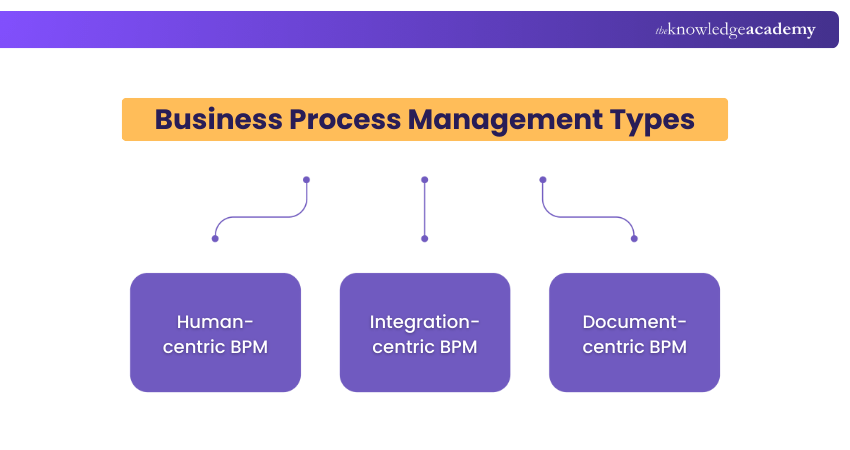
1) Human-centric BPM: In this type, people play the biggest role. Tasks require human decision-making, approvals, or collaboration. With user-friendly tools, such as drag-and-drop workflows and role-based task assignments, it ensures accountability and steady processes. This is used in employee onboarding, customer support, and internal approvals.
2) Integration-centric BPM: This focuses on processes involved with minimal human interaction. It relies heavily on system integrations, Application Programming Interface (APIs), and data automation to keep running operations smoothly. One common example includes Customer Relationship Management (CRM) systems, where information flows automatically to reduce manual work and improve accuracy.
3) Document-centric BPM: This revolves around specific documents that move through multiple steps, such as contracts, purchase orders or compliance reports. It helps to streamline form submissions, reviews, and signatures to ensure documentation is handled securely and efficiently.
Choosing the appropriate Types of Business Management Process depends on an organisation's specific needs, objectives, and existing processes. Whether focusing on human interactions, automation, integration, or other factors, the diverse types of BPM provide a comprehensive toolkit for enhancing efficiency and achieving Business goals.
Empower teams with smart decisions and effective strategies with Senior Management Training – Join now!
BPM Lifecycle
To manage BPM lifecycle effectively, it is crucial to understand that every workflow goes through a structured lifecycle. Let's look at it in detail below.
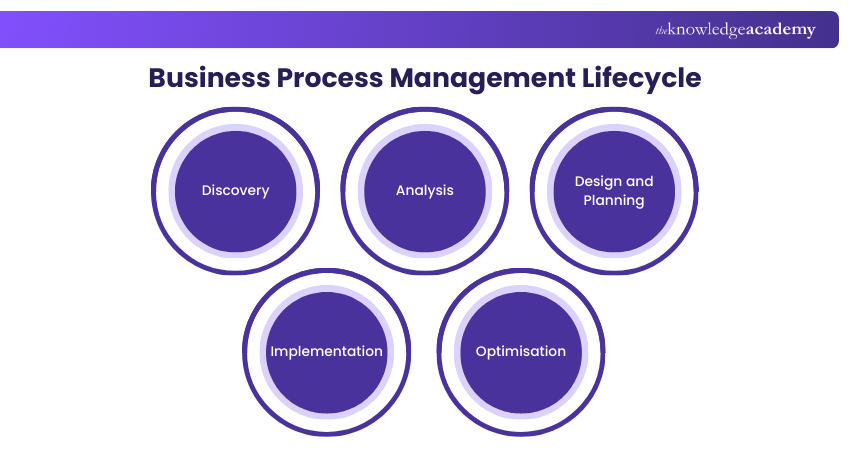
1) Discovery
Organisations begin identifying and documenting their current processes. This phase helps to create a clear inventory of existing workflows and highlight areas that need to be prioritised based on risks, performance issues, or goals.
2) Analysis
In this stage, the performance of the process is examined to spot bottlenecks, errors, or compliance issues. It uses stakeholder feedback, performance data, and process mining tools to help businesses identify which improvement will bring value.
3) Design and Planning
This is the future-state processes designed by rethinking workflows, roles, rules, and supporting technologies. A well-framed and detailed plan is made to ensure the redesign process is scalable, efficient, and ready for execution.
4) Implementation
Here, the improved processes are rolled out across the organisation using BPM platforms and change management support. This includes configuring systems, training employees, and ensuring smooth adoption for teams to follow new workflows.
5) Optimisation
After implementation, processes are monitored using Key Performance Indicators (KPIs) and feedback. This stage focuses on refining operations, automating tasks, and adapting processes based on business needs.
Improve productivity with proven strategies. Join Performance Management Training today!
What are the Benefits of Business Process Management?
Business Process Management (BPM) drives continuous improvement and organisational value. Key benefits include:
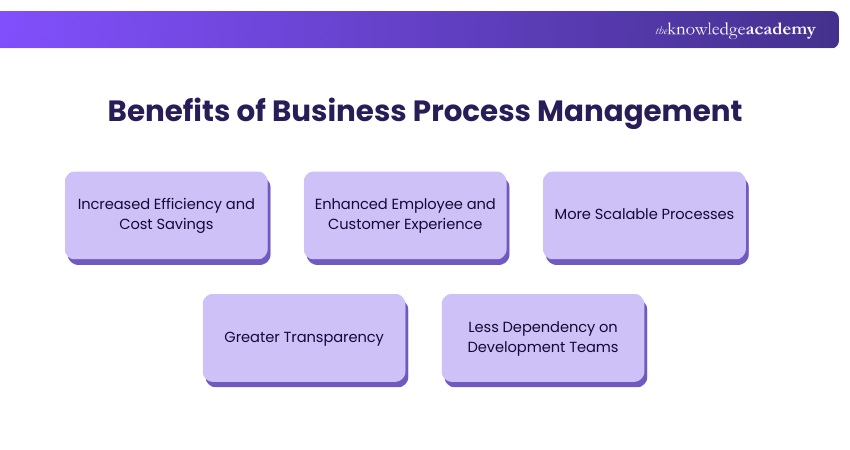
1) Increased Efficiency and Cost Savings
BPM removes redundancies and bottlenecks, improving productivity and allowing faster achievement of business outcomes with fewer resources. Also, it helps to reduce operational costs by eliminating wasteful steps and automating manual work.
2) Enhanced Employee and Customer Experience
By automating repetitive tasks and improving access to information, BPM helps employees stay focused and engaged, leading to higher customer satisfaction. Streamlined workflows result in quicker service delivery and consistent customer experiences.
3) More Scalable Processes
Well-defined workflows and automation support consistent global operations, making it easier to scale processes across teams and geographies. Organisations can expand confidently without losing quality or control over their operations.
4) Greater Transparency
BPM assigns clear task ownership and responsibilities, encouraging communication and building trust through better visibility. Decision-makers can track progress in real time, leading to faster resolution of issues.
5) Less Dependency on Development Teams
Low-code BPM platforms empower business users to design and automate processes independently, increasing agility and innovation. This reduces IT backlog and allows teams to quickly adapt processes whenever the business requires a change.
Optimise operations to drive better business results with Operations Management Training – Join today!
BPM Best Practices
For effective Business Process Management (BPM), focus on aligning processes with organisational objectives, engaging stakeholders during implementation, and regularly monitoring performance to enhance efficiency and foster an ongoing Business Process Improvement Strategy. The Benefits of Business Process Improvement will ensure that the organisation can quickly adapt to changes and remain competitive.
Business Process Management Use Cases
BPM is commonly applied to streamline workflows, enhance customer onboarding, strengthen Compliance Management and optimise supply chains. It also aids in automating repetitive tasks and improving cross-departmental collaboration.
What is the Future of Business Process Management?
The future of BPM will be defined by Artificial Intelligence (AI), Machine Learning, and hyper automation. These technologies will enable predictive insights, adaptive workflows and continuous optimisation. Low-code platforms will empower business users to refine processes quickly, making BPM more data-driven and essential for digital transformation.
BPM Examples and Applications
Business Process Management (BPM) helps organisations optimise workflows and improve efficiency across departments and industries. Below are common Business Process Management examples and real-world applications:
1) BPM Examples
Business Process Management can impact powerfully across different business functions. Let's look at examples to see how BPM supports better results.
1) Sales: BPM streamlines the entire sales cycle. It improves visibility into customer data, tracks performance, and ensures sales activities support organisational goals. Example, A technology company uses BPM to automate follow-ups and analyse sales trends to help teams focus on high-value trends.
2) Human Resources: HR departments use BPM to automate workflow, such as recruitment, onboarding, performance evaluation and leave approvals. For example, a retail company utilises BPM to automate onboarding tasks for reducing delays and improving the hiring engagement.
3) Finance: In this sector, BPM supports operations, such as budgeting, compliance and reporting. It ensures accuracy, faster approvals and better resource control. For example, a manufacturing company firm uses BPM for real-time budget tracking to optimise spending and improve financial planning.
2) BPM Applications
BPM is widely used across various sectors to improve processes, lower costs, and improve compliance. Some sectors include:
1) Healthcare: Manages patient records, appointments, and billing for accurate and timely care.
2) Finance: Speeds up the loan processing, strengthens audit trails, and supports regulatory requirements.
3) Retail: Improves inventory control, order management, and increases the efficiency of customer service.
4) Logistics: Optimises shipment tracking, delivery routing, and daily operations conducted in the warehouse.
Conclusion
In today’s ever-changing business landscape, organisations face challenges to stay efficient and adaptable. Understanding What is Business Process Management gives businesses a valuable strategic advantage. With BPM, they can simplify workflows, reduce delays and support innovation across teams. This leads to improved performance, better customer satisfaction, and enhanced competitive drive.
Excel in any Business Environment and transform your Leadership abilities– join our Management Courses.
Frequently Asked Questions
What are Business Process Management Tools?

Business Process Management tools are software platforms that help organisations design, automate, monitor, and improve workflows. It provides features, such as processing, modelling, analytics, and system integration. For example, Appian and Nintex.
What are BPM Principles?
Business Process Management (BPM) principles emphasise aligning processes with organisational objectives, improving efficiency, and fostering ongoing improvement. Core principles include:
1) Customer focus
2) Adaptability
3) Collaboration
4) Effective use of technology
What are the Other Resources and Offers Provided by The Knowledge Academy?
The Knowledge Academy takes global learning to new heights, offering over 3,000 online courses across 490+ locations in 190+ countries. This expansive reach ensures accessibility and convenience for learners worldwide.
Alongside our diverse Online Course Catalogue, encompassing 17 major categories, we go the extra mile by providing a plethora of free educational Online Resources like Blogs, eBooks, Interview Questions and Videos. Tailoring learning experiences further, professionals can unlock greater value through a wide range of special discounts, seasonal deals, and Exclusive Offers.
What is The Knowledge Pass, and How Does it Work?
The Knowledge Academy’s Knowledge Pass, a prepaid voucher, adds another layer of flexibility, allowing course bookings over a 12-month period. Join us on a journey where education knows no bounds.
What are the Related Courses and Blogs Provided by The Knowledge Academy?
The Knowledge Academy offers various Management Courses, including the Business Process Improvement Training, Senior Management Training, and Performance Management Training. These courses cater to different skill levels, providing comprehensive insights into Essential Crisis Management Tools.
Our Business Skills Blogs cover a range of topics related to Business Process Management, offering valuable resources, best practices, and industry insights. Whether you are a beginner or looking to advance your Business skills, The Knowledge Academy's diverse courses and informative blogs have got you covered.

James Smith


Digital Marketing Manager and Trainer
James Smith is a digital marketing professional with over a decade of experience in SEO, content strategy, paid media and analytics. He has supported both SMEs and global brands in transforming their digital presence. James’s writing and training are rooted in results-driven tactics and the latest marketing trends.
View Detail
Upcoming Business Skills Resources Batches & Dates
Date
 Leadership Skills Training
Leadership Skills Training
Fri 31st Jul 2026
Leadership Skills Training
Fri 2nd Oct 2026
Leadership Skills Training
Fri 27th Nov 2026

 If you wish to make any changes to your course, please


