


 Top Rated Course

We may not have the course you’re looking for. If you enquire or give us a call on +64 98874342 and speak to our training experts, we may still be able to help with your training requirements.
12 Industries AI Will Disrupt: A New Era of Learning
Lily Turner 27 March 2026AI will significantly reshape healthcare, finance, manufacturing, retail, and transport by automating tasks, boosting efficiency, and changing job roles. It will demand new digital skills while helping businesses innovate faster and deliver smarter, more personalised services across the many Industries AI Will Disrupt.

Training Outcomes Within Your Budget!
We ensure quality, budget-alignment, and timely delivery by our expert instructors.
Table of Contents
Ever noticed how Netflix predicts your next binge or your bank flags fraud before you do? That’s Artificial Intelligence (AI) at work, powering smart decisions and personal experiences. From shopping to healthcare, it’s the invisible force behind daily life. And now, the Industries AI Will Disrupt are already feeling the shift.
The Industries AI Will Disrupt go well beyond tech, reshaping areas like healthcare and customer service. In this blog, we explore key sectors, AI’s benefits, and concerns, helping you navigate a world driven by smart systems.
Table of Contents
1) Why AI is a Disruptive Force?
2) Industries That AI Might Disrupt
3) Advantages of AI Advancements
4) Concerns Regarding AI Advancements
5) Conclusion
Why AI is a Disruptive Force?
AI is a disrupting force because it can think, learn, and make decisions like humans. It can analyse data quickly, find patterns, and improve over time. With these abilities, AI automates routine tasks, reduces errors, speeds up decisions, and changes how businesses operate. As it grows, AI will transform job roles and encourage organisations to adopt smarter and more efficient ways of working.
Examples:
1) In healthcare, AI scans medical images to help doctors detect diseases earlier
2) In finance, AI systems identify fraud within seconds and protect users
3) In retail, AI recommends products based on customer behaviour
4) In transportation, AI powers self-driving technology and smarter traffic control
5) In manufacturing, AI robots improve safety and speed up production

Industries That AI Might Disrupt
These are the industries that Artificial Intelligence might disrupt. Let’s look at 12 industries that AI is likely to disrupt:
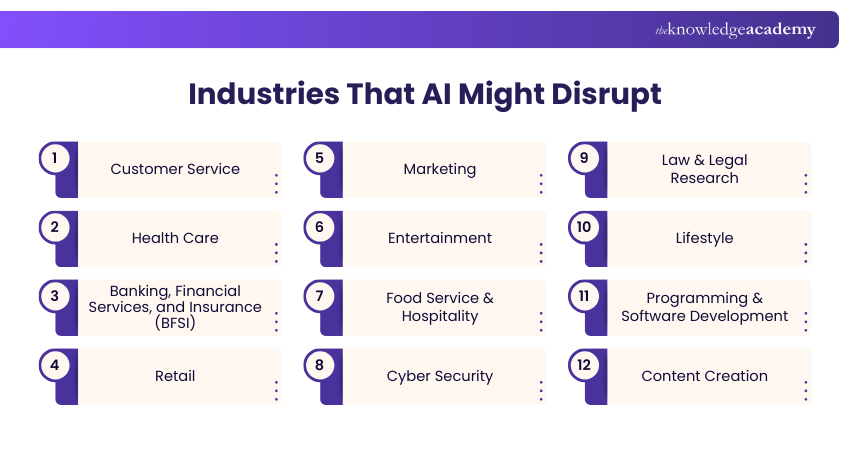
1) Customer Service
AI is boosting customer service by handling simple tasks faster with chatbots. It reduces wait times, saves costs, and keeps customers happy. And this is only the beginning.
a) AI is improving customer service by automating tasks and providing faster support.
b) Chatbots and virtual assistants handle inquiries and offer instant assistance to customers.
c) They can answer questions, process orders, and resolve simple issues without human help.
d) AI operates 24/7, handles multiple customers at once, and provides quick responses, reducing wait times.
e) This results in better customer satisfaction and lower operational costs by automating repetitive tasks.
2) Health Care
The healthcare industry is using AI to enhance patient care. It helps detect diseases early, improves diagnosis, and supports better treatment decisions.
a) AI can analyse medical records and data, recommend treatments, and even predict diseases.
b) It helps doctors to understand issues in medical images like X-rays and MRIs.
c) AI can detect early signs of cancer or heart disease, leading to earlier treatments.
d) AI improves, helps doctors make more accurate diagnoses, and helps to develop new drugs.
3) Banking, Financial Services, and Insurance (BFSI)
The BFSI industries are improving by adopting AI to enhance their services. It strengthens security and speeds up financial processes.
a) AI helps catch fraud, manage risks, and give personalised financial advice and services.
b) It can analyse financial reports and process claims faster than humans.
c) AI also helps in investments by making decisions. Analysing large amounts of data to understand trends.
d) In the future, we could see more AI-driven automation in finance to make services faster and more efficient.
Step into the future with OpenAI Expertise with our OpenAI Training – Sign up Today!
4) Retail
AI is now transforming the retail industry in many ways. It helps personalise shopping, manage inventory better, and improve customer experiences.
a) AI offers a more personalised shopping experience by giving recommendations of products based on previous shopping or searches.
b) It helps manage inventory and optimise supply chains.
c) Retailers are using cashier less stores with the support of AI. Making shopping faster and more convenient.
d) In the future, AI will change and could include virtual shopping assistants and automated Warehouse Management.
5) Marketing
AI is now revolutionising marketing by helping businesses to understand their customers.
a) AI analyses customer data to Predictive Analysis and understand customers buying behaviour and preferences.
b) AI can do more targeted and cost-efficient marketing campaigns.
c) AI automates content creation, like product descriptions and social media posts.
d) Marketers can now mainly focus on planning while AI handles repetitive tasks.
6) Entertainment
AI is influencing the entertainment industry. It recommends content and enhances personalised viewer experiences.
a) AI gives personalised recommendations on many platforms like Netflix and Spotify.
b) It improves video game environments and creates intelligent, non-playable characters.
c) AI is used to generate new content for movies, TV shows, and music.
d) As AI continues to evolve, the entertainment world will see more exciting changes.
7) Food Service & Hospitality
AI is changing the food service and hospitality industries. It supports faster service and smoother customer experiences.
a) AI-influenced robots can take food orders, serve drinks, and even cook.
b) In hotels, AI enhances customer service with virtual assistants for bookings and room service.
c) AI also helps to provide personalised recommendations based on customer preferences, such as their previous order and searches.
d) These kinds of innovations improve customer experience and streamline operations.
8) Cyber Security
AI is playing an important role in cyber security. It detects threats quickly and helps protect systems from attacks.
a) AI detects and responds to cyber threats in real-time, keeping systems secure.
b) It analyses network activity to spot potential threats and stop attacks before they cause damage.
c) AI helps businesses predict and stay ahead of emerging cyber threats.
d) As cyberattacks become more complex, AI is becoming an essential tool for protection.
Transform Excel mastery into AI-Driven Success with our AI and ML with Excel Training – Register today!
9) Law & Legal Research
The legal industry also benefits from AI.
a) AI is used to review contracts, conduct legal research, and predict case outcomes.
b) It helps lawyers save time by automating routine tasks and focusing on strategy.
c) AI can make legal services more affordable by automating simple tasks.
d) In the future, AI could play a bigger role in contract law and dispute resolution.
10) Lifestyle
The legal industry also benefits from AI. It speeds up document review and supports faster, more accurate research.
a) AI helps with smart homes by adjusting temperature and lighting based on preferences.
b) Personal assistants like Siri and Alexa help manage tasks and provide information.
c) AI could also help with personal fitness, mental health, and home maintenance.
d) Devices powered by AI can monitor health, suggest improvements, and even remind us to stay active.
11) Programming & Software Development
AI is speeding up Software Development processes. It automates testing and helps developers build better software faster.
a) AI tools can write code, debug programs, and test software for bugs
b) It reduces human error and accelerates development time
c) As AI evolves, it could automate entire Software Development cycles
d) This could lower costs and lead to more innovative applications
12) Content Creation
AI is already helping generate content across various fields. It creates text, images, videos, and designs faster and more efficiently.
a) AI tools write articles, create social media posts, and even generate video scripts.
b) Content creators can produce more in less time with the help of AI.
c) As AI improves, it will create high-quality content that connects with audiences.
d) This will change how content is created and consumed, making AI a bigger part of content production.
Advantages of AI Advancements
These are the advantages of AI advancements:
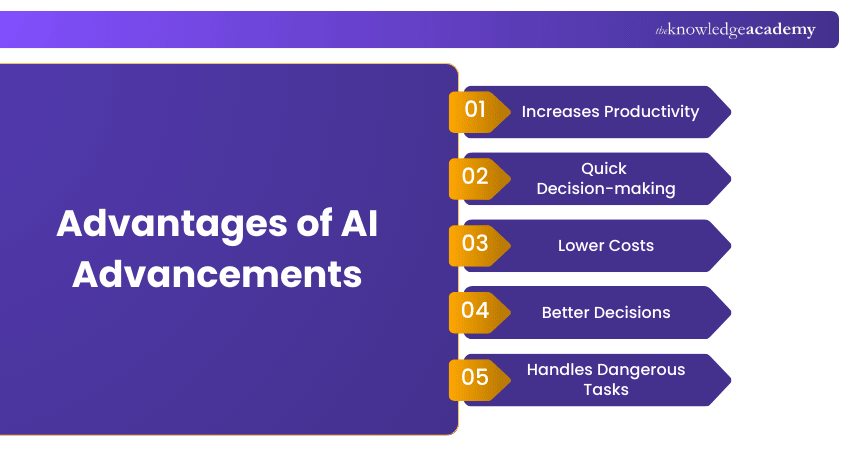
1) Increases Productivity: AI can take over tasks that take humans longer, speeding up work and boosting productivity.
2) Quick Decision-making: Decisions can be made more quickly, helping businesses perform better.
3) Lower Costs: Automating tasks and improving efficiency helps businesses save money.
4) Better Decisions: AI takes huge amounts of data to find useful insights that humans might miss, helping businesses make smarter choices.
5) Handles Dangerous Tasks: Robots can do work in dangerous places, keeping people safe from harm.
Your future in AI begins with Machine Learning. Join our Machine Learning Course – Today!
Concerns Regarding AI Advancements
Here are the concerns regarding AI advancements:
1) Job Loss: Now that tasks are automated, some workers might lose their jobs because machines can take over their work.
2) Privacy Issues: Using large amounts of data creates concerns about how that data is collected, stored, and used.
3) Malicious Use: When technology is used for harmful purposes, it could be more dangerous, like cyberattacks or spreading false information.
4) Unintended Issues: Machines become more independent and there’s a worry that they could become more powerful and can cause problems.
5) Responsible Development: It's important to be careful while developing new things and using technology.
Conclusion
AI is rapidly changing industries all over the world, providing both challenges and opportunities. From improving healthcare outcomes to changing customer service, the Industries AI Will Disrupt are immense. To stay competitive, businesses must understand these changes and transform. Accepting AI’s capability at the same time addressing its concerns will be important for navigating this new era of transformation.
Step into AI and empower your future career with our Artificial Intelligence & Machine Learning Course – Join now!
Frequently Asked Questions
Which Industry Uses AI the Most?

These are the industries using AI the most:
1) Healthcare: AI supports diagnosis, treatment, and care
2) Finance: Detects fraud, manages risk and analyses data
3) Customer Service: Chatbots handle queries and support
4) Retail: Powers personalised shopping and inventory
5) Manufacturing: Automates production and boosts output
What Jobs Will AI Replace?
AI is likely to replace jobs with repetitive tasks. These are some examples:
1) Data Entry: Quickly inputs large volumes of data
2) Customer Service: Chatbots handle basic inquiries
3) Manufacturing: Robots manage routine production tasks
4) Transportation: Self-driving tech may replace drivers
What are the Other Resources and Offers Provided by The Knowledge Academy?
The Knowledge Academy takes global learning to new heights, offering over 3,000+ online courses across 490+ locations in 190+ countries. This expansive reach ensures accessibility and convenience for learners worldwide.
Alongside our diverse Online Course Catalogue, encompassing 17 major categories, we go the extra mile by providing a plethora of free educational Online Resources like Blogs, eBooks, Interview Questions and Videos. Tailoring learning experiences further, professionals can unlock greater value through a wide range of special discounts, seasonal deals, and Exclusive Offers.
What is The Knowledge Pass, and How Does it Work?
The Knowledge Academy’s Knowledge Pass, a prepaid voucher, adds another layer of flexibility, allowing course bookings over a 12-month period. Join us on a journey where education knows no bounds.
What are the Related Courses and Blogs Provided by The Knowledge Academy?
The Knowledge Academy offers various Artificial Intelligence & Machine Learning Courses, including the Introduction to AI Course, Machine Learning Course, and the AI and ML with Excel Training. These courses cater to different skill levels, providing comprehensive insights into OpenAI Alternatives.
Our Data, Analytics & AI Blogs cover a range of topics related to Artificial Intelligence, offering valuable resources, best practices, and industry insights. Whether you are a beginner or looking to advance your Data, Analytics & AI skills, The Knowledge Academy's diverse courses and informative blogs have got you covered.

Lily Turner


Senior AI/ML Engineer and Data Science Author
Lily Turner is a data science professional with over 10 years of experience in artificial intelligence, machine learning, and big data analytics. Her work bridges academic research and industry innovation, with a focus on solving real-world problems using data-driven approaches. Lily’s content empowers aspiring data scientists to build practical, scalable models using the latest tools and techniques.
View Detail
Upcoming Data, Analytics & AI Resources Batches & Dates
Date
 Introduction to AI Course
Introduction to AI Course
Fri 12th Jun 2026
Introduction to AI Course
Fri 21st Aug 2026
Introduction to AI Course
Fri 2nd Oct 2026

 If you wish to make any changes to your course, please


