


 Top Rated Course

We may not have the course you’re looking for. If you enquire or give us a call on +64 98874342 and speak to our training experts, we may still be able to help with your training requirements.
Top 43+ Agile Interview Questions and Answers in 2025
The Knowledge Academy 24 April 2026Agile is an iterative, flexible methodology focused on collaboration and Continuous Improvement. Agile Interview Questions are designed to assess a candidate's understanding of Agile principles and methodologies. Read this blog to know more about these questions and prepare yourself extensively for your next Project Management Interview.
Training Outcomes Within Your Budget!
We ensure quality, budget-alignment, and timely delivery by our expert instructors.
Table of Contents

Are you preparing for an Agile interview and feeling overwhelmed by the potential questions? Don't worry; we've got you covered with the ultimate guide to mastering Agile interviews. Understanding the top Agile Interview Questions can significantly boost your confidence and readiness.
Dive into our comprehensive blog featuring the top 43+ Agile Interview Questions and expert answers. Whether you're new to Agile or a seasoned pro, this resource will help you ace your interview and land your dream job in this dynamic field.
Table of Contents
1) Agile Interview Questions and Answers
a) Define Agile in Brief.
b) Mention the Advantages and Disadvantages of the Agile process.
c) What do you Mean by Agile Testing? What are its Principles?
d) Describe the Various Types of Agile Methodologies.
e) What are the Essential Qualities Required to be a Good Agile Tester?
f) What do you Understand by Agile Frameworks?
g) Explain Incremental and Iterative Development in Agile.
h) What are the Best Agile Tools?
i) Describe the Most Critical Agile Metrics?
j) When not to use Agile?
2) Conclusion
Agile Interview Questions and Answers
Are you looking for frequently asked Agile Interview Questions that will enable you to ace the Interview? You are at the right place! Here is a list of the most frequently asked questions and their respective answers for the Agile interviews. Let's have a detailed look at each one of them:
Define Agile in Brief.

Agile is a popular collection of methodologies and best practices emphasising collaborative development. The needs of their clients and viable solutions are discovered through self-organising interactions between cross-functional teams.
Mention the Advantages and Disadvantages of the Agile Process.
Using the Agile process has several benefits, some of which are listed below:
a) Adapts readily to requirements that vary
b) Direct communication with team members and clients
c) Emphasises technical proficiency and superior design
d) Rapid and ongoing development
e) Enables client and project team engagement and cooperation
f) Promotes and ensures client satisfaction
g) Quicker consumer or end-user feedback
h) Detects and fixes code issues as soon as they are identified
i) Division of an Agile project into small, repeatable parts called Sprints or Iterations, which last between one to four weeks
j) Quick product delivery
k) Simple to control and more flexible
The disadvantages of the Agile method are as follows:
a) Lack of formal documentation and planning
b) difficult to estimate the resource needs and effort is difficult
c) Unsuitable for small development projects
d) Expensive in comparison to other development techniques
e) More time and effort are needed from everyone.
f) Risk of a long-term project
g) Scalability issues with massive projects
h) Testing and test creation challenges
What do you Mean by Agile Testing? What are its Principles?
Agile Testing, as the term implies, is System Testing where software is tested for any faults, errors, and other such issues. It is a crucial step in the development process since it helps testers and developers collaborate effectively, enhancing performance in general. Additionally, it aids in assuring the successful delivery of superior goods. Testing is typically done so that testers can locate and fix issues at every stage of the development process. Following are the seven guiding principles of Agile Testing:
a) Continuous Testing
b) Continuous Feedback
c) Collaboration
d) Clean Code
e) Less Documentation
f) Test-Driven
g) Customer Satisfaction
Describe the Various Types of Agile Methodologies.
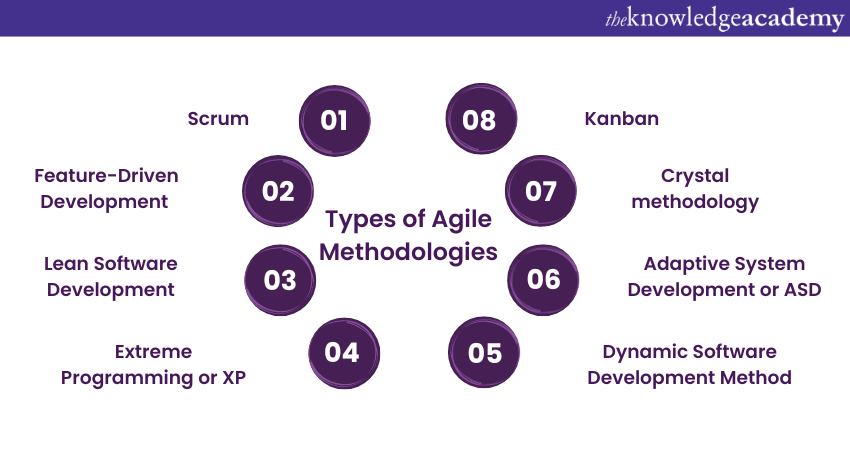
Agile Methodology comprises of various types which are implemented widely across in the industry of Software Development and Project Development. Here are its different types listed below:
a) Scrum: Utilises hypotheses tested through feedback, self-management, small teams, and iterative sprints, focusing on incremental development.
b) Feature-Driven Development or FDD: Emphasises lightweight, incremental Software Development with two-week cycles, delivering stable, functional software on time.
c) Lean Software Development: Minimises waste and maximises value, focusing on efficiency, customer respect, and Continuous Improvement.
d) Extreme Programming or XP: Flexible, low-risk development with continuous testing and feedback to meet client requirements.
e) Dynamic Software Development Method: Ensures proper governance and user-driven Project Management, anticipating modifications to deliver on time and within budget.
f) Adaptive System Development or ASD: Promotes continuous adaptation with cycles of 'Speculate,' 'Collaborate,' and 'Learn'.
g) Crystal methodology: Focuses on individual customers and communication, offering flexible, lightweight development with variants like Crystal Clear, Yellow, Orange, and Red.
h) Kanban: Uses a visual board to manage projects, facilitating task management, Continuous Improvement, and enhanced workflow.
What are the Essential Qualities Required to be a Good Agile Tester?
An effective Agile Tester possesses knowledge of Agile concepts, strong communication skills, the ability to prioritise and comprehend requirements, understands project risks, maintains a positive, solution-focused attitude, recognises customer needs, and demonstrates critical thinking, creativity, and adaptability to change.
Join our Agile Project Management Foundation and Practitioner Course to learn more about Agile Methodology!
What do you Understand by Agile Frameworks?
Agile Frameworks refer to a set of principles and practices designed to guide the development of Software and other projects in a flexible and iterative manner. The Agile approach emphasises collaboration, adaptability to change, and delivering small, incremental improvements regularly. It is particularly popular in Software Development but has been applied to various other fields as well.
Explain Incremental and Iterative Development in Agile.
Here’s a detailed explanation of Incremental and Iterative Development:
Incremental Development:
The process is broken into manageable segments in this type of Development. The work finished in the preceding increment is expanded upon in each successive Increment. Functionalities are gradually added based on everything that has already been built.
Iterative Development:
This entails creating a system that goes through repeated cycles or Iterations. Based on the outcomes of the most recent iteration, adjustments are performed. As a result, the project can change over time.
Unlock your potential and drive your career forward with our SAFe Agile Certification!
What are the Best Agile Tools?
Agile employs a variety of Agile tools, including the following:
a) Icescrum
b) Rally Software
c) Agilent
d) Version One
e) Agilo
f) X-planner
What are the Most Important Agile Metrics?
Agile metrics are of various types, of which some of the most critical ones are as follows:
a) Velocity: Tracks project velocity, keeping all team members informed about progress and performance metrics.
b) Work Role Allocation: Helps Project Managers assign roles and prioritise tasks accurately.
c) Sprint Burndown: Monitors project completion progress through each sprint and required tasks.
d) Cumulative Flow Diagram: Depicts team workflow, showing time consumed (x-axis) and work done (y-axis), visualising progress, backlogs, work in progress, and throughput.
e) Business Value Delivery: Focuses the team on efficiency.
f) Coverage of Time Consumed: Measures time needed for development and testing using the ratio of code lines to related lines.
g) Time of Defect Resolution: Indicates the time required to troubleshoot and fix bugs.
When Should Agile not be used?
Project Managers should take note of the following cases when they should not utilise the Agile Methodology:
a) Inflexible Requirements: Agile needs flexible project requirements, working in short bursts with continuous releases and testing.
b) Indivisible Functionality: Agile requires project functionality to be broken down into small, mangeable user stories for incremental development.
c) Team Skill Level: Agile demands a skilled, experienced team capable of high concentration on tasks.
d) Customer Availability: Agile requires ongoing customer engagement for demos and discussions.
e) Task Volume Evaluation: Agile necessitates prioritising high-value tasks within fixed timeframes for effective Time Management.
Differentiate Between Product Backlog and Sprint Backlog.
The development team, typically owns the Sprint Backlog. It only includes the features and specifications that pertain to the particular Sprint. It is regarded as a portion of the backlog for the product. It is a list of everything that must be done to finish a specific sprint. It solely consists of tasks that can be completed during an Agile sprint. It is unique to the sprint target for that single sprint only.
On the other hand, the project owner oversees the ownership of Product Backlog and upkeep. It often includes all of the product's features as well as its specifications. Everything that needs to be done to finish the procedure has been compiled. Simply put, it divides each item into a sequence of steps. It is more precise in terms of the product's intended use.
What is Pair Programming? Explain its Benefits.
Pair Programming is Computer Programming in which two people collaborate on writing code while using the same machine or computer side by side. It's a method that's primarily employed in Agile Software Development. One person writes the code for this programming, and another examines and reviews each line of code. While working, they both rotate between their roles. The following are some Pair Programming benefits:
a) Creates code of a better standard
b) Lowers the likelihood of mistakes
c) Increases output
d) Enhances team cooperation
Become a certified Agile Project Manager –register for our Agile Programme Management Course now!
What do you Understand by the Agile Manifesto? What are its Values and Principles?
The Agile Manifesto, created in 2001, guides Agile Software Development, emphasising flexibility, iterative progress, and customer collaboration.
Values:
a) Individuals and Interactions over Processes and Tools
b) Working Software over Comprehensive Documentation
c) Customer Collaboration over Contract Negotiation
d) Responding to Change over Following a Plan
Principles:
a) Customer satisfaction through continuous delivery
b) Welcome changing requirements
c) Frequent delivery of working software
d) Daily collaboration between business and developers
e) Motivated individuals, trusted to perform
f) Face-to-face communication is best
g) Working software as progress measure
h) Promote sustainable development
i) Focus on technical excellence
j) Simplicity is key
k) Self-organising teams create the best outcomes
l) Regular reflection and adjustment
What do you Mean by Spike and Zero Sprint in Agile?
Zero Sprint– In Agile development, the first Sprint's setup phase is zero Sprints. Before beginning the project, various tasks that must be completed. These tasks are referred to as the "Zero Sprint" and include creating the development environment and backlogs, among other things.
Spike– The kind of story that can be read in between Sprints is called Spike. Spikes are frequently utilised for tasks involving design or technical challenges, such as research, design, prototyping, and exploration. Spikes come in two varieties: technical spikes and functional spikes.
What is the Appropriate way to use the Agile model?
The Agile Model is best used for projects requiring flexibility, iterative progress, and continuous customer involvement. Start by clearly defining project goals and breaking the work into manageable tasks. Establish cross-functional teams that include developers, testers, and business analysts to ensure collaboration and shared understanding.
Conduct regular sprints, typically lasting two to four weeks, where teams work on defined tasks and deliver working software increments. Hold daily stand-up meetings to track progress, identify obstacles, and adjust plans as needed.
At the end of each sprint, review the work completed with stakeholders, gather feedback, and incorporate it into the next iteration. Continuously evaluate and improve processes to enhance team efficiency and product quality, ensuring alignment with customer needs and project goals.
What is Meant by Release Candidate?
A software application ready for release but has yet to receive official approval is known as a Release Candidate. A software programme must undergo a rigorous testing procedure to ensure it satisfies all requirements before being considered a release candidate.
Although it can also be used in other contexts, such as Product Development, the word "Release Candidate" is frequently employed in the Software Development industry. A Release Candidate is typically the penultimate stage before a product is formally released in Agile and Scrum.
State the Differences Between Agile and Scrum.
Agile and Scrum offer excellent customer experiences during the Software Development cycle and use comparable techniques like team-based iterations. However, neither of them can be substituted for the other. The decision to use any of them for project development mostly depends on the type of project, budget, time, and feasibility. They differ in several ways, some of which are listed below:
|
Aspect |
Agile | Scrum |
|
Definition |
Approach for Software and Project Management | Agile variant detailing procedure and steps |
|
Methodology |
Focus on incremental and iterative sprints | Application of Agile technique |
|
Best for |
Tasks with small groups of specialists | Projects with continuously changing requirements |
|
Progress |
Takes a while to complete | Progresses slowly over time |
|
Design and Implementation |
Simple design and implementation | Requires creativity and originality |
|
Management |
Project Manager oversees all tasks | Team manages tasks collectively |
|
Communication |
Emphasises direct communication | Focuses on generating business value |
|
Flexibility |
Less rigorous, allows more change | Less flexible |
Want to become an Agile Project Manager? Register for our AgilePM Foundation Certification Course today!
What are Burn-up and Burn-down Charts in Agile?
The two kinds of charts, namely Burn-up and Burn-down in Agile, are described as follows:
a) Burn-up chart: A Burn-up chart visually represents completed and pending work in a sprint or iteration. It uses two lines to track planned and completed work, helping Project Managers assess team efficiency and estimate remaining project time.
b) Burn-down chart: A Burn-down chart visualises the pace of work against user stories, showing total effort and work volume for each iteration. The Y-axis represents work quantity, while the X-axis tracks time, illustrating project progress and future projections.
What are the Various Kinds of Burndown Charts?
A Burndown chart graphically shows the amount of work still to be done in a Sprint. It monitors the Sprint's development and spots any potential issues. Here is a list that highlights and describes the various types of Burndown charts:
a) Product Burndown Chart: Illustrates data story points of each Agile sprint, depicting project requirements completion against time consumed, showing achieved product goals and pending work.
b) Sprint Burndown Chart: Shows remaining tasks for a specific sprint, easing workflow and displaying project work completion rate and remaining work for the Scrum team.
c) Release Burndown Chart: Illustrates team progress for project work aimed at a release, updated after each sprint to assess progress regularly.
d) Defect Burndown Chart: Displays project defects, tracking their identification and resolution, or elimination from the project.
What do you Understand About the 'Planning Poker' Technique?
A consensus-based technique called Planning Poker, commonly called Scrum Poker, aids Agile teams in estimating the time and effort needed to finish each initiative on their Product Backlog. It also while identifies problems early on and throughout the development of a user story. It shortens the meeting, makes it more productive, and involves the entire team in creating estimations. The primary purpose of this technique is to prevent participant influence and compel everyone to think for themselves and express their opinions.
What do you Understand About the 'Planning Poker' Technique?
The major Agile components are as follows:
a) Test-driven development
b) Continuous deployment
c) Pair programming
d) Class responsibilities and collaborators cards
e) Daily stand-up meetings
What do you Understand About the 'Planning Poker' Technique?
Here are the various differences between the Agile methodology and Traditional methodology, described in the table below as shown:
|
Aspect |
Agile Methodology |
Traditional Methodology |
|
Focus |
Teamwork, customer collaboration, software features, flexibility |
Upfront planning, scope, cost, time |
|
Testing Timing |
Concurrent with development |
End of development phase |
|
Testing Scope |
Small features |
Whole application |
|
Stakeholder Involvement |
Includes customers throughout |
Excludes stakeholders in development phase |
|
Team Collaboration |
Testers and developers work collaboratively |
Testers and developers work in isolation |
|
Customer Interaction |
Ongoing at every development step |
Limited to requirement phase |
|
Process Flexibility |
More focused and flexible |
Less flexible |
|
Project Suitability |
Large and complex projects |
Small or simple projects |
Why do Companies Adopt the Agile Methodology?
Companies adopt the Agile methodology due to some key reasons, which are as follows:
a) Faster Time-to-Market:Agile's incremental and continuous delivery approach speeds up product creation.
b) Rapid ROI: Quicker time-to-market results in faster return on investment.
c) High Product Quality: Iterative development and continuous improvement enhance product quality.
d) Decreased Risk: Regular testing throughout development mitigates expensive risks.
e) Improved Adaptability: Smaller, collaborative units reduce project complexity and boost efficiency.
f) More Satisfied Customers: Agile prioritises client feedback, ensuring business needs are met.
Why do Companies Adopt the Agile Methodology?
A Release burn-down chart is a type of chart that depicts the summary for the project’s release progress by displaying the remaining work after the commencement of each Agile Sprint, against the ideal workload. It basically offers the team with an overview of the release progress, depicting the sprints on the horizontal x-axis and the remaining work on the vertical y-axis.
Why do Companies Adopt the Agile Methodology?
Here are the three facets of Agile, defined briefly as follows:
a) Epic: An epic in Agile is a massive body of project work which can be segregated into many small-sized user stories. Such user stories are also called ‘issues’ in Jira. These epics typically contain various teams assigned to multiple projects that are trackable on many boards.
b) User story: A software system can be described using an informal, natural language description. Such a description is known as a ‘User story’, which is generally written from an end-user's perspective. User stories can also be recorded on index cards or in a digital format on Project Management Software.
c) Task: When a user story in Agile is broken down to a smaller unit of work. It is termed as a task, which is generally worked on and completed by a single team member.
How is a Sprint’s Velocity Measured?
An Agile Sprint’s velocity can be calculated with a mathematical approach, where the backlog items are divided by the total length of the team’s Sprint in days. In other words, the project’s story points are divided the number of sprints. For example, if the Scrum team has completed 100 points over the course of 5 sprints, then the sprint’s velocity is calculated to be 20 points per sprint.
Explain Incremental and Iterative Development in Agile Methodology.
Incremental and iterative development form the heart of the Agile methodology. Incremental development works as the processing mechanism of breaking a project into small, workable parts referred to as increments. New functional elements are added to the product in each increment. Iterative development is actually a series of cycles or iterations where a product is researched, developed, and tested successively.
Explain the Difference Between Waterfall Model and Agile Model.
While the Waterfall Model is linear and sequential in the development of the software project, the Agile Model emphasises iteration and incremental development by breaking down projects into small parts and developing them within very short cycles or sprints.
They allow checking and making changes on an ongoing basis. Agile is supportive of flexibility and rapid change response while the Waterfall Model is more rigid and fitting to projects where requirements do not change.
|
Feature |
Waterfall Model |
Agile Model |
|
Structure |
Sequential, linear phases |
Iterative, cyclical development |
|
Flexibility |
Rigid, difficult to change requirements mid-project |
Flexible, adaptable to changing needs |
|
Project Planning |
Detailed upfront planning |
Ongoing planning and adaptation |
|
Customer Involvement |
Limited customer involvement after initial requirements gathering |
Frequent customer interaction and feedback |
|
Testing |
Testing done at specific stages, often near the end |
Testing integrated throughout the development process |
|
Documentation |
Heavy emphasis on detailed documentation |
Lighter documentation focus, prioritising working software |
|
Team Size |
Can involve larger teams |
Often works best with smaller, self-organising teams |
|
Suitable for |
Well-defined projects with clear requirements |
Projects with evolving requirements or uncertainty |
What are Different Types of Agile Methodology?
There are many iterative and incremental Software Development approaches to the Agile methodology. Principal among these are the following:
a) Scrum, where teams iterate work within sprints, completing small chunks of defined work within fixed time intervals.
b) Kanban, where the focus is on the visualisation of workflow.
c) Extreme Programming (XP), which is oriented to achieving satisfaction for the customer through continuous feedback and development of high-quality software.
d) Lean, which optimises maximum value by reducing waste.
e) Feature-Driven Development (FDD), which involves making a list of features and planning the development around this list.
These methodologies might have their special practices, but they are generally targeted toward the same purpose: improvement in product development by means of collaboration and flexibility.
What are Story Points in Agile, and How do They Contribute to Project Estimation and Planning?
Story Points in Agile are a unit of measure used to estimate the amount of effort required to fully implement a user story. They help gauge the complexity, risk, and effort involved, focusing on relative effort over absolute time estimates like hours or days. Story points facilitate effective comparison and prioritisation of tasks within the team.
Estimating tasks in story points allows teams to balance their workload and manage project timelines and capacities more effectively. By incorporating uncertainty and relative effort, story points contribute to better sprint planning and help teams manage their workloads more efficiently.
What are the Challenges of Agile Transformation?
Embarking on an Agile transformation is no walk in the park. Resistance to change can crop up from team members who are comfortable with the old ways, and shifting the organisational culture to embrace Agile values can be a Herculean task.
Scaling Agile across large or dispersed teams adds another layer of complexity, demanding stellar coordination and communication. The initial stages might see a dip in productivity as everyone gets up to speed, and finding skilled Agile Coaches to steer the ship isn't always easy.
Aligning Agile with existing corporate structures can feel like fitting a square peg into a round hole, and keeping stakeholders engaged and supportive is an ongoing battle. Plus, measuring the success of Agile transformation requires clear metrics and constant vigilance.
What are a Sprint Planning Meeting, Sprint Review Meeting and Sprint Retrospective Meeting?
A Sprint Planning Meeting is held at the beginning of a sprint in Agile development. The team plans the work to be done during the sprint, breaking it into manageable tasks and estimating the effort required.
The Sprint Review Meeting occurs at the end of the sprint, where the team demonstrates the completed work to stakeholders and receives feedback.
The Sprint Retrospective Meeting takes place after the sprint concludes. Here, the team looks back on the sprint's process, evaluates successes and areas for improvement, and devises strategies for enhancing performance in subsequent sprints.
What are a Sprint Planning Meeting, Sprint Review Meeting and Sprint Retrospective Meeting?
A Product Roadmap is a strategic document that outlines the vision and direction for a product's development. It provides a high-level overview of the features, enhancements, and goals planned for the product over time. It is used to communicate the product strategy to stakeholders, including the development team, executives, and customers.
The roadmap helps align everyone involved on the priorities and timeline for upcoming work, ensuring that efforts are focused on delivering the most value to the business and its customers.
Define the Role of an Agile Coach and Outline Their Responsibilities Within a Development Team.
An Agile Coach guides development teams in the adoption and execution of Agile methodologies, aiming to boost both productivity and efficiency. They are tasked with mentoring and educating team members, orchestrating Agile ceremonies such as sprints, stand-ups, and retrospectives, and nurturing a culture of perpetual enhancement.
Agile Coaches empower teams to self-organise, overcome obstacles, and steadfastly adhere to Agile principles. Furthermore, they liaise with stakeholders to synchronise project objectives with Agile methodologies, support the deployment of Agile tools, and foster a collaborative, transparent communication environment. Their ultimate ambition is to maximise team performance and proficiently deliver superior products.
What are the Phases of Agile Implementation?
The phases of Agile implementation can vary depending on the specific framework or methodology being used, but generally include the following:
a) Assessment and Planning: Evaluate the organisational readiness to adopt Agile methodologies and create a clear roadmap for its implementation.
b) Training and Education: Provide the team members and relevant stakeholders with adequate Agile training.
c) Initial Agile Pilot: Use a pilot project or team to test the effectiveness of proposed Agile method.
d) Scaling Agile: Analyse the test results and implement Agile practices across the entire organisation.
e) Continuous Improvement: Constantly assess and refine the organisation’s Agile practices to improve efficiency and effectiveness.
f) Sustaining Agile: Embed and ingrain the Agile values and practices into the organisational culture to ensure long term benefits and success.
What is the Significance of Daily Stand-Up Meeting?
The Daily Stand-up or the Daily Scrum meeting serves the following purposes:
a) Communication: It facilitates daily team communication, enabling team members to update the team about the previous day’s work and make plans for the days’ work.
b) Transparency: The meeting encourages transparency and keeps every team member informed about the tasks and challenges to expect.
c) Collaboration: It fosters team spirit and cooperation among team members enabling efficient knowledge sharing and work distribution.
d) Focus and Alignment: The meeting helps focus on key tasks and aligns the team members towards the achievement of a common goal.
e) Adaptation: The meeting allows the team to quickly adapt to any potential changes. The daily progress reports and obstacle discussions aid in this.
How do you create an Agile culture within the organisation?
Creating an Agile culture within an organisation requires a combination of leadership, communication, and consistent practices. Here are some key steps to achieve this:
a) Establish cross-functional teams which can collaborate and communicate with each other efficiently and create a culture of trust in the organisation.
b) Encourage continuous learning and improvement by offering regular training and knowledge sharing platforms.
c) Adopt iterative work approach by encouraging teams to deliver value in increments and allowing feedback and improvement.
d) Promote open information sharing and transparency to align the organisation towards the achievement of a common goal.
e) Recognise and celebrate success irrespective of the scale to reinforce the team’s beliefs in Agile practices and keeping all team members motivated.
Why do you Want to Become an Agile Coach?
When answering the question "Why do you want to become an Agile Coach?" in an interview, it's important to convey your passion for Agile principles and your desire to help teams and organisations succeed. Here's a sample answer:
"I want to become an Agile Coach because I am deeply passionate about Agile methodologies and the transformative impact they can have on teams and organisations. Throughout my career, I have seen firsthand how Agile practices can improve collaboration, increase productivity, and drive innovation. As an Agile Coach, I want to make use of my experience and knowledge to help teams embrace Agile principles and practices.
The end result of all of this being delivering higher-quality products faster and more efficiently. I am excited about the opportunity to empower teams to reach their full potential and to be a catalyst for positive change within organisations."
What are the two Main Purposes of PI Objectives?
The two main purposes of Program Increment (PI) objectives in Scaled Agile Framework (SAFe) are alignment and planning.
1) Alignment: PI objectives ensure all teams within a Release Train are aligned toward common goals for the upcoming Program Increment. This synchronises efforts, minimises dependencies, and focuses teams on critical priorities.
2) Planning: PI objectives form the basis for PI Planning the Program Increment's work. They provide clarity on goals, helping teams break them down into actionable tasks. This process aids in capacity estimation and creating a realistic PI plan.
What is the Difference Between Agile Release Train and Scrum Team?
An Agile Release Train (ART) and a Scrum team are both components of the Scaled Agile Framework, but they serve different purposes and operate at different levels within the organisation.
Agile Release Train (ART):
a) An Agile Release Train is a long-lived, self-organising team of Agile teams that plan, commit, and execute together.
b) It consists of 5-12 Agile teams, typically around 50-125 individuals, and is responsible for delivering value independently.
c) The ART is aligned to a common mission or business objective and operates on a fixed cadence, typically 8-12 weeks called a Program Increment (PI).
d) The ART includes various roles such as Release Train Engineer (RTE), Product Management, System Architect/Engineering, and other stakeholders.
Scrum Team:
a) A Scrum team is a small, cross-functional team of 5-9 individuals who work together to deliver a potentially shippable product increment at the end of each Sprint.
b) The team is self-organising and includes roles such as Scrum Master, Product Owner, and Development Team members.
c) Scrum teams operate within the Agile Release Train and are responsible for delivering specific features or components of the larger solution.
|
Feature |
Agile Release Train (ART) |
Scrum Team |
|
Focus |
Program Level |
Team Level |
|
Size |
Large (50-125 people) |
Small (5-9 people) |
|
Structure |
Composed of multiple Scrum Teams |
Single, self-organising team |
|
Goals |
Delivering a working increment of a larger program |
Completing user stories within a Sprint cycle |
|
Planning |
Program Increment (PI) Planning - sets goals for the entire ART |
Sprint Planning - sets goals for the upcoming Sprint |
|
Roles |
Release Train Engineer (RTE), System Architect, Product Manager |
Product Owner, Scrum Master, Development Team |
|
Ceremonies |
PI Planning, Iteration Review, System Demo |
Sprint Planning, Daily Scrum, Sprint Review, Sprint Retrospective |
|
Delivery |
Releases occur at the end of each PI (typically 3-4 months) |
Delivers working software at the end of each Sprint (typically 1-4 weeks) |
|
Dependencies |
Manages dependencies between multiple Scrum Teams |
Focuses on internal team dependencies within the Sprint |
What are the Acceptance Criteria in Agile?
Acceptance Criteria in Agile are the conditions that a product or feature must meet to be accepted by stakeholders as complete. They are specific, measurable, and typically derived from user stories. Acceptance criteria help define the scope of work, guide development, and provide a shared understanding of what needs to be done. They are used to determine when a user story is finished and meet the customer's expectations.
What is the Agile Model of Software Development?
The Agile Model of Software Development is a cyclical and incremental approach to Software Development. Agile prioritises adaptability and customer partnership. This allows for quick response to changing circumstances, and it delivers the operational software at regular intervals called iterations or sprints.
Agile techniques like Scrum, Kanban, and Extreme Programming (XP) put emphasis on delivering value to the customers frequently, embracing adaptive planning, constant refinement, and teamwork between multi-functional units.
Agile processes give priority to people and interactions instead of processes and tools, working software instead of comprehensive documentation, customer collaboration instead of contract negotiation, and responding to change instead of following the plan.
How Does Agile Methodology Work in Banking?
Agile methodology in banking enhances efficiency, responsiveness, and customer satisfaction through several key practices:
a) Customer-Centric Approach: Solutions are developed iteratively with continuous feedback, ensuring they meet customer expectations
b) Speed and Flexibility: Agile enables rapid response to market volatility and regulatory changes by breaking projects into manageable parts for quicker delivery
c) Cross-Functional Teams: Collaboration among developers, testers, business analysts, and product owners ensures comprehensive project coverage
d) Continuous Improvement: Teams regularly review and refine processes, allowing banks to adapt to changing markets
e) Risk Management: Early identification and addressing of risks mitigate potential issues, reducing their impact on the final product
What are the six Agile Principles?
Here are the six Agile principles:
a) Customer Satisfaction: Deliver valuable software quickly and involve the customer throughout the development process.
b) Welcome Change: Embrace and adapt to changes in requirements to maintain competitive advantage.
c) Deliver Working Software: Provide working software in short, iterative cycles for immediate stakeholder feedback.
d) Collaboration: Foster cooperation between cross-functional teams with face-to-face communication.
e) Self-organising Teams: Empower teams to choose the best methods for delivering value.
f) Reflect and Adjust:Regular self-evaluation to identify and implement improvements for increased efficiency.

The Knowledge Academy


Global Training Provider
The Knowledge Academy is a world-leading provider of professional training courses, offering globally recognised qualifications across a wide range of subjects. With expert trainers, up-to-date course material, and flexible learning options, we aim to empower professionals and organisations to achieve their goals through continuous learning.


 If you wish to make any changes to your course, please


