


 Top Rated Course

We may not have the course you’re looking for. If you enquire or give us a call on +47 80010068 and speak to our training experts, we may still be able to help with your training requirements.
What is Data Architecture? Key Concepts, Types, and Benefits
William Brown 27 April 2026Data Architecture outlines the process of collecting, storing, managing and using data. It efficiently connects business goals with technical data solutions. Effective Data Architecture is crucial for data-driven initiatives, like Business Intelligence, analytics, and Machine Learning, enabling organisations to leverage data effectively.

Training Outcomes Within Your Budget!
We ensure quality, budget-alignment, and timely delivery by our expert instructors.
Table of Contents
Related Courses
Data plays a critical role in how organisations operate, innovate, and grow, yet its true value depends on how well it is structured. Understanding What is Data Architecture helps organisations organise, integrate, and manage data efficiently across systems. It provides clarity, consistency, and control in complex data environments.
In this blog, we understand Data Architecture and why it acts as the backbone of reliable data management. You will gain insight into its purpose, key components, and how it supports scalable, informed, and strategic business decisions.
Table of Contents
1) What is Data Architecture?
2) Importance of Data Architectures
3) Popular Data Architecture Frameworks
4) Types of Data Architectures
5) Benefits of Data Architectures
6) How is Data Architecture Implemented?
7) Data Architecture vs Data Modeling
8) Data Architecture Best Practices
9) Conclusion
What is Data Architecture?
Data Architecture is the design that dictates the whole process of data collection, transformation, storage, and usage in the organisation, thereby outlining the path through which information travels and meets business requirements. It lays down the models, rules, and frameworks that control data management and allow trustworthy data processing and analytical activities to thrive.

Components of Data Architecture
From data collection and storage to data access and usage, here are the components of Data Architecture:
1) Data Sources
Systems, applications, and external feeds that produce raw structured and unstructured data. They give out the inputs that pass through the data architecture.
2) Databases
Thanks to databases, structured or semi-structured data is stored in databases to be utilised in operational and transactional purposes. They facilitate access, updates, and compatibility with other systems.
3) Data Lakes
The data lakes save large quantities of unstructured data in its natural form. They are in favor of flexibility in analytics, processing, and future use of data.
4) Data Analytics
Data analytics utilises data to extract insights and make decisions by applying analytical tools to analyse and diagnose the data. These are reporting, real-time analysis, and advanced analytics.
5) Artificial Intelligence
Artificial intelligence applies data to model and automate support of predictions and judgment. It is based on available, quality information through architecture.
6) Data Governance
Data governance stipulates policies, jobs, and constraints of data security and data consistency. It guarantees systems accountability, compliance, and data quality.
Embrace and lead Digital transformation! Sign up for our BCS Foundation Certificate in Digital Business Change now!
Importance of Data Architectures
Data Architecture provides several key benefits to organisations. It helps businesses to enhance strategic planning and make operational decisions. Some of them are listed below:
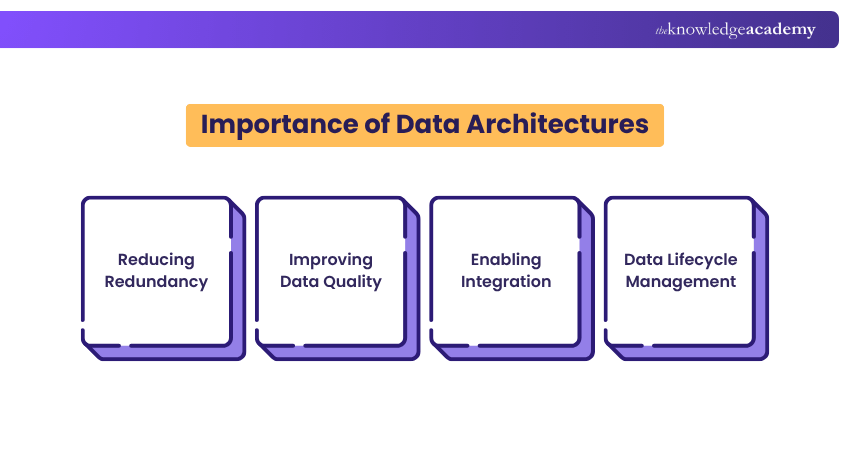
1) Reducing Redundancy: A standardised Data Architecture minimises duplication by defining clear storage rules. This reduces inconsistencies and improves integration.
2) Improving Data Quality: It prevents poorly managed data lakes by enforcing governance and security standards. It ensures that data is clean, consistent and well-organised.
3) Enabling Integration: A Data Architecture that breaks down silos enables seamless data sharing across departments, leading to unified metrics and improved decision-making.
4) Data Lifecycle Management: It manages data over time, moving less used data to cost-effective storage while keeping it accessible for audits and reports.
Popular Data Architecture Frameworks
Organisations can use popular architecture frameworks to create and implement Data Architectures rather than working from scratch. The three frameworks are mentioned below:
The Open Group Architecture Framework (TOGAF)
TOGAF is a method created in 1995 by The Open Group, with IBM as one of its key members. It provides a comprehensive blueprint for designing and building a company’s IT setup, including how it manages data. It’s built on four main parts:
a) Business Architecture: Outlines how the organisation is structured, how it operates, and how it manages data.
b) Data Architecture: Describes what data the business uses, how it’s organised, and how it’s stored and managed.
c) Application Architecture: Illustrates the software systems used and how they support business activities, as well as their interconnections.
d) Technical Architecture: Covers the technology (like hardware, software, and networks) needed to run important systems.
DAMA-DMBOK 2
DAMA International, short for Data Management Association International, is a nonprofit organisation focused on improving how organisations manage data and information. One of its key resources is the DAMA-DMBOK 2, which stands for Data Management Body of Knowledge, covering important topics such as Data Architecture, governance, ethics, data modelling, storage, security, and integration.
Decode your business needs and deliver reliable solutions! Sign up for our Business Analysis Courses now!
Zachman Framework for Enterprise Architecture
The Zachman Framework is a popular structured approach for viewing and organising enterprise architecture. It utilises a matrix with six levels of detail, from broad overviews to specific details, matched with six key questions, such as "what," "how," and "why." While it helps organise and analyse data clearly, it doesn’t provide specific steps or methods for completing the work.
Types of Data Architectures
Data Architecture can be designed in different ways depending on organisational needs and data complexity. Each approach supports data management and system integration differently. Below are the types of Data Architectures:
Centralised Architectures
Centralised Architectures have the advantages of pulling information provided by different parts of the organisation into a single platform, such as a data warehouse or data lake, that is controlled by a single model. This structure assists in the standardisation of data, minimises duplication, and facilitates steady and high-quality analytics and reporting.
Decentralised Architectures
Decentralised Architectures allocate data ownership over the entire organisation. This will result in better data management, more efficient handling of data, and quicker response to particular data demands.
Achieve professional excellence with the BCS International Diploma in Business Analysis – Join now!
Benefits of Data Architectures
A well-designed Data Architecture can provide businesses with several important benefits, including the following:
Reducing Redundancy
Data can often overlap across different sources, which can lead to inconsistency, errors, and missed opportunities. A strong Data Architecture helps you standardise data storage and minimise duplication, thereby improving data quality and encouraging accurate analysis.
Improving Data Quality
Data Architectures can address problems in poorly managed data lakes (also called "data swamps"). This is done by ensuring proper standards and governance. This helps improve the overall data quality and ensures it remains useful for future insights.
Enabling Integration
Data is often isolated due to technical or organisational barriers. Modern Data Architectures help with integration across different domains. This helps provide a more consistent understanding of key metrics and offers a broader view of customers, products, and markets, improving data-driven decisions.
Data Lifecycle Management
Data Architecture also helps manage data over time. As data becomes less useful and is accessed less frequently, it can be moved to more affordable storage solutions. This allows businesses to retain data for reports and audits without incurring unnecessary storage costs.
How is Data Architecture Implemented?
Here are the key phases involved in building a robust Data Architecture:
Step 1: Align to Business Goals
Begin by determining business goals like analytics, compliance, or automation. These objectives direct information priorities, sources, and integrations of systems.
Step 2: Manage Data Models and Governance.
Design conceptual, logical, and physical data models in order to organise data flow. Establish policies of governance in ownership, data access, and data lifecycle management.
Step 3: Architecture Design.
Choose storage, integration, and data consumption technologies. Determine the flow of data between systems and their storage places.
Step 4: Build and Integrate
Deploy data pipelines, APIs, and access tools such as dashboards. Use compliance and security controls during implementation.
Step 5: Observe, Develop, and Grow
It is necessary to continuously check the performance and change the architecture when needed. Modernise the designs to support growth, new applications, and changing regulations.
Data Architecture vs Data Modeling
Data Modeling lays out the data's structure, relationships, and format for particular use cases. It is concerned with arranging data elements according to business needs.
Data Architecture, on the other hand, considers a larger aspect and chooses the way data is stored, integrated, and applied throughout systems. It includes data models within a comprehensive framework for controlling large amounts of data.
Data Architecture Best Practices
Effective Data Architecture helps organisations generate meaningful insights. Following best practices ensures reliable and scalable results.
a) Business Alignment: Ensure the architecture supports long-term business goals and strategic objectives.
b) Flexibility and Scalability: Design systems that adapt to change and scale with growing data volumes.
c) Integrated Governance and Security: Embed governance and security controls into the architecture from the start.
d) Unification: Enable multiple data workloads to operate on shared data securely and consistently.
e) Open Foundation: Avoid vendor lock-in by using open, interoperable technologies.
f) Data Democratisation: Provide broad data access while maintaining clear governance and control.

Conclusion
A data foundation of good quality is very important for today's organisations. Knowing What is Data Architecture is a way to create huge, safe systems that make data-driven choices possible. This method gives data a long-term position as a strategic advantage.
Architect Your Career! Build a strong foundation with our BCS Foundation Certificate in Architecture Concepts and Domains - Sign up now!
Frequently Asked Questions
What is a Data Architecture Diagram?

Data Architecture diagram visually represents how and where data flows, is stored, and is consumed in an organisation. It provides a clear overview of how data is collected in the system.
What Are The Key Features of Modern Data Architecture?
Modern data architecture focuses on scalability, real-time data access, and seamless system integration. It supports flexible growth, analytics, and strong governance across platforms.
What are the Other Resources and Offers Provided by The Knowledge Academy?
The Knowledge Academy takes global learning to new heights, offering over 3,000+ online courses across 490+ locations in 190+ countries. This expansive reach ensures accessibility and convenience for learners worldwide.
Alongside our diverse Online Course Catalogue, encompassing 17 major categories, we go the extra mile by providing a plethora of free educational Online Resources like Blogs, eBooks, Interview Questions and Videos. Tailoring learning experiences further, professionals can unlock greater value through a wide range of special discounts, seasonal deals, and Exclusive Offers.
What is The Knowledge Pass, and How Does it Work?
The Knowledge Academy’s Knowledge Pass, a prepaid voucher, adds another layer of flexibility, allowing course bookings over a 12-month period. Join us on a journey where education knows no bounds.
What are the Related Courses and Blogs Provided by The Knowledge Academy?
The Knowledge Academy offers various Business Analysis Courses, including the BCS Foundation Certificate In Agile, BCS Foundation Certificate In Organisational Behaviour, and BCS Foundation Certificate In User Experience. These courses cater to different skill levels, providing comprehensive insights into Stakeholder Engagement.
Our Business Analysis Blogs cover a range of topics related to Data Architecture Building, offering valuable resources, best practices, and industry insights. Whether you are a beginner or looking to advance your Business Analysis skills, The Knowledge Academy's diverse courses and informative blogs have got you covered.

William Brown


Senior Business Analyst and Strategic Advisor
William Brown is a senior business analyst with over 15 years of experience driving process improvement and strategic transformation in complex business environments. He specialises in analysing operations, gathering requirements and delivering insights that support effective decision making. William’s practical approach helps bridge the gap between business goals and technical solutions.
View Detail
Upcoming Business Analysis Resources Batches & Dates
Date
 BCS Foundation Certificate in Architecture Concepts and Domains
BCS Foundation Certificate in Architecture Concepts and Domains
Mon 3rd Aug 2026
BCS Foundation Certificate in Architecture Concepts and Domains
Mon 7th Dec 2026

 If you wish to make any changes to your course, please


