




We may not have the course you’re looking for. If you enquire or give us a call on +47 80010068 and speak to our training experts, we may still be able to help with your training requirements.
What is a SIPOC Diagram: The Beginner’s Guide to Process Mapping
William Brown 17 April 2026A SIPOC Diagram gives a high-level view of suppliers, inputs, processes, outputs, and customers, helping teams understand and improve business processes. It is a simple yet powerful tool useful for providing clarity, cutting through complexity, and aligning teams before going into detailed process improvements.

BCS Practitioner Certificate in Modelling Business Processes Training
 Top Rated Course
Top Rated Course
Exclusive 40% OFF
Training Outcomes Within Your Budget!
We ensure quality, budget-alignment, and timely delivery by our expert instructors.
Table of Contents

A SIPOC Diagram is a simple and powerful tool that documents your business processes. It provides the right amount of high-level information to understand how the processes function. Organisations utilise this diagram to improve and analyse processes based on customer experience. This is useful for setting the foundation of meaningful process improvements and aligns each step to deliver value.
Before trying to enhance a business process, the first step is to understand it. Business processes can be complex, but this diagram maps out how each piece of the process is interconnected, from suppliers to customers. In this blog, you will learn about what a SIPOC Diagram is, its importance, how to create one, and more. Keep reading to learn more!
Table of Contents
1) What is a SIPOC Diagram?
2) The Importance of SIPOC Diagrams
3) How to Create a SIPOC Diagram?
4) When Should You Use a SIPOC Diagram?
5) Benefits of Using SIPOC Diagrams
6) Examples of SIPOC Diagrams
7) SIPOC Diagram vs Workflow Diagram
8) Best Practices for Creating a SIPOC Diagram
9) Conclusion
What is a SIPOC Diagram?
A SIPOC Diagram is a high-level business process mapping tool that documents business processes; Suppliers, Inputs, Process, Outputs, and Customers of a workflow. It provides a simplified view of how materials or data move through a process, showing each part’s contribution and value.
SIPOC Diagrams help teams understand processes that directly impact customer experience. It offers an overview to stakeholders to support decision-making and identify areas needing improvement. As part of Business Process Management (BPM), this diagram sets the groundwork for continuous process enhancement.

The Importance of SIPOC Diagrams
The SIPOC Diagram is significant as it offers a concise overview of a business process, aiding stakeholders in understanding its essential elements. It streamlines complex procedures, enabling the easier detection of inefficiencies, gaps, or chances for enhancement.
SIPOC Diagrams help improve communication between teams by making sure that everyone understands their responsibilities and the flow of tasks. They are very helpful in process improvement efforts, providing a basis for more detailed analysis in BPM.
What are the Components of SIPOC?
Below are the five most important components of SIPOC:
a) Suppliers: It provides the inputs for the business process
b) Inputs: These are resources you require for operation
c) Process: It presents the high-level steps of the process
d) Outputs: It is the outcome produced by the process
e) Customers: The recipients of the results who benefited from the process
How to Create a SIPOC Diagram?
Here is how you can create a SIPOC Diagram in a seven-step process that highlights all the key elements of the process.
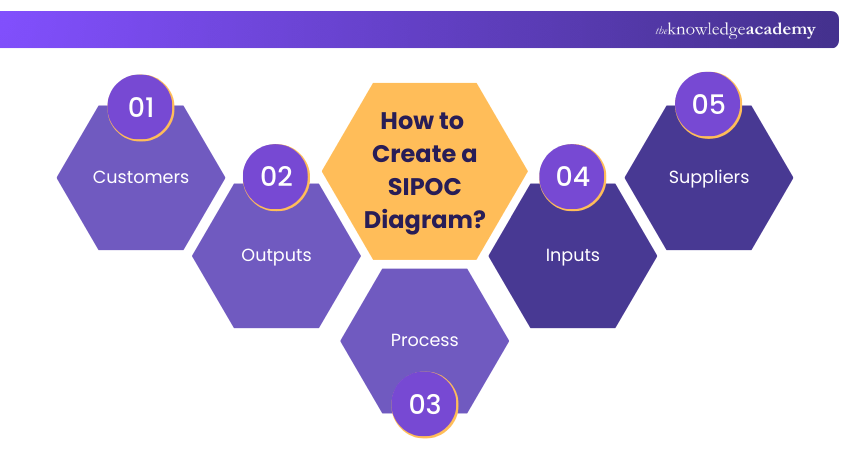
Step 1: Customers
Start by identifying who the customers are and what they need. Customers may be internal (within the organisation) or external (end-users or clients). Defining their expectations and level of influence ensures the process aligns with the voice of the customer.
Step 2: Outputs
Next, list the outputs produced by the process. These may include products, services, completed actions, or information. Outputs should directly reflect customer requirements and clearly represent the value customers expect to receive.
Step 3: Process
After listing the outputs, outline the high-level steps that make up the process. It is preferable to keep it simple, with no more than 5-10 steps. This gives an overview of where the process begins, what happens in between, and where it ends.
Step 4: Inputs
Now, document the materials, data, or information required to conduct the process. Inputs come from suppliers and must be clearly identified. It can be done through the assistance of relevant stakeholders to maintain accuracy.
Step 5: Suppliers
Finally, list the sources of the inputs, such as vendors, departments, or individuals. It is important to focus only on suppliers who directly impact the process outputs. This helps to keep the SIPOC Diagram concise and meaningful.
Transform complex processes with confidence and learn process modelling effectively with BCS Certificate in Business Analysis Practice now!
When Should you use a SIPOC Diagram?
A SIPOC Diagram can be utilised on many occasions. Here is the complete list of business processes where you create a SIPOC Diagram to improve the effectiveness of the process:
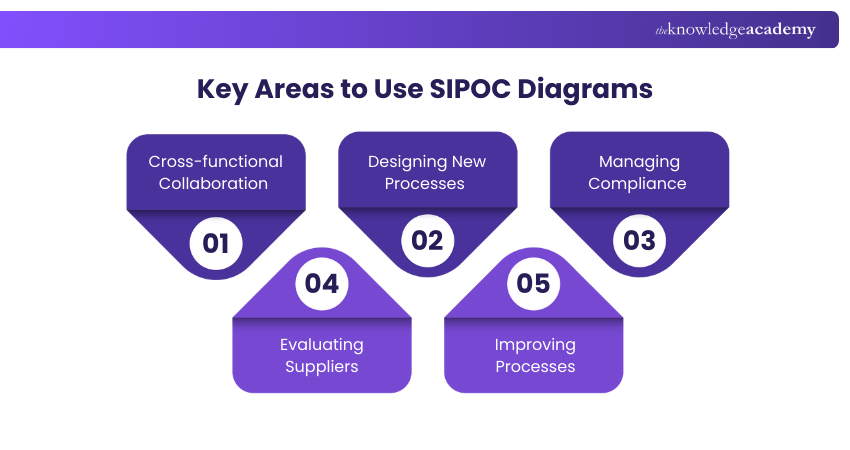
1) Cross-functional Collaboration
A SIPOC Diagram facilitates cross-functional collaboration by gathering different departments or stakeholders to participate in a process. As an example, a retail business could utilise a SIPOC analysis to coordinate sales, marketing, and operations departments in order to improve product distribution.
2) Designing New Processes
A SIPOC Diagram ensures that all essential elements are considered when creating new business processes. A manufacturing company could utilise a SIPOC Six Sigma Diagram to outline the steps involved in introducing a new product line, such as suppliers, inputs, tasks, results, and clients.
3) Managing Compliance
SIPOC Diagrams assist in ensuring adherence to regulations by pinpointing non-compliant areas. For instance, a pharmaceutical company could utilise an SIPOC Diagram to ensure its drug development process fulfils the Food and Drug Administration (FDA) standards.
4) Evaluating Suppliers
You can use a SIPOC analysis to assess the performance of suppliers. Timely assessment is the key to cutting down unnecessary resource consumption. For example, a restaurant can use an SIPOC Diagram to evaluate the performance of food suppliers based on factors like delivery time, quality of product, and pricing.
5) Improving Processes
SIPOC Diagram is useful for pinpointing the underlying causes of inefficiencies in order to enhance current processes. For example, a hospital could utilise a SIPOC Diagram to identify areas where patients experience lengthy waiting periods and implement measures to simplify those areas.
Become a certified business analyst and start your journey with BCS International Diploma in Business Analysis today!
Benefits of Using SIPOC Diagrams
A SIPOC Diagram is a valuable reference that enables you to work in alignment with your business goals. Some of the key benefits of using SIPOC Diagrams include:
a) Enhancing Customer Service: The SIPOC Diagram helps businesses in identifying the gaps between customer needs and the output delivered. This can enhance the customer satisfaction level.
b) Anticipating Project Needs: A business can assess whether the inputs and suppliers align with their outputs. It also enables early identification of discrepancies.
c) Boosting Efficiency: The SIPOC Diagram can highlight non-value-adding components of the process, enabling better efficiency of the project.
d) Educating Team Members: The tool can teach your team members and stakeholders about your business process and give them the important details.
Example of SIPOC Diagrams
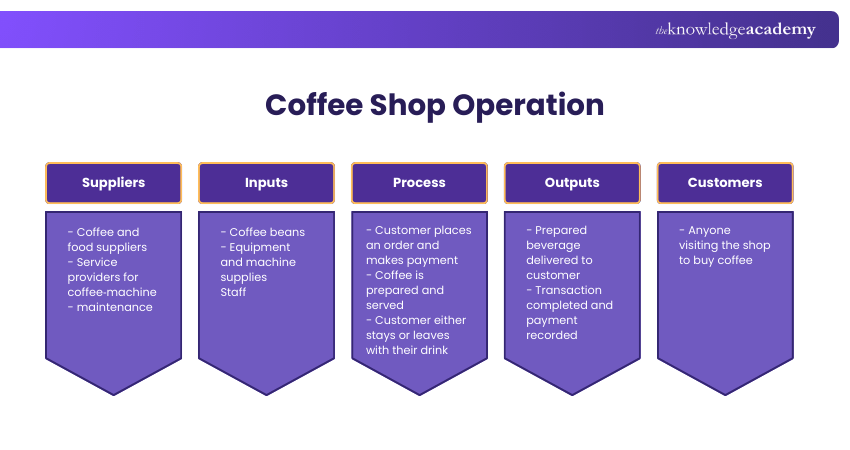
A SIPOC Diagram is commonly used in process improvement, Lean, and Six Sigma projects because it provides clarity before deeper analysis begins. Let’s look at the example below for better understanding.
Engage stakeholders effectively with our BCS Professional Certificate in Stakeholder Engagement Training – Join now!
SIPOC Diagram vs Workflow Diagram
Workflow Diagrams provide a graphic map of a business process or project. It shows the sequence of tasks and how they connect, making it organised and simpler to view dependencies. This makes it useful for Project Management and detailed process analysis.
A SIPOC Diagram is a specialised workflow diagram that takes a higher-level view. It focuses on who creates and receives materials or data throughout the process. By documenting Suppliers, Inputs, Process, Outputs, and Customers. it emphasises the relationship between stakeholders and the flow of value.
Best Practices for Creating a SIPOC Diagram
A well-built SIPOC Diagram helps organisations understand the flow of a business process before making improvements. Let's look at the following best practices to ensure the diagram delivers real impact.
a) Bring the Team Together: Create the SIPOC collaboratively with the people to perform the process. Also, include sponsors for new processes so they understand the impact of decisions.
b) Limit Items in Each SIPOC Section: Keep each category focused on only the essential points. Move detailed or complex ideas to the side for later discussion.
c) Keep the Diagram High-level: Capture the big-picture steps instead of detailed workflows. Consider starting with customer needs (COPIS) to assess value effectively.
d) Review and Get Feedback: Share the SIPOC Diagram with sponsors and stakeholders for validation. Their input confirms accuracy and detects missing elements.
e) Clarify Unknowns First: Avoid changing the process until every step is understood. Use SIPOC mapping to identify and resolve uncertainties before improvement begins.
Conclusion
A SIPOC Diagram brings the team together around a shared understanding of how workflows work. Keeping the diagram high-level, involving the right people, limiting unimportant details, and validating uncertainties ensures clarity to drive smart business decisions. This diagram becomes a catalyst for process improvement, helping teams commit to delivering value to customers.
Start learning business analysis effectively and upgrade your skills with Business Analysis Courses – Join now!
Frequently Asked Questions
Is SIPOC a Six Sigma Tool?

Yes, it’s a Six Sigma tool that can be utilised to map the business process and find out improvement opportunities.
Is SIPOC Still Used?
Yes, SIPOC is widely used as a core tool in Lean Methodology and Six Sigma. It's simple; high-level view helps teams align, define process boundaries, and spot improvement areas. It remains a valuable tool across industries, working for both new designs and existing process optimisation.
What are the Other Resources and Offers Provided by The Knowledge Academy?
The Knowledge Academy takes global learning to new heights, offering over 3,000+ online courses across 490+ locations in 190+ countries. This expansive reach ensures accessibility and convenience for learners worldwide.
Alongside our diverse Online Course Catalogue, encompassing 17 major categories, we go the extra mile by providing a plethora of free educational Online Resources like Blogs, eBooks, Interview Questions and Videos. Tailoring learning experiences further, professionals can unlock greater value through a wide range of special discounts, seasonal deals, and Exclusive Offers.
What is The Knowledge Pass, and How Does it Work?
The Knowledge Academy’s Knowledge Pass, a prepaid voucher, adds another layer of flexibility, allowing course bookings over a 12-month period. Join us on a journey where education knows no bounds.
What are the Related Courses and Blogs Provided by The Knowledge Academy?
The Knowledge Academy offers various Business Analysis Courses, including the BCS Practitioner Certificate In Modelling Business Processes Training, BCS Foundation Certificate In Business Analysis, and BCS Practitioner Certificate In User Experience Training. These courses cater to different skill levels, providing comprehensive insights into Business Process Management.
Our Business Analysis Blogs cover a range of topics related to IT Solutions, offering valuable resources, best practices, and industry insights. Whether you are a beginner or looking to advance your Business Analysis skills, The Knowledge Academy's diverse courses and informative blogs have got you covered.

William Brown


Senior Business Analyst and Strategic Advisor
William Brown is a senior business analyst with over 15 years of experience driving process improvement and strategic transformation in complex business environments. He specialises in analysing operations, gathering requirements and delivering insights that support effective decision making. William’s practical approach helps bridge the gap between business goals and technical solutions.
View Detail
Upcoming Business Analysis Resources Batches & Dates
Date
 BCS Practitioner Certificate in Modelling Business Processes Training

 If you wish to make any changes to your course, please


