


 Top Rated Course

We may not have the course you’re looking for. If you enquire or give us a call on +47 80010068 and speak to our training experts, we may still be able to help with your training requirements.
Volume of a Cuboid: Explained with Examples
The Knowledge Academy 11 February 2026Wondering how to calculate the Volume of a Cuboid? It's the measure of space a cuboid occupies, calculated by multiplying its length, breadth, and height. This blog explains its formula, practical applications, and examples to help you understand this fundamental concept in geometry. Dive in to explore more about Cuboid Volume!

Training Outcomes Within Your Budget!
We ensure quality, budget-alignment, and timely delivery by our expert instructors.
Table of Contents

Stuck figuring out how much packing to bring for that big move? Ever wondered exactly how much water fits in that rectangular fish tank? The answer lies in a secret weapon of the 3D world: the Volume of a Cuboid. This essential concept unlocks the mysteries of any box-shaped object. Don't be fooled by its seemingly simple form!
This blog is your go-to guide to conquering the Volume of a Cuboid. We'll break down the formula, tackle real-life examples, and equip you with the skills to measure the volume of any cuboid with confidence. So, ditch the guesswork and become a master of cuboid volume – your boxes (and fish!) will thank you!
Table of Contents
1) What is Volume of a Cuboid?
2) Volume of Cuboid Formula
3) How to Calculate Volume of Cuboid?
4) Practical Examples of Cuboid Volume Calculation
5) How to Find Area of Cuboid?
6) What is the Difference Between Cube and Cuboid?
7) Conclusion
What is Volume of a Cuboid?
The Volume of a Cuboid is the amount of space it occupies in three dimensions. It's a measure of the capacity of the cuboid, indicating how much material it can hold inside. This concept is essential in various fields, such as architecture, shipping, and manufacturing, where understanding the space within a three-dimensional object is crucial.
The Volume of a Cuboid is determined by multiplying its length, width, and height. Think of it as filling the box with tiny cubes, each with a side length of one unit. Similarly, understanding the Volume of Hemisphere involves calculating based on its radius, which can help in various geometric applications. The total number of these tiny cubes that fit inside the box gives you the volume.

Volume of Cuboid Formula
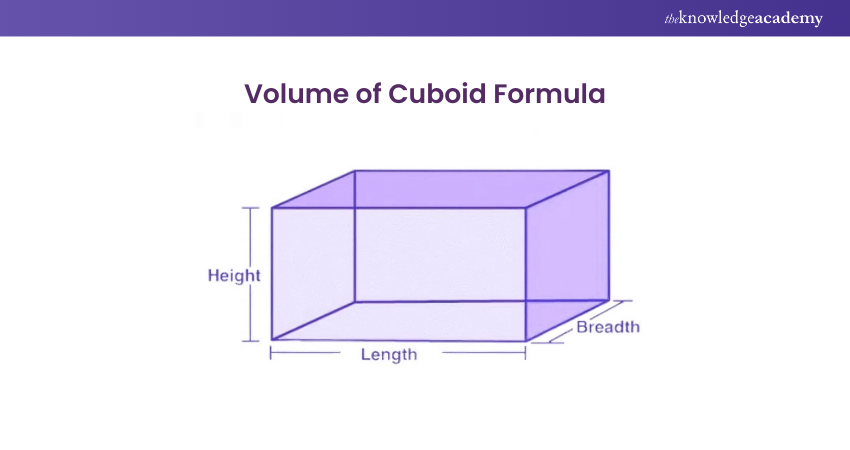
A cuboid is a three-dimensional shape (3D) with six rectangular faces, and its volume can be found by multiplying its length (l), width (w), and height (h). The formula for the Volume (V) of a Cuboid is:

where:
a) l is the length of the cuboid
b) w is the width
c) h is the height
This formula applies to all cuboids, regardless of the specific dimensions of each side. By multiplying these three dimensions, you get the total space occupied by the cuboid.
Unlock the formula for Surface Area of a Cylinder and master your math skills. Discover more in our detailed guide!
How to Calculate Volume of Cuboid?
To calculate the Volume of a Cuboid, you need to know three key measurements: its length, width, and height. These dimensions define the size of the cuboid in three-dimensional space. Once you have these measurements, calculating the volume is straightforward.
Here's the formula:

Let's break it down with an example. Suppose your gift box has a length of 5 cm, a width of 3 cm, and a height of 4 cm. Using the formula, you would calculate the volume as follows:

So, the volume of your gift box is 60 cubic centimetres. This means you could fit 60 little 1 cm³ cubes inside the box.
Practical Examples of Cuboid Volume Calculation
To better understand how to apply the volume formula, let's go through some practical examples involving different scenarios.
1) Calculating the Volume of a Cube
A cube is a special type of cuboid where every side is of equal length. Therefore, if a cube has a side length of a, the volume formula simplifies to:

Example: If a cube has a side length of 4 units:
Cube the side length: 43=64
Result: The volume of the cube is 64 cubic units.
2) Determining the Volume of a Cuboid
For a standard cuboid with different length, width, and height measurements, use the general formula.
Example: If a cuboid has a length of 5 units, a width of 3 units, and a height of 2 units:
Multiply the length, width, and height:

The volume of the cuboid is 30 cubic units.
3) Volume of a Cuboid with Different Units
When dealing with different units, it's crucial to convert them to the same unit before computing the volume.
Example: If a cuboid has a length of 1 meter, a width of 50 centimeters, and a height of 200 millimeters, convert all measurements to the same unit (e.g., meters):
Convert the width and height to meters:

Multiply the converted dimensions:

The volume of the cuboid is 0.1 cubic meters.
Unlock your potential! Register for our Personal Development Courses today to enhance your skills, boost your confidence, and realise your goals.
4) Finding the Width of a Cuboid Given Its Volume
Sometimes, you may know the volume and two of the dimensions and need to find the third dimension. If the volume (V), length (l), and height (h) are known, you can rearrange the formula to find the width (w):

If a cuboid has a volume of 60 cubic units, a length of 5 units, and a height of 3 units:
Substitute the known values into the rearranged formula:

The width of the cuboid is 4 units.
5) Finding the Length of a Cuboid Given Its Volume
Similarly, if the volume (V), width (w), and height (h) are known, you can find the length (l) by rearranging the formula:

Example: If a cuboid has a volume of 120 cubic units, a width of 4 units, and a height of 5 units:
Substitute the known values into the rearranged formula:

The length of the cuboid is 6 units.
How to Find the Area of a Cuboid?
The total surface area of a cuboid can be calculated using the formula:

where l is the length, b is the breadth, and h is the height of the cuboid. This formula adds up the areas of all six rectangular faces.
To find the lateral surface area (the area excluding the top and bottom), use the formula:

Ensure that all dimensions are in the same units before applying the formula.
What is the Difference Between Cube and Cuboid?
A cube is a special type of cuboid where all sides are of equal length, making it a three-dimensional square. In contrast, a cuboid has rectangular faces, and its length, breadth, and height can all be different.
This difference means that while a cube has all edges equal, a cuboid can vary in dimensions, giving it a more elongated or flattened appearance compared to the uniform shape of a cube. In a similar way, the volume of a Cone can vary depending on its height and the radius of its base.
Conclusion
Congratulations, box-master! You’ve cracked the code to measuring the Volume of Cuboid-shaped goodies—boxes, containers, or anything with those neat rectangular sides. Here’s the deal: practice is your best friend. So, the next time you spot a box—be it your snack stash or a mysterious package—whip out that formula and show off your math mojo. And when you're ready to take on more shapes, try calculating the Volume of a Sphere—it's a fun challenge!
Take charge of your future! Join our Career Development Course today and unlock the skills and strategies to advance your professional journey.
Frequently Asked Questions
What are the Properties of Volume of Cuboid?

The Volume of a Cuboid represents the total space it occupies in three dimensions, determined by its length, breadth, and height. It is always expressed in cubic units, such as cubic meters or cubic centimetres. The volume changes proportionally with any change in its dimensions, making it ideal for measuring storage or capacity.
How to Get the Surface Area of a Cuboid?
The surface area of a cuboid is the total area covered by its six rectangular faces. It includes the areas of the top, bottom, front, back, and both sides. Surface area is useful for calculating material requirements like wrapping or painting and is expressed in square units such as square meters.
What are the Other Resources and Offers Provided by The Knowledge Academy?
The Knowledge Academy takes global learning to new heights, offering over 3,000+ online courses across 490+ locations in 190+ countries. This expansive reach ensures accessibility and convenience for learners worldwide.
Alongside our diverse Online Course Catalogue, encompassing 19 major categories, we go the extra mile by providing a plethora of free educational Online Resources like Blogs, eBooks, Interview Questions and Videos. Tailoring learning experiences further, professionals can unlock greater value through a wide range of special discounts, seasonal deals, and Exclusive Offers.
What is The Knowledge Pass, and How Does it Work?
The Knowledge Academy’s Knowledge Pass, a prepaid voucher, adds another layer of flexibility, allowing course bookings over a 12-month period. Join us on a journey where education knows no bounds.
What are the Related Courses and Blogs Provided by The Knowledge Academy?
The Knowledge Academy offers various Personal Development Courses, including the Engineering Skills Training, Time Management Training and the Supervisor training. These courses cater to different skill levels, providing comprehensive insights into Best Courses After 12th.
Our Business Skills Blogs cover a range of topics related to Personal Development, offering valuable resources, best practices, and industry insights. Whether you are a beginner or looking to advance your Engineering skills, The Knowledge Academy's diverse courses and informative blogs have got you covered.

The Knowledge Academy


Global Training Provider
The Knowledge Academy is a world-leading provider of professional training courses, offering globally recognised qualifications across a wide range of subjects. With expert trainers, up-to-date course material, and flexible learning options, we aim to empower professionals and organisations to achieve their goals through continuous learning.

Upcoming Business Skills Resources Batches & Dates
Date
 Engineering Skills Training
Engineering Skills Training
Fri 17th Jul 2026
Engineering Skills Training
Fri 9th Oct 2026

 If you wish to make any changes to your course, please


