


 Top Rated Course

We may not have the course you’re looking for. If you enquire or give us a call on +47 80010068 and speak to our training experts, we may still be able to help with your training requirements.
Rule of Thirds Photography Guide for Better Composition
The Knowledge Academy 03 March 2026Rule of Thirds Photography divides an image into a 3×3 grid, placing key subjects on lines or intersections to create balanced, dynamic, and engaging photos. It is a simple and powerful technique that improves storytelling, focus, and visual flow. It is widely used in portraits, product shots, landscapes, and mobile photography.

Training Outcomes Within Your Budget!
We ensure quality, budget-alignment, and timely delivery by our expert instructors.
Table of Contents

Have you ever taken a photo that should have looked amazing but felt flat or awkward? Well, you are not alone. Many great moments get captured with poor framing. That is where Rule of Thirds Photography makes a big difference. It is a simple composition method that helps you place your subject in a more natural and eye-pleasing way.
With this method, you do not just click pictures but guide your viewer’s attention. Adjusting your subject in the frame, your photos feel more balanced and professional. In this blog, you will explore Rule of Thirds Photography, its importance, key tips, examples, and more to help you make everyday shots look thoughtfully designed.
Table of Contents
1) What is Rule of Thirds in Photography?
2) Why is the Rule of Thirds Important in Photography?
3) How Do You Apply the Rule of Thirds in Photography?
4) Examples of Rule of Thirds in Photography
5) Tips and Tricks to Improve Your Rule of Thirds in Photography
6) Fixing Rule of Thirds Composition in Post-processing
7) Best Tools for Editing Using the Rule of Thirds
8) How to Break the Rule of Thirds in Photography?
9) When Should You Use the Rule of Thirds in Photography?
10) How to Break the Rule of Thirds in Photography?
11) Conclusion
What is Rule of Thirds in Photography?
The Rule of Thirds Photography is a composition technique that places the main subject about one-third of the way from the edge of the frame. The goal is to create images that feel more balanced, natural, and visually engaging. This method has its roots in art and architecture and is one of the widely used composition guidelines for photographers at every level.
To use the Rule of Thirds properly, align your subject with the grid lines by adjusting your camera position or subject placement. This method makes photos look natural and engaging. When editing, use crop grids to maintain the alignment after resizing or reframing.

Why is the Rule of Thirds Important in Photography?
The Rule of Thirds in Photography is important because it creates a better balance between the subject and the surrounding elements in the frame. It helps you decide how much foreground, background, and empty space to add to make images feel structured. This is useful, especially in scenes with lots of open space, where subject placement is crucial.
Also, the Rule of Thirds Photography makes photos easier and more enjoyable to view. When composition follows this rule, viewers can quickly identify the subject and naturally explore the rest of the image. This approach helps to turn a simple shot into a stronger visual narrative.
How Do You Apply the Rule of Thirds in Photography?
Using the Rule of Thirds is a straightforward and effective way to improve your composition in photography. The idea is simple:
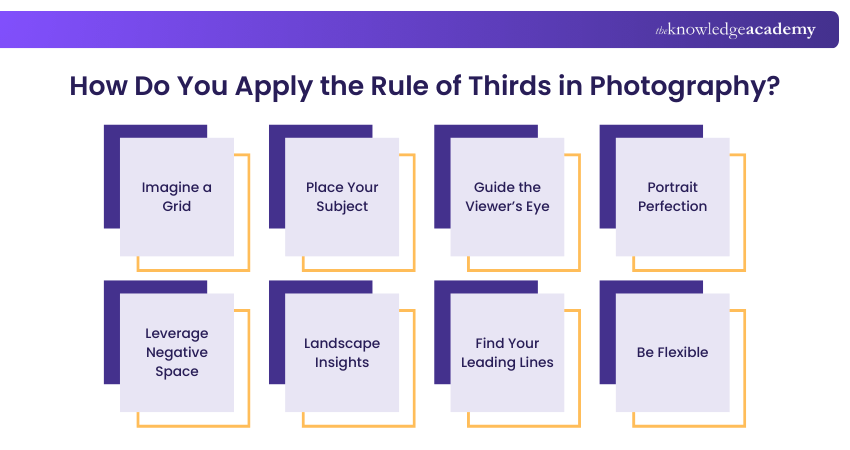
1) Imagine a Grid: Picture your viewfinder divided into nine identical parts by two vertical and two horizontal lines. These intersections become your ideal focal points.
2) Place Your Subject: Whether it's a person, flower, animal, or building, position your subject along one of these grid lines or intersections. This simple shift can transform your composition, whether your shot is horizontal or vertical.
3) Guide the Viewer’s Eye: For subjects that suggest movement or direction , like a face, car, or pointing gesture—aim to have them "look into" the frame. This naturally draws the viewer deeper into your image rather than having them look away.
4) Portrait Perfection: When shooting portraits, try aligning the eyes along the top horizontal line. This not only creates balance but also enhances the subject’s natural appeal.
5) Leverage Negative Space: If your subject is looking to one side, placing them on the opposite intersection offers extra breathing room. This negative space allows the viewer’s gaze to follow the direction of the subject’s look, adding depth and intrigue.
6) Landscape Insights:Instead of centring the horizon, try placing it on the lower or upper third line. Decide what’s more compelling; the sky or the land, and position the horizon accordingly to create a more dynamic scene.
7) Find Your Leading Lines: In the absence of a clear horizon, use natural elements like roads, rivers, or even a line of trees to guide the eye to a key focal point on your grid.
8) Be Flexible: Remember, the rule of thirds is a guideline, not an ironclad rule. Experiment with placement to see what best enhances your composition.
Turn good photos into stunning visuals with Photo Retouching Training – Sign up today!
Examples of Rule of Thirds in Photography
The best way to understand the Rule of Thirds is to see how it works in real shooting scenarios. Let’s look at some of the examples below:
1) Landscape Photography
In Landscape Photography, the Rule of Thirds is useful for positioning the horizon and creating a visual balance. Instead of placing the horizon in the centre, align it with either the top or the bottom of the third line. If the foreground is more interesting, such as rivers or roads, place the horizon on the top third. If the sky is the highlight, then place the horizon on the bottom third to give it more space.
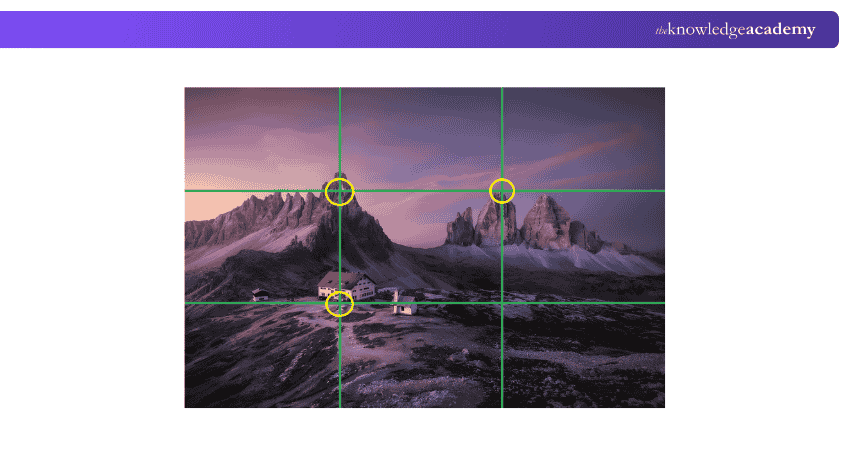
You can also use the intersection points to position key focal elements such as trees, mountain peaks, boats, or rock formations. Placing these subjects slightly off-centre adds depth and makes the scene feel more dynamic. This approach guides the viewer’s eye naturally through the image, creating movement rather than a static, flat composition.
2) Portrait Photography
In Portrait Photography, the Rule of Thirds helps place the subject in a way that feels natural and engaging. For wider or environmental portraits, position the person along one of the vertical lines instead of the centre. This helps to keep attention on the subject while still showing meaningful background context.
For closer portraits and headshots, try aligning eyes along the top horizontal third line or at an upper intersection point. Since viewers are naturally drawn to the eyes, this placement creates a stronger connection and balance. Also, it leaves useful negative space in the direction the subject is facing. This makes the portrait look more open and expressive.
3) Astrophotography
Astrophotography and the rule of thirds unite to compose mesmerising celestial vistas. By placing the Milky Way, stars, or planets along the gridlines or at intersections, Astro-Photographers add structure to the seemingly boundless night sky. Moreover, aligning the horizon with the lower third can accentuate foreground elements, like silhouetted landscapes or trees, providing context and scale.
More importantly, the rule of thirds aids in preventing overemphasis on a singular element, creating a balanced cosmic symphony. This technique showcases the marriage of art and science,resulting in breathtaking and harmonious Astro-photographs that resonate with both experienced and new stargazers.
4) Wildlife and Pet Photography
When photographing animals, placing more distant subjects along one of the vertical gridlines helps create balance and visual appeal. Aligning their heads with an upper or lower power point forms a strong focal area that naturally draws the viewer’s attention.
For closer portraits, position the animal’s head on an upper power point and let the body follow a lower gridline. This arrangement adds depth, enhances the overall composition and helps the viewer connect with the subject more personally.
5) Street Photography
In wider street scenes, try placing the horizon or key road elements like pavements or crossings along the horizontal gridlines. This instantly brings balance to your frame and subtly guides the viewer’s eye through the bustle of the street. Look for architectural lines, such as building edges, lampposts, or flagpoles, that naturally fall on the vertical gridlines; these small alignments can bring surprising harmony to your shot.
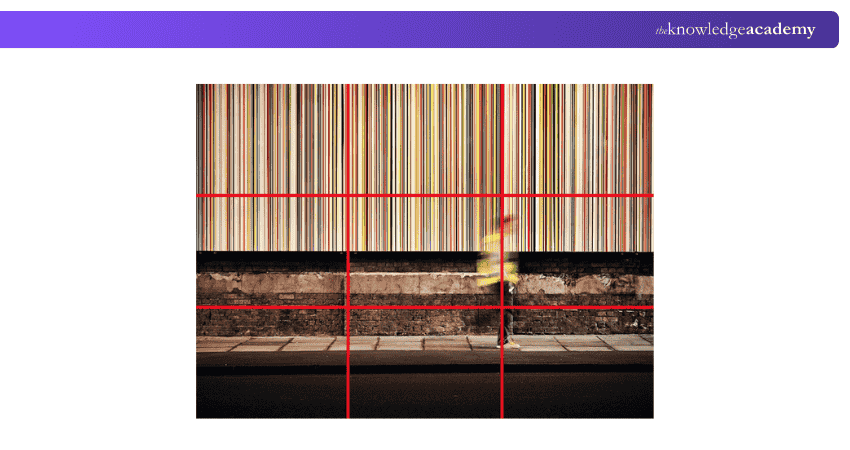
If you enjoy shooting closer portraits, place the subject’s head on a power point and let their body follow a vertical gridline. This approach establishes a strong visual connection between the subject and their environment.
Learn how to turn your visual ideas into stunning digital reality in our Photoshop Course – Register today!
Tips and Tricks to Improve Your Rule of Thirds in Photography
Here are some tips to help you excel at Rule of Thirds Photography:
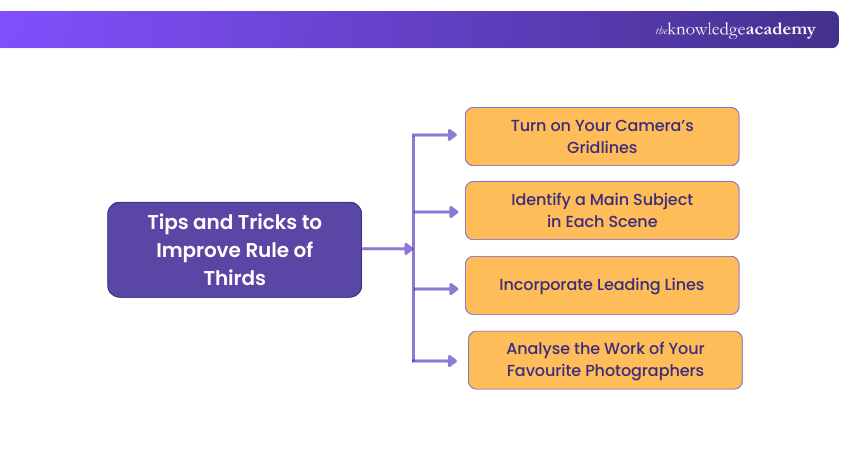
1) Turn on Your Camera’s Gridlines
Most cameras and smartphones let you add gridlines to your screen. These act as guides, helping you place subjects along the lines or intersections for balanced, eye-catching shots. Using gridlines makes it much easier to apply the rule of thirds consistently.
2) Identify a Main Subject in Each Scene
Before taking a photo, decide what the primary focus will be. It could be a mountain, a person, or even a flower. Place that subject along one of the gridlines or intersections to create balance and direct attention to the most essential part of your image.
3) Incorporate Leading Lines
Leading lines, such as roads, rivers, or fences, guide the viewer’s eye through the photo. When combined with the rule of thirds, they add depth and interest. Position your subject on a gridline and use the lines in the scene to draw attention towards it.
4) Analyse the Work of Your Favourite Photographers
Study photos by Photographers you admire and notice how they use the rule of thirds. Look at where they place their subject and how the composition feels balanced. Over time, this practice will sharpen your eye and help you apply the rule naturally in your own shots.
Turn every frame into a story and make your visuals speak louder than words with Cinematography Course for Crafting Visual Stories – Join now!
Fixing Rule of Thirds Composition in Post-Processing
Here are the steps you can take to fix the Rule of Thirds composition after processing:
1) Use the crop tool with a rule-of-thirds grid to reframe your image during post-processing.
2) Adjust the frame so that the key subjects align with gridlines or power points for better balance.
3) Shift the horizons, main subjects or architectural lines into more visually appealing positions.
4) Refine the composition by making small adjustments that improve flow and draw attention to important elements.
5) Improve the overall impact by transforming a flat or centred shot into a more dynamic, intentional composition.
Best Tools for Editing Using the Rule of Thirds
If you weren’t able to apply the rule of thirds while shooting, you can easily fix your composition during editing. Most editing software offers built-in grids to help you reframe your image accurately. Here’s how to use them across different platforms:
1) Adobe Photoshop
Photoshop offers two ways to apply a rule-of-thirds grid:
Way 1
1) Open the software and load your image.
2) Select the cropping tool from the top toolbar.
3) Choose the overlay options in the crop tool toolbar and select ‘Rule of Thirds’.
4) Tick ‘Always Show Overlay’ so the grid stays visible during cropping.
Way 2
1) Go to Edit > Preferences > Guides, Grids & Slices.
2) Set ‘Gridline Every’ to ‘100’, change the unit to ‘Percent’, and set subdivisions to ‘3’.
3) If the grid isn’t visible, enable it through View > Extras.
2) Lightroom
This popular editing tool (also available on mobile) includes built-in rule-of-thirds guidelines.
1) Import your image.
2) Go to the ‘Develop’ area and open the ‘Crop Overlay’.
3) Select ‘Crop Guide Overlay’ and choose ‘Thirds’ to enable the grid.
3) GIMP
GIMP allows you to turn on a customisable grid.
1) Go to ‘View’ and select ‘Show Grid’.
2) The default grid appears with evenly spaced lines.
3) To adjust spacing, go to Image > Configure Grid and divide your image dimensions by 3 to match rule-of-thirds proportions.
4) Customise line style, colour, and spacing as needed.
4) Canva
Canva supports grid guides, and advanced guide controls may vary by plan.
1) Create a custom artboard that matches your image size.
2) Upload your photo and place it on the canvas.
3) Go to Files > View Settings and choose ‘Add guides’.
4) Under ‘Custom’, set the number of rows and columns to 3 x 3 to activate the rule-of-thirds grid.
Learn to plan, shoot, and direct with confidence with Filmmaking Course – Join now!
How to Break the Rule of Thirds in Photography?
Consider these steps to break the Rule of Thirds in Photography:
1) Embrace Centred Composition: Sometimes placing your subject in the centre can emphasise symmetry and balance, especially in portraits or architecture.
2) Focus on Symmetry: For scenes with perfect symmetry, breaking away from the rule of thirds can highlight the balanced nature of the subject.
3) Create Tension: Positioning your subject off the typical grid can evoke a sense of tension or drama, leading to a more engaging image.
4) Use Negative Space Creatively: Fill the frame intentionally with your subject or use negative space unconventionally to evoke mood or focus on details.
When Should You Use the Rule of Thirds in Photography?
The Rule of Thirds in Photography is one of the simplest and most reliable composition techniques you can use. While it is not meant to be used in every single shot, it fits a wide range of photography styles and subjects. Let’s look at some of the important areas where it can be used below:
1) Use it as your default composition when no other framing idea comes to mind.
2) Apply it in everyday shooting situations for quick visual balance.
3) Use the Rule of Thirds in landscape shoots to proportion the sky and land effectively.
4) Use it in portraits, especially side-facing shots to create depth and a natural look.
5) Apply it in still-life shoots to position objects with stronger visual weight.
6) Use it in architecture shots to avoid stiff compositions.
7) Apply it in commercial and product shoots for a more professional layout.
How to Break the Rule of Thirds in Photography?
The Rule of Thirds must be broken when another composition technique suits the scene better, such as symmetry, centred framing, or patterns. If the subject or environment naturally suggests a different layout, follow what the scene demands instead of forcing a third-based placement.
Also, breaking the Rule of Thirds is useful when using other composition techniques, such as the golden ratio or the triangular balance. Take a moment to study what you want to express, try multiple framings, and compare results. Learning the rule and then breaking it with intention leads to more creative and purposeful photography.
Conclusion
Photography is not only about what you capture, but how you frame it. The Rule of Thirds Photography gives a simple and practical way to create balance, focus, and visual interest in almost every scene. Also, placing key elements along grid lines makes images feel more natural and engaging across landscapes, portraits, and product shots. Use this rule as a go-to guide, but experiment and break it when it demands to help your photos stand out.
Fuel your free time and turn your hobby into a profitable endeavour. Sign up for our Hobbies & Interests Training now!
Frequently Asked Questions
How to Check Rule of Thirds?

Overlay a 3x3 grid on your viewfinder or image. Align key subjects along the gridlines or at the intersections to create balance. This simple check guides your framing, ensuring the composition naturally directs the viewer’s eye and adds visual interest.
How Can I Practice the Rule of Thirds?
The best way to learn the rule of thirds is through consistent practice. With time, the gridlines and focal points become intuitive, naturally shaping your compositions. Try visiting an outdoor space and challenge yourself to capture ten well-composed shots using the rule. Before shooting, choose your main focal point.
What are the Other Resources and Offers Provided by The Knowledge Academy?
The Knowledge Academy takes global learning to new heights, offering over 3,000+ online courses across 490+ locations in 190+ countries. This expansive reach ensures accessibility and convenience for learners worldwide.
Alongside our diverse Online Course Catalogue, encompassing 17 major categories, we go the extra mile by providing a plethora of free educational Online Resources like Blogs, eBooks, Interview Questions and Videos. Tailoring learning experiences further, professionals can unlock greater value through a wide range of special discounts, seasonal deals, and Exclusive Offers.
What is The Knowledge Pass, and How Does it Work?
The Knowledge Academy’s Knowledge Pass, a prepaid voucher, adds another layer of flexibility, allowing course bookings over a 12-month period. Join us on a journey where education knows no bounds.
What are the Related Courses and Blogs Provided by The Knowledge Academy?
The Knowledge Academy offers various Hobbies & Interest Training, including the Filmmaking Course, Cinematography Course for Crafting Visual Stories, and the Photography Course. These courses cater to different skill levels, providing comprehensive insights into Photographer Job Description.
Our Business Skill Blogs cover a range of topics related to Photography, offering valuable resources, best practices, and industry insights. Whether you are a beginner or looking to advance your Photography skills, The Knowledge Academy's diverse courses and informative blogs have got you covered.

The Knowledge Academy


Global Training Provider
The Knowledge Academy is a world-leading provider of professional training courses, offering globally recognised qualifications across a wide range of subjects. With expert trainers, up-to-date course material, and flexible learning options, we aim to empower professionals and organisations to achieve their goals through continuous learning.

Upcoming Business Skills Resources Batches & Dates
Date
 Photography Course
Photography Course
Fri 19th Jun 2026
Photography Course
Fri 4th Sep 2026
Photography Course
Fri 27th Nov 2026

 If you wish to make any changes to your course, please


