


 Top Rated Course


We may not have the course you’re looking for. If you enquire or give us a call on +47 80010068 and speak to our training experts, we may still be able to help with your training requirements.
What is Ordinal Data: Definition, Examples and Uses
The Knowledge Academy 28 February 2026Ordinal Data groups qualitative variables into ranked categories, showing order or preference without equal intervals, helping analyse surveys and comparisons. It highlights relative rankings, allowing comparison of preferences or satisfaction levels, and guides decisions without assuming precise numerical differences.

Training Outcomes Within Your Budget!
We ensure quality, budget-alignment, and timely delivery by our expert instructors.
Table of Contents

Have you ever come across a dataset where the values follow a clear order but the differences between them aren’t exact? This is called Ordinal Data. While it may seem tricky to interpret at first, understanding its structure can help you uncover valuable insights and turn qualitative information into meaningful, actionable results. By learning how to work with Ordinal Data, you can make smarter decisions and reveal patterns hidden within your datasets.
In this blog, we’ll explain What is Ordinal Data and cover key topics like examples, collection methods, analysis techniques, and uses. Let’s dive in and simplify these concepts, turning your data journey from confusion to clarity.
Table of Contents
1) What is Ordinal Data?
2) Examples of Ordinal Data
3) How to Collect Ordinal Data?
4) How to Analyse Ordinal Data?
5) Uses of Ordinal Data
6) Advantages and Disadvantages of Ordinal Data
7) Conclusion
What is Ordinal Data?
Ordinal Data is a type of Qualitative Data that organises variables into ordered categories by following a natural sequence or rank, such as high to low. In the measurement level hierarchy, such data types are more complex than Nominal Data but less complex than Interval and Ratio data.
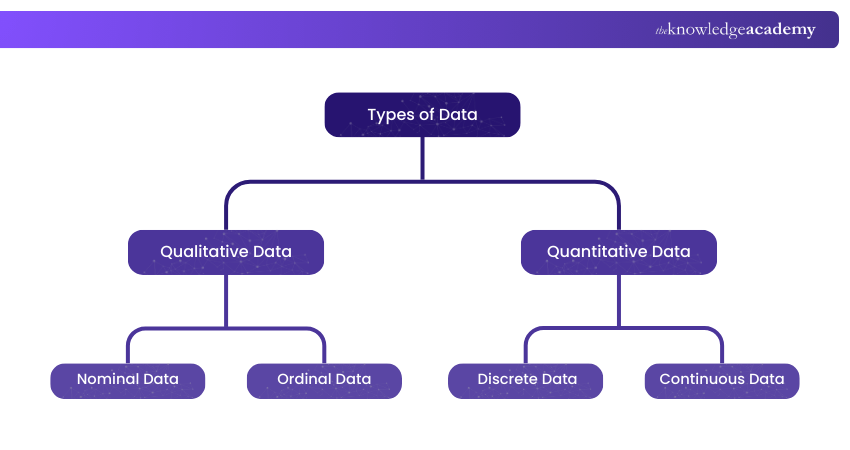
Ordinal Data is often used to assess customer feedback, satisfaction levels, economic status, education level, and observations. It indicates the order that is not suitable for precise Statistical Analysis, as arithmetic operations cannot be performed on Ordinal Data due to the undefined categorical intervals.
Characteristics of Ordinal Data
The key characteristics of Ordinal Data are:
a) Categorical Nature: Ordinal Data consists of non-numeric or categorical values, using numbers as categorisation labels.
b) Natural Order: They are always ranked in a natural order or hierarchy, hence the term "Ordinal."
c) Extension of Nominal Data: This data type can be seen as an extension of Nominal Data by adding a specific order to the categories.
d) Uneven Intervals: While Ordinal Data is ordered, the Confidence Interval between values is not evenly distributed or quantifiable.
e) Summary Statistics: It can be used to calculate summary statistics such as frequency distribution, Median, Mode, and range.
f) Median Availability: Ordinal Data inherently has a Median, representing the middle value in the ordered categories.

Examples of Ordinal Data
Ordinal Data often includes ratings about opinions, feelings, or demographic factors like social status or income, categorised into levels. Here are the key examples of Ordinal Data:
1) Income Levels: Income levels are divided into three categories based on annual earnings. Poor or Low Income (£10K-£20K) includes individuals or households earning between £10,000 and £20,000 per year.
Middle income (£20K-£35K) covers those making between £20,000 and £35,000 annually. The wealthy (£35K-£100K) include individuals or households with an income between £35,000 and £100,000.
2) Education Level: Education is classified into different levels based on academic progression. Elementary refers to basic primary education. High School is secondary education, usually completed by teenagers.
The College includes Undergraduate studies leading to a Bachelor’s degree. Graduate covers Postgraduate education, such as Master’s degrees. Post-graduate includes advanced degrees beyond a master’s, such as PhDs.
3) Employee Satisfaction: Employee satisfaction is rated on an ordinal scale from 1 to 5 (1 for very happy and 5 for very unhappy). Extremely Happy (1) means employees feel highly positive and satisfied, while Happy (2) indicates general contentment.
Neutral (3) reflects no strong feelings. Unhappy (4) shows dissatisfaction, and Extremely Unhappy (5) represents strong negativity toward the workplace.
4) Customer Feedback: Customer feedback is measured on an ordinal scale from Very Satisfied to Very Dissatisfied. Very Satisfied means customers are extremely happy with the product or service, while Satisfied indicates general happiness.
Neutral shows no strong opinion. Dissatisfied means customers are unhappy, and Very Dissatisfied reflects strong dissatisfaction.
How to Collect Ordinal Data?
To collect Ordinal Data, you must involve logically ordered categories that are not measured in exact intervals. Here’s an overview of the procedure:
Methods of Collecting Ordinal Data
Collecting ordinal data involves techniques that capture ranked responses or preferences without requiring exact numerical measurements. Common methods include:
1) Likert Scales: Ask respondents to indicate their level of agreement, satisfaction, or attitude towards a statement using ordered response options (e.g., strongly disagree, disagree, neutral, agree, strongly agree).
2) Rating Scales: Let participants evaluate their experience or perception by assigning a numeric or verbal rating within a fixed range (e.g., rating customer service from 1 to 5).
3) Ranking Questions: Require individuals to prioritise or order options according to preference, importance, or relevance, clearly demonstrating relative position (e.g., ranking features of a product from most to least important).
4) Frequency Scales: Encourage respondents to specify how often an event occurs or a behaviour happens using ordered categories (e.g., never, rarely, occasionally, frequently, always).
5) Structured Observation: Researchers classify behaviours or phenomena using an ordered scale (e.g., low, medium, high classroom engagement) to capture relative differences without exact measurements.
Enhance your Business Analytics skills- Join our Introduction To Business Analytics Training today!
How to Analyse Ordinal Data?
When working with Ordinal variables, it’s important to use analysis techniques that respect the inherent order without assuming consistent intervals between categories. Let’s explore some of the key methods for analysing Ordinal Data:
1) Descriptive Statistics
Descriptive statistics summarise ordinal data by showing how responses are distributed. Frequency counts, percentages, and bar charts help visualise patterns and the order of categories, making it easier to understand trends and preferences within the dataset.
2) Central Tendency
Central tendency identifies the typical response in ordinal data. The mode shows the most frequent category, while the median reflects the middle-ranked value. The mean is avoided, as unequal intervals between categories make precise averaging unreliable.
3) Variability
Variability measures how to spread out the ordinal responses. By examining the minimum and maximum values or calculating the range using numerical codes for ranks, researchers can understand dispersion and detect patterns or inconsistencies across the ordered categories.
4) Statistical Tests
Non-parametric statistical tests analyse ordinal data by focusing on ranks rather than exact values. Methods like Mann–Whitney U, Kruskal–Wallis H, and Mood’s median test compare distributions across groups to determine significant differences or trends.
Uses of Ordinal Data
Ordinal Data is a crucial type of data used across various fields, providing valuable insights in research and practice. Here are some key applications:
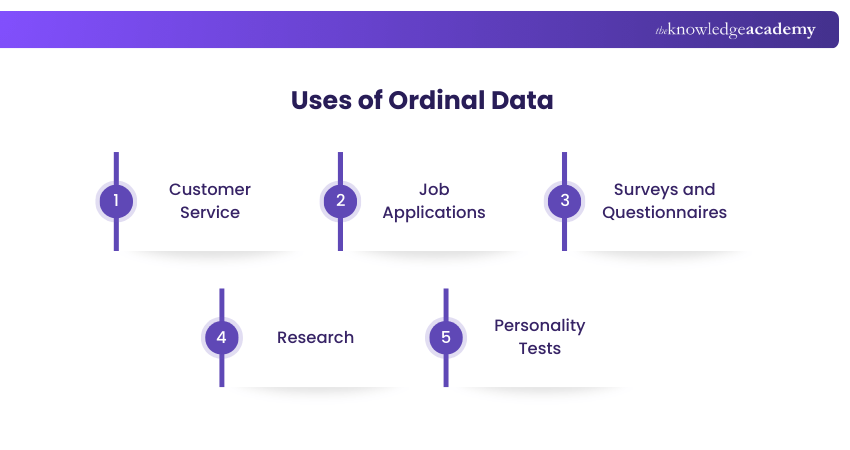
1) Customer Service
Businesses use Ordinal Data to enhance Customer Service. After using a service or purchasing a product, customers are often asked to rate their experience, providing businesses with valuable feedback to improve their offerings.
2) Job Applications
Employers sometimes use a Likert scale to gather information from job applicants. For example, in the application process for a Social Media Manager position, a Likert scale can gauge an applicant's familiarity with platforms like Facebook, Twitter, and LinkedIn, helping in assessing their suitability for the role.
3) Surveys and Questionnaires
Due to its ordered nature, Ordinal Data is ideal for surveys and questionnaires. Statistical Analysis categorises respondents based on their responses, distinguishing between categorical and numerical data. This data helps in making inferences and drawing conclusions about respondents in relation to specific variables, facilitating easy categorisation and collation.
4) Research
Researchers utilise Ordinal Data to gather useful information on their study subjects. For instance, medical researchers may collect data on the side effects of a medication from patients, using Ordinal Data to rank the severity of side effects experienced, aiding in assessing the medication's impact.
5) Personality Tests
Personality tests assess traits, behaviours, and preferences. Employers use them to gauge candidate fit, while psychologists use them to understand clients, guide interactions, and make informed decisions about communication and treatment strategies.
Enhance quality management—Sign up for our Statistical Process Control Training today!
Advantages and Disadvantages of Ordinal Data
Ordinal Data, with its ability to capture order and preferences, offers valuable insights in various fields. However, like any tool, it has its own set of strengths and limitations, as discussed below:
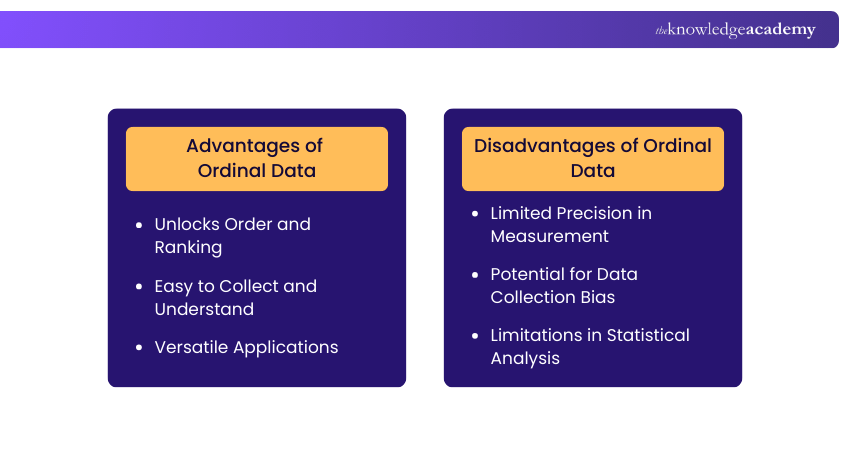
Advantages of Ordinal Data
Here are the advantages of Ordinal Data:
a) Unlocks Order and Ranking: Ordinal Data excels where simple categories fall short. Unlike Nominal vs Ordinal Data, it reveals not just “what” but also “how much” or “in what order,” providing information about preferences, rankings, and degrees of something. For example, a customer satisfaction survey with ratings from “Extremely Unsatisfied” to “Highly Satisfied” not only indicates whether customers are happy but also how strongly they feel.
b) Easy to Collect and Understand: Gathering Ordinal Data often involves straightforward methods like surveys, questionnaires, and rating scales. These familiar tools make it readily accessible for researchers and users across various disciplines.
c) Versatile Applications: From gauging student performance in education to monitoring patient well-being in healthcare, Ordinal Data finds diverse applications. Its ability to capture rankings and preferences proves valuable for decision-making in numerous sectors.
Disadvantages of Ordinal Data
Here are the disadvantages of Ordinal data:
a) Limited Precision in Measurement: While Ordinal Data reveals order, it lacks the precise measurements and calculations possible with interval and ratio data. For instance, using Likert scales to measure income levels allows for relative comparisons (e.g., higher or lower) but not exact differences between income brackets.
b) Potential for Data Collection Bias: The design and wording of questions can influence responses and introduce bias in Ordinal Data. Careful crafting of surveys and questionnaires is crucial to collect accurate and meaningful information.
c) Limitations in Statistical Analysis: Not all statistical methods are suitable for Ordinal Data. Averaging rankings, for example, can be misleading due to potentially unequal intervals between categories. Therefore, specialised non-parametric tests are often required for accurate analysis.
Conclusion
Understanding What is Ordinal Data helps you interpret ranked information where order matters but exact differences don’t. By analysing surveys, ratings, and performance rankings, you can identify patterns, compare preferences, and transform simple rankings into meaningful insights that support informed decisions and effective strategies.
Bridge Business Needs with IT Solutions- Get certified with our BCS Practitioner Certificate In Requirements Engineering - Join now!
Frequently Asked Questions
Are Ordinal Variables Categorical or Quantitative?

Ordinal variables are categorical in nature. This is because their exact differences are not measurable. However, they do exist in a meaningful order.
Are Likert Scales Ordinal or Interval Scales?
Likert scales are typically categorised as Ordinal scales because they rank responses. However, the intervals between these responses are not always equal.
What are the Other Resources and Offers Provided by The Knowledge Academy?
The Knowledge Academy takes global learning to new heights, offering over 3,000+ online courses across 490+ locations in 190+ countries. This expansive reach ensures accessibility and convenience for learners worldwide.
Alongside our diverse Online Course Catalogue, encompassing 19 major categories, we go the extra mile by providing a plethora of free educational Online Resources like Blogs, eBooks, Interview Questions and Videos. Tailoring learning experiences further, professionals can unlock greater value through a wide range of special discounts, seasonal deals, and Exclusive Offers.
What is The Knowledge Pass, and How Does it Work?
The Knowledge Academy’s Knowledge Pass, a prepaid voucher, adds another layer of flexibility, allowing course bookings over a 12-month period. Join us on a journey where education knows no bounds.
What are the Related Courses and Blogs Provided by The Knowledge Academy?
The Knowledge Academy offers various Business Analyst Courses, including the Statistics Course, Statistical Process Control Training, and the Mathematical Optimisation for Business Problems Training. These courses cater to different skill levels, providing comprehensive insights into Statistical Modeling.
Our Business Analysis Blogs cover a range of topics related to Ordinal Data, offering valuable resources, best practices, and industry insights. Whether you are a beginner or looking to advance your Data Analysis skills, The Knowledge Academy's diverse courses and informative blogs have got you covered.

The Knowledge Academy


Global Training Provider
The Knowledge Academy is a world-leading provider of professional training courses, offering globally recognised qualifications across a wide range of subjects. With expert trainers, up-to-date course material, and flexible learning options, we aim to empower professionals and organisations to achieve their goals through continuous learning.


 If you wish to make any changes to your course, please


