


 Top Rated Course

We may not have the course you’re looking for. If you enquire or give us a call on +47 80010068 and speak to our training experts, we may still be able to help with your training requirements.
Top 10 Beginner DevOps Projects to Learn in 2026
Lily Turner 07 April 2026Discover the top 10 beginner DevOps Projects to gain hands-on experience with Docker, Jenkins, Kubernetes, Terraform, Git, and more. Start your DevOps journey today! These projects offer real-world exposure to key tools and workflows, helping you build confidence, sharpen your skills, and stand out in the job market.

Training Outcomes Within Your Budget!
We ensure quality, budget-alignment, and timely delivery by our expert instructors.
Table of Contents
Are you ready to embark on a journey into the world of DevOps? As the software development landscape evolves, the demand for efficient and seamless operations is higher than ever. What projects should you tackle first to build a solid foundation? In this blog, we'll explore the top 10 popular DevOps Projects for beginners, designed to introduce you to essential concepts and practices. Discover the best DevOps Project ideas that will set you on the path to success.
Why is DevOps so crucial today? How can these beginner projects pave the way for a successful career in this field? Join us as we delve into these exciting DevOps Projects. They offer you a stepping stone into a future of efficient, collaborative, and high-paced software development. Let’s dive in!
Table of Contents
1) What is DevOps?
2) Benefits of DevOps
3) Top 10 DevOps Projects for Beginners
4) What Tools are Commonly Used in DevOps Projects?
5) What are Some Real-World DevOps Projects?
6) Conclusion
What is DevOps?
DevOps, an abbreviation for the combined terms Development (Dev) and IT Operations (Ops), is a methodology used in the modern Software Development industry. It is a cost effective and high-paced method used for deploying software products across multiple platforms, as per different needs.
DevOps has been around the Software Development industry since the 80s, however, it gained prominence during the mid 2000s. Since then, it has been a crucial aspect of the Software Development Life Cycle or SDLC. DevOps importance has been growing ever since as each software development requiring DevOps implenmentation even more. With the advent of automation, DevOps has witnessed a tremendous growth, with a skyrocketing global demand for professionals.

Benefits of DevOps
There are various benefits of DevOps. Let’s take a look at some of the prominent ones:

1) Enhanced Collaboration and Trust: DevOps champions the concept of systems thinking, urging teams to consider the broader impact of their work. DevOps fosters shared objectives, transparency, and collective responsibility, eliminating silos and aligning priorities for better end products. This shift in mindset bridges the gap between developers and operations, leading to improved speed and quality.
2) Increased Release Velocity and Efficiency: In the domain of software development, rapid delivery is crucial. DevOps practices empower teams to deploy more frequently, with greater consistency and reliability. Embracing automation and streamlined processes boosts productivity and ensures a smoother release cadence, unlike manual testing and disjointed tools.
3) Quicker Issue Resolution: DevOps thrives on rapid feedback and problem-solving, using open communication to minimise downtime and swiftly address issues. Quick resolution is key to maintaining customer satisfaction and operational confidence. Conversely, communication barriers can exacerbate issues, but DevOps promotes collaborative efforts to expedite fixes and maintain a fluid release pipeline.
4) Proactive Management of Unplanned Work: Unforeseen tasks can disrupt planned activities, but DevOps strategies manage surprises without derailing projects. Enhanced visibility and proactive reviews balance focus on planned and unplanned tasks. DevOps leverages automation and teamwork to minimise errors and improve recovery times during disruptions, ensuring effective operations.
Kickstart your Docker skills by registering for our introduction to Docker Course now!
Top 10 DevOps Projects for Beginners
Here is a list of the top 10 most popular DevOps Projects for Beginners:
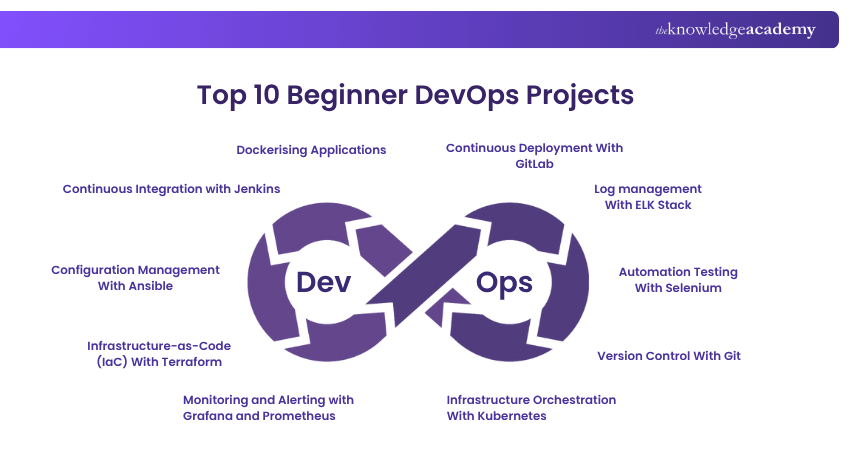
Dockerising Applications
Docker has transformed how applications are packaged and deployed. Dockerising an app means placing it and its dependencies into a lightweight, portable container. This ensures consistent performance across different environments.
By using Docker, teams avoid the “it works on my machine” problem. Applications, along with libraries and configuration files, are packaged into Docker images that run reliably on any system with Docker installed.
Docker supports scalability and better resource use. Multiple containers can run on one host, allowing teams to split apps into smaller, manageable units.
It also speeds up deployment and supports continuous integration. Containers start quickly, making frequent updates, rollbacks, and testing easier in fast-paced environments.
Continuous Integration with Jenkins
Continuous Integration (CI) is a software development practice where developers frequently merge code into a shared repository. Jenkins, a leading open-source automation server, plays a central role in enabling CI pipelines.
Jenkins automates tasks like building, testing, and deploying code after each change. Here's how it works:
1) Developers push code to the repository, triggering Jenkins
2) Jenkins pulls the latest code, builds the application, and resolves dependencies
3) It runs automated tests to ensure code stability
4) If tests succeed, Jenkins can deploy the application to test or production environments
Configuration Management with Ansible
Ansible is a free, agentless configuration management tool that simplifies automating application and infrastructure setups. It uses SSH for remote connections and YAML-based playbooks to define the desired system state.
Tasks like installing packages, managing services, and updating configurations are easily automated. Its idempotent nature ensures consistent results regardless of system state.
Ansible is ideal for repetitive tasks and maintaining stability across systems. Exploring Ansible Interview Questions helps understand its core features and real-world use cases.
Infrastructure-as-Code with Terraform
Infrastructure-as-Code (IaC) means managing infrastructure like software using code. Terraform, by HashiCorp, is a widely used IaC tool that defines infrastructure through configuration files.
These files describe resources like servers and databases and how they’re connected. Terraform works with major cloud platforms such as AWS, Azure, and Google Cloud.
It uses HashiCorp Configuration Language (HCL) and supports modules for reusable setups. Terraform files can be version-controlled and shared for consistent infrastructure deployment.
Its “plan” feature previews changes before applying, reducing risks and manual errors across environments.
Design infrastructure for cloud computing resources through our Terraform Training today!
Monitoring and alerting with Grafana and Prometheus
Prometheus is a time-series database that collects and stores metrics from sources like servers and applications. It uses a pull-based model to scrape data from targets at regular intervals.
Grafana is a powerful visualisation tool that connects to Prometheus and other sources to create custom dashboards. It displays metrics in real-time through graphs, charts, and tables.
Together, Prometheus and Grafana provide strong monitoring and alerting capabilities. Prometheus stores the data, while Grafana helps explore and visualise it easily.
You can set alerts in Grafana based on set thresholds. These alerts notify teams via email, Slack, or other tools. Exploring Grafana Interview Questions can deepen your knowledge of managing and querying this data effectively.
Infrastructure Orchestration with Kubernetes
Kubernetes is a robust platform for managing containerised applications. It automates deployment, scaling, and resource allocation, offering a unified interface to control infrastructure.
By managing a cluster of nodes, Kubernetes handles scheduling, placement, and ensures high availability. Using configuration files, you define how apps run, including replicas, networking, and storage.
Kubernetes enables automatic scaling based on demand by adjusting replicas. It also integrates with networking and storage systems, letting you manage policies and volumes efficiently.
A Kubernetes Cheat Sheet can assist with key commands and best practices for smooth operations.
Learn to run applications on Virtual Machines, by signing up for the Kubernetes Training today!
Version Control With Git
Git is a distributed Version Control System that revolutionised the way software development teams manage and track changes to their codebase. It provides a scalable and efficient way to collaborate on projects, enabling developers to work together seamlessly.
Additionally, developers can track changes to files and collaborate on projects without overwriting each other's work. It allows multiple developers to work on different branches simultaneously and merge their changes when ready.
Git's decentralised nature ensures that each developer has a complete copy of the repository, including the entire history of changes. This allows developers to work offline and sync their changes with the central repository when connected.
Git provides a range of powerful features, including branching and merging. Developers can create branches to work on new features or bug fixes independently, keeping the main branch clean and stable. Merging branches allows for the seamless integration of changes into the main codebase.
Additionally, Git enables easy reverting to previous versions of code, enabling developers to roll back to a stable state if needed. It also supports collaboration by facilitating pull requests and code reviews, allowing for quality control and knowledge sharing.
Git's lightweight and fast operations make it a preferred choice for version control in both small and large-scale projects. Its flexibility, speed, and powerful branching and merging capabilities have made it the industry standard for version control in software development.
Automation Testing With Selenium
Git is a distributed Version Control System that helps developers manage code changes and collaborate efficiently. Each developer has a full copy of the repository, enabling offline work and easy syncing.
It supports branching and merging, so teams can develop features or fixes independently without disrupting the main codebase. Git also allows version rollback and simplifies collaboration through pull requests and code reviews.
Lightweight and fast, Git is the go-to tool for version control in modern software development projects of all sizes.
Log Management with ELK Stack
The ELK Stack Elasticsearch, Logstash, and Kibana are an open-source toolsets for managing and analysing logs. It helps organisations collect, search, and visualise log data for effective system monitoring.
Elasticsearch is the core search and analytics engine, indexing log data for fast queries. Logstash ingests and processes logs from multiple sources, forwarding them to Elasticsearch.
Kibana is the visual interface that allows users to explore data through dashboards and create alerts and insights from log patterns.
Together, the ELK Stack supports real-time monitoring, centralised logging, and improved system troubleshooting.
Continuous Deployment With GitLab
GitLab is a widely used DevOps platform offering tools for source code management, continuous integration, and continuous deployment. It automates software delivery for faster, more reliable releases.
Using GitLab’s CI/CD pipelines, teams can automate the build, test, and deployment processes based on code changes. This ensures a smooth rollout of new features and fixes.
GitLab supports environment setup, scripting, and strategies like rolling updates, blue-green deployments, and canary releases. It integrates seamlessly with Docker and Kubernetes for efficient containerised deployments and resource management.
Advance your career with DevOps - join our comprehensive Certified Agile DevOps Professional Course and start learning today!
What Tools are Commonly Used in DevOps Projects?
DevOps Projects rely on a range of tools that automate and streamline the software development lifecycle. Common tools include Git for version control, Jenkins or GitLab CI/CD for continuous integration and delivery, and Docker for containerisation. Kubernetes is widely used for orchestrating containers in production environments, ensuring scalability and reliability.
For configuration management and infrastructure as code, tools like Ansible, Terraform, and Puppet are frequently used. Prometheus and Grafana help with monitoring and visualisation, while ELK Stack and Splunk are popular for log management. These tools collectively enable automation, faster deployments, and improved collaboration between development and operations teams.
What are Some Real-world DevOps Projects?
Real-world DevOps Projects often involve implementing CI/CD pipelines, automating infrastructure provisioning, or migrating legacy systems to cloud-native environments. For example, an e-commerce company may use DevOps practices to deploy updates multiple times a day using Jenkins pipelines and Docker containers, ensuring minimal downtime and fast rollbacks.
Another common project is building a monitoring and alerting system using Prometheus and Grafana to track application health and performance. Organisations also run security-focused DevOps (DevSecOps) projects to integrate automated security checks into the development pipeline, ensuring compliance and resilience from development through to production.
Keen on transforming your DevOps Strategy, refer to our blog on Ansible Tower.
Conclusion
Embarking on these top 10 beginner DevOps projects will provide you with the necessary skills and knowledge. As the software development landscape evolves, these projects provide a solid foundation for efficient, collaborative, and high-paced development. Start your DevOps journey today and revolutionise your development process.
Advance your career in DevOps and become a certified-register now for the Certified DevOps Professional (CDOP) Course!
Frequently Asked Questions
How Does DevOps Impact Software Development?

DevOps improves Software Development by integrating development and operations teams, enabling faster releases and continuous feedback. It promotes automation, collaboration and real-time monitoring, which reduces delays and errors. As a result, organisations deliver high-quality software more efficiently while responding quickly to changing business requirements.
Which Issues can DevOps Resolve?
DevOps resolves issues such as slow release cycles, communication gaps between teams, manual deployment errors, and inconsistent environments. By automating workflows and improving collaboration, it minimises downtime, enhances reliability, and reduces operational risks, allowing businesses to deliver stable software with greater speed and confidence.
What are the other Resources and Offers Provided by The Knowledge Academy?
The Knowledge Academy takes global learning to new heights, offering over 3,000+ online courses across 490+ locations in 190+ countries. This expansive reach ensures accessibility and convenience for learners worldwide.
Alongside our diverse Online Course Catalogue, encompassing 17 major categories, we go the extra mile by providing a plethora of free educational Online Resources like Blogs, eBooks, Interview Questions and Videos. Tailoring learning experiences further, professionals can unlock greater value through a wide range of special discounts, seasonal deals, and Exclusive Offers.
What are the Related Courses and Blogs Provided by The Knowledge Academy?
The Knowledge Academy offers various DevOps Certifications, including Certified DevOps Professional (CDOP), Kubeflow Training, Kubernetes Training and Docker Course. These courses cater to different skill levels, providing comprehensive insights into Kubernetes Cheat Sheet.
Our Programming & DevOps Blogs cover a range of topics related to DevOps Certifications, offering valuable resources, best practices, and industry insights. Whether you are a beginner or looking to advance your Programming skills, The Knowledge Academy's diverse courses and informative blogs have you covered.

Lily Turner


Senior AI/ML Engineer and Data Science Author
Lily Turner is a data science professional with over 10 years of experience in artificial intelligence, machine learning, and big data analytics. Her work bridges academic research and industry innovation, with a focus on solving real-world problems using data-driven approaches. Lily’s content empowers aspiring data scientists to build practical, scalable models using the latest tools and techniques.
View Detail
Upcoming Programming & DevOps Resources Batches & Dates
Date
 Certified DevOps Professional (CDOP)
Certified DevOps Professional (CDOP)
Thu 1st Oct 2026
Certified DevOps Professional (CDOP)
Thu 17th Dec 2026

 If you wish to make any changes to your course, please


