


 Top Rated Course

We may not have the course you’re looking for. If you enquire or give us a call on +47 80010068 and speak to our training experts, we may still be able to help with your training requirements.
What is Child Development? Stages, Importance, and Challenges
Michael Jones 27 April 2026Child development is the process of physical, emotional, cognitive, and social growth in children from birth through adolescence to adulthood. It involves learning, communication, and behavioural changes that shape personality, relationships, and life skills, influenced by genetics, environment, and experiences.

Training Outcomes Within Your Budget!
We ensure quality, budget-alignment, and timely delivery by our expert instructors.
Table of Contents
Developmental psychology focuses on the study of the progression and maturation of children from birth to the teenage years in areas of learning and essential abilities. It studies the influence of nature and nurture on the various stages of growth - physical, emotional, cognitive, and social. Understanding What is Child Development provides the foundation for the topics covered in this blog.
Table of Contents
1) What is Child Development?
2) Importance of Child Development
3) Child Development Stages
4) Components of Child Development
5) Developmental Milestones
6) Measuring Physical Child Development: Growth Charts
7) Challenges in Child Development
8) Conclusion
What is Child Development?
Child development refers to the transformation of a child in terms of physical, mental, emotional, and social aspects during the process of growing up. These different areas interact with one another to determine the child's way of learning, acting, and communicating, as well as understanding the surrounding world.
Moreover, it points out the role of factors like health, relationships, and environment in determining the child's progress. Acknowledging these stages enables adults to take better care of children's needs, provide timely solutions for early needs, and set up favorable conditions for development to take place healthily.

Importance of Child Development
Monitoring Child Development is a powerful tool to ensure they meet every milestone and are growing at the same pace as their peers. Disturbances in development as a child may lead to dysfunctionality as an adult or other behavioural issues. These milestones are a list of developmental skills typically mastered around the same time for all children. They serve as useful guidelines for ideal development.
By checking a child's progress against these age markers, you can do a 'check-in' to make sure they're roughly 'on track' for their age. This process, usually conducted by child/mother services and paediatricians during infancy and toddlerhood, and later through preschool and school assessments, helps detect any early developmental hiccups.
Early detection and, if necessary, early intervention for developmental challenges can reduce their impact on a child's skill development and confidence, or even indicate a potential future diagnosis. Developmental milestone checklists or charts guide what is 'normal' for specific age ranges, highlighting any areas where a child might be delayed.
However, it's crucial to remember that while Child Development follows a predictable sequence, each child is unique in their developmental journey and the time frames within which they achieve these milestones.
Child Development Stages
Child development stages serve as an effective means for parents, teachers and medical professionals to grasp a child’s growth in the areas of physical, cognitive, emotional and social during the time from birth until early school years. They not only point out the important milestones but also make it simpler to detect the time when a child may require extra help.
a) Birth to 18 months (Infancy): Infants go through significant changes and development by the end of this stage. They will have the ability to lift their heads, respond to their parents/guardians, and even communicate with them through sounds.
b) 18 months to 3 years (Toddler): Toddlers are more active and independent than ever. They develop their speech and vocabulary in simple words and phrases and have a better understanding of the world around them as they express a wider range of emotions.
c) 3 to 5 years (Preschool): Children become noticeably more fluent, both linguistically and socially, by the end of the year. They can form sentences, have interactive play, and inquire about how things function.
d) 6 to 12 years (School age): A child of this age will not only be able to think in a complex manner but also coordinate excellently with his/her body movements. Reading and writing will be common skills that they will acquire and practice during this period, along with the ability to follow complex instructions and establish deep friendships.
e) 13 to 18 years (Adolescence): The often chaotic and unpredictable period of adolescence is explained in terms of people undergoing major physical, psychological, and mental transformations, which allow them to gain autonomy, assert their identity, and develop critical thinking skills.
Components of Child Development
Now that you know what Child Development is, you might want to better understand its five major components. Those five components cover each element of a Child’s Development.
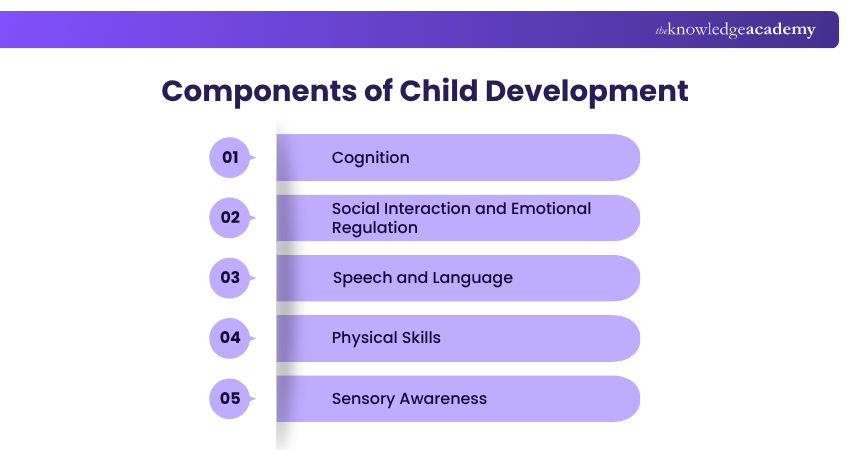
a) Gross Motor Skills - Large muscle abilities like crawling, jumping, or running.
b) Fine Motor Skills - Small-muscle tasks, such as writing, drawing, or manipulating objects.
c) Speech and Language: Communication skills involve understanding and using language.
d) Cognitive and Intellectual Skills: Thinking and learning abilities are used for problem solving.
e) Social and Emotional Skills: Skills for interacting with others, forming friendships, and managing emotions.
Developmental Milestones
Developmental milestones, you must be wondering what they are! Well, let this blog explain. The milestones are simply the benchmarks each child fills in in their developmental process.
The Milestones as an infant are:
1) First cry after birth
2) Smiling with intent
3) Waving
4) Moving objects and transferring them from one hand to another
5) Transition from crawling to walking.
Growing older, the milestones are a little more complex like:
1) Retaining names of people and things
2) Using sentences of three to four words
3) Differentiating shapes and colours
4) Retaining and reenacting poems or songs from memory
5) Storytelling.
As they grow bigger, their milestones evolve accordingly.
Influential Factors on Development
For a child to develop in the healthiest ways, there are a few factors that play a big role. To further understand the factors in Child Development, read the following points:
1) Physical Well-being and Health
To be physically healthy, the child needs a combination of healthy, nutritious food, as well as a healthy amount of physical activity, including participation in Extracurricular Activities. The movement while they play and engage in these activities stimulates parts of their brain in ways that promote growth and development. They must eat nutritious food to support this growth.
2) Emotional Wellness and Stability
The child’s relationship with their caretakers and peers in their early life will act as a framework for their personality. Having a good home environment helps the child have a sense of security and stability. This further facilitates healthy development.
Learn to manage stress mindfully and build resilience with our Handle Stress And Develop Your Resilience - Register now!
3) Cultural and Community Influences
A sense of community is a very important element in Child Development, which is subjective in nature of the culture they belong to and plays a big role in the development of the child. Educating the child about different cultures and modelling respect helps promote a more accepting nature in the child.
4) Social Interactions
Often when a child is introduced to new adults, the parents prompt the child to say, “hello” and when given a gift the parent’s often prompt the child to say, “thank you”. This helps the child understand the norms of social interactions and how to communicate with their social environment.
5) Active learning
The child must have an abundance of opportunities to learn from. This helps diversify the child’s knowledge of the world and how to appropriately participate or manage in a situation. The child must actively learn from their parents and peers.
Measuring Physical Child Development: Growth Charts
Every child grows at their own pace, and healthy development can vary widely in shape and size. Factors such as genetics, gender, nutrition, physical activity, health conditions, hormones, and environment all influence a child’s height and weight differently.
Healthcare professionals use growth charts to assess a child’s physical development alongside their overall wellbeing and family background. They may also consider:
1) Whether the child is meeting other developmental milestones
2) Any signs of potential health concerns
3) The height and weight of parents and siblings
4) If the child was born prematurely
5) Whether puberty began earlier or later than typical
Children grow at their own individual rate, with a wide variety of healthy sizes and shapes among them. Factors like genetics, gender, health problems, nutrition, physical activity, environment, and hormones all play a role in determining a child's height and weight, and these can vary widely within families.
Doctors often consider growth charts alongside a child's overall well-being, environment, and genetic background. They may also evaluate with the help of these factors:
1) Is your child reaching other developmental milestones?
2) Are there signs that suggest the child is not healthy?
3) What are the height and weight of the child's parents and siblings?
4) Was the child born prematurely?
5) Has the child shown signs of starting puberty earlier or later than average?
Aid in creating a safe space for everyone around you with our Mindfulness Training - Sign up now!
Challenges in Child Development
Kids might have to deal with different developmental difficulties that can influence their growth, learning, and socializing with others. The challenges could be caused by biological, environmental, or social factors, thus the necessity of early recognition and assistance.
a) Developmental Delays: Very few children manage to reach all the milestones expected for their age, which results in affecting the development of one or multiple areas.
b) Biological and Environmental Risks: Factors like prematurity, chronic illness, poor nutrition, or living in a bad environment can slow or even stop development.
c) Lack of Stimulation or Support: Children who have very little interaction, play, or learning opportunities are likely to lag behind in language, cognitive, and social growth.
d) Behavioural or Emotional Difficulties: Kids might find it difficult to control themselves, interact with others, or deal with emotions, which in turn affects their learning and relationships.
e) Delayed Identification: Developmental issues could be unnoticed all the way when the signs are slight, thus leading to the loss of early support opportunities.
Conclusion
Understanding What is Child Development gives clarity on how children grow, learn and adapt. Recognising challenges early allows adults to provide the right support at the right time. When children receive strong guidance and nurturing environments, they are better prepared for lifelong learning and wellbeing.
Learn how you can prevent psychological distress that can lead to extreme adversities. Sign up for our Prevention Psychology Training - Register now!
Frequently Asked Questions
What are the most important things for a child's development?

There may be a lot of debate on this subject matter, but the most important thing in a Child’s Development is nurture. The nurture the child receives in their early life frames the person they grow into.
What is Child Psychology?
Child Psychology aims to identify, acknowledge and rectify Child Development disturbances. Apart from this, it aims to create a safe space for children with unique needs and aids them in every possible way.
What are the Other Resources and Offers Provided by The Knowledge Academy?
The Knowledge Academy takes global learning to new heights, offering over 3,000+ online courses across 490+ locations in 190+ countries. This expansive reach ensures accessibility and convenience for learners worldwide.
Alongside our diverse Online Course Catalogue, encompassing 17 major categories, we go the extra mile by providing a plethora of free educational Online Resources like Blogs, eBooks, Interview Questions and Videos. Tailoring learning experiences further, professionals can unlock greater value through a wide range of special discounts, seasonal deals, and Exclusive Offers.
What is The Knowledge Pass, and How Does it Work?
The Knowledge Academy’s Knowledge Pass, a prepaid voucher, adds another layer of flexibility, allowing course bookings over a 12-month period. Join us on a journey where education knows no bounds.
What are the Related Courses and Blogs Provided by The Knowledge Academy?
The Knowledge Academy offers various Mental Health Courses, including the Mental Capacity Training, Mindfulness Training, and Counselling Course. These courses cater to different skill levels, providing comprehensive insights into Big Five Personality Traits.
Our Health & Safety Blogs cover a range of topics related to Child Development, offering valuable resources, best practices, and industry insights. Whether you are a beginner or looking to advance your Health & Safety skills, The Knowledge Academy's diverse courses and informative blogs have got you covered.

Michael Jones


Health and Safety Consultant and Compliance Trainer
Michael Jones is a seasoned health and safety expert with more than 15 years of experience in workplace safety, risk management, and compliance training. He has worked across construction, manufacturing, and corporate sectors, helping organisations meet legal requirements and create safer working environments. Michael’s training and writing are known for being practical, clear, and aligned with UK regulations.
View Detail

Upcoming Health & Safety Resources Batches & Dates
Date
 Handle Stress and Develop Your Resilience
Handle Stress and Develop Your Resilience
Fri 21st Aug 2026
Handle Stress and Develop Your Resilience
Fri 23rd Oct 2026

 If you wish to make any changes to your course, please


