


 Top Rated Course

We may not have the course you’re looking for. If you enquire or give us a call on +47 80010068 and speak to our training experts, we may still be able to help with your training requirements.
Bitbucket vs GitHub: Which Platform is Right for You?
Scarlett Adams 15 December 2025GitHub and Bitbucket are cloud-based platforms for hosting, managing, and collaborating on code using Git version control, ideal for developers and teams. They support version tracking, pull requests, and team collaboration. Each platform offers unique strengths tailored to different development environments and workflows.

Training Outcomes Within Your Budget!
We ensure quality, budget-alignment, and timely delivery by our expert instructors.
Table of Contents
Have you ever wondered which platform comes out on top in the Bitbucket vs GitHub debate? Whether you're starting your first coding project or managing large-scale software with a team, choosing the right version control platform can shape your workflow and boost collaboration. GitHub and Bitbucket both offer powerful tools, but they suit different goals, team sizes, and tech environments. In this blog, we’ll explore their core differences, highlight their strengths, and guide you in selecting the best fit for your development journey.
Table of Contents
1) Overview of GitHub and Bitbucket
2) Key Differences Between GitHub and Bitbucket
a) Core Features
b) Privacy And Access
c) UX and Ease of Use
d) Third-Party Integrations
e) Data Storage
f) Wikis and Community Support
g) Developer Adoption
3) GitHub vs Bitbucket: Which One is Right for You?
4) Conclusion
Overview of GitHub and Bitbucket
If you are in the coding or development field, then you must have heard the names of GitHub and Bitbucket. Both tools give developers the option to safely manage their code through version control. But their background, ecosystem and use-case are slightly different. Let us first understand the basics of what these tools exactly are.
What is GitHub?
GitHub is a cloud-based platform where developers store, manage, and collaborate with their team. Built on the Git version control system, GitHub is known for its clean, user-friendly interface, making it accessible to both beginners and experienced professionals.

Key points:
1) Widely used for open-source and public repositories
2) Acquired by Microsoft in 2018
3) Supports automation with GitHub Actions
4) Offers features like CI/CD, issue tracking, and pull requests
5) Includes AI tools such as GitHub Copilot

What is Bitbucket?
Bitbucket is also a Git-based platform where you can securely store and manage your code. It is a product of the Atlassian company, which is also famous for tools like Jira and Trello. Bitbucket is mostly used for private repositories and enterprise-level teams.
Key points:
1) Free plan includes more private repositories
2) Seamless integration with Jira and Confluence
3) Built-in CI/CD pipelines for automation
4) Strong branch permissions and security controls
5) Ideal for teams within the Atlassian ecosystem
Understand coding fundamentals for responsive web layouts. Join our Website Design Course now!
Key Differences Between GitHub and Bitbucket
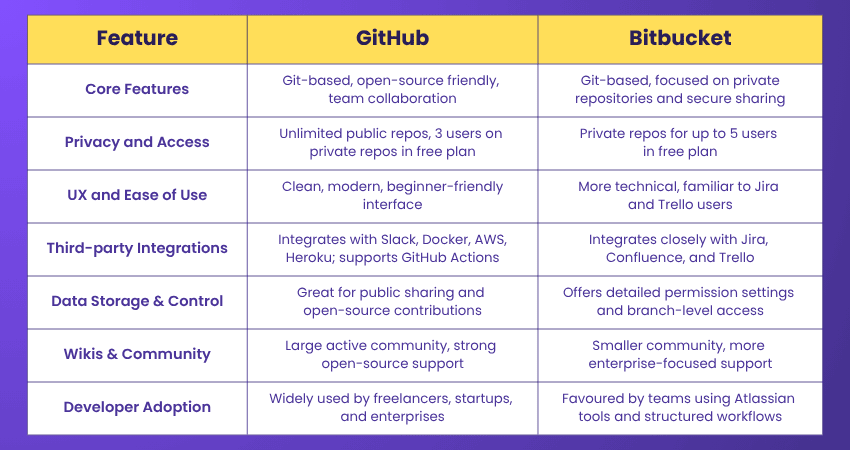
Bitbucket vs GitHub are both tools used for version control, but they differ in how they are built, who uses them, and what features they focus on. Let’s look at the difference between Bitbucket and GitHub:
1) Core Features
GitHub is a platform based on Git that helps teams manage their code, keep track of changes, and work together. It is well-known for supporting open-source projects where developers share their code with the world.
On the other hand, Bitbucket also started by supporting both Git and Mercurial but now supports only Git. It is more focused on private projects and teams that want to keep their code secure and shared with only a few people.
2) Privacy and Access
GitHub’s free plan allows unlimited public repositories and lets up to three users work on private ones. This is great for people working on open-source projects. It suits individual developers and small collaborations starting out.
In contrast, Bitbucket’s free plan includes private repositories for up to five users, which is useful for small teams. To add more users, you’ll need to switch to a paid plan. This makes it a better fit for startup teams with limited budgets.
3) UX and Ease of Use
GitHub has a clean, modern design that is easy for beginners to use. You can browse projects, create pull requests, and review code without any confusion.
Its intuitive layout makes navigating projects quick and hassle-free.
On the other hand, Bitbucket’s interface is more technical and works well for users already familiar with Atlassian tools like Jira and Trello. New users might need a bit of time to get used to it. However, teams using Jira will find the workflow smooth and familiar.
4) Third-party Integrations
GitHub has strong automation tools like GitHub Actions, which help with testing, deployment, and CI/CD. It also connects well with tools like Slack, Docker, AWS, and Heroku. These integrations streamline development from planning to production.
In contrast, Bitbucket works best with other Atlassian tools. If your team already uses Jira, Trello, or Confluence, Bitbucket makes it easy to connect everything. Task tracking and documentation can be managed together smoothly. This tight connection improves productivity within the same toolset.
5) Data Storage
Both GitHub and Bitbucket store your code using Git. GitHub is better for sharing public projects with open-source communities. It’s ideal when you want visibility and contributions from global developers.
On the other hand, Bitbucket gives you more control over who can see and change your code. You can set permissions for branches or give users read-only access, which is helpful for larger organisations. Its detailed access controls help manage complex team structures.
6) Wikis and Community Support
GitHub has a very active community. Users often take part in discussions, report issues, and improve readme files. It is a trusted platform for open-source development. Active support makes it easy to solve problems and learn.
In contrast, Bitbucket also offers wikis and issue tracking, but its community is smaller. It is mainly used by teams working within the Atlassian ecosystem, so there is less public activity. While smaller, the support is tailored for enterprise collaboration.
7) Developer Adoption
GitHub is the most widely used platform by developers. Freelancers, students, startups, and large companies all use it. It is beginner-friendly and has a strong support system. Its popularity also means more learning resources and examples.
On the other hand, Bitbucket is more popular with businesses and teams that use Jira for project tracking. It may not be as widely used as GitHub, but it is a good choice for those already working with Atlassian tools. It appeals more to professional teams with structured workflows.
Attain the knowledge of working and creating the touch component of mobile. Join our React Native Training now!
Bitbucket vs GitHub: Which One is Right for You?
Choosing between GitHub and Bitbucket depends on your team size, tools, and how you work. Both platforms are reliable, but the right one for you will depend on your specific needs. Here are a few key points to help you decide:
1) If you need strong community support and wide integrations with tools like Slack, Docker, and AWS, GitHub is a great option. It is easy to connect with other developers and find help when needed.
2) If your team already uses Atlassian tools like Jira, Confluence, or Trello, Bitbucket is a better fit. It offers seamless integration, keeping your project management and code development connected in one place.
3) For small teams that want private repos, both platforms work well. However, Bitbucket allows five free collaborators, while GitHub offers only three, giving Bitbucket a bit more flexibility.
4) For advanced CI/CD workflows, both GitHub Actions and Bitbucket Pipelines are powerful tools. If you're already using a specific toolchain, choose the one that fits best with your current setup.
Conclusion
Both Bitbucket vs GitHub are useful tools that help manage code and team collaboration. GitHub is best for more community support and open-source focus, while Bitbucket integrates better with tools like Jira. Choosing the best platform based on your team's needs, tools, and project type is a smart decision. Take time to explore their features and try out their free plans. The right platform can boost your workflow and make team collaboration smoother.
Learn cutting-edge technologies for versatile web solutions. Join our App & Web Development Training now!
Frequently Asked Questions
Is Bitbucket Owned by GitHub?

No, Bitbucket is not owned by GitHub. Bitbucket is owned by Atlassian, the same company behind Jira and Trello. GitHub, on the other hand, has been owned by Microsoft since 2018. The two platforms are separate and serve different user bases, although both support Git version control.
Is Bitbucket Discontinued?
No, Bitbucket is not discontinued. It is actively maintained by Atlassian. However, in 2020, Bitbucket discontinued support for Mercurial repositories and now supports Git only. It continues to receive updates and is widely used by teams working with Atlassian tools.
What are the Other Resources and Offers Provided by The Knowledge Academy?
The Knowledge Academy takes global learning to new heights, offering over 3,000+ online courses across 490+ locations in 190+ countries. This expansive reach ensures accessibility and convenience for learners worldwide.
Alongside our diverse Online Course Catalogue, encompassing 19 major categories, we go the extra mile by providing a plethora of free educational Online Resources like Blogs, eBooks, Interview Questions and Videos. Tailoring learning experiences further, professionals can unlock greater value through a wide range of special discounts, seasonal deals, and Exclusive Offers.
What is The Knowledge Pass, and How Does it Work?
The Knowledge Academy’s Knowledge Pass, a prepaid voucher, adds another layer of flexibility, allowing course bookings over a 12-month period. Join us on a journey where education knows no bounds.
What are the Related Courses and Blogs Provided by The Knowledge Academy?
The Knowledge Academy offers various App & Web Development Training, including the MEAN Stack Web Development Training, Git & GitHub Fundamentals Course and the Mobile App Development Course. These courses cater to different skill levels, providing comprehensive insights into What is Software.
Our Programming & DevOps Blogs cover a range of topics related to GitHub, offering valuable resources, best practices, and industry insights. Whether you are a beginner or looking to advance your GitHub knowledge, The Knowledge Academy's diverse courses and informative blogs have got you covered.
Upcoming Programming & DevOps Resources Batches & Dates
Date
 Git & GitHub Fundamentals
Git & GitHub Fundamentals
Fri 11th Sep 2026
Git & GitHub Fundamentals
Fri 11th Dec 2026

 If you wish to make any changes to your course, please


