


 Top Rated Course

We may not have the course you’re looking for. If you enquire or give us a call on +47 80010068 and speak to our training experts, we may still be able to help with your training requirements.
What is B2B Marketing: Guide to 2026’s Best Strategies
James Smith 03 March 2026B2B Marketing promotes products or services from one business to another, focusing on trust, ROI, education, and long-term client relationships. It’s about understanding customer needs and delivering value through trust, expertise, and communication, involving longer sales cycles with stakeholders, and a focus on strong business results.

Training Outcomes Within Your Budget!
We ensure quality, budget-alignment, and timely delivery by our expert instructors.
Table of Contents
In today’s business landscape, companies must connect with other businesses in a thoughtful and strategic way, focusing on real problems and creating long-term relationships. This is why understanding What is B2B marketing is essential to help organisations reach decision-makers with the right message at the right time.
According to recent industry forecasts, the global B2B market is projected to reach £15.13 billion in 2025. This reflects the expansion and demand of this market. In this blog, be ready to explore What is B2B Marketing, its process, importance, and more in detail. So, keep reading to learn more!
Table of Contents
1) What is B2B Marketing?
2) The B2B Marketing Process Explained
3) How is B2B Marketing Different From B2C Marketing?
4) Strategies for Effective B2B Marketing
5) Building a B2B Marketing Plan
6) Current B2B Marketing Trends
7) What are the Four Types of B2B?
8) Which Social Media Platform is Best for B2B Marketing?
9) Conclusion
What is B2B Marketing?
B2B Marketing stands for Business-to-business marketing. It refers to the strategy, campaign, or content that a business uses to promote and sell its products or services to another business. This can include software, professional services, or manufacturing solutions.
The primary goal of B2B Marketing is to attract the right audience and convert leads into long-term customers. It focuses on capturing attention quickly and maintaining interest by providing value. For example, HubSpot uses content-led marketing to attract and educate businesses through blogs, free tools, or webinars.

The B2B Marketing Process Explained
For a successful B2B Marketing strategy, it is essential to understand the customer needs and the buyer journey. Aligning marketing efforts with this journey can improve customer experience and generate high-quality leads. Let’s look at the key stages in its process
1) Awareness
In this stage, the buyer realises they have a problem and begins searching for possible solutions. They may not fully know which product or provider they need yet, so visibility is of utmost importance at this stage. For increasing visibility, increase awareness through SEO, paid campaigns, and Top-of-the-funnel (TOFU) content, such as blogs and videos.
For Example: IBM builds awareness by publishing industry research and thought leadership content on AI and digital transformation to help businesses recognise problems.
2) Consideration
In the Consideration stage, buyers begin comparing different solutions and vendors to identify the best fit for their specific needs. They actively evaluate features, benefits, pricing, and credibility. At this stage, B2B Marketing must support decision-making with Bottom-of-the-funnel (BOTF) content such as comparison pages or email campaigns.
For Example: Zoom supports the consideration stage by detailing solution pages and use case content to help businesses compare features and fit their needs.
3) Decision
Here, the buyer chooses the solution that provides them with the highest value and fits their budget. At this point, proof, clarity, and confidence is important. B2B Marketing can utilise strong marketing of their product value, use Return on Investment (ROI) calculators, case studies, or testimonials to build trust.
For Example: SAP drives decisions using ROI focused case studies and customer success stories to help organisations justify their purchases.
4) Retention
B2B Marketing process does not end after making a sale but retaining a long-term relationship with the audience or customer. This means encouraging renewals and turning customers into advocates. For retaining them, B2B marketing can maintain engagement through personalised emails, surveys, loyalty programmes, or product updates.
For Example: Adobe maintains retention through consistent customer education, certifications, and product updates to encourage long-term use and loyalty.
How is B2B Marketing Different From B2C Marketing?
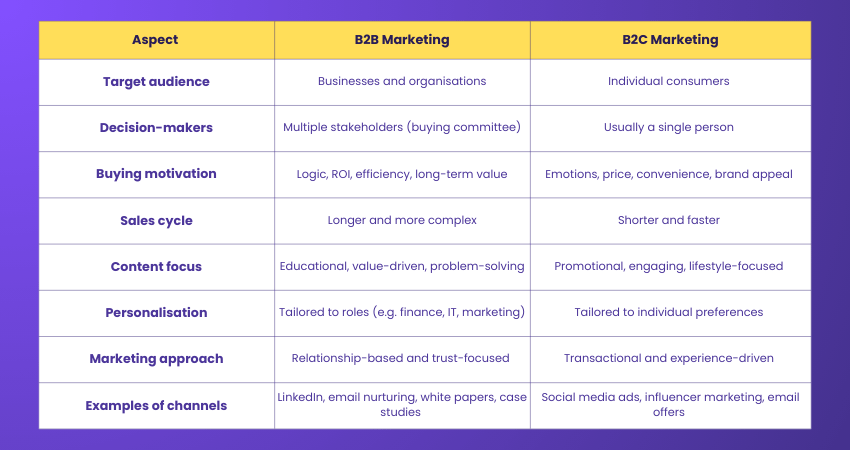
B2B Marketing is focused on promoting products or services from one business to another, targeting multiple decision-makers for a long buying cycle. It emphasises value, ROI, and scalable outcomes through educational, trust-based content.
B2C Marketing targets individual consumers who make quick purchasing decisions driven by emotions, pricing, and convenience. Here, content is promotional and experience-focused to support fast actions.
For more clarity, check the table provided below:
Think strategically and learn market strategies for driving impactful business success with the Strategic Marketing Course – Join now!
Strategies for Effective B2B Marketing
Success in B2B Marketing doesn't arise from chance; it's meticulously crafted through a symphony of strategic efforts. From identifying the right audience to delivering compelling content, B2B Marketing strategies are the threads that weave together growth, engagement, and lasting connections. Let’s explore its key strategies below.
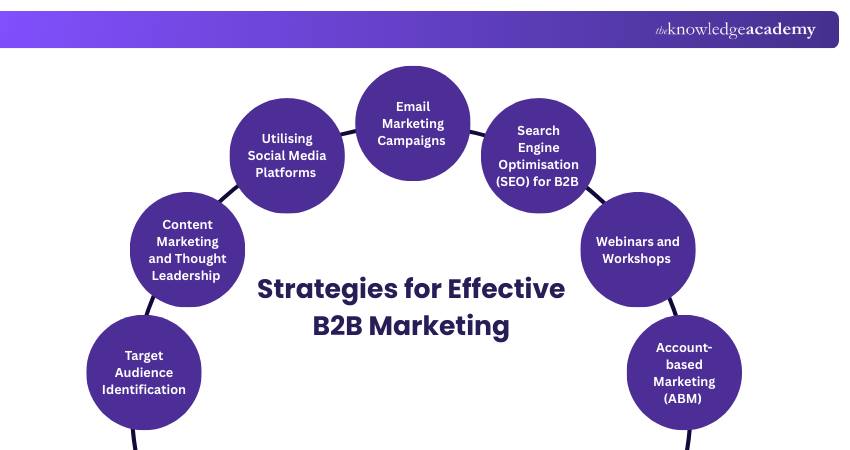
1) Target Audience Identification
Identifying the right target audience steers B2B Marketing in the right direction. This strategy involves not just understanding demographics, but delving deeper into the pain points, challenges, and aspirations of potential clients.
Precise audience segmentation allows B2B marketers to tailor their messages, ensuring they resonate with the right people. This laser-focused approach magnifies the impact of subsequent strategies, making every interaction more meaningful.
2) Content Marketing and Thought Leadership
B2B Marketing leverages content as a vehicle for thought leadership – a way to establish credibility and authority. Through insightful blog posts, whitepapers, videos, and webinars, businesses showcase their expertise, addressing industry pain points and offering solutions.
This positions them as trusted advisors in the eyes of their audience, which not only attracts leads but also nurtures them into loyal clients. Over time, this credibility shortens sales cycles by building confidence before the sales conversation begins.
3) Utilising Social Media Platforms
Social media isn't just for consumer brands; it's a treasure trove for B2B Marketing. The strategy here involves selecting platforms where target businesses congregate and tailoring content to suit their professional interests. Regular posting, sharing industry news, and engaging in meaningful discussions create a digital presence that's both personable and professional.
Social media platforms also serve as networking spaces, where B2B marketers can initiate and nurture relationships, laying the groundwork for future collaborations. It allows brands to stay visible to key decision-makers through ongoing professional conversations.
4) Email Marketing Campaigns
Email Marketing in the B2B landscape is akin to personalised correspondence. Crafting compelling emails that offer value, whether through educational content, industry insights, or exclusive offers, establishes a direct line of communication with any potential clients.
Nurturing leads through well-timed emails keeps businesses top-of-mind and gradually guides recipients towards conversion. The key here is relevancy and authenticity – emails that feel like a meaningful dialogue rather than generic sales pitches.
5) Search Engine Optimisation (SEO) for B2B
SEO is the map that guides potential clients to your doorstep. B2B Marketing strategies focus on optimising website content and structure to appear prominently in Search Engine Results.
This is achieved through strategic use of keywords, high-quality backlinks, and a user-friendly design. Appearing in organic search results not only boosts visibility but also conveys credibility, as businesses are perceived as relevant and authoritative sources.
6) Webinars and Workshops
Webinars and workshops are stages where B2B Marketing comes to life. These interactive sessions provide valuable insights and education, positioning the business as a knowledge hub.
Participation not only showcases expertise but also fosters engagement. As attendees absorb valuable information, trust deepens, transforming them from leads into prospects and, eventually, into loyal clients.
7) Account-based Marketing (ABM)
In the world of B2B, one size doesn't fit all. Account-Based Marketing (ABM) is a bespoke strategy where Marketing efforts are laser-focused on high-value accounts. Tailoring content, outreach, and interactions to the specific needs of these accounts, businesses can nurture deeper relationships and drive higher conversion rates.
ABM transforms B2B Marketing into a precision art, where each interaction is carefully crafted to resonate with the individual recipient. This targeted approach improves engagement quality and maximises return from high-value accounts.
Elevate your Marketing prowess with our Mobile Marketing Course and harness the potential of mobile to fuel your business growth!
Building a B2B Marketing Plan
Building a B2B Marketing Plan isn't just about plotting actions; it's about weaving strategies into a cohesive tapestry that guides a business towards its objectives. Here's how to construct a comprehensive B2B Marketing Plan that propels your business forward.
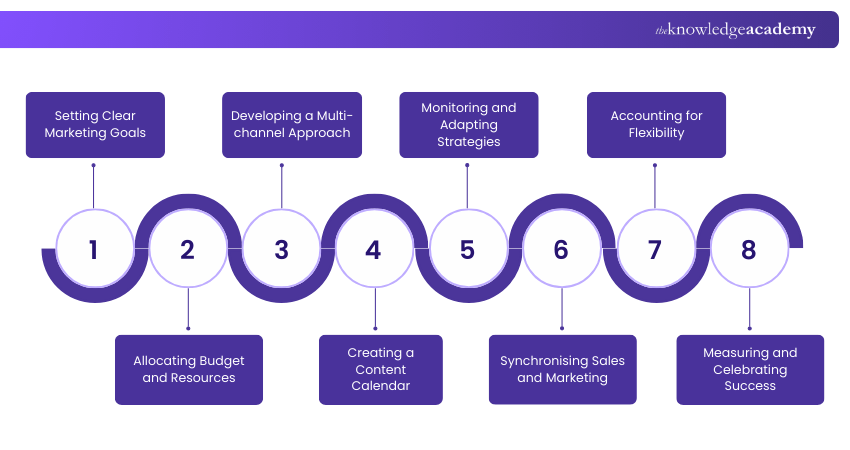
1) Setting Clear Marketing Goals
Talking about B2B Marketing Plan begins with clarity. Define your objectives in tangible terms – whether it's increasing lead generation by a certain percentage, boosting conversion rates, or expanding into new markets. These goals serve as the guiding stars, steering your strategies and actions towards measurable outcomes.
2) Allocating Budget and Resources
Every journey requires resources, and your B2B Marketing plan is no different. Determine the budget required to execute your strategies effectively, allocating funds to various channels and activities based on their expected impact. Additionally, identify the human resources be it in-house marketers or external agencies – needed to execute your plan seamlessly.
3) Developing a Multi-channel Approach
Diversity is key in B2B Marketing. Your B2B Marketing Plan should encompass a Multi-channe`l approach, leveraging a combination of platforms such as social media, email Marketing, content distribution, webinars, and more. This ensures wider reach and increased engagement, allowing your message to resonate with your audience across various touchpoints.
4) Creating a Content Calendar
Compelling content is the fuel that powers your B2B Marketing engine. A content calendar provides structure and consistency, mapping out what kind of content will be created, when it will be published, and how it aligns with your Marketing goals. This calendar not only keeps your messaging relevant but also ensures that you remain a constant presence in the minds of your audience.
5) Monitoring and Adapting Strategies
A B2B Marketing plan isn't etched in stone; it's a living document that evolves with your business and the market. Regularly monitor the performance of your strategies against your goals. Analyse data, assess Key Performance Indicators (KPIs), and identify areas of success and improvement. This data-driven approach empowers you to adapt your strategies on-the-go, optimising your plan for the best possible outcomes.
6) Synchronising Sales and Marketing
In the world of B2B, sales and Marketing are intertwined threads. Ensure that your B2B Marketing Plan aligns seamlessly with your sales strategy. Define how leads will be transferred from Marketing to sales, and establish a feedback loop that keeps both teams informed about what's working and what needs refinement.
7) Accounting for Flexibility
Flexibility is the heartbeat of a successful B2B Marketing Plan. The business landscape is dynamic, and your plan should be equipped to navigate changes and unexpected developments. Have contingency strategies in place to address unforeseen challenges and seize emerging opportunities.
8) Measuring and Celebrating Success
As your B2B Marketing Plan unfolds, it's vital to track progress against your goals. Regularly assess the impact of your strategies and celebrate milestones achieved. This not only motivates your team but also provides insights into what's working, allowing you to fine-tune your plan for even better results.
Turn visitors into customers. Optimise, convert, and grow faster with Conversion Rate Optimisation Training today!
Current B2B Marketing Trends
B2B marketing evolves rapidly, shaped by the changing behaviour of the buyer and advances in technology. This marks the emergence of trends that transform businesses significantly. Let’s look at some trends below.
1) Brand Building: B2B marketers are investing in brand building to stay ahead in the competitive curve. Through creative storytelling, they deliver strong engagement and ROI.
2) Artificial Intelligence (AI): AI improves ad targeting, content creation, and campaign optimisation, helping marketers analyse large data sets to deliver accurate content.
3) Data-driven Decision-making: Marketers are using analytics to refine strategies, prove the effectiveness of campaigns, and demonstrate the value to internal stakeholders and teams.
4) Personalisation: It is boosting AI-driven automation and account-based marketing. Using first-party data, businesses deliver tailored content to resonate with decision-makers.
5) Video and Interactive Content: Video marketing, webinars, virtual events, and interactive demos to help brands build strong connections, increase engagement, and foster sharing.
6) Social Selling: It is a lead-generation strategy by sharing valuable insights with B2B marketers to build relationships and trust with prospects before a direct sales conversation begins.
7) Sustainability and Purpose-driven Marketing: Brands are prioritising ethical and sustainable practices to align with customer values and build long-term trust and credibility.
What are the Four Types of B2B?
The B2B Market is made up of four different types, as mentioned below.
1) Producers: They buy products or services to create other goods or deliver services. They focus on quality, reliability, and long-term value.
2) Re-sellers: They purchase products to sell again for profit. For them, marketing highlights pricing, margins, and ease of distribution.
3) Governments: They buy goods and services to support public operations and infrastructure. These purchases follow strict regulations and formal procurement processes.
4) Institutions: This includes non-profits, hospitals, and educational bodies that buy to support their mission. They prioritise value, reliability, and cost-efficiency.
Which Social Media Platform is Best for B2B Marketing?
Social platforms play an important role in B2B Marketing. Some of the popular ones include LinkedIn, YouTube, Facebook, Twitter, and TikTok. Each platform supports B2B goals in different ways. However, LinkedIn stands out as the best platform for lead generation. Since it is designed for professionals, it makes it easier to reach decision-makers and share business-focused content.
Conclusion
Understanding What is B2B Marketing is integral for enabling organisations to move beyond short-term strategies to building long-term relationships. It helps them stay ahead of the competitive market and achieve sustainable growth as they head into 2026. From understanding buyer journeys to choosing the right platforms, business success depends on delivering value and trust at every point of the buyer journey.
Learn how to build modern marketing skills with Marketing Courses now!
Frequently Asked Questions
What are the 7Ps of B2B Marketing?

The 7Ps of B2B Marketing include product, price, place, promotion, people, process, and Physical Evidence. This structured framework helps businesses plan, execute, and refine their marketing strategies.
How do B2B Marketers Determine Pricing Strategies?
B2B marketers set pricing strategies by analysing cost, competitors, and valuing customer perception. They assess the willingness to pay and expected ROI. Some common approaches include tiered pricing, volume discounts, subscriptions, and value-added services.
What are the Other Resources and Offers Provided by The Knowledge Academy?
The Knowledge Academy takes global learning to new heights, offering over 3,000+ online courses across 490+ locations in 190+ countries. This expansive reach ensures accessibility and convenience for learners worldwide.
Alongside our diverse Online Course Catalogue, encompassing 17 major categories, we go the extra mile by providing a plethora of free educational Online Resources like Blogs, eBooks, Interview Questions and Videos. Tailoring learning experiences further, professionals can unlock greater value through a wide range of special discounts, seasonal deals, and Exclusive Offers.
What is The Knowledge Pass, and How Does it Work?
The Knowledge Academy’s Knowledge Pass, a prepaid voucher, adds another layer of flexibility, allowing course bookings over a 12-month period. Join us on a journey where education knows no bounds.
What are the Related Courses and Blogs Provided by The Knowledge Academy?
The Knowledge Academy offers various Marketing Courses, including the Digital Marketing Course, Strategic Marketing Course, and Conversion Rate Optimisation Training. These courses cater to different skill levels, providing comprehensive insights into Brand Identity.
Our Digital Marketing Blogs cover a range of topics related to Marketing and Brand Building, offering valuable resources, best practices, and industry insights. Whether you are a beginner or looking to advance your Marketing skills, The Knowledge Academy's diverse courses and informative blogs have got you covered.

James Smith


Digital Marketing Manager and Trainer
James Smith is a digital marketing professional with over a decade of experience in SEO, content strategy, paid media and analytics. He has supported both SMEs and global brands in transforming their digital presence. James’s writing and training are rooted in results-driven tactics and the latest marketing trends.
View Detail
Upcoming Digital Marketing Resources Batches & Dates
Date
 Digital Marketing Course
Digital Marketing Course
Fri 17th Jul 2026
Digital Marketing Course
Fri 13th Nov 2026

 If you wish to make any changes to your course, please


