Who should attend this ISO 55001 Lead Implementer Training Course?
The ISO 55001 Lead Implementer Training Course is designed to equip participants with the expertise to guide an organisation in establishing, implementing, managing, and maintaining an Asset Management System as per the ISO 55001 Standard. Here are the individuals who would significantly benefit from attending the ISO 55001 Lead Implementer Training Course:
- Asset Managers
- Operational Managers
- Quality Managers
- Consultants
- Project Managers
- Maintenance Managers
- Risk Managers
- Professionals transitioning from other standards
Prerequisites of the ISO 55001 Lead Implementer Training Course
There are no formal prerequisites for attending this ISO 55001 Lead Implementer Training Course.
ISO 55001 Lead Implementer Training Course Overview
ISO 55001 is an international standard for an asset management system that aids businesses in efficiently managing their assets to maximise their lifetime value. It provides a framework to establish, maintain, implement, and enhance efficient control and governance of assets to realise value through managing risk and opportunity. Our industry experts have curated this training to assist organisations in successfully implementing the Asset Management Systems (AMS) framework to achieve the desired balance of cost, risk, and performance of the assets. This training course will help individuals manage their organisation's assets while saving on costs and improving employee efficiency and accountability. Holding skills to implement the AMS framework successfully will open doors for individuals to grab highly paid job roles in reputed enterprises.
This 3-day ISO 55001 Lead Implementer training course will provide delegates with the best practises of asset management systems and effectively improve an organisation’s asset management. During this training, delegates will learn the principles and practises of effective management of an AMS. They will also acquire the skills to maintain, establish, implement, and manage an asset management system. Our highly professional trainer with years of experience in teaching such courses will conduct this training course and help delegates acquire the professional capabilities to implement ISO 55001 in an organisation.
Course Objectives
- To understand how to plan, implement, monitor, and maintain an AMS
- To acquire knowledge of implementation principles
- To interpret the ISO 55001 requirements in the context of an organisation
- To learn approaches, methods, and techniques for the implementation of an AMS
- To understand the operations of an asset management system
At the end of this training, delegates will be able to plan, implement, manage, monitor, and maintain an asset management system. They will also be able to improve an organisation’s asset management by using their assets to their maximum potential.
Skills You'll Gain After Completing this ISO 55001 Lead Implementer Training
The ISO 55001 Lead Implementer Training focuses on implementing and managing Asset Management Systems (AMS) in accordance with ISO 55001 requirements. It addresses system structure, organisational context, operational controls, and implementation planning within asset-focused environments.
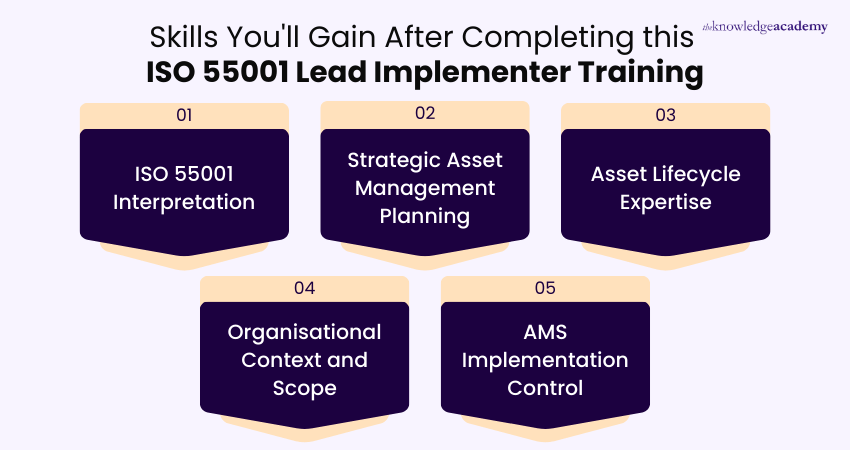
Here are the key skills learners will gain after completing this training:
- ISO 55001 Interpretation: Apply ISO 55001 scope and terms to structure, document, and control Asset Management Systems in line with standard requirements.
- Strategic Asset Management Planning: Develop Strategic Asset Management Plans incorporating organisational objectives, stakeholder expectations, and defined asset management objectives.
- Asset Lifecycle Expertise: Implement lifecycle-based controls covering asset planning, acquisition, operation, maintenance, and disposal decision processes.
- Organisational Context and Scope: Determine Asset Management System scope by evaluating organisational context, internal and external issues, and stakeholder needs and expectations.
- AMS Implementation Control: Execute Asset Management System implementation using defined strategies, operational planning controls, economic analysis, and risk assessment methods.





 If you miss out, enquire to get
yourself
on the waiting list for the next day!
If you miss out, enquire to get
yourself
on the waiting list for the next day!













 If you wish to make any changes to your course, please


