


 Top Rated Course

We may not have the course you’re looking for. If you enquire or give us a call on + 1-866 272 8822 and speak to our training experts, we may still be able to help with your training requirements.
Lean Process Improvement: 7 Key Steps for Manufacturing Success
William Brown 16 July 2026Lean Process Improvement is a method to streamline operations by removing waste, improving workflow, and focusing on customer value. It helps organisations speed up production, reduce errors and strengthen quality. It also builds a culture of continuous improvement, resulting in more efficient, reliable and cost-effective operations.

Training Outcomes Within Your Budget!
We ensure quality, budget-alignment, and timely delivery by our expert instructors.
Table of Contents
Have you ever wondered why some manufacturing plants run smoothly while others struggle with delays, defects, and rising costs? The difference often comes down to how effectively a company applies Lean Process Improvement. In today’s competitive world, where efficiency and speed determine success, manufacturers can no longer afford wasteful processes, unnecessary steps, or repeated errors.
In this blog, we’ll explore what is a Lean Process Improvement, why it matters, and the practical steps manufacturers can take to improve their operations. By the end, you’ll see how Lean principles help create faster, cleaner, and more efficient manufacturing systems.
Table of Contents
1) What is Lean Process Improvement?
2) Why is Lean Process Improvement Important?
3) Steps to Improve Lean Processes
4) The 5 Core Principles of Lean and How to Apply Them
5) What are the Advantages of Lean Process Improvement?
6) Tools and Techniques for Lean Process Improvement
7) Lean Process Improvement vs Value Stream Management
8) Conclusion
What is Lean Process Improvement?
Lean Process Improvement is a structured approach used to enhance manufacturing efficiency by reducing waste and improving the flow of work. It focuses on analysing processes, identifying non-essential activities and redesigning workflows so that every step adds value for the customer. The goal is to achieve faster production, fewer defects and smoother operations using fewer resources.
Lean also encourages employees to participate in problem-solving and continuous improvement, creating a culture where teams regularly refine processes. By adopting Lean principles, manufacturers strengthen quality, reduce delays and build more efficient, resilient operations.

Why is Lean Process Improvement Important?
Lean Process Improvement is important because it helps manufacturers manage rising customer expectations, supply chain pressures and increasing operational costs. By streamlining workflows and removing waste, Lean boosts productivity, improves quality and reduces delays.
It also allows teams to identify issues early and take quick corrective action, resulting in lower downtime and less scrap. Lean further builds a proactive culture where employees continuously improve processes, creating a more engaged, adaptable and resilient manufacturing workforce.
Steps to Improve Lean Processes
Below are the seven essential steps to make Lean Process Improvement practical and effective within a manufacturing setting. These steps align with the Lean Process Improvement examples we discussed, showing how each action translates into real, measurable improvements on the production floor.
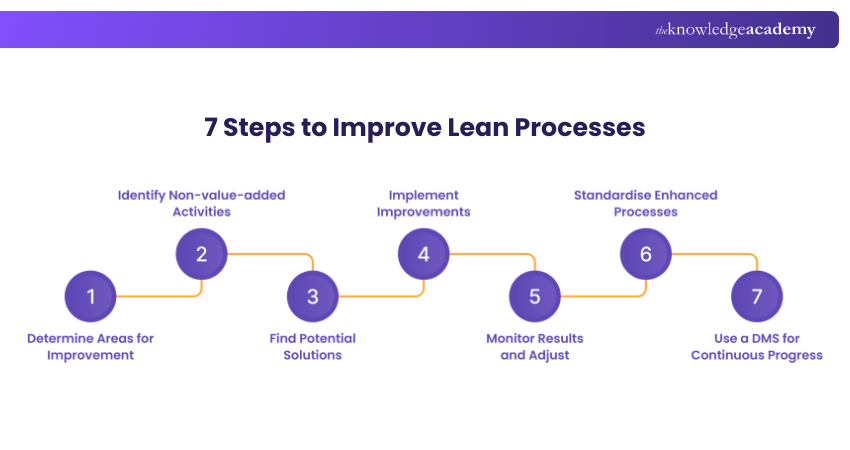
1) Determine Areas for Improvement
The first step is to understand where problems exist. This involves observing the process, speaking with employees and reviewing performance data. The goal is to pinpoint what slows down productivity or affects quality.
Example:
The company notices that assembling metal brackets takes longer than expected, and workers often wait for parts to arrive from the previous station.
2) Identify Non-value-added Activities
Non-value-added activities are tasks that consume time or resources but do not contribute to what the customer actually needs. Lean aims to eliminate or reduce these activities.
Example:
By reviewing the process, the team identifies waste:
a) Workers wait for materials
b) Tools are stored far away
c) Workers move back and forth to collect parts
All these actions add no value to the final product.
3) Find Potential Solutions
Once waste is identified, the next step is brainstorming solutions. Teams should suggest improvements that reduce time, remove unnecessary steps or simplify the workflow.
Example:
The team suggests:
a) Creating a small storage rack with all the required parts nearby
b) Rearranging tools so they’re easy to reach
c) Coordinating with the previous station to ensure parts arrive on time
4) Implement Improvements
After agreeing on the best solutions, the changes are put into action. This may involve rearranging the workspace, updating instructions or training employees.
Example:
The company installs a parts rack next to the workstation and organises tools using shadow boards. They also adjust the schedule so materials arrive exactly when needed.
5) Monitor Results and Adjust
After implementation, it’s essential to measure whether the improvements are working. If results don’t match expectations, adjustments should be made.
Example:
After the changes, assembly time improves by 20%. However, workers report that some tools are still not placed in an ideal order. The team reorganises the layout again to further improve efficiency.
6) Standardise Enhanced Processes
Once the new method proves effective, it should be documented and taught to everyone. Standardisation ensures consistency and prevents the process from slipping back into old habits.
Example:
The new workstation layout, tool placement and material delivery schedule are documented. Employees receive quick training to ensure everyone follows the same improved workflow.
7) Use a DMS for Continuous Progress
A Daily Management System (DMS) helps teams review progress, track key metrics and solve issues quickly. Regular check-ins ensure improvements continue and new problems are addressed early.
Example:
Supervisors and operators review daily charts showing assembly time, delays and issues. If parts arrive late or tools are misplaced, it is discussed and corrected immediately to keep the process running smoothly.
Boost efficiency and reduce waste – Join our Certified Lean Foundation & Practitioner Course today!
The 5 Core Principles of Lean and How to Apply Them
The five core principles of Lean provide the foundation for reducing waste, improving flow and delivering greater value. Here is a quick look at each principle:
1) Value
Value is defined by what the customer needs and is willing to pay for. By understanding expectations around quality, features and delivery time, manufacturers can focus only on activities that add value and remove those that do not.
2) Value Stream
The value stream covers every step involved in delivering the product. Mapping helps identify bottlenecks, waste, and delays, making it easier to redesign processes for smoother operations.
3) Flow
Flow ensures work moves continuously without interruptions. Improving flow may involve reorganising layouts, balancing tasks or simplifying steps, so production proceeds smoothly from start to finish.
4) Pull
Pull means producing only when there is actual customer demand. This prevents overproduction, reduces excess inventory and keeps resources aligned with real requirements.
5) Perfection
Perfection emphasises continuous improvement. Even when processes work well, Lean encourages ongoing refinement to improve quality, reduce defects and enhance efficiency over time.
What are the Advantages of Lean Process Improvement?
Here are the key advantages of Lean Process Improvement and how it helps manufacturers achieve stronger, faster and more efficient operations:
Minimised Waste
a) Eliminates unnecessary steps, movement and delays
b) Reduces excess inventory, scrap and rework
c) Lowers production costs by using resources more efficiently
d) Helps create a cleaner, more organised and productive workplace
Customer Focus
a) Ensures processes are aligned with what customers truly value
b) Improves product quality and delivery times
c) Helps respond faster to customer needs and market changes
d) Builds stronger customer satisfaction and loyalty
Continuous Improvement
a) Encourages teams to regularly identify and fix problems
b) Promotes a culture where employees contribute ideas for better processes
c) Helps organisations adapt quickly to new challenges
d) Supports long-term operational excellence and sustainable business growth
Tools and Techniques for Lean Process Improvement
Here are some of the most effective tools and techniques that support Lean Process Improvement and help organisations achieve smoother, waste-free operations.
5S Method
The 5S Method is a workplace organisation technique that uses five steps: Sort, Set in Order, Shine, Standardise and Sustain, to create a clean, structured and highly efficient workspace. It ensures that tools, materials, and equipment are always in the right place and easy to locate.
How it Helps:
a) Reduces clutter and unnecessary items
b) Minimises time wasted searching for tools
c) Improves safety by keeping floors and stations clear
d) Creates consistent work habits through standard routines
e) Enhances productivity by maintaining an orderly workflow
Join our 5S Training today and create a workspace built for maximum productivity.
6S Method
The 6S Method is an enhanced version of 5S that adds a sixth step, Safety, to the workplace organisation approach. It ensures clean, organised and efficient work areas while also eliminating hazards that could cause injuries or slow down production.
How it Helps:
a) Improves workplace safety and reduces accident risks
b) Maintains the structured organisation created through 5S
c) Enhances employee awareness of safe working habits
d) Prevents equipment damage and safety-related delays
e) Creates a healthier, more productive work environment
Kaizen
Kaizen is a continuous improvement strategy where employees contribute small, meaningful ideas to improve processes. It focuses on simple, low-cost changes rather than major overhauls.
How it Helps:
a) Encourages everyone to participate in the improvement
b) Builds a culture of teamwork and shared responsibility
c) Eliminates waste through frequent small changes
d) Boosts employee morale and ownership
e) Makes processes more flexible and easier to adapt
PDCA Cycle
The PDCA Cycle (Plan, Do, Check, Act) is a four-step problem-solving method used to test ideas, evaluate results and refine improvements through a structured approach.
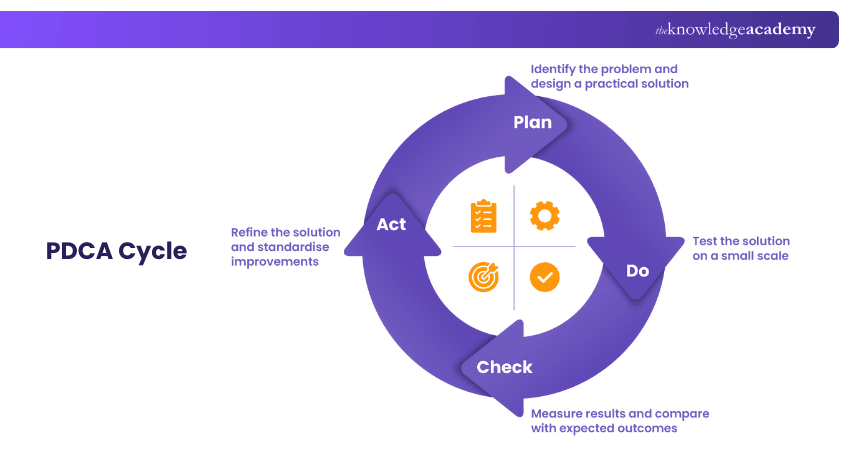
How it Helps:
a) Ensures improvements are tested before full implementation
b) Reduces risks linked to trial-and-error changes
c) Promotes data-driven decision-making
d) Encourages ongoing review of performance
e) Supports continuous learning and refinement
Six Sigma
Six Sigma is a data-driven improvement methodology used to reduce defects, minimise process variation and improve overall quality using structured analysis tools like DMAIC (Define, Measure, Analyse, Improve, Control).
How it Helps:
a) Identifies root causes using statistical analysis
b) Reduces defects and rework
c) Improves accuracy, consistency and quality
d) Helps teams make objective decisions using data
e) Strengthens customer satisfaction by lowering error rates
Discover how to map and optimise workflows with our Value Stream Mapping Training – Join now!
Lean Process Improvement vs Value Stream Management
The table below describes the difference between Lean Process Improvement and Value Stream Management:
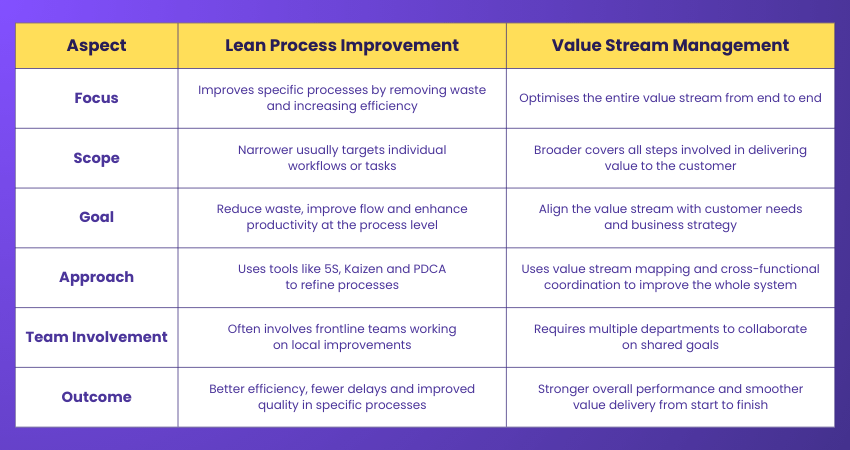
Lean Process Improvement focuses on enhancing individual processes by removing waste, shortening cycle times and improving efficiency at a local level. It uses tools such as 5S, Kaizen and PDCA to refine how work is carried out within specific areas.
Value Stream Management, on the other hand, looks at the entire flow of value from start to finish. It examines every step involved in delivering a product or service, ensuring departments work together to eliminate bottlenecks and optimise the whole system rather than isolated parts.
Conclusion
Lean Process Improvement gives manufacturers a practical way to eliminate waste, improve workflow and deliver higher-quality products using fewer resources. By applying its principles and tools, organisations can achieve smoother operations, stronger performance and long-term efficiency. Lean isn’t just an improvement method; it’s a long-term advantage that drives real transformation.
Join our Lean Training today to master waste elimination and process optimisation skills.
Frequently Asked Questions
How do you use Lean for Process Improvement?

Lean is used for process improvement by identifying customer value, mapping the value stream, removing waste, and creating smooth workflow. Organisations then standardise processes, empower teams to solve problems, and continuously refine systems to improve efficiency, quality, and performance.
What is the Most Important Step in Lean?
The most important step in Lean is defining customer value. Understanding what customers truly need ensures all activities align with delivering that value. This clarity helps remove waste, prioritise improvements, and guide decision-making across the entire process.

William Brown


Senior Business Analyst and Strategic Advisor
William Brown is a senior business analyst with over 15 years of experience driving process improvement and strategic transformation in complex business environments. He specialises in analysing operations, gathering requirements and delivering insights that support effective decision making. William’s practical approach helps bridge the gap between business goals and technical solutions.
View Detail

 If you wish to make any changes to your course, please


