


 Top Rated Course


We may not have the course you’re looking for. If you enquire or give us a call on +91-181-5047001 and speak to our training experts, we may still be able to help with your training requirements.
What Does a Full-Stack Developer Do? Why You Need One Now
Richard Harris 18 April 2026This blog provides a thorough understanding of Full-Stack Developers, detailing their tasks across front-end and back-end development. It emphasises the essential skills, challenges, and adaptability required in this role, making it an essential read for aspiring Full-Stack Developers and tech enthusiasts.

Training Outcomes Within Your Budget!
We ensure quality, budget-alignment, and timely delivery by our expert instructors.
Table of Contents

If you are from the tech field, you must have heard the term ‘Full Stack Development’. Full-Stack Development includes everything in the field of software development. In this field, there are some individuals who are skilled at the front end, and some are skilled at the back end, but there are also some individuals who are skilled at doing everything like the front end, back end, design, databases and much more. These individuals are called Full-Stack Developers.
A Full-Stack Developer is a professional who is responsible for handling the complete software applications. If you are curious to know more about what does a Full-Stack Developer do, this blog is for you. In this blog, you will learn about what a Full-Stack Developer does and how the entire process of creating and maintaining a website or application falls under the duties of Full-Stack Developers.
Table of contents
1) What is a Full-Stack Developer?
2) Key roles and responsibilities of Full Stack Developer
3) Education required to be a Full Stack Developer
4) Skills and tools used by Full Stack Developer
5) Personality traits of a professional Full-Stack Developer
6) Reasons for becoming a Full-Stack Developer
7) Conclusion
What is a Full-Stack Developer?
A Full-Stack Developer is an expert in developing both client-side (front-end) and server-side (back-end) components of web applications or software. They are well-versed in a wide range of technologies and programming languages, which allows them to work on all aspects of software projects, from designing the user interface to managing databases and server infrastructure.
Key roles and responsibilities of Full Stack Developer
Here is the breakdown of what a Full-Stack Developer does or the key roles and responsibilities of a Full-Stack Developer. Let’s have a look at them.
1) Front-end development: A Full Stack Developer specialises in creating and enhancing the user interface and user experience aspects of a software application. They work with languages like HTML, CSS or JavaScript to create a visual and interactive interface that users see and interact within a web application. This includes designing web pages, handling user input and making the application visually appealing and user-friendly.
2) Database management: Full-Stack Developers often need to work with databases, which includes designing database schemes and writing queries, ensuring data integrity and security.
3) Back-end development: Full-Stack Developers are responsible for the server-side logic and database management of a software application. They work with server-side programming languages (e.g., Python, Ruby, Java, Node.js, PHP) to build the application's core functionality, handle data storage and retrieval, and ensure the security and performance of the server. They also work with databases (e.g., MySQL, PostgreSQL and MongoDB) to store and manage data.
4) DevOps and deployment: They are expected to have some knowledge of DevOps practices, which involve setting up and maintaining the infrastructure, automating deployment processes, and ensuring the application is scalable and reliable.
5) Version Control: Full-Stack Developers use version control systems like Git to manage the codebase and collaborate with other Developers effectively.
6) Testing and quality assurance: This is one of the essential steps of the development procedure. Full-Stack Developers are generally responsible for checking the design algorithm, bugs, and correctness and providing code reviews.
7) Create a better user experience: It is very important to know how the user feels when going through the interface. Hence, Full-Stack Developers create a user experience that involves reducing user actions and offering helpful messages and more.
8) Data modelling: Data modelling includes drawing a base of the application. Setting up the best strategies and implementing what is needed is very important in data modelling. Full-Stack Developers build databases that store information, create tables and exchange relations between them.
If you want to learn the advantages of CSS, register at our CSS Introduction & Intermediate Course now!
Education required to be a Full Stack Developer
Full-Stack Developers are extremely intelligent professionals who have been trained by education and years of experience in related fields. These designations are highly in demand, but there are certain types of education and work experience that Full-Stack Developer has to fulfil to get hired. Let's understand this in more detail.
1) Education: To become a full-Stack Developer, an individual is required to have a relevant degree in computer science, software programming, computer programming, and statistics. You may not require more than a relevant degree to qualify for a job, but the chances of getting hired become higher when you have a higher degree. There are some Full-Stack Developers who even go for master’s degrees to stand out from the crowd.
2) Work experience: To get a high-paying job as a Full-Stack Developer, you need to show your work experience. This can be done with thorough education or past experience in a related field. There are certain positions in Full-Stack development which require a minimum of 3 years of experience with specific coding languages such as CSS, HTML, JavaScript and more.
Learn the fundamentals of our web development with our Web Development Training now!
Skills and tools used by Full Stack Developer
Full-Stack Developer need a wide range of skills and tools to perform their task effectively. Here’s a list of some of the skills and tools used by Full-Stack Developers.
1) Knowledge of JavaScript frameworks and libraries like React, Angular, or Vue.js is often required.
2) Proficiency in tools like Adobe XD, Sketch, Figma, or Adobe Photoshop for designing user interfaces.
3) Knowledge of preprocessors such as SASS or LESS to streamline CSS development.
4) Proficiency in server-side programming languages like JavaScript (Node.js), Python (Django, Flask), Ruby (Ruby on Rails), Java (Spring), or PHP (Laravel).
5) Building and consuming RESTful and GraphQL APIs.
6) Knowledge of tools like phpMyAdmin, Sequel Pro, or GUIs is provided by database systems.
7) Possesses strong problem-solving and critical thinking abilities, essential for troubleshooting issues and optimising code efficiently.
Learn to build the website by joining our Website Design Course now!
Personality traits of a professional Full Stack Developer
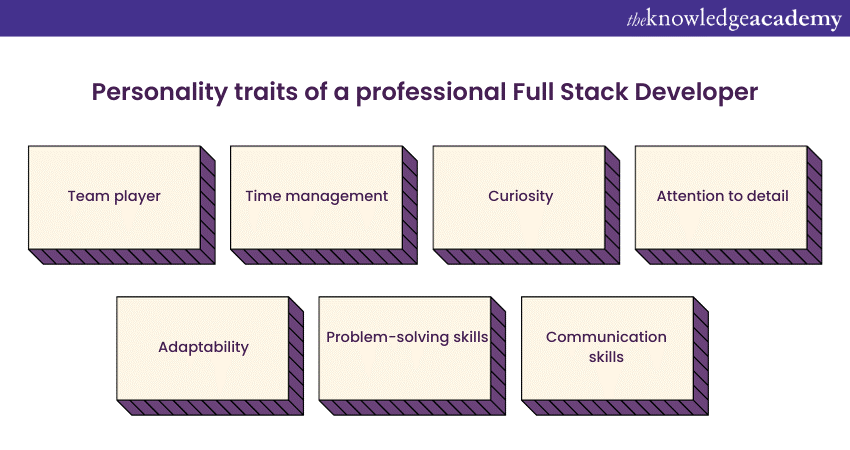
Here are the personality traits that help make a professional Full-Stack Developer:
1) Team player: Collaboration is a significant part of software development. A great Full-Stack Developer should be a team player who can willingly share knowledge and assist colleagues.
2) Time management: Managing multiple tasks and deadlines is common in Full-Stake Development. The ability to effectively manage time and the capability to prioritise tasks efficiently are crucial qualities.
3) Curiosity: A curious mind helps in staying up to date with the latest technologies and tools. It also drives a desire to continually improve and enhance skills.
4) Attention to detail: A great Full-Stack Developer should have attention to detail skills. They must check their work twice or thrice to make sure it is correct.
5) Adaptability: Full-Stack Developers often work with a diverse array of technologies and frameworks. Adaptability and a willingness to learn new tools and languages are essential qualities, especially when preparing for Full Stack Developer Interview Questions.
6) Problem-solving skills: Full-Stack Developers often work with a wide range of technologies and frameworks. Being adaptable and open to learning new tools and languages is crucial in this field.
7) Communication skills: Full-Stack Developers often work in teams and need to communicate effectively with other developers, designers, project managers, and clients. Clear and concise communication is vital.
Reasons for becoming a Full-Stack Developer
Becoming a Full-Stack Developer can offer several advantages and reasons why you might consider pursuing this career path. Here are some compelling reasons why you should consider becoming a Full-Stack Developer.
1) Versatility: Full-Stack Developers have a broad skill set that allows them to work on different parts of a project. This versatility can be a significant asset in various job roles and industries.
2) Job opportunities: They are in high demand because they can handle multiple aspects of a project. This demand often translates into more job opportunities and potentially higher salaries.
3) Continuous learning: Technology is constantly evolving. Full-Stack Developers are continually exposed to a diverse range of technologies, languages, and frameworks, keeping them constantly engaged in learning and abreast of the latest industry trends.
4) Job security: With a wide skill set, Full-Stack Developers are less vulnerable to economic downturns or industry-specific changes. They can adapt to different roles or niches within the tech industry.
5) Career growth: Full-Stack development can serve as a stepping stone to various roles in the tech industry, including becoming a technical lead, project manager, or even a CTO.
Conclusion
We hope now you have understood what a Full-Stack Developer does. The role of a Full-Stack Developer is undeniably dynamic and multifaceted. This jack-of-all-trades in the world of web and software development is responsible for bridging the gap between front-end and back-end development, ensuring that a project runs smoothly from start to finish. When considering the difference between MEAN Stack and Full Stack, it's key to recognize that Full Stack developers need to be proficient in a wider range of tools and may work with various back-end technologies beyond Node.js, which is the core of MEAN Stack.
Learn to develop an app and website by signing up for our App & Web Development Training now!
Frequently Asked Questions

Richard Harris


Senior Full Stack Developer and Technology Educator
Richard Harris is a highly experienced full-stack developer with deep expertise in both frontend and backend technologies. Over his 12-year career, he has built scalable web applications for startups, enterprises and government organisations. Richard’s writing combines technical depth with clear explanations, ideal for developers looking to grow in modern frameworks and tools.


 If you wish to make any changes to your course, please


