


 Top Rated Course


We may not have the course you’re looking for. If you enquire or give us a call on +91-181-5047001 and speak to our training experts, we may still be able to help with your training requirements.
How Does Blockchain Technology Help Organizations When Sharing Data?
Richard Harris 10 April 2026Blockchain Technology has benefited the world in different manners. This blog will explain the applications of Blockchain Technology in Organisations
Home
 Resources
Data, Analytics & AI
How Does Blockchain Technology Help Organizations When Sharing Data?
Resources
Data, Analytics & AI
How Does Blockchain Technology Help Organizations When Sharing Data?
Resources
Data, Analytics & AI
How Does Blockchain Technology Help Organizations When Sharing Data?

Training Outcomes Within Your Budget!
We ensure quality, budget-alignment, and timely delivery by our expert instructors.
Table of Contents
The dynamic nature of the modern world means that it is constantly evolving. The emergence of Blockchain Technology has played a central role in the way we perform several tasks and operations. But do you know How Does Blockchain Technology Help Organisations when Sharing Data? No! Worry not; we've got you covered in this blog.
Every firm needs to share data with different stakeholders to take important decisions, and it forms one of the core processes of every business. Due to the increased digital transactions and data access, existing Web 2.0 data-sharing techniques are becoming expensive. Organisations now require much more advanced forms of data-sharing methods that are more secure and reliable.
Blockchain Technology is one of the best options for these challenges of sharing data on centralised databases. According to Grand View Research, the Blockchain Technology market size is expected to increase at a Compound Annual Growth Rate (CAGR) of 87.7% from 2023 to 2030. Data is the new gold in this era, so learn how does Blockchain technology help organisations when sharing data, among other essential applications.
Table of Contents
1) How Does Blockchain Technology Help Organisations when Sharing Data?
2) Applications of Blockchain in Data Management
3) The types of organisations that benefit from Blockchain Technology
4) Challenges of using Blockchain technology
5) The future of sharing data through Blockchain Technology
6) Conclusion
How Does Blockchain Technology Help Organisations when Sharing Data?
Blockchain Technology provides a people-to-people decentralised data management system. Initially, Blockchain is a digital collection of data sorted out over the entire network of connected systems. With solutions like Blockchain in AWS, it offers a complete approach to storing data, making it nearly impossible to break the security system and hack the data stored in the Blockchain.
When a new transaction occurs on the decentralised network, the authentication of those data will be listed in the ledger of the concerned system or the person. A cryptographic signature system called Hash has been put in place to keep track of the details of transactions in the Blockchain system. Introducing the Hash system in every transaction enables perfect security for data management. This system eliminates all security concerns and becomes more popular among individuals and organisations for real-time data sharing. Thus, interfering in the data-sharing framework is nearly impossible.
With our Blockchain Training courses learn to become an expert at Blockchain technology. Sign up now!
Applications of Blockchain in Data Management
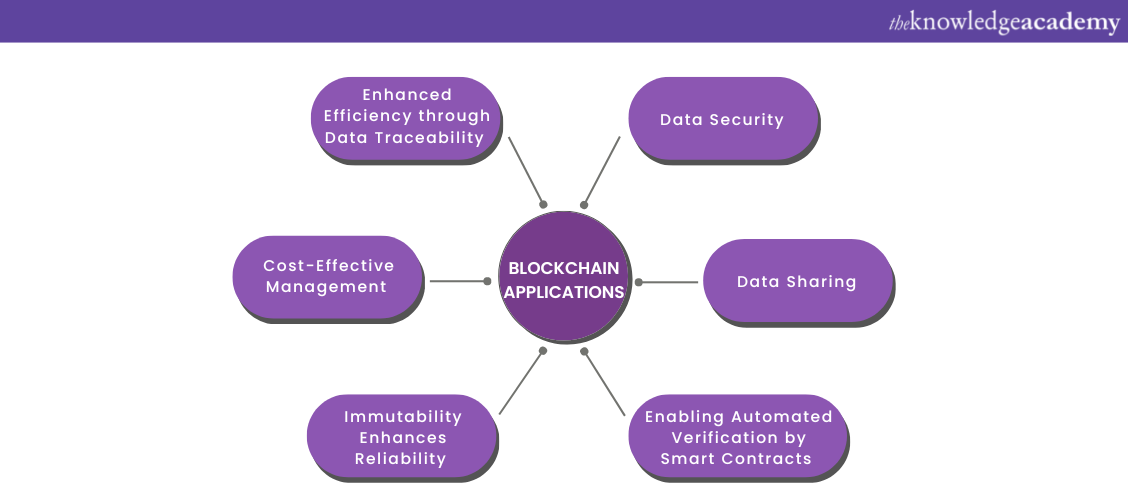
There are various ways the Blockchain supports Data Management systems. The Uses of Blockchain are plenty, but the following is a list of some of its common applications in Data Management.
Data security
If hackers attempt to alter any part of the Blockchain, it would be easily detected since it is tightly interconnected with the entire network. As a result, they would need to modify every block in the chain. Like other Blockchain Technology Alternatives, this structure ensures that the chain of individual blocks effectively addresses security and privacy concerns in data sharing.
Data sharing
Even though Blockchain supports Data Privacy, decentralisation is a fundamental feature that allows for organised frameworks for secure data sharing between organisations and inter-departmental operations. All business corporates are now adopting Blockchain technology, as it ensures secure data sharing, which is essential for running a business efficiently and effectively.
Enabling automated verification by Smart Contracts
Data verification is critical for companies. It secures the data, makes it more reliable and thus enhances the overall data protection systems and processes. Smart Contracts in Blockchain help reduce risks and malicious code interference. Rather than running on individual nodes, these contracts run in a sandbox environment, which makes them flexible to perform several different functions. This way, the contracts can focus better on protecting and verifying the data. Additionally, since it is decentralised, the chain itself proves the activity, and thus no proof is required for the transaction.
Immutability enhances reliability
Companies greatly benefit from the immutability feature of data in the Blockchains, which helps secure the data. Since the Blockchains are decentralised, the data cannot be modified. This way, any transactions made on the nodes automatically become secured and tamper-proof.
Cost-effective management
One of the primary features of Blockchains is that it is decentralised, enabling the network to maintain data integrity on a peer-to-peer level. Moreover, nodes joining the Blockchain can be used to manage and assess how the chain uses the data resources. It helps in quickly retrieving the data as well as in verifying the data. There is no limit on joining and exiting the nodes in public chains such as Bitcoin and Ethereum. As a result, companies can autonomously share data at a wide scale.
Enhanced efficiency through data traceability
For companies, traceability is a crucial factor. It enables them to track and maintain records, because of which they can quickly retrieve and use the data. Here, traceability of the data means that it can be tracked back in time or location. Since Blockchains are linear, tracing any event is simple. In addition, as the involvement of third parties is eliminated from the Blockchain, the system's overall efficiency enhances considerably.
In the above section, we discussed some common Blockchain Applications and how it helps businesses run their operations smoothly and effectively. In the following parts, we present the types of companies that benefit significantly from the technology.

The Types of Organisations that Benefit from Blockchain Technology
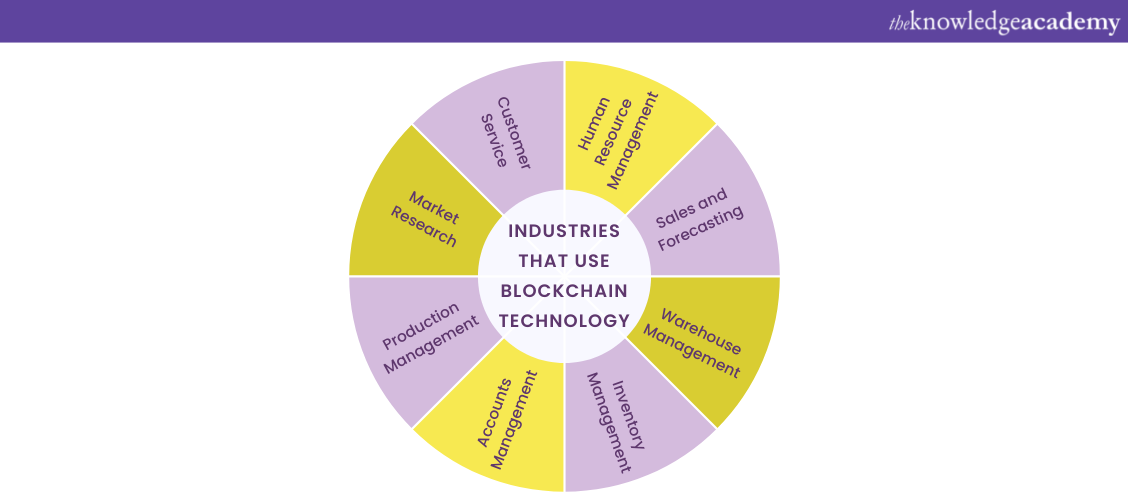
Throughout the History of Blockchain, it was limited to sharing financial records between companies and inter-departments. However, the role and importance of data security have increased, and companies have realised they can use the network to share data securely. Several companies are now striving to make the chain the central data-sharing platform. This technology has emerged as a boon for companies, regardless of their size of operations.
Following is a list of some industries that can significantly benefit from the secured data-sharing feature of Blockchain technology.
The industries currently using the technology for data management
1) Human Resource Management
2) Sales and Forecasting
3) Warehouse Management
4) Inventory Management
5) Accounts Management
6) Production Management
7) Market Research
8) Customer Service
Learn the basics of Ethereum and Blockchain 101 in Ethereum Developer Training today!
Challenges of using Blockchain technology
Even though Blockchain technology enables secure and tamper-proof data sharing across multiple networks, it is still in its early development phase. Developers are working to address minor challenges before it gains widespread adoption across the business sector and other organizations. Some of the key issues that Blockchain technology currently faces include a lack of administration, immature infrastructure, and standardization. To understand how Blockchain vs Data Science compares in handling data-related challenges, exploring their differences and applications can provide valuable insights.
Yet, these are minor issues that could be easily tackled over time. Blockchain technology is a revolution in data management systems because of decentralisation, and it enhances better communication and cooperation between organisations by allowing data sharing safely and securely.
The future of sharing data through Blockchain technology
Developers are now learning more through tests because Blockchain technology is still experimental. Yet, the most successful companies have recognised the technology's potential to revolutionise data sharing for everyone. Since the technology makes it easy to share data, the current Web 2.0 platforms will almost certainly be outdated in a few years. Thus, Blockchain technology is the future of data-sharing management.
Conclusion
Blockchain is currently in its initial development phase, and you might witness a few ups and downs. Yet, the benefits of decentralised Blockchain technology enhanced the data-sharing process more safely and securely. In this blog, we explained How Does Blockchain Technology Help Organisations when Sharing Data and the companies and industries that use it for sharing data.
Explore our uniquely specialised training in Altcoin and the cryptocurrency ecosystem in the Bitcoin and Cryptocurrency Course!
Frequently Asked Questions

Richard Harris


Senior Full Stack Developer and Technology Educator
Richard Harris is a highly experienced full-stack developer with deep expertise in both frontend and backend technologies. Over his 12-year career, he has built scalable web applications for startups, enterprises and government organisations. Richard’s writing combines technical depth with clear explanations, ideal for developers looking to grow in modern frameworks and tools.


 If you wish to make any changes to your course, please


