


 Top Rated Course

We may not have the course you’re looking for. If you enquire or give us a call on +91-181-5047001 and speak to our training experts, we may still be able to help with your training requirements.
Agile vs DevOps | Differences & Comparison
David Evans 17 April 2026Agile prioritises iterative development, adaptability, and close team collaboration, while DevOps enables rapid, automated delivery and reliable operations. Together, they streamline the software lifecycle, improve deployment speed, product quality, and ensure continuous alignment among development, testing, and operations teams.

Training Outcomes Within Your Budget!
We ensure quality, budget-alignment, and timely delivery by our expert instructors.
Table of Contents
Modern software delivery demands speed, quality, and adaptability, but choosing the right approach can be challenging. Agile and DevOps are often mentioned together, yet they serve distinct purposes within the development lifecycle. Understanding how they differ is essential for building efficient, high-performing teams. This blog clarifies where each approach fits best.
In this blog, you’ll explore the Agile vs DevOps key differences and similarities, along with their practical use cases. We’ll break down how each methodology works, when to use them individually, and how they complement each other.
Table of Contents
1) What is Agile?
2 What is DevOps?
3) What is the Difference Between Agile vs DevOps?
4) Agile and DevOps Similarities
5) Can Agile and DevOps Work Together?
6) Is DevOps Replacing Agile?
7) Conclusion
What is Agile?
Agile is a Software Development model that focuses on flexibility, collaboration and continuous improvement. It promotes work delivery in small, manageable steps rather than the use of long-term plans, which are not flexible.
Agile is not a single method butan umbrella for frameworks and practices driven by the Agile Manifesto and the 12 principles. Such values assist teams in modifying their procedures to respond positively to change and serve the customers with higher value.

What is DevOps?
Devops is a Software Development strategy that aligns development and operations teams in order to produce software faster, more secure, and efficient. It removes traditional silos, enhancing cooperation in the development of lifecycle.
DevOps can minimise the cost, time, and resources used through integration of development (Dev) and operations (Ops), hence speeding up delivery, improving reliability and accelerating releases. This would help organisations to act fast with regard to the market needs and at the same time achieve quality and secure software which provides them with a competitive edge.
Kickstart your tech career with our DevOps Foundation Certification — Register today!
What is the Difference Between Agile vs DevOps?
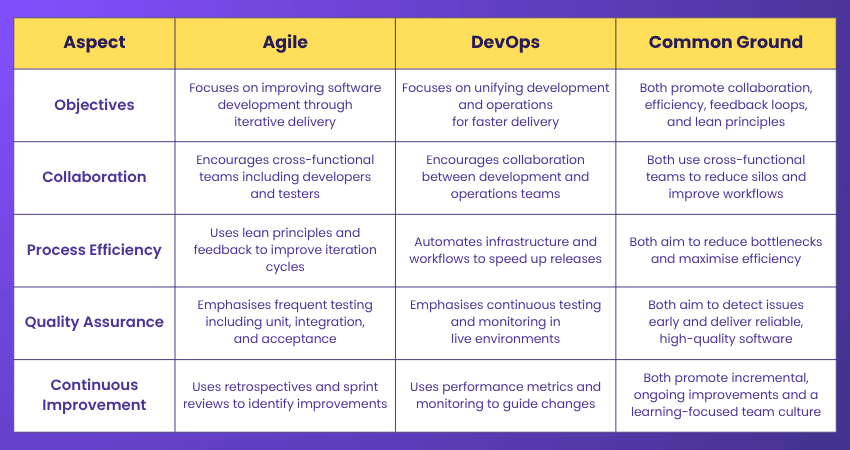
Agile vs DevOps both aim to improve software delivery, but they focus on different stages and goals within the lifecycle. Being aware of what is the difference between Agile and DevOps assists teams in using the appropriate strategy at the appropriate moment and unites them to achieve higher results. The key differences between DevOps vs Agile are:
1) Objectives
Agile focuses on Software Development through iterative development, frequent feedback and responsiveness to changes in requirements. DevOps is aimed at faster delivery, the automation of testing and deployment, making sure that the operations in the pipeline are reliable.
2) Collaboration
The collaboration in Agile is focused on the work of product and developer teams, which have short cycles and are in constant communication. DevOps is an expansion of these concepts that incorporates operations teams and puts ownership (shared) in build, test, deployment and support operations.
3) Quality Assurance
Agile embraces continuous testing in the Software Development life cycle to keep the features on track. Devops extends this through automation and endless testing between settings and reduces bugs sooner and enhances stability.
4) Continuous Improvement
Agile focuses on the learning and refinement processes using the retrospectives of sprints and stakeholder feedback. Devops incorporates the use of continuous improvement through the automatic feedback loop of monitor, build, test and production.
5) Efficiency
Agile is efficient in the sense that it divides the development process into small, manageable steps that are responsive to change. DevOps is known to increase the end-to-end efficiency, efficiency through automation of workflow, faster releases, and aligning the functions of development and operations.
Manage projects that deliver real business value with our AgilePM® Foundation & Practitioner (AgilePM® V3) Course – Join Now!
Agile and DevOps Similarities
Even though there may be lots of differences between them, there are some points where Agile and DevOps are quite alike:
1) Collaboration: Both Agile and DevOps encourages cross-functional activities. These activities help in ensuring a smooth flow from the beginning to the end.
2) User centric: Both Agile and DevOps, when they begin any project, their main target is to achieve complete user satisfaction. All the developments and changes that are undertaken by them are done keeping the users in mind.
3) Adaptability: As both strive towards achieving user satisfaction, they encourage for complete adaptability towards any new advancement sin projects or tasks. The Agile teams are asked to monitor their progress regularly. Similarly, the Devops team also encourages to monitor any feedback loops that will help in identifying any areas for improvement.
4) Accountability: Both Agile and DevOps promote to take accountability and responsibility for any product’s lifecycle. Whether it be Agile collectively monitoring the product development process or the DevOps team looking into the production cycle from the beginning to the end.
Can Agile and DevOps Work Together?
Agile vs DevOps can work together effectively. Agile focuses on iterative development, customer collaboration, and responding to change. DevOps complements this by enabling continuous integration, automation, and faster, more reliable delivery. While Agile improves how teams build software, DevOps enhances how they release and manage it.
Together, they create a streamlined development-to-delivery pipeline. This integration shortens feedback loops, breaks down silos between development and operations, and supports continuous improvement. The result is faster time to market, higher-quality products, and a culture of collaboration. Agile and DevOps are not competing methods but complementary practices that drive modern software success.
Is DevOps replacing Agile?
No, DevOps is not replacing Agile. Instead, the two complement each other. Agile focuses on iterative development, customer feedback, and collaboration within development teams.
DevOps extends these principles to include operations, enabling continuous delivery and faster deployments. Many organisations adopt both to streamline the entire Software Development lifecycle from planning to production.
Conclusion
Agile vs DevOps is not about choosing one over the other but understanding how they work together to strengthen software delivery. Agile encourages flexibility and customer orientation, whereas DevOps proves to be fast, automated, and operationally stable. They can be effectively used together to form a sustained, superior quality delivery channel that enables business innovation, scalability and business success over the long term.
Advance your capability to lead complex change initiatives with the Agile Programme Management (AgilePgM®) Course- Sign in now!
Frequently Asked Questions
Is Jira a DevSecOps Tool?

Jira itself is not a DevSecOps tool but can be part of a DevSecOps toolchain. It supports project tracking, issue management, and team collaboration. When integrated with security and CI/CD tools, Jira helps manage and monitor secure development workflows in DevSecOps environments.
Is DevOps Lean or Agile?
DevOps is influenced by both Lean and Agile principles. Like Lean, it aims to eliminate waste and improve flow. Like Agile, it values collaboration, iteration, and customer feedback. DevOps extends Agile practices beyond development into deployment and operations for end-to-end delivery efficiency.
What are the Other Resources and Offers Provided by The Knowledge Academy?
The Knowledge Academy takes global learning to new heights, offering over 3,000+ online courses across 490+ locations in 190+ countries. This expansive reach ensures accessibility and convenience for learners worldwide.
Alongside our diverse Online Course Catalogue, encompassing 17 major categories, we go the extra mile by providing a plethora of free educational Online Resources like Blogs, eBooks, Interview Questions and Videos. Tailoring learning experiences further, professionals can unlock greater value through a wide range of special discounts, seasonal deals, and Exclusive Offers.
What is The Knowledge Pass, and How Does it Work?
The Knowledge Academy’s Knowledge Pass, a prepaid voucher, adds another layer of flexibility, allowing course bookings over a 12-month period. Join us on a journey where education knows no bounds.
What are the Related Courses and Blogs Provided by The Knowledge Academy?
The Knowledge Academy offers various Agile Training, including Agile Project Management Foundation & Practitioner (AgilePM®) Training, Lean Portfolio Management SAFe® Course and Agile User Stories Course. These courses cater to different skill levels, providing comprehensive insights into Workstreams in Project Management.
Our Project Management Blogs cover a range of topics related to Agile and DevOps, offering valuable resources, best practices, and industry insights. Whether you are a beginner or looking to advance your Project Management skills, The Knowledge Academy's diverse courses and informative blogs have got you covered.

David Evans


Certified Project Trainer and Agile Delivery Expert
David Evans brings over a decade of hands-on experience in project delivery, Agile transformation, and team leadership. With a background in technology and business consulting, David has led cross-functional teams through Agile and Waterfall projects in both public and private sectors. He combines technical knowledge with practical insights to help readers navigate the challenges of modern project environments.

Upcoming Programming & DevOps Resources Batches & Dates
Date
 AgilePM® Foundation & Practitioner (AgilePM® v3)
AgilePM® Foundation & Practitioner (AgilePM® v3)
Mon 22nd Jun 2026
AgilePM® Foundation & Practitioner (AgilePM® v3)
Mon 29th Jun 2026
AgilePM® Foundation & Practitioner (AgilePM® v3)
Mon 6th Jul 2026
AgilePM® Foundation & Practitioner (AgilePM® v3)
Mon 13th Jul 2026
AgilePM® Foundation & Practitioner (AgilePM® v3)
Mon 20th Jul 2026
AgilePM® Foundation & Practitioner (AgilePM® v3)
Mon 27th Jul 2026
AgilePM® Foundation & Practitioner (AgilePM® v3)
Mon 3rd Aug 2026
AgilePM® Foundation & Practitioner (AgilePM® v3)
Mon 10th Aug 2026
AgilePM® Foundation & Practitioner (AgilePM® v3)
Mon 17th Aug 2026
AgilePM® Foundation & Practitioner (AgilePM® v3)
Sat 22nd Aug 2026, Sun 23rd Aug 2026
AgilePM® Foundation & Practitioner (AgilePM® v3)
Mon 24th Aug 2026
AgilePM® Foundation & Practitioner (AgilePM® v3)
Tue 1st Sep 2026
AgilePM® Foundation & Practitioner (AgilePM® v3)
Mon 7th Sep 2026
AgilePM® Foundation & Practitioner (AgilePM® v3)
Mon 14th Sep 2026
AgilePM® Foundation & Practitioner (AgilePM® v3)
Mon 21st Sep 2026
AgilePM® Foundation & Practitioner (AgilePM® v3)
Mon 28th Sep 2026
AgilePM® Foundation & Practitioner (AgilePM® v3)
Mon 5th Oct 2026
AgilePM® Foundation & Practitioner (AgilePM® v3)
Sat 10th Oct 2026, Sun 11th Oct 2026
AgilePM® Foundation & Practitioner (AgilePM® v3)
Mon 12th Oct 2026
AgilePM® Foundation & Practitioner (AgilePM® v3)
Mon 19th Oct 2026
AgilePM® Foundation & Practitioner (AgilePM® v3)
Mon 26th Oct 2026
AgilePM® Foundation & Practitioner (AgilePM® v3)
Mon 2nd Nov 2026
AgilePM® Foundation & Practitioner (AgilePM® v3)
Mon 9th Nov 2026
AgilePM® Foundation & Practitioner (AgilePM® v3)
Mon 16th Nov 2026
AgilePM® Foundation & Practitioner (AgilePM® v3)
Mon 23rd Nov 2026
AgilePM® Foundation & Practitioner (AgilePM® v3)
Mon 30th Nov 2026
AgilePM® Foundation & Practitioner (AgilePM® v3)
Mon 7th Dec 2026
AgilePM® Foundation & Practitioner (AgilePM® v3)
Sat 12th Dec 2026, Sun 13th Dec 2026
AgilePM® Foundation & Practitioner (AgilePM® v3)
Mon 14th Dec 2026
AgilePM® Foundation & Practitioner (AgilePM® v3)
Mon 21st Dec 2026

 If you wish to make any changes to your course, please


