
Leadership Courses

Online Instructor-led (1 days)

Online Self-paced (8 hours)

Leadership Skills Course Outline

Module 1: Introducing Leadership Theories​

  • Leadership
  • Leadership Philosophies
  • Behavioural Study – Ohio State
  • LBDQ
  • LBDQ Behaviours
  • Effective Leaders

Module 2: Leadership Styles

  • What is Leadership Style?
  • Styles of Leadership

Module 3: Organisations and Culture

  • Morgan’s Organisational Metaphors
  • Machines
  • Political Systems
  • Organisms
  • Flux and Transformation
  • Morgan’s Organisational Metaphors
  • Culture
  • Culture is Both Subjective and Objective
  • Culture is Multileveled and Dynamic
  • Individual Vs Group Orientation
  • Cross-Cultural Behaviours

Module 4: Dealing with Difficult or Tricky People

  • Steps for Mediation

Module 5: Understanding the Importance of Motivation

  • Theories of Motivation
  • Motivating the Team to Perform

Module 6: Stages of Team Development

  • What is a Team?
  • Why Does a Team Need Leading?
  • Team Development
    • 1st Stage is Forming
    • 2nd Stage is Storming
    • 3rd Stage is Norming
    • 4th Stage is Performing
    • 5th Stage Adjourning
  • Team Building and Ways to Build Your Team
  • Delegation: Benefits
  • Delegation: Barriers
  • Delegation: Checklist

Module 7: Team Roles

  • Team Roles Overview
  • Who is on Your Team?
  • Belbin Roles
  • Belbin Roles - Strengths
  • Belbin Roles – Allowable Weaknesses

Module 8: Change Management

  • What is Change Management?
  • Dealing with Change

Module 9: Influences of Change

  • Overview of Influences of Change
  • Building Blocks of Change

Module 10: Field-Force Analysis

  • Overview
  • Steps of Field-Force Analysis​

Module 11: Culture and Change

  • What is Organisational Culture?
  • Culture and Change
  • Culture Develops and How to Identify it?

Module 12: Effective Communication

  • Communication Process
  • Types of Communication
  • Communicating with Impact
  • Visual
  • Vocal
  • Verbal
  • Communicating Clearly

Show moredown

Who Should Attend this Leadership Skills Training?

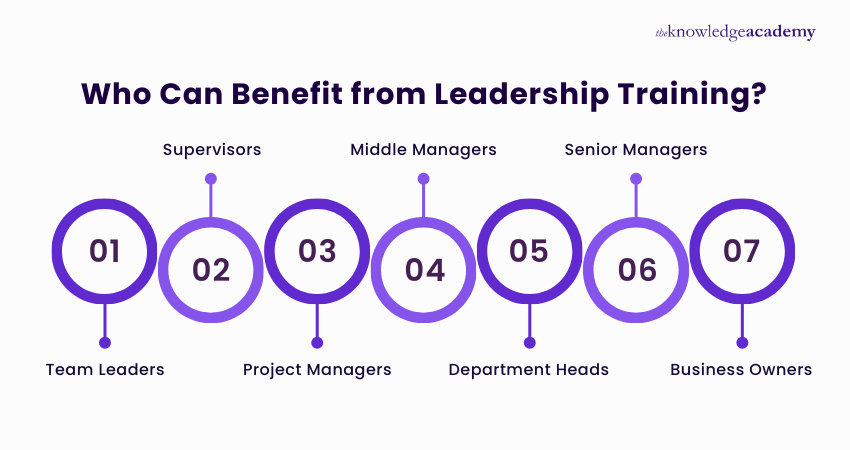
The Leadership Skills Training is designed for individuals at various levels of an organisation who aim to enhance their leadership abilities and positively impact their teams and projects. This Leadership Course can benefit a wide range of professionals, including:

  • Aspiring Leaders
  • Team Leaders
  • Middle Managers
  • Supervisors
  • Project Managers
  • Department Heads
  • Entrepreneurs

Prerequisites of the Leadership Skills Course

There are no formal prerequisites for this Leadership Skills Training Course.

Leadership Skills Course Overview

Leadership Skills Training provides a structured introduction to the core principles required for effective leadership in today’s evolving business environment. Delegates explore key concepts that support professional growth, organisational performance, and sustained success.

This training enables delegates to develop the ability to motivate teams, make informed decisions, and adapt to change confidently. By strengthening communication, team building, and strategic thinking skills, delegates enhance their leadership capability across diverse roles and industries.

This 1-Day course offered by The Knowledge Academy supports delegates in applying leadership principles effectively in real-world settings. Delegates gain practical insight and confidence to lead teams, manage challenges, and drive performance within their organisations.

Leadership Skills Course Objectives

  • To introduce delegates to the core principles of effective leadership
  • To enhance delegates’ communication skills, enabling them to inspire and lead teams
  • To provide practical techniques for building and managing high-performing teams
  • To equip delegates with decision-making strategies tailored for leadership roles
  • To develop conflict resolution skills to foster a harmonious work environment
  • To empower delegates with the knowledge and confidence to take on leadership responsibilities

After completing this Leadership Course, delegates will emerge as more effective and confident leaders, equipped with the skills necessary to inspire and guide their teams toward success in today's dynamic business environment. This enhanced leadership capability will not only benefit their careers but also contribute to the overall growth and success of their organisations.

Show moredown

What’s Included in this Leadership Skills Course?

  • World-Class Training Sessions from Experienced Instructors  
  • Leadership Skills Certificate
  • Digital Delegate Pack

Show moredown

Online Instructor-led (1 days)

Online Self-paced (8 hours)

Introduction to Supervising a Team Course Outline

Module 1: Role of the Supervisor

  • Roles and Responsibilities of a Supervisor
  • Importance of Supervision
  • Functions of a Supervisor
  • Supervisor’s Interaction with Others
  • Management Functions
  • Skills Required
  • Challenges
  • Supervision, Management and Evaluation

Module 2: Interpersonal Skills

  • What Does it Mean to be Assertive?
  • When to be Assertive?
  • Being Assertive in the Workplace
  • Influence
  • Trust
  • Communication Process
  • Active Listening Skills
  • Verbal and Nonverbal Communication
  • Good Presentation
  • Oral Communication
  • Presenting Clear Messages
  • Written Communication

Module 3: Motivating Others

  • Motivating People
  • Supervisors and Motivation
  • Behavioural Approach
  • Herzberg’s Motivating Factors
  • Rewards and Punishments
  • Theory Z
  • Theory W
  • Summary of Theories
  • Humanistic Approach
  • Maslow’s Hierarchy of Needs
  • Tips for Motivation
  • Disciplinary Action
  • Goal Setting and Feedback
  • Benchmarking
  • Balanced Scorecard
  • Plan-Do-Check-Act Cycle for Continuous Improvement

Module 4: Power of Planning

  • Identify Objectives and Goals
  • Creating a Plan
  • Overview of Priority Tasks
  • Delegation
    • Benefits
    • Important Points
    • Effective Delegation
  • Decision-Making
    • Theories
    • Process
    • Tools and Techniques
  • Group Problem Solving and Decision Making
  • Questioning Techniques

Show moredown

Who should attend this Introduction to Supervising a Team Course?

The Introduction to Supervising a Team Training Course is designed for individuals who are new to or aspiring to take on supervisory roles within an organisation. This Leadership Course can benefit a wide range of professionals, including:

  • New Supervisors
  • Aspiring Team Leaders
  • Junior Managers
  • Shift Supervisors
  • Project Coordinators
  • Project Managers
  • Department Coordinators

Prerequisites of the Introduction to Supervising a Team Course

There are no formal prerequisites for this Introduction to Supervising a Team Training Course.

Introduction to Supervising a Team Course Overview

Introduction to Supervising a Team is a crucial Leadership Course that offers a comprehensive overview of the benefits and techniques essential for effective team management. In today's dynamic work environment, the ability to supervise a team is of utmost importance for organisational success.

Understanding the principles covered in this course is vital for professionals who aspire to excel in leadership roles. Team Leaders, Managers, and anyone responsible for overseeing a group of individuals will greatly benefit from mastering the subject. Effective team supervision is the linchpin of a successful organisation.

The 1-day training provided by the Knowledge Academy equips delegates with practical knowledge and skills. They will learn about the specific role of a supervisor, essential interpersonal skills, motivational tools, and efficient planning techniques. This Leadership Course also empowers supervisors to boost team morale, enhance productivity, and, in turn, contribute to increased profitability and a contented team.

Course Objectives

  • To introduce delegates to the fundamental principles of team supervision
  • To enhance delegates' interpersonal and communication skills
  • To equip delegates with motivational tools and techniques
  • To emphasise the importance of efficient planning in team supervision
  • To empower delegates to increase team morale and productivity
  • To provide a foundation for effective team leadership in the business context

Upon completion of these Leadership Training Courses, delegates will emerge with a solid foundation in team leadership and supervisory skills, enabling them to inspire and guide their teams effectively. They will be equipped with the knowledge and techniques needed to enhance team morale, productivity, and ultimately contribute to the success of their businesses.

Show moredown

What’s included in this Introduction to Supervising a Team Course?

  • World-Class Training Sessions from Experienced Instructors
  • Introduction to Supervising a Team Certificate
  • Digital Delegate Pack

Show moredown

Online Instructor-led (1 days)

Online Self-paced (8 hours)

Agile Leadership Training Course Outline

Module 1: Getting Started with Agile

  • What Exactly is Agile?
  • Agile Basic Concepts
  • Agile and Lean
  • 5 Principles of Lean
  • Agile Manifesto
  • Principles of Agile Development
  • Agile Practices and Tools

Module 2: All You Need to Catch Agile Leadership

  • What is Agile Leadership?
  • Embracing Uncertainty to Increase Business Value
  • Adding Business Value to the Organisational Mission
  • Agile Development Methodologies
  • Identifying Business Values
  • Lean Six Sigma
  • Sharpening your Influencing Skills
  • Agile Leadership Framework
  • Problem Solving
  • Emotional Intelligence for the Agile Leader
  • Cultivating your Emotional Intelligence
  • Appreciating Diverse Organisational Cultures
  • Creating an Agile Environment
  • Implementing your Agile Leadership Action Plan

Module 3: Approved Agile Methods

  • Scrum Overview
  • Scrum Planning
  • Core Values of Scrum
  • Sprint Artifacts (Deliverables)
  • Agile Tools

Module 4: Agile Manager’s Role

  • Managers Versus Self-Organisation
  • What is a manager?
  • Lean Management
  • Agile Management
  • Agile Leader

Module 5: Need of CEO’s Contribution

  • What is a CEO?
  • Roles and Responsibilities of the CEO
  • Corporate Structure of a Company

Module 6: Motivating the Agile Workforce

  • Why Motivation is Essential for Knowledge Workers?
  • Self-Direction, Self-Organisation
  • Learning Enterprise

Module 7: Self-Organisation

  • Letting the Team Go
  • Delegation is Not a Zero-Sum Game
  • Complex Environments
  • Self-Organisation is Not Self-Management
  • Self-Organising Team
  • Managing Self-Organising Teams
  • Visibility and Reporting in an Agile Environment

Module 8: Agile Culture and Driving Change

  • What Corporate Culture is and is Not?
  • Hiring and Firing According to Culture
  • Storytelling
  • Taking Your Time
  • Change Patterns

Module 9: Agile Leadership – Final Thoughts

  • Continuous Improvement
  • Agile is Not a Place
  • What Message Are You Communicating?
  • Think and Act Like an Owner
  • Role of Leadership in an Agile Company

Show moredown

Who Should Attend this Agile Leadership Training Course?

The Agile Leadership Course is tailored for professionals who aim to foster adaptability and innovation within their organisations with the help of Agile methodologies. This Leadership Training Course can benefit a wide range of professionals, including:

  • Agile Leaders and Managers
  • Scrum Masters
  • Product Owners
  • Project Managers
  • Team Leads
  • Executives and Senior Managers
  • Professionals involved in Agile practices

Prerequisites of the Agile Leadership Training Course

There are no formal prerequisites for this Agile Leadership Course.

Agile Leadership Training Course Overview

Agile Leadership Training introduces the principles and behaviours needed to lead effectively in fast-changing environments. It focuses on building adaptive mindsets and embedding agility across teams to support continuous improvement and responsive decision-making.

This training strengthens delegates’ ability to lead through change, manage uncertainty, and inspire high-performing teams. Delegates develop practical leadership skills that enhance readiness, improve resilience, and enable organisations to respond confidently to evolving business demands.

This 1-Day course offered by The Knowledge Academy helps delegates apply Agile Leadership principles confidently in real-world situations. Through practical scenarios, delegates learn to guide teams, foster innovation, and lead change with confidence.

Agile Leadership Training Course Objectives

  • To understand the fundamental principles of agile leadership
  • To enhance leadership skills suited for agile environments
  • To develop strategies for fostering an agile culture
  • To improve team collaboration and performance
  • To master change management techniques
  • To build resilience within teams and organisations

After completing this Agile Leadership Training, delegates will receive a certificate, signifying their ability to lead and manage teams agilely. This certification helps professionals demonstrate their updated skills and commitment to continuous improvement, enhancing their career prospects and providing them with the tools to drive significant organisational impact.

Show moredown

What’s Included in this Agile Leadership Training Course?

  • World-Class Training Sessions from Experienced Instructors  
  • Agile Leadership Certificate
  • Digital Delegate Pack

Show moredown

Online Instructor-led (1 days)

Online Self-paced (8 hours)

Employee Motivation Course Outline

Module 1: Introduction to Motivation

  • Define Motivation
  • Types of Motivation
  • Maslow’s Hierarchy of Needs
  • Herzberg’s Two Factor Theory
  • McGregor’s Theory X and Theory Y
  • PERMA Model

Module 2: Using Reinforcement and Expectancy Theory

  • Define Reinforcement Theory
  • Behaviour Modification
  • Appropriate Uses in the Workplace  
  • Define Expectancy Theory
  • Understanding Three Factors

Module 3: Personality’s Role in Motivation

  • Identify Your Personality Type
  • Identify Personality Type of Others
  • Motivators by Personality Type

Module 4: Setting Goals

  • Goal and Motivation
  • Setting SMART Goals
  • Evaluate and Adapt

Module 5: Personal Toolbox

  • Build Own Motivational Plan
  • Encourage Growth and Development

Module 6: Motivation on Job

  • Key Factors
  • Create a Motivational Organisation and Job
  • Approaches to Motivate Employees

Module 7: Address Specific Moral Issues

  • Dealing with Individual Moral Problem
  • Address Team Morale
  • Tips and Tricks to Motivate De-Motivated Employees

Module 8: Keep Yourself Motivated

  • Identify Personal Motivators
    • Money
    • Mission
    • Relationships
    • Creativity
  • Maximise Your Motivators

Show moredown

Who Should Attend this Staff Motivation Training?

The Employee Motivation Course is intended for a wide range of professionals who are responsible for managing teams and are seeking to enhance their skills in motivating and engaging their staff. This course can benefit a wide range of professionals, including:

  • Managers
  • Team Leaders
  • Supervisors
  • Human Resources (HR) Professionals
  • Department Heads
  • Project Managers
  • Entrepreneurs and Small Business Owners

Prerequisites of the Staff Motivation Training

There are no formal prerequisites for this Employee Motivation Course.

Staff Motivation Training Course Overview

Staff Motivation Training focuses on understanding what drives individuals at work and how motivation impacts performance. It covers key motivation theories and practical approaches to help delegates inspire, engage, and manage their teams effectively.

This training enhances delegates ability to apply motivation techniques in real workplace scenarios. It supports stronger leadership capability, improved morale, and the creation of resilient, high-performing teams aligned with organisational goals.

This 1-Day Staff Motivation Training offered by The Knowledge Academy enables delegates to confidently apply motivation principles in real-world settings. Delegates gain practical insight into goal setting and behaviour reinforcement to build a motivated workforce.

Staff Motivation Training Course Objectives

  • To understand the core theories of motivation and their application in the workplace
  • To apply reinforcement and expectancy theory effectively to boost employee morale
  • To identify and work with different personality types within the team
  • To set SMART goals that encourage employee motivation and productivity
  • To address individual morale issues and promote overall employee growth
  • To enhance leadership and management skills in the context of Staff Motivation

Upon completion of this Employee Motivation Course, delegates will gain a comprehensive understanding of staff motivation theories and practical tools to create a motivated workforce. They will be equipped to boost employee morale, drive productivity, and foster a work environment where employees feel valued, leading to increased loyalty and organisational success.

Show moredown

What’s Included in this Staff Motivation Training Course?

  • World-Class Training Sessions from Experienced Instructors  
  • Staff Motivation Certificate
  • Digital Delegate Pack

Show moredown

Online Instructor-led (1 days)

Online Self-paced (8 hours)

Decision Making Course Outline

Module 1: Introduction to Decision Making

  • What is Decision Making?
  • What are Decision Making Skills?
  • Importance of Decision Making
  • Elements of Decision Making
  • Characteristics of Decision Making
  • Types of Decision Making
  • Approaches to Decision Making
  • Different Ways to Make Decisions
  • Differences Between Individual and Group Decisions

Module 2: Factors Influencing Decisions

  • Programmed Vs Non Programmed Decisions
  • Information Inputs
  • Prejudice
  • Cognitive Constraints
  • Attitudes About Risk and Uncertainty
  • Personal Habits
  • Social and Cultural Influences

Module 3: Decision Making Skills

  • Problem Solving
  • Leadership
  • Reasoning
  • Intuition
  • Teamwork
  • Emotional Intelligence
  • Creativity
  • Time Management

Module 4: Steps to Effective Decision Making

  • Identify Decision
  • Gather Relevant Information
  • Identify Alternatives
  • Weigh Evidence
  • Choose Among Alternatives
  • Take Action
  • Review Decision

Module 5: Techniques and Methods of Decision Making

  • Marginal Analysis
  • Co-Effectiveness Analysis
  • Operations Research
  • Linear Programming

Module 6: Principles of Decision Making

  • Theories in Decision Making
    • Marginal Theory
    • Mathematical Theory
    • Psychological Theory
  • Principles of
    • Limiting Factors
    • Alternatives
    • Participation

Module 7: Models of Decision Making

  • Rational/Normative Model-Economic Man
  • Non-Rational/Administrative Model

Module 8: Decision Making in Today's World

  • How to Improve Decision-Making Skills?
  • How much does Hierarchy Matter?
  • Top Down Vs Bottom Up Decision Making
  • Decision Making in an Uncertain and Confusing World
  • How can Cutting Edge Technologies Enable Better Decision Making?

Show moredown

Who Should Attend this Decision Making Course?

The Decision Making Certification Training is ideal for individuals across various professional levels and industries who want to enhance their ability to make effective and well-informed decisions. This course can benefit a wide range of professionals, including:

  • Managers
  • Team Leaders
  • Supervisors
  • Department Heads
  • Project Managers
  • Entrepreneurs
  • Business Owners

Prerequisites of the Decision Making Course

There are no formal prerequisites for attending this Decision Making Course.

Decision Making Course Overview

Decision Making Course introduces delegates to the principles and techniques that support clear, unbiased choices in personal and professional settings. It explains how effective decision-making improves productivity, confidence, and outcomes across everyday  scenarios.

This training supports professionals seeking to strengthen leadership and management capability. It builds the ability to evaluate options, reduce bias, and make sound judgments, enabling managers and team leaders to guide teams and achieve organisational goals.

This 1-Day Decision Making Course offered by The Knowledge Academy enables delegates to apply decision-making principles with confidence. Through focused learning and interactive practice, delegates gain the skills to use models, techniques, and structured approaches in real-world situations.

Decision Making Course Objectives

  • To understand the key steps to effective Decision Making
  • To explore the various factors influencing decisions
  • To master different approaches to Decision Making
  • To learn techniques for making informed decisions
  • To grasp the principles of effective Decision Making
  • To understand the non-rational/administrative model of Decision Making

Upon completion of this Decision Making Course, delegates will be empowered to make effective and efficient decisions in various situations, manage factors that influence decisions, and lead with confidence in their professional roles. This training opens doors to improved Decision Making skills and leadership capabilities.

Show moredown

What’s Included in this Decision-Making Course?

  • World-Class Training Sessions from Experienced Instructors
  • Decision Making Certificate
  • Digital Delegate Pack

Show moredown

Online Instructor-led (1 days)

Online Self-paced (8 hours)

Creative and Analytical Thinking Training​ Course Outline

Module 1: Introduction to Creative and Analytical Thinking

  • Understanding the Role of Creative and Analytical Thinking in Leadership
  • Key Principles of Creative and Analytical Thinking
  • Synergy between Creative and Analytical Approaches in Decision-Making
  • Recognising Biases and Cognitive Barriers in Problem Solving

Module 2: Creativity and Innovation in Business

  • How Creativity Drives Business Success
  • Encouraging Innovative Thinking Across Teams
  • The Link Between Creativity and Competitive Advantage
  • Real-World Examples of Creativity in Business

Module 3: Unlocking Your Creativity

  • Methods to Enhance Creative Thinking
  • Tools and Techniques for Generating Ideas
  • How to Stimulate Creativity in the Workplace
  • Avoiding Common Pitfalls in Group Discussions

Module 4: Thinking Styles and Their Impact on Decision-Making

  • Understanding Different Thinking Styles in the Workplace
  • How to Use Both Analytical and Creative Thinking Effectively
  • The Role of Personality in Problem Solving
  • Adapting Your Thinking Style to Different Work Situations

Module 5: Analytical Tools for Effective Decision-Making

  • Key Analytical Tools for Business Planning
  • Using Data and Information for Better Decision Making
  • How to Choose the Right Tool for the Situation
  • Techniques for Evaluating Business Scenarios

Module 6: Problem Solving and Prioritisation

  • A Structured Approach to Solving Business Problems
  • Steps for Prioritising Problems and Solutions
  • How to Gather and Analyse Information for Better Decisions
  • Practical Steps for Solving Complex Issues

Module 7: Putting Creativity and Analysis into Practice

  • Turning Ideas into Action: Making Decisions Based on Analysis
  • Presenting Your Findings Clearly to Stakeholders
  • Overcoming the Challenges of Analysis Paralysis
  • Real-World Applications: Using Creativity and Analysis in Business

Show moredown

Who should attend this Creative and Analytical Thinking Training Course?

The Creative and Analytical Thinking Training Course is designed for individuals from various professional backgrounds who are looking to enhance their creative and analytical thinking skills. This Leadership Course can benefit a wide range of professionals, including:

  • Managers
  • Team Leaders
  • Supervisors
  • Project Managers
  • Entrepreneurs
  • Business Owners
  • Innovators

Prerequisites of the Creative and Analytical Thinking Training Course

There are no formal prerequisites for this Creative and Analytical Thinking Training Course.

Creative and Analytical Thinking Training Course Overview

The Creative and Analytical Thinking Training Course explores the vital skills of Creative and Analytical Thinking. These abilities empower individuals to tackle problems, foster innovation, and drive progress, both in their personal and professional lives. In today's dynamic work environment, where problem-solving and innovation are paramount, mastering these skills is crucial for all professionals.

This course is invaluable for professionals from various fields, including Executives, Managers, and Team Leaders, who need to navigate complex challenges and make strategic decisions. Creative and Analytical Thinking equips them with the tools to think outside the box, identify patterns, and develop innovative solutions. By mastering this subject, professionals can enhance their communication, creativity, and problem-solving.

The Knowledge Academy's 1-day Creative and Analytical Thinking Training Course is meticulously designed to enhance delegates' problem-solving skills by nurturing their Creative and Analytical Thinking capabilities. Delivered by expert trainers, this course covers a comprehensive range of topics, including creativity exploration, thinking styles, and analytical tools.

Course Objectives

  • To understand the principles of creative thinking and its applications
  • To explore analytical thinking and its role in problem-solving
  • To identify and leverage different thinking styles for enhanced creativity
  • To apply analytical tools for planning and prioritising tasks
  • To develop a systematic approach to creative problem-solving
  • To become proficient in identifying the root causes of issues

Upon completing this course, delegates will gain the competence to tackle challenges using their Creative and Analytical Thinking skills. They will possess the ability to utilise analytical tools for effective planning, problem-solving, and issue prioritisation, thereby ensuring sustainable growth and proactive issue prevention.

Show moredown

What’s included in this Creative and Analytical Thinking Training Course?

  • World-Class Training Sessions from Experienced Instructors  
  • Creative and Analytical Thinking Certificate
  • Digital Delegate Pack

Show moredown

Online Instructor-led (1 days)

Online Self-paced (8 hours)

Design Thinking Training​ Course Outline

Module 1: Introduction

  • What is Design Thinking?
  • How do Design Thinking, Lean, and Agile Work Together?
  • Benefits of Design Thinking at Work
  • What is the Relationship Between Design Thinking and UX Design?

Module 2: Design Thinking Process

  • Design Process
  • Stages in Design Thinking
  • Example Project

Module 3: Research

  • Identifying Drivers
  • Information Gathering 
  • Target Groups
  • Sampling and Feedback 

Module 4: Idea Generation

  • Basic Design Directions
  • Themes of Thinking
  • Inspiration and References
  • Brainstorming
  • Value
  • Inclusion
  • Sketching
  • Presenting Ideas

Module 5: Refinement

  • Thinking in Signs
  • Appropriation
  • Humour
  • Personification
  • Visual Metaphors
  • Modification
  • Thinking in Words
  • Words and Language
  • Thinking in Shapes, Proportions, and Colour

Module 6: Prototyping

  • Developing Designs 
  • "Types" of Prototypes
  • Vocabulary

Module 7: Implementation

  • Format
  • Materials
  • Finishing
  • Media and Scale

Show moredown

Who Should Attend this Design Thinking Training Course?

The Design Thinking Training is suitable for a diverse range of professionals who are interested in enhancing their problem-solving, innovation, and collaboration skills. This course can benefit a wide range of professionals, including:

  • Project Managers
  • Product Managers
  • UI/UX Designers
  • Entrepreneurs
  • Engineers and Developers
  • Marketing Professionals
  • Educators

Prerequisites of the Design Thinking Training Course

There are no formal prerequisites for this Design Thinking Course.

Design Thinking Training Course Overview 

Design Thinking Course introduces a user-centred approach to solving complex problems and developing innovative solutions. It covers the Design Thinking process, creative ideation, prototyping, and solution refinement to drive meaningful outcomes. 

This training strengthens problem-solving, creativity, and decision-making skills in uncertain and fast-changing environments. Delegates build practical readiness to innovate, improve processes, and support organisational resilience. 

This 1-Day Design Thinking Course offered by The Knowledge Academy helps delegates apply Design Thinking principles confidently. Delegates gain practical insight into generating ideas, prototyping solutions, and presenting innovations effectively. 

Design Thinking Course Objectives

  • To comprehend the fundamental principles of Design Thinking
  • To master the Design Thinking process and its applications
  • To generate innovative ideas and refine them effectively
  • To create prototypes and present ideas convincingly
  • To implement Design Thinking techniques for business growth
  • To foster a culture of innovation and efficiency within organisations

Upon completing this course, delegates will possess the skills and knowledge to efficiently apply the Design Thinking process, generate user-centric solutions, and contribute to business growth and innovation. This training empowers individuals to enhance products, processes, and services within their organisations, paving the way for a more innovative and successful work environment.

Show moredown

What’s Included in this Design Thinking Training Course?

  • World-Class Training Sessions from Experienced Instructors  
  • Design Thinking Certificate
  • Digital Delegate Pack

Show moredown

Online Instructor-led (1 days)

Online Self-paced (8 hours)

High-Performing Teams Training​ Course Outline

Module 1: Developing High Performing Teams

  • What is a Team?
  • Introduction to High Performing Teams
  • Why Organisations are Using Teams?
  • How High Performing Team Concept Established?

Module 2: Types of Teams

  • Different Types of Teams
  • Task Force
  • Quality Circles
  • Project Teams
  • Extending the Concept

Module 3: What Makes High Performing Teams?

  • Purpose
  • Responsibility and Empowerment
  • Team Processes
  • Team Members’ Contributions
  • Intangibles

Module 4: Setting Up Teams to Achieve High Performance

  • Purpose of the Team
  • Is a Team the Best Solution?
  • What Sort of Team will Work Best?
  • What will it Take to Sustain the Team Within the Organisation?
  • Who Should be Appointed to the Team?
  • Who Should Lead the Team?
  • Rules Need to be Established
  • What Sort of Objectives will be Needed?
  • Feedback Loops
  • What Training Will the Team Need?

Module 5: Developing Teams to High Performance

  • Problems of Converting Existing Work Groups to Teams

Module 6: Applications and Experience

  • Problems of Converting Existing Work Groups to Teams
  • Manufacturing Applications
  • Customer Service Applications
  • Public Service Application
  • Start-Up Experience
  • Teams
  • Specialist Teams

Show moredown

Who should attend this High Performing Teams Training Course?

The High Performing Teams Course is specifically designed for individuals and groups aiming to cultivate exceptional teamwork, collaboration, and productivity within their professional environments. This course can benefit a wide range of professionals, including:

  • Team Leaders
  • Managers
  • Supervisors
  • Project Managers
  • Department Heads
  • Human Resources (HR) Professionals
  • Entrepreneurs and Business Owners

Prerequisites of the High Performing Teams Training Course

There are no formal prerequisites for this High Performing Teams Training Course.

High Performing Teams Training Course Overview

High Performing Teams Training introduces delegates to the principles that drive productive, engaged, and goal-focused teams. It explains how strong team dynamics improve efficiency, collaboration, and outcomes across organisational environments.

This training supports managers and leaders seeking to strengthen their ability to build and guide effective teams. It develops the skills needed to improve teamwork, achieve objectives, and contribute meaningfully to organisational success.

This 1-Day course offered by The Knowledge Academy enables delegates to apply team leadership principles with confidence. Through focused learning, delegates gain the ability to develop cohesive teams, manage performance, and achieve business goals efficiently.

High Performing Teams Training Course Objectives

  • To understand the fundamentals of High Performing Teams
  • To identify different types of teams and their purposes
  • To set up teams for achieving high performance
  • To establish effective feedback loops
  • To develop teams to reach high performance
  • To explore Belbin's contributions to team dynamics

Upon completing this course, delegates will be equipped to lead and work effectively within high-performing teams, ensuring tasks are delivered efficiently and business goals are met consistently. This training strengthens teamwork, leadership, and management skills, supporting organisational success and career progression into managerial, leadership, and supervisory roles.

Show moredown

What’s Included in this High Performing Teams Training Course?

  • World-Class Training Sessions from Experienced Instructors  
  • High-Performing Teams Certificate
  • Digital Delegate Pack

Show moredown

Online Instructor-led (1 days)

Online Self-paced (8 hours)

Leadership and Management Course Outline

Module 1: Overview of the Principles of Leadership and Management

  • Overview of Leadership
  • Principles of Leadership
  • Overview of Management
  • Principles of Management
  • Levels of Management
  • Leaders and Managers
  • Leaders Vs Managers
  • Team Leaders Vs Managers

Module 2: Developing as a Team Leader

  • What is a Team?
  • Developing as a Team Leader
  • Activity
  • Tools and Techniques

Module 3: Overview of Leading Work Teams

  • Leading Work Team

Module 4: Developing Work Teams

  • Developing Work Teams
  • Framework for Developing Work Teams

Module 5: Communicating Effectively

  • Introduction to Communication
  • Principles of Effective Communication
  • Overview of Communicating Effectively
  • Barriers to Effective Communication
  • Overcoming Barriers to Communication

Module 6: Dealing with Change

  • What is Change?
  • How to Deal with Change?

Module 7: Briefing the Team

  • Introduction to Team Briefing
  • Process of Team Briefing
    • Planning and Preparation
    • Setting the Agenda
    • Communicating the Briefing
    • Active Listening and Responding

Module 8: Motivating the Team to Perform

  • Things to Do to Motivate the Team to Perform
  • Real Life Scenario

Module 9: Planning and Monitoring Work

  • Introduction to Planning
  • Monitoring Work

Module 10: Business Improvement

  • Introduction to Business Improvement
  • Steps for Business Improvement
  • Group Discussion

Module 11: Induction and Coaching

  • Introduction to Induction and Coaching
  • Principles of Leader as a Coach
  • Benefits of Induction and Coaching

Show moredown

Who Should Attend this Leadership and Management Skills Course?

The Leadership and Management Course is designed for individuals across various levels of an organisation who seek to enhance their abilities in leading teams, making informed decisions, and driving successful outcomes. This course can benefit a wide range of professionals, including:

  • Team Leaders
  • Managers
  • Supervisors
  • Project Managers
  • Department Heads
  • Senior Managers
  • Entrepreneurs and Business Owners

Prerequisites of the Leadership and Management Skills Course

There are no formal prerequisites for this Leadership and Management Skills Course.

Leadership and Management Skills Course Overview

Leadership and Management Training introduce delegates to the principles that guide teams and resources towards organisational goals. It explains how effective leadership and management improve communication, and performance across professional environments. 

This training supports professionals seeking to strengthen leadership and managerial capability. It builds the ability to develop strategies, overcome communication barriers, and direct resources effectively to achieve business objectives. 

This 1-Day Leadership and Management Course offered by The Knowledge Academy enables delegates to apply leadership and management principles with confidence. Through focused learning, delegates gain the skills to communicate effectively, understand management, and lead teams towards outcomes. 

Leadership and Management Course Objectives 

To understand the principles of leadership and management

  • To differentiate between leadership and management
  • To grasp the various levels of management
  • To develop effective leadership and management strategies
  • To identify barriers to effective communication and learn to overcome them
  • To direct an organisation's resources for improved efficiency and goal attainment

Upon completing this Leadership and Management Course, delegates will have the skills and knowledge required to excel in leadership and management roles. They will be empowered to overcome communication barriers, develop effective strategies, and efficiently allocate resources, contributing to improved organisational efficiency and career growth in high-paying leadership and management positions.

Show moredown

What’s Included in this Leadership and Management Skills Course?

  • World-Class Training Sessions from Experienced Instructors  
  • Leadership and Management Skills Certificate
  • Digital Delegate Pack

Show moredown

Online Instructor-led (1 days)

Online Self-paced (8 hours)

Delegation Training​ Course Outline

Module 1: Introduction to Delegation

  • Characteristics of Delegation
  • Elements of Delegation
  • Why is Delegation Important?

Module 2: Benefits

  • Benefits of Delegation

Module 3: Key Principles of Effective Delegation

  • Key Principles

Module 4: Assigning Tasks for Delegation

  • Ways for Assigning Tasks for Delegation

Module 5: Delegation Communication

  • Introduction
  • Delivering Task Clearly

Module 6: Conveying Delegated Task to Team Members

  • Ways to Convey Delegated Task to Team Members

Module 7: Completing Action Plans for Delegated Task

  • Tips to Complete Action Plans for Delegated Task

Module 8: Monitoring Progress on Delegated Tasks

  • Ways for Monitoring Progress on Delegated Tasks

Show moredown

Who Should Attend this Delegation Training?

This Delegation Course is designed to equip delegates with the skills and knowledge to enhance their managerial effectiveness. This course can be beneficial to the following professionals:

  • Team Leaders
  • Managers
  • Project Managers
  • Department Heads
  • Operations Managers
  • Human Resources (HR) Professionals
  • Senior Executives

Prerequisites of the Delegation Training

There are no formal prerequisites for this Delegation Course.

Delegation Training Course Overview

Delegation Training focuses on developing tasks, responsibilities, and authority effectively. It helps delegates understand core delegation principles, communication methods, and control mechanisms to ensure work is completed efficiently while maintaining accountability and performance standards.

This training strengthens leadership capability by improving task prioritisation, decision-making, and workload management. Delegates build practical skills to reduce pressure, enhance team productivity, and support organisational resilience through structured and confident delegation practices.

This 1-Day course offered by The Knowledge Academy helps delegates apply Delegation Training principles confidently at work. Delegates learn to monitor delegated tasks and use effective techniques to improve efficiency, leadership, and team performance.

Delegation Training Course Objectives

  • To understand the fundamental concept of effective delegation
  • To acquire skills for monitoring the progress of delegated tasks
  • To learn various methods for assigning tasks for delegation
  • To master the elements of effective delegation
  • To grasp the importance of delegation in the workplace
  • To effectively deliver delegated tasks and responsibilities

Upon completing this Delegation Training Course, delegates will possess the knowledge and skills to effectively manage teams and delegated tasks. They will be able to apply the essential elements of delegation and effectively convey tasks, ultimately benefiting their career progression, improving work efficiency, and reducing stress.

Show moredown

What’s Included in this Delegation Training?

  • World-Class Training Sessions from Experienced Instructors 
  • Delegation Certificate
  • Digital Delegate Pack

Show moredown

Online Instructor-led (1 days)

Online Self-paced (8 hours)

Business Administration Course Outline

Module 1: Introduction to Business Administration

  • Objectives of Business Administration
  • Marketing Principles
  • Marketing Operations
  • Business Ethics
  • Information System
  • Impact of Economic Variable
  • Fundamental Principles for Essential Companies
  • Identify and Analyse Courses of Action to Resolve Complex Problems
  • Analyse the Impact of External Environment
  • Understanding the Different Types and Structures of Organisations
  • Importance of Co-Operation Between Internal Departments
  • Probability and Statistics for Business Application

Module 2: Management Skills

  • Introduction to Management Skills
  • Chain Management and Time Management
  • Information System
  • Business Law
  • Cost Management and Human Resource Management
  • Organisation Behaviour
  • Management Classes
  • Strategic Management
  • Project Management Principle
  • Improving Team Understanding
  • Computing
  • Learn Decision Models and Computing
  • Risk Management

Module 3: Business Administration Training

  • Evaluate Financial Performance
  • Evaluation and Continuous Learning
  • Structure Presentation
  • Organising Effective Meetings
  • Communication Matters
  • Principles of Accounting
  • Disciplines of Business
  • Establishing Management Knowledge
  • Methods of Inquiry
  • Implement Marketing Strategies
  • Developing a Network Between Company and Customer
  • Reduce the Risk of Negligence
  • Create More Motivated and Engaged Workforce
  • Professional and Service Projects

Module 4: Effective Communication Skills

  • Overcoming Barriers in Communication
  • Communicating with Confidence
  • Listening Well and Questioning Skill
  • Communicating Effectively
  • Attempt to Resolve Conflict
  • Non-Verbal Communication
  • Assertiveness
  • Relational Communication

Module 5: Business Accounts and Transactions

  • Interpretation of Financial Statements
  • Introduction to Revenue Tax
  • Calculating the Tax Payable by Organisations
  • Employees’ Tax and Provisional Tax
  • Managing Capital
  • Organisation Records
  • Develop and Evaluate Financial Plan
  • Implement Financial Product and Services
  • Analyse and Assess the Impact of Economic Variables
  • Design and Implement Strategies for Personal and Professional Development
  • Highlighting Ethics and Values in the Finance Sector
  • Coordinate Planning, Implementation, and Management
  • Introduction to Entrepreneurial Finance
  • Financial Statement Analysis

Show moredown

Who Should Attend this Business Administration Course?

The Business Administration Course is designed to provide an in-depth understanding of various aspects of business management and operations. It is ideal for professionals and individuals from various backgrounds who seek to enhance their knowledge and skills in the field of business administration. However, it is especially beneficial for these professionals:

  • Entrepreneurs
  • Business Consultants
  • Finance Professionals
  • Administrative Assistants
  • Supply Chain Managers
  • Operations Managers
  • Aspiring Business Administrators

Prerequisites of the Business Administration Course

There are no formal prerequisites for this Business Administration Course. However, a basic understanding of Business and Economics would be beneficial for the delegates.

Business Administration Course Overview

Business Administration Training introduces delegates to the principles that guide effective management of people, time, and resources. It explains how operational efficiency, communication, and decision-making support organisational performance and long-term success.

This training supports professionals seeking growth in leadership roles. It builds the ability to navigate organisational structures, apply analytical thinking, and communicate with impact, enabling managers and entrepreneurs to lead confidently in dynamic business environments.

This 1-Day Business Administration Course offered by The Knowledge Academy enables delegates to apply Business Administration principles with confidence. Delegates gain the skills to understand organisational frameworks, use statistical concepts, and contribute effectively to business success.

Business Administration Course Objectives

  • To gain knowledge about basic principles used for business marketing
  • To understand various business laws and attributes of modern business
  • To learn about the use of information systems in Business Administration
  • To combine chain management activities into a continuous process
  • To acquire the ability to work with other individuals or teams

After attending this Business Administration Course, delegates will be proficient in various lucrative management skills to accomplish specific tasks. They will be able to manage time so that the correct time is allotted to the right activity. They will also be able to use information systems in management to store financial information in an organised way.

Show moredown

What’s Included in this Business Administration Course?

  • World-Class Training Sessions from Experienced Instructors
  • Business Administration Training Certificate
  • Digital Delegate Pack

Show moredown

Online Instructor-led (1 days)

Online Self-paced (8 hours)

Business Development Training​ Course Outline

Module 1: Introducing Business Development

  • What is Business Development?
  • Business Change Goals
  • Change Management
  • Stakeholders
  • Lean Start-Up Mentality
  • Corporate Culture

Module 2: Roles and Processes in Business Development

  • Role and Role Profile
  • Organisational Unit
  • Process
  • Steps to Business Development

Module 3: Portfolio

  • Portfolio Structure
  • Portfolio Life Cycle
  • Portfolio Management

Module 4: Resources

  • Skills
  • Budget
  • Internal Resources
  • External Resources
  • Mergers and Acquisitions
  • Controlling

Module 5: Target Market

  • Market Observation
  • Market Segmentation
  • Risk Analysis
  • Internationalisation

Module 6: Market Cultivation Strategy

  • Pricing
  • Sales Concept
  • Partner Concept
  • Marketing Concept
  • Sales Enablement

Show moredown

Who should attend this Business Development Training?

This Business Development Course is designed to equip delegates with the fundamental knowledge and skills needed to drive business growth. However, this training course is especially beneficial for the following professionals:

  • Business Development Managers
  • Sales Representatives
  • Marketing Professionals
  • Entrepreneurs and Small Business Owners
  • Team Leaders
  • Product Managers
  • Customer Relationship Managers

Prerequisites of the Business Development Training

There are no formal prerequisites for this Business Development Course. However, a basic understanding of Business along with industry awareness would be beneficial for the delegates.

Business Development Training Overview

Business Development is the strategic process of improving a business over time, focusing on aligning with customer demands, increasing market penetration, and creating long-term value. It plays a pivotal role in expanding sales, product offerings, revenue, and brand awareness. This Business Development Training equips professionals with the knowledge to enhance their profiles and unlock career opportunities through Business Development.

Proficiency in Business Development is essential for professionals seeking to excel in leadership roles and those aiming to add value to their organisations. Managers, Consultants, Contractors, and those involved in strategic decision-making should master this subject. It's particularly important for those looking to contribute to their organisation's growth and success.

The Knowledge Academy's 1-day Business Development Training provides delegates with a comprehensive understanding of Business Development, including identifying gaps in their business development processes, corporate culture, portfolio structure, risk analysis, and sales enablement.

Course Objectives

  • To identify damaging gaps in the Business Development process
  • To understand corporate culture's role in Business Development
  • To grasp portfolio structure and its significance
  • To learn risk analysis techniques
  • To enhance sales enablement strategies
  • To explore the steps involved in effective Business Development

Upon completing this course, delegates will possess the skills and knowledge to contribute to their organisation's growth and success through effective Business Development. This training empowers professionals to improve their Business Development processes, create long-term value, and unlock career opportunities in leadership roles.

Show moredown

What’s included in this Business Development Training?

  • World-Class Training Sessions from Experienced Instructors
  • Business Development Certificate
  • Digital Delegate Pack

Show moredown

Online Instructor-led (1 days)

Online Self-paced (8 hours)

Technical Team Leading Training Course Outline

Module 1: Introduction to Technical Team Leading

  • Introduction
  • Works of a Technical Team Lead
  • Tech Lead Vs Team Lead

Module 2: Technical Team Leading Skills

  • Introduction
  • Communication
  • Project Management
  • Software Architecture
  • Systems Testing
  • Analytical Thinking
  • Problem-Solving
  • Attention to Detail
  • Coding
  • Leadership
  • How to Improve Technical Leadership Skills?
  • Technical Lead Skills in the Workplace

Module 3: Technical Lead’s Responsibilities

  • Ensure Code Quality
  • Make Architectural Decisions
  • Manage Technical Debt

Module 4: Challenges Faced by Technical Team Lead

  • Introduction
  • Product-Market Compatibility Issue
  • Demotivated Team
  • Unsuccessful Product
  • Unhappy Clients
  • Disconnect Between Business and IT
  • Toxic Team Culture

Module 5: Mindset in Tech Leadership

  • Caring Mindset
  • Abundance Mindset
  • Challenging Believes Mindset
  • Collective Mindset
  • Growth Mindset

Module 6: Establishing the Operational Process

  • How to Become more Productive?
  • How to Empower your Staff?
  • Importance of Milestones in Projects

Module 7: Personal and Team Development

  • How to write a Personal Development Plan?
  • Daily Habits of the Successful Leaders
  • Checklist to Better Change Management
  • Easy Way to Fast-Track Career

Module 8: Metrics to Measure the Performance of Tech Lead

  • Conducting Detailed Assessments to Make the Right Decisions
  • Team Building
  • Motivating the Team
  • Tracking the Progress

Show moredown

Who should attend this Technical Team Leading Training Course?

This Technical Team Leading Course is designed to equip participants with the skills required to effectively manage technical projects and teams. This training course will be especially beneficial for the following professionals:

  • Technical Team Leads
  • Software Engineers
  • IT Managers
  • Project Managers
  • Business Analysts
  • DevOps Engineers
  • Quality Assurance Professionals

Prerequisites of the Technical Team Leading Training Course

There are no formal prerequisites for this Technical Team Leading Course. However, a solid understanding of technical concepts and strong communication skills would be beneficial for the delegates.

Technical Team Leading Training Course Overview

Technical leadership involves managing a team of technical professionals, making decisions related to engineering and software development, and prioritising tasks to streamline work processes. It plays a crucial role in ensuring project success by allocating responsibilities and promoting self-organisation among team members. The Technical Team Leading Training equips delegates skills to become efficient technical leaders, facilitating career advancement.

Proficiency in technical leadership is essential for professionals aiming to excel in roles that require managing technical teams and project delivery. Software Developers, Engineers, Project Managers, and anyone involved in Technical Project Management should aim to master this subject. It's especially valuable for those looking to enhance their technical and leadership skills and contribute to the success of technical projects.

The Knowledge Academy's 1-day Technical Team Leading Training Course provides delegates with the skills and knowledge necessary for efficient technical team leadership. Delegates will learn how to ensure the smooth functioning of technical operations, manage technical project delivery, and effectively address challenges with their expertise.

Course Objectives

  • To assist teams in enhancing work productivity and manage tasks accordingly
  • To work with each team member individually to identify their skills gap
  • To make hard decisions using good judgment and limited information
  • To find the ways to improve your processes and documentation
  • To prioritise the needs of the team over the needs of the individual
  • To develop a leadership mindset to interact with their employees efficiently

Upon completing the Technical Team Leading Training Course, delegates will benefit from enhanced knowledge and practical skills in technical team leadership. They will be well-equipped to lead technical projects, manage team dynamics, and drive success in technical environments.

Show moredown

What’s included in this Technical Team Leading Training Course?

  • World-Class Training Sessions from Experienced Instructors
  • Technical Team Leading Certificate
  • Digital Delegate Pack

Show moredown

Online Instructor-led (1 days)

Online Self-paced (8 hours)

Design Thinking for R&D Engineers Training Course Outline

Module 1: Introduction to Design Thinking

  • What is Design Thinking?
  • Design Thinking Process
  • How Do Design Thinking, Lean, and Agile Work Together?
  • Benefits of Design Thinking at Work
  • Design Thinking Methodology
  • What is the Relationship Between Design Thinking and UX Design?

Module 2: R&D Engineer

  • What is an R&D Engineer?
  • What Does an R&D Engineer Do?
  • How to Become an R&D Engineer?
  • Skills to Become an R&D Engineer
  • Design Thinking Methodology

Module 3: Importance of R&D in Design Thinking

  • Do Focus Groups Still Hold Value?
  • So How Do We Conduct Focus Groups?

Module 4: Key Elements of Design Thinking Process

  • Process
  • Empathy
  • Team Work and Collaboration
  • Un-Learn and Relearn
  • Creative Confidence

Module 5: Start and End of R&D Projects

  • Phases
  • Start
  • End

Module 6: R&D Design Sprint

  • Problem and Solution
  • R&D Sprint
  • Aftermath
  • Epilogue

Module 7: Innovation in R&D: Design Thinking to Develop New Models

  • Overview
  • New Perspectives from the Outside
  • Collaborating Radically
  • Sharing Knowledge
  • Exploring Options and Ideas Early
  • Incentivising Change
  • Creating a Common Goal

Module 8: R&D Canvas: Design Thinking Tool for the Management of R&D Projects

  • Introduction
  • Methodology
  • Management of R&D Projects
  • R&D Canvas During the Project Execution

Module 9: Solve Complex Problems Through Design

  • Deconstructionism
  • Abduction and Synthesis
  • Multiplicity
  • Critique
  • Empathy

Module 10: Innovation Challenges in Design Thinking

  • Challenges to Innovation
  • People Desirability
  • Business Viability
  • Technical Feasibility

Show moredown

Who should attend this Design Thinking for R&D Engineers Training Course?

The Design Thinking for R&D Engineers Training Course is a transformative course that equips Research and Development Engineers with the innovative principles of design thinking. This course will benefit the following professionals:

  • Product Managers
  • Software Engineers
  • UX Designers
  • Industrial Designers
  • Scientists
  • Architects
  • Business Analysts

Prerequisites of the Design Thinking for R&D Engineers Training Course

There are no formal prerequisites for this Design Thinking for R&D Engineers Training Course. However, familiarity with design concepts might prove to be beneficial for the delegate.

Design Thinking for R&D Engineers Training Course Overview

Design Thinking is a dynamic approach to solving practical and creative problems, drawing inspiration from design, engineering, and business practices. It aims to generate innovative products that meet customer needs and drive revenue. This training empowers organisations and individuals to identify opportunities, foster creativity, and enhance their operations.

Proficiency in Design Thinking for R&D Engineers is crucial for professionals looking to excel in roles that involve research and development, product innovation, and User Experience (UX) design. Engineers, Researchers, Product Developers, and those interested in enhancing their creativity and problem-solving skills should aim to master this subject. It is especially important for those seeking to contribute to product success and customer satisfaction through innovative approaches.

The Knowledge Academy's 1-day Design Thinking for R&D Engineers Training Course provides delegates with a comprehensive understanding of the Design Thinking process, its relationship with UX design, and the essential skills for R&D Engineers. Delegates will also learn about measuring product and technical success. Under the guidance of our experienced trainers, delegates will master critical Design Thinking concepts.

Course Objectives

  • To understand the Design Thinking process and its relevance to R&D engineering
  • To gain essential skills for becoming an R&D Engineer
  • To comprehend the importance of R&D in Design Thinking and product development
  • To learn various methods for measuring product and technical success
  • To enhance creativity and problem-solving skills through Design Thinking
  • To contribute to product innovation and customer satisfaction through Design Thinking principles

At the end of this Leadership Training, delegates will be able to allow stakeholders to be part of the process and measure the success of the product. They will be able to solve complex problems through design.

Show moredown

What’s included in this Design Thinking for R&D Engineers Training Course?

  • World-Class Training Sessions from Experienced Instructors
  • Design Thinking for R&D Engineers Certificate
  • Digital Delegate Pack

Show moredown

Online Instructor-led (1 days)

Online Self-paced (8 hours)

OPITO Incident Commander Training Course Outline

Module 1: Incident Commander

  • What is an Incident Commander?
  • Why do Teams Need an Incident Commander?
  • Duties of an Incident Commander
  • Becoming an Incident Commander
  • Best Practices for Incident Commanders

Module 2: Emergency Planning

  • Why Have an Emergency Plan?
  • Legal Requirements for Having an Emergency Response Plan
  • Objective of the Emergency Plan
  • Vulnerability Assessment
  • Examples of Technological and Natural Hazards
  • Series of Events or Decisions that Should Be Considered
  • Elements of the Emergency Plan

Module 3: Emergency Response Plan

  • What is an Emergency Response Plan for an Oil and Gas Facility?
  • Effectiveness of Oil and Gas Facility’s Emergency Response Plan Against a Fire Emergency
  • Offshore Challenge
  • Forecast for Safety
  • Communication

Module 4: Incident Management Organisational Structure

  • Functional Structure
  • Command Function
  • Operations Section
  • Other Sections

Module 5: Managing an Incident Response

  • Notification and Activation
  • Establishing the IMS Organisation
  • Initial Assessment and Response
  • Initial Incident Briefing
  • Implementing the Response-Small to Medium or Simple Incidents
  • Implementing the Response-Major and Complex Incidents

Module 6: Maintaining a State of Readiness

  • Commissioning of New Oil Refinery Assets
  • Bridging the Gap Between Construction and Operations for New Refinery Assets
  • Operational Readiness
  • Operational Readiness Assessments and Reviews
  • Maintain Equipment Readiness During Modified or Idle State

Show moredown

Who should attend this OPITO Incident Commander Training Course?

The OPITO Incident Commander Training is crucial for ensuring the safety of personnel, assets, and the environment in the event of incidents such as fires, explosions, oil spills, and other emergencies. This course will benefit the following professionals:

  • Emergency Response Team Leaders
  • Offshore Installation Managers
  • Health and Safety Professionals
  • Offshore Workers
  • Offshore Emergency Drillers (OED)
  • Offshore Emergency Response Trainers (OERT)
  • Offshore Emergency Consultants (OEC)

Prerequisites of the OPITO Incident Commander Training Course

There are no formal prerequisites for this OPITO Incident Commander Training Course. However, prior experience in Incident Management and Emergency Response is recommended. Also, familiarity with the offshore oil and gas industry might prove to be beneficial for the delegates.

OPITO Incident Commander Training Course Overview

An Incident Commander plays a crucial role in addressing and resolving incidents effectively. They are responsible for investigating, diagnosing issues, and orchestrating incident response efforts. This training equips delegates with the skills needed to excel in the role of an Incident Commander, emphasising efficient communication and resource management.

Proficiency in OPITO Incident Commander Training is essential for professionals aiming to excel in roles involving incident response, emergency planning, and safeguarding the environment and community. Individuals working in health and safety, emergency management, and those looking to enhance their leadership and incident management skills should aim to master this subject.

The Knowledge Academy's 1-day OPITO Incident Commander Training Course provides delegates with comprehensive knowledge of incident identification and resolution. They will learn about emergency planning for environmental and community safety, operational readiness, and bridging the gap between construction and operations for new refinery assets.

Course Objectives

  • To develop delegates' knowledge of incident management principles and best practices in line with OPITO standards
  • To enhance the decision-making skills of potential Incident Commanders during high-pressure emergency scenarios
  • To instill an in-depth understanding of the roles and responsibilities of an Incident Commander within the context of safety and operational efficiency
  • To equip delegates with the skills to effectively communicate and coordinate with multiple stakeholders during an incident.
  • To train delegates in the systematic assessment and prioritisation of tasks during emergency response situations

Upon completing this Leadership Skills Training, delegates will possess the skills and knowledge to excel in incident management and contribute to the safety and environmental protection efforts in their organisations. This training empowers professionals to enhance their incident resolution and leadership skills, fostering career growth and expanded professional networks.

Show moredown

What’s included in this OPITO Incident Commander Training Course?

  • World-Class Training Sessions from Experienced Instructors
  • OPITO Incident Commander Certificate
  • Digital Delegate Pack

Show moredown

Online Instructor-led (1 days)

Online Self-paced (8 hours)

Managing Innovation Course Outline

Module 1: Innovation – What it is and Why it Matters?

  • What is Innovation?
  • Importance of Innovation
  • Innovation is not Just High Technology
  • Innovation and Entrepreneurship
  • Strategic Advantage through Innovation
  • A Process View of Innovation
  • Innovation Scopes and Types
  • Key Aspects of Innovation
  • Innovation Management

Module 2: Innovation as a Core Business Process

  • Different Circumstances and Similar Management
  • Services and Innovation
  • Variations on a Theme
  • Contingency Model of the Innovation Process
  • Evolving Models of the Process
  • Learning to Manage Innovation
  • What do We Know About Successful Innovation Management?

Module 3: Building the Innovative Organisation Culture

  • Introduction
  • Innovative Organisation Culture
  • Methods
  • Company and Project

Module 4: Developing an Innovation Strategy

  • Introduction
  • Innovation Strategy
  • Choice of Strategy
  • Demands of Innovation Strategy
  • Strategic Management
  • Competitor Analysis
  • Blue Ocean Strategy
  • Elements of Corporate Innovation Strategy
  • Critical Factors in Innovation Strategy
  • Positions – National Factors
  • Paths – Time Horizons
  • Processes – Knowledge
  • Innovation Process

Show moredown

Who Should Attend this Managing Innovation Course?

The Managing Innovation Training focuses on equipping individuals with the skills and knowledge required to effectively lead, facilitate, and manage innovation within organisations. This Innovation Management Course will benefit the following professionals:

  • Product Managers
  • Research and Development (R&D) Professionals
  • Engineers
  • Business Analysts
  • Marketers
  • Customer Service Representatives
  • Sales Personnel

Prerequisites of the Innovation Management Course

There are no formal prerequisites for this Managing Innovation Training. However, familiarity with problem solving and decision-making might prove to be beneficial for the delegate.

Innovation Management Course Overview

Managing Innovation Training introduces delegates to the principles of identifying, developing, and implementing new ideas within organisations. It explains how structured innovation supports transformation, competitiveness, and long-term business success.

This training supports leaders and professionals seeking to build a culture of creativity and continuous improvement. It develops the ability to lead change, evaluate ideas, and create innovative solutions that strengthen market position and organisational performance.

This 1-Day course offered by The Knowledge Academy enables delegates to apply innovation management principles with confidence. Through focused learning and practical activities, delegates gain the skills to stimulate creativity, overcome barriers, and drive meaningful change effectively.

Course Objectives

  • To understand the fundamentals of innovation management and its role in organisational success
  • To identify and cultivate sources of innovation within and outside the organisation
  • To develop skills for effective idea generation, evaluation, and selection
  • To learn methods for implementing innovation projects and managing change
  • To explore best practices for fostering a culture of innovation and creativity

After completing this Managing Innovation Training, delegates will receive a certification in Innovation Management, affirming their understanding and capabilities in leading innovation efforts. This recognition boosts professional credentials and enables successful management of innovation projects, driving growth and maintaining a competitive edge.

Show moredown

What’s Included in this Managing Innovation Course?

  • World-Class Training Sessions from Experienced Instructors
  • Management Innovation Training Certificate
  • Digital Delegate Pack

Show moredown

Online Instructor-led (1 days)

Online Self-paced (8 hours)

Executive Leadership Coaching Training Course Outline

Module 1: Executive Leadership Coaching

  • Leadership
  • Transformational Leadership Development
  • Executive Coaching
  • Executive Coaching and Psychological Processes
    • Self-Efficacy
    • Developmental Support
    • Positive Affect
    • Openness to New Behaviours
    • Developmental Planning
  • Executive Coaching and Transformational Leadership Behaviour

Module 2: Three Traits Every Successful Leader Must Have

  • Introduction
  • Desire to Lead
  • Commitment to the Mission and Vision of the Organisation
  • Integrity
    • Sincerity
    • Consistency
    • Substance

Module 3: Introduction to Influence and Persuasion

  • Influence and Persuasion are Forms of Communication
  • Manipulation Vs Influence and Persuasion
  • Establishing Rapport as a Means to Influence and Persuasion

Module 4: Influence and Persuasion in Sales

  • Establishing a Basis for Persuasion in Sales
  • Persuasion During Negotiations
  • Adopt the Correct Attitude
  • Know Your Ultimate Conditions

Module 5: Skills-Based Approach

  • 4 Core Skills for Coaching Conversations
  • Building Coaching Skills Creates a Coaching Culture
  • Coaching Doesn't Happen in a Vacuum

Show moredown

Who should attend this Executive Leadership Coaching Training Course?

The Executive Leadership Coaching Course is tailored for professionals who are at various career stages and looking to enhance their leadership skills and capabilities. This training is well-suited for a diverse range of professionals, including:

  • Entrepreneurial Leaders
  • Sales and Marketing Directors
  • Project Directors
  • HR and Talent Managers
  • Nonprofit and NGO Leader
  • Healthcare Administrators
  • Legal Firm Partners
  • Hotel General Managers

Prerequisites of the Executive Leadership Coaching Training Course

There are no formal prerequisites for the Executive Leadership Coaching Course.

Executive Leadership Coaching Training Course Overview

Executive Leadership Coaching is a powerful approach to achieving organisational goals, enabling leaders to form strong and trustworthy partnerships to enhance and sustain their performance. It focuses on helping business leaders at all levels maximise their influential leadership skills. This training empowers professionals and organisations to unlock and unleash their full potential effectively.

Executive Leadership Coaching Training Course is vital for professionals across all industries, including managers, executives, team leaders, and those aspiring to develop their leadership abilities. This training equips individuals with the knowledge and skills needed to create a leadership environment that fosters growth and enhances organisational performance.

This 1-day Executive Leadership Coaching Course provided by The Knowledge Academy offers an extensive understanding of executive coaching and leadership. Delegates will explore concepts such as transformational leadership development, development planning, openness to new behaviors, and development support. Led by highly experienced trainers, this training empowers delegates to develop the skills and knowledge required to excel in Executive Leadership Coaching.

Course Objectives

  • To master the principles of transformational leadership behavior
  • To commit to the mission and vision of the organisation
  • To establish rapport for influence and persuasion
  • To develop core coaching skills for effective leadership conversations
  • To lay the foundation for sales effectiveness
  • To foster a culture of continuous leadership growth

Upon completion of this Executive Leadership Coaching Training Course, delegates will have the knowledge and skills to drive transformational leadership within their organisations, enhance employee performance, and create an environment of continuous leadership development. This training equips professionals and organisations to unlock their leadership excellence and drive exceptional results.

Show moredown

What’s included in this Executive Leadership Coaching Training Course?

  • World-Class Training Sessions from Experienced Instructors
  • Executive Leadership Coaching Certificate
  • Digital Delegate Pack

Show moredown

Online Instructor-led (1 days)

Online Self-paced (8 hours)

Practical Thinking Course Outline

Module 1: Introduction to Practical Thinking

  • What is Practical Thinking?
  • Why Practical Thinking is Important?
  • Steps to Solve a Problem Practically

Module 2:  Creativity Tools

  • Reversal
  • Scamper
  • Attribute Listing, Morphological Analysis, and Matrix Analysis
  • Brainstorming
  • Reframing Matrix
  • Subconscious Problem Solving

Module 3: Tools for Understanding Complex Situations

  • Drill Down
  • Cause and Effect Diagram

Module 4: Techniques for Effective Decision Making

  • Paired Comparison Analysis
  • Grid Analysis
  • PMI – Weighing the Pros and Cons of a Decision
  • Force Field Analysis
  • Six Thinking Hats
  • Cost/Benefit Analysis

Module 5: Project Planning Skills

  • Gantt Charts
  • Critical Path Analysis
  • Planning Cycle

Module 6: Memory Techniques

  • Link Method and Story Method
  • Number/Rhyme Mnemonic
  • Number/Shape Mnemonic
  • Alphabet Technique
  • Journey System
  • Roman Room Mnemonic

Module 7: Time Management Skills

  • Deciding Work Priorities
  • Activity Logs
  • Action Plans
  • Prioritising List

Module 8: Techniques for Controlling Stress

  • Stress Diary
  • Anticipating Stress
  • Thought Awareness, Rational Thinking, and Positive Thinking
  • Self-Hypnosis and Auto Suggestion
  • Meditation
  • Time Management
  • Eliminating Stress from the Environment

Show moredown

Who should attend this Practical Thinking Course?

The Practical Thinking Training is tailored for individuals across various fields who seek to enhance their Practical Thinking skills and problem-solving abilities. This course is valuable for a diverse range of professionals, including:

  • Marketing Managers
  • Product Designers
  • Project Managers
  • Policy Makers
  • Data Analysts
  • Start-up Founders
  • Healthcare Professionals

Prerequisites of the Introduction to Practical Thinking Course

There are no formal prerequisites for the Practical Thinking Training.

Practical Thinking Masterclass Course Overview

Practical Thinking Course, a 1-day Leadership Course, is a comprehensive training coursedesigned to equip professionals with the essential skills and techniques needed to thrive in today's fast-paced and ever-evolving business landscape. In an era where adaptability and problem-solving are paramount, this course provides a practical framework for harnessing the power of innovative thinking.

In an increasingly complex world, the ability to master Practical Thinking is not only desirable but imperative. Professionals across various industries, from managers and executives to entrepreneurs and creative thinkers, should aim to excel in this subject. Practical Thinking empowers individuals to navigate challenges, make informed decisions, and unlock their potential for success.

The Knowledge Academy's 1-day Practical Thinking Training offers a tailored and immersive learning experience. Delegates will gain proficiency in various techniques, including time management, force field analysis, brainstorming, and critical path analysis, among others. Led by our highly experienced trainers, this course equips delegates with the tools to enhance their problem-solving skills, bolster decision-making capabilities, and boost productivity.

Course Objectives

  • To introduce delegates to the fundamental principles of Practical Thinking and its application in both personal and professional contexts
  • To equip delegates with a diverse set of thinking techniques, such as the six thinking hats and the roman room mnemonic, to approach problems from various angles
  • To enhance time management skills, enabling delegates to make strategic decisions about work priorities
  • To teach the art of self-hypnosis and its potential benefits in enhancing focus and creativity
  • To improve interview skills and question formulation, aiding professionals in conducting more effective interviews
  • To guide delegates in the process of weighing the pros and cons of decisions, allowing for informed choices in complex situations

Upon completion of this Leadership Training, delegates will emerge with a heightened ability to think critically, solve problems efficiently, and make informed decisions. They will possess a versatile toolkit of thinking techniques and the confidence to apply them in real-world scenarios, ultimately leading to increased personal and professional success.

Show moredown

What’s included in this Practical Thinking Course?

  • World-Class Training Sessions from Experienced Instructors
  • Practical Thinking Certificate
  • Digital Delegate Pack

Show moredown

Online Instructor-led (1 days)

Online Self-paced (8 hours)

Building a Customer-Centric Service Culture Training Course Outline

Module 1: Introduction to Customer-Centric Service Culture

  • What is Customer-Centricity?
  • Importance of a Customer-Centric Approach
  • Impact of Service Culture on Customer Loyalty
  • Common Challenges in Achieving Customer-Centricity
  • Aligning Service Culture with Organisational Goals

Module 2: Defining Your Customer Persona

  • Creating Customer Personas and Profiles
  • Gathering Customer Data and Insights
  • Identifying Customer Pain Points and Needs
  • Segmenting Your Customer Base
  • Mapping the Customer Journey

Module 3: Leadership and Employee Engagement

  • Leadership's Role in Creating a Customer-Centric Culture
  • Employee Buy-In and Engagement
  • Aligning Employee Goals with Customer Success
  • Recognition and Rewards for Customer-Centric Behaviour

Module 4: Empowering Employees to Serve Customers

  • Providing Adequate Training and Development
  • Encouraging Employee Autonomy
  • Empowerment Vs Micromanagement
  • Equipping Employees with the Right Tools and Resources
  • Creating a Safe Environment for Experimentation

Module 5: Communication and Feedback

  • Open and Transparent Communication Channels
  • Gathering and Acting on Customer Feedback
  • Employee Feedback and Suggestions
  • Continuous Improvement Through Feedback Loops
  • Integrating Feedback into Decision-Making

Module 6: Customer-Centric Processes and Systems

  • Aligning Processes with Customer Needs
  • Streamlining Customer Touchpoints
  • Implementing Customer-Centric Technologies
  • Measuring Process Efficiency and Customer Satisfaction
  • Cross-Functional Collaboration for Process Improvement

Module 7: Measuring and Monitoring Customer-Centricity

  • Key Performance Indicators (KPIs) for Customer-Centricity
  • Customer Satisfaction (CSAT) and Net Promoter Score (NPS)
  • Analysing Customer Churn and Retention Rates
  • Real-Time Dashboards and Reporting
  • Benchmarking Against Industry Standards

Module 8: Sustaining a Customer-Centric Culture

  • Embedding Customer-Centric Values in Organisational DNA
  • Encouraging Innovation and Adaptation
  • Celebrating Customer Success Stories
  • Addressing Resistance to Change
  • Staying Ahead of Evolving Customer Expectations

Show moredown

Who should attend this Building a Customer-Centric Service Culture Training Course?

The Building a Customer-Centric Service Culture Training Course is tailored for professionals across industries who are dedicated to creating exceptional customer experiences and fostering a customer-centric mindset within their organisations. This training is ideal for a diverse range of professionals, including:

  • Customer Service Managers
  • Frontline Customer Service Representatives
  • Sales and Marketing Professionals
  • Business Owners and Entrepreneurs
  • Retail Managers
  • Hospitality Managers
  • Call Center Managers
  • Client Relationship Managers

Prerequisites of the Building a Customer-Centric Service Culture Training Course

There are no formal prerequisites required for the Building a Customer-Centric Service Culture Course.

Building a Customer-Centric Service Culture Training Course Overview

The Building a Customer-Centric Service Culture Training, a 1-day Leadership Course, is a pivotal course designed to instill professionals with the knowledge and skills required to foster a customer-centric service culture within their organisations. In a business landscape where customer loyalty and satisfaction are paramount, this course addresses the critical need to create a positive and personalised customer experience.

In today's competitive business environment, the importance of mastering the art of a customer-centric approach cannot be overstated. Professionals across various domains, including executives, managers, and entrepreneurs, should aspire to excel in this subject. A customer-centric culture enables businesses to meet customer expectations, drive loyalty, and spur business growth.

The Knowledge Academy's 1-day training equips delegates with the comprehensive understanding and tools necessary to cultivate a customer-centric service culture. This course covers a wide range of topics, including the challenges and benefits of becoming a customer-centric organisation, the business case for a customer-centric culture, and the practical steps for implementation.

Course Objectives

  • To provide delegates with an in-depth understanding of the principles and importance of a customer-centric service culture
  • To equip delegates with the knowledge and skills required to build a customer-centric culture within their organisations
  • To address the challenges associated with becoming a customer-centric organisation and strategies for overcoming them
  • To highlight the benefits of a customer-centric approach, including enhanced customer loyalty and business growth
  • To explore the differences between relational and transactional service models and their impact on customer satisfaction
  • To guide delegates in the practical steps and tools for implementing a customer-centric approach within their organisations

Upon completion of this course, delegates will possess the knowledge and skills needed to transform their organisations into customer-centric entities. They will be better prepared to anticipate and meet customer needs, drive brand loyalty, and enhance business growth, ultimately opening new career opportunities and adding significant value to their professional profiles.

Show moredown

What’s Included in this Building a Customer-Centric Service Culture Training Course?

  • World-Class Training Sessions from Experienced Instructors
  • Building A Customer-Centric Service Culture Certificate
  • Digital Delegate Pack

Show moredown

Online Instructor-led (1 days)

Online Self-paced (8 hours)

Instructional Design Training Course Outline

Module 1: Introduction to Instructional Design

  • Defining Instructional Design and Its Purpose
  • Role of an Instructional Designer
  • Ethical Considerations in Instructional Design

Module 2: Needs Assessment and Analysis

  • Conducting a Needs Assessment
  • Identifying Learning Objectives and Goals
  • Analysing the Target Audience
  • Identifying Knowledge and Skill Gaps
  • Using Data and Research for Decision-Making

Module 3: Designing Instructional Materials

  • Determining Learning Outcomes
  • Storyboarding and Sequencing Content
  • Selecting Instructional Strategies
  • Creating Engaging Learning Activities
  • Incorporating Multimedia and Interactive Elements

Module 4: Assessment and Evaluation

  • Types of Assessment
  • Developing Effective Assessments
    • Quizzes
    • Tests
    • Projects
  • Rubrics and Scoring Guidelines
  • Evaluation Methods and Metrics
  • Continuous Improvement through Evaluation

Module 5: Learning Theories and Models

  • Behaviourism, Cognitivism, and Constructivism
  • Adult Learning Theories
  • Bloom's Taxonomy and its Application
  • Gagné's Nine Events of Instruction
  • Merrill's First Principles of Instruction

Module 6: Technology and E-Learning Tools

  • Leveraging Learning Management Systems
  • Authoring Tools and Content Creation Software
  • Gamification and Simulations
  • Accessibility and Universal Design for Learning
  • Mobile Learning and Responsive Design

Module 7: Project Management in Instructional Design

  • Setting Project Goals and Scope
  • Creating Timelines and Milestones
  • Resource Allocation and Budgeting
  • Managing Stakeholder Expectations
  • Addressing Scope Creep and Changes

Module 8: Communication and Collaboration

  • Effective Communication with Subject Matter Experts
  • Collaborative Design and Development Processes
  • Facilitating Feedback and Iteration
  • Building a Supportive Learning Community

Show moredown

Who should attend this Instructional Design Training?

This Instructional Design Course provides professionals with a solid foundation in the principles, methodologies, and best practices of designing effective learning experiences. This training can be helpful for many professionals, including:

  • E-learning Developers and Designers
  • Corporate Trainers
  • Educational Technologists
  • Curriculum Developers
  • Teachers and Professors
  • HR Training and Development Specialists
  • Content Writers
  • Multimedia Designers

Prerequisites of the Instructional Design Training

There are no formal prerequisites required for the Instructional Design Course.

Instructional Design Training Course Overview

The Instructional Design Course offers a comprehensive understanding of creating effective learning experiences and environments. Instructional Design is the key to engaging and motivating learners to acquire specific knowledge and skills, making it essential for professionals seeking to excel in the field of education and training.

In today's competitive educational landscape, the importance of mastering Instructional Design cannot be overstated. Educators, Trainers, Instructional Designers, and anyone involved in curriculum development should aim to become proficient in this subject. Instructional Design Instructional Design Courses form the foundation of creating compelling and impactful learning experiences.

This 1-day Instructional Design Course by The Knowledge Academy provides delegates with the knowledge and skills required to design engaging and effective learning experiences. Delegates will learn about the principles, stages, and components of Instructional Design, as well as how to calculate return on investment and select appropriate evaluation tools. Our experienced trainers will guide delegates through the process and equip them with the tools needed to excel in the field.

Course Objectives

  • To provide delegates with a comprehensive understanding of Instructional Design and its role in creating effective learning experiences
  • To familiarise delegates with the components and principles of Instructional Design, enabling them to design engaging and impactful educational materials
  • To guide delegates through the stages of instructional design, from analysis to evaluation, ensuring a well-rounded understanding of the process
  • To empower delegates to calculate the return on investment for instructional materials and make data-driven decisions
  • To introduce delegates to various multimedia tools and technologies that enhance the learning experience
  • To enable delegates to determine the most suitable delivery systems and evaluation tools for their instructional materials

Upon completion of this Instructional Design Training, delegates will possess the skills and knowledge required to create engaging, effective, and impactful learning experiences. They will be better prepared to design educational materials that drive meaningful comprehension and knowledge acquisition, ultimately leading to career advancement and enhanced earning potential.

Show moredown

What’s included in this Instructional Design Training?

  • World-Class Training Sessions from Experienced Instructors
  • Instructional Design Certificate
  • Digital Delegate Pack

Show moredown

Online Instructor-led (1 days)

Online Self-paced (8 hours)

Women's Leadership Training Course Outline

Module 1: Introduction to Leadership 

  • What is Leadership? 
  • Characteristics of Leadership 
  • Importance of Leadership 
  • Role of a Leader 
  • Qualities of a Leader 
  • Leadership Ethics 
  • Leadership Styles 

Module 2: Women in Leadership

  • Women Leadership
  • Characteristics of Women Leadership
  • Importance of Women Leadership
  • Representation of Women in Different Sectors
  • Benefits of Women in Leadership
  • Barriers

Module 3: Nurture Women’s Leadership

  • Actively Recruit Women
  • Create and Encourage Networking Opportunities
  • Pair Women with Mentors in Leadership
  • Creating and Encourage Training Opportunities

Module 4: Encourage Networking Opportunities

  • Create a Women’s Networking Group
  • Encourage Women to Join Organisations
  • Networking Builds Confidence
  • Networking and Recruiting

Module 5: Pair Women with Mentors

  • Benefits of Mentoring
  • Think Creatively
  • Incorporate Mentoring at Every Stage
  • Encourage Women to Mentor

Module 6: Women's Leadership in the Business and Profit Sector

  • Importance of Women Leadership in Your Organisation
  • Why Women Make Great Business Leaders?
  • Women Leaders and Profitability
  • Business Advantages of Female Leadership

Module 7: Power of Women in Leadership

  • What are “female” Leadership Qualities?
  • Why we Need More Women in Leadership Roles?
  • Feminine Leadership Qualities that Drive Success
  • Traits of a Strong Woman 

Show moredown

Who Should Attend this Women's Leadership Training?

The Women’s Leadership Course is designed for professionals who want to improve their leadership abilities and improve their careers, with a particular attention on empowering women in management roles. This Leadership Course is well suited for:

  • Women Executives and Managers
  • Team Leaders
  • Supervisors
  • Entrepreneurs
  • Business Owners
  • Diversity & Inclusion Managers
  • Government Officials and Policy Makers

Prerequisites of the Women's Leadership Training

There are no formal prerequisites to attend the Women's Leadership Course.

Women's Leadership Training Course Overview

Women’s Leadership Training introduces delegates to the principles and practices that empower women to succeed in leadership roles. It explains how effective leadership builds confidence, influence, and impact within modern professional environments.

This training supports aspiring and current leaders in strengthening their ability to inspire, adapt, and lead with purpose. It develops skills to influence teams, navigate challenges, and contribute meaningfully to organisational success.

This 1-Day course offered by The Knowledge Academy enables delegates to apply leadership principles with confidence. Through focused learning, delegates gain the tools to overcome challenges, enhance leadership capability, and progress in leadership roles.

Women’s Leadership Training Course Objectives

  • To empower aspiring female leaders with the tools and techniques required to master the subject of leadership better
  • To create a system for recognising and promoting high-performing female employees within organisations
  • To create and encourage networking opportunities for women
  • To encourage women to get into mentorship roles
  • To help aspiring female leaders to effectively navigate the complexities in the contemporary professional space

Upon completion of this Women’s Leadership Training Course, delegates will emerge with a deep expertise of the advantages of women's leadership within organisations. They will be geared up with the know-how and ability to foster inclusivity, mentorship, and female leadership, contributing to accelerated compatibility, innovation, empathy, and honesty in management roles and ultimately leading to organisational success.

Show moredown

What’s Included in this Women's Leadership Training?

  • World-Class Training Sessions from Experienced Instructors
  • Women's Leadership Certificate
  • Digital Delegate Pack

Show moredown

Online Instructor-led (1 days)

Online Self-paced (8 hours)

Data to Insights Training Course Outline

Module 1: Introduction to Data Analysis

  • Definition of Data Analysis and its Importance  
  • Types of Data and Data Sources 
  • Data Collection and Data Preparation  

Module 2: Data Cleaning and Preparation

  • Data Cleaning Techniques
  • Handling Missing Data and Outliers
  • Data Normalisation and Standardisation

Module 3: Exploratory Data Analysis

  • Statistical Methods for Data Analysis
  • Visualisation Techniques for Data Analysis
  • Identifying Patterns and Relationships in Data

Module 4: Data Modelling and Predictive Analytics

  • Introduction to Data Modelling
  • Regression Analysis
  • Predictive Analytics and Forecasting

Module 5: Data Visualisation and Communication

  • Data Visualisation Techniques
  • Importance of Storytelling in Data Communication
  • Best Practices in Data Communication

Module 6: Data-Driven Decision Making

  • Incorporating Data-Driven Decision Making in Business Strategy
  • Importance of Data-Driven Decision Making
  • Ethical Considerations of Data Analysis

Module 7: Data Analysis

  • Introduction to Data Analysis Tools 
  • Data Analysis Best Practices
  • Problem Solving with Data Analysis 

Show moredown

Who should attend this Data to Insights Training Course?

The Data to Insights Training Course is designed for professionals seeking to upskill and use data to make informed business decisions and extract valuable insights. This course will benefit the following professionals:

  • Data Analysts
  • Business Analysts
  • Data Scientists
  • Marketing Analysts
  • Financial Analysts
  • Operations Managers
  • Decision-makers

Prerequisites of the Data to Insights Training Course

There are no formal prerequisites to attend the Data to Insights Training Course. However, having a basic understanding of data analysis and spreadsheet software would be beneficial for the delegates.

Data to Insights Training Course Overview

The Data to Insights Training Course is designed to introduce delegates to the critical process of translating raw data into actionable insights. In today's competitive business landscape, this skill is essential for informed decision-making and maintaining a competitive edge. Data to Insights empowers organisations to uncover patterns, trends, and growth opportunities, making data-driven success and innovation possible.

Understanding the Data to Insights process is crucial for professionals across various industries, especially those in leadership roles. Leaders, Data Analysts, and Decision-makers can gain a competitive advantage by mastering this subject. It equips them with the ability to make informed choices based on data, fostering organisational growth and adaptability in a data-centric job market.

The Knowledge Academy's 1-day Data to Insights Training Course equips delegates with essential skills and approaches to transform raw data into actionable insights. Delegates will learn efficient data analysis techniques, including statistical principles, data mining methods, and data visualisation tools to communicate findings effectively. Moreover, this Leadership Course delves into Machine Learning techniques to unearth hidden patterns in data.

Course Objectives

  • To understand the importance of data analysis and insights in driving business success
  • To provide knowledge of statistical concepts and methods for accurate data analysis and interpretation
  • To equip delegates with the skills and techniques needed to effectively analyse and interpret data for meaningful insights
  • To become familiar with data visualisation techniques and tools for communicating insights to stakeholders
  • To understand data mining techniques for extracting valuable insights from large datasets
  • To identify and address data quality issues to ensure reliable insights

After attending these Leadership Courses, delegates will be able to successfully evaluate and understand data for relevant insights. They will be able to create and implement data-driven business growth and success plans. They will also be able to use their newly learned skills and knowledge to their position and contribute to the success of their organisation.

Show moredown

What’s included in this Data to Insights Training Course?

  • World-Class Training Sessions from Experienced Instructors
  • Data to Insights Certificate
  • Digital Delegate Pack

Show moredown

Online Instructor-led (1 days)

Online Self-paced (8 hours)

Creative Leader Training Course Outline

Module 1: Introduction to Leadership

  • What is Leadership?
  • What Do Leaders Do?
  • What are the Different Types of Leadership?
  • What are the Qualities of a Good Leader?
  • How Does Leadership Work?
  • Leadership Vs Management

Module 2: Leadership Effectiveness

  • Introduction
  • What is Effective Leadership?
  • Expectations for Leaders
  • Most Effective Leadership Styles
  • How to Lead a Team to Success?
  • Leadership Development

Module 3: Creative Leadership

  • What is Creative Leadership?
  • Importance of Creativity in Leadership
  • Creativity and Role of Leader
  • Theories of Leadership
  • Supporting Leadership Theories

Module 4: Creative Leaders

  • Overview
  • Characteristics of Creative Leaders
  • Qualities of Creative Leader
  • Different Ways to Be Creative Leader

Module 5: Leadership, Culture, and Innovation

  • Leading During Times of Rapid Change
  • Culture Building
  • Performance Indicators
  • Appetites and Attitudes for Innovation

Module 6: Develop Creativity in Leadership

  • Why is Creativity Important in Leadership?
  • Strategies for Utilising Creativity in Leadership
  • Tips for Implementing Creativity in Leadership

Show moredown

Who should attend this Creative Leader Training?

This Creative Leadership Training aims to help professionals delve into both theoretical and practical exercises to develop a leadership style that champions creativity and encourages risk-taking in a constructive manner. This course can be a valuable for various professionals, including:

  • Creative Directors
  • Art Directors
  • Design Team Leaders
  • Film and TV Production Heads
  • Advertising Managers
  • Music Producers
  • Content Strategists

Prerequisites of the Creative Leader Training

There are no formal prerequisites for attending the Creative Leadership Training.

Creative Leader Training Course Overview

The Creative Leader Training is one of the most coveted Leadership Courses offered by The Knowledge Academy that is designed to enhance leadership skills and foster creativity within organisations. Leadership is about inspiring and guiding individuals towards a common goal, and this course equips professionals to do just that, with a focus on creative leadership.

It's imperative for professionals to master the subject of Creative Leadership, as it not only empowers them to manage teams effectively but also opens doors to lucrative opportunities in multinational organisations. Creative Leaders are in high demand, and this course caters to those who aspire to excel in leadership roles.

In this 1-day Creative Leader Training Course by the Knowledge Academy, delegates will learn to implement effective leadership frameworks, understand organisational culture, and hone creative leadership skills. They will gain insights into managing challenging individuals and team dynamics. Our expert trainers will guide delegates to become proficient and mindful Creative Leaders, ultimately enhancing their career prospects.

Course Objectives

  • To become familiar with creativity in leadership skills
  • To gain an understanding of an organisation and its culture
  • To learn about effective leadership and manage a team
  • To become familiar with the basics of how to lead a team
  • To improve your understanding about leadership, culture, and innovation
  • To acquire information about the development of creativity in leadership

Upon completion of this Creative Leader Training Course from The Knowledge Academy, delegates will be equipped with innovative leadership techniques and insights to drive creativity within their teams. They'll be empowered to foster a culture of innovation, ensuring their organisations stay ahead in an ever-evolving marketplace.

Show moredown

What’s included in this Creative Leader Training Course?

  • World-Class Training Sessions from Experienced Instructors
  • Creative Leader Training Certificate
  • Digital Delegate Pack

Show moredown

Online Instructor-led (1 days)

Online Self-paced (8 hours)

Ethical Leadership Training Course Outline

Module 1: Introduction to Ethical Leadership

  • Definition of Ethical Leadership
  • Importance of Ethical Leadership
  • Key Elements of Ethical Leadership
  • Characteristics of Ethical Leadership

Module 2: 4-V Model of Ethical Leadership

  • Vision
  • Values
  • Voice
  • Virtues

Module 3: Impacts of Ethical Leadership

  • Organisational Culture
  • Business Performance
  • Society
  • Well-Being of the Individual
  • Energy of the Team
  • Health of the Organisation

Module 4: How to Be an Ethical Leader?

  • Defined Organisation Values
  • Be Aware of your Values
  • Set the Tone
  • Identify Ethical Dilemmas
  • Dealing with Ethical Dilemmas
  • Have Courage

Module 5: Ethical Leadership as a Moral Compass for Decision-Makers

  • Guiding Principles
  • Stakeholder Consideration
  • Ethical Decision-Making Models
  • Encouraging Ethical Behaviour
  • Accountability and Transparency

Module 6: How to Improve Your Ethical Leadership Skills?

  • Choose Ethical Business Partners
  • Make your Values Visible
  • Set Desired Behaviours and Put a Control Mechanism in Place
  • Never Ask an Employee to Act Against the Agreed Rules
  • Don’t Lie About the Future
  • Don’t Hinder the Development of Your Team Members
  • Identify Potential “Worst Case Scenarios.”
  • Acknowledge Others

Module 7: Challenges of Ethical Leadership

  • Maintaining Consistency
  • Establishing Policies
  • Building an Atmosphere
  • Gray Areas
  • Maintain Values During Growth Periods
  • Remain Transparent During Change
  • Combat Toxic Workplace Culture
  • Maintain a Consistent Message

Module 8: Steps to Deal with Ethical Issues

  • Clarification
  • Provide Resources and Education
  • Escalate Issues if Necessary
  • Maintain Consistency in Handling of Similar Issues

Module 9: Incorporating Ethical Leadership in Business

  • Develop an Environment of Transparency
  • Build a Dynamic Culture Based on Ethical Values
  • Institute and Adhere to a Code of Conduct
  • Build a Workforce with Similar Values

Module 10: Ethical Leadership and Corporate Social Responsibility

  • Essence of Ethical Leadership
  • Role of Corporate Social Responsibility
  • Synergy Between Ethical Leadership and CSR
  • Benefits of Ethical Leadership and CSR
  • Challenges and Future Directions

Show moredown

Who Should Attend this Ethical Leadership Training Course?

The Ethical Leadership Training Course is particularly well-suited for individuals who are passionate about understanding and implementing ethical practices in their leadership roles. This course can be beneficial for a wide range of professionals, including:

  • Senior Executives
  • Human Resources Managers
  • Team Leaders
  • Corporate Governance Officers
  • Business Consultants
  • Public Sector Administrators
  • Educational Administrators
  • Ethics Compliance Officers

Prerequisites of the Ethical Leadership Training Course

There are no formal prerequisites for this Ethical Leadership Training Course.

Ethical Leadership Training Course Overview

Ethical Leadership Training introduces the principles and practices required to lead with integrity and fairness. It covers ethical decision-making, values-based leadership, and approaches to building trust and accountability. 

This training strengthens judgement, communication, and leadership confidence in complex situations. Delegates develop the skills to address dilemmas, manage conflict ethically, and sustain a positive culture.

This 1-Day Ethical Leadership Training offered by The Knowledge Academy helps delegates apply ethical leadership principles in real-world settings. Delegates gain practical tools to lead transparently, inspire trust, and promote accountability across teams.

Ethical Leadership Course Objectives

  • To understand the core principles of ethical leadership
  • To identify and analyse ethical dilemmas in the workplace
  • To implement effective ethical decision-making processes
  • To foster a culture of integrity and transparency
  • To manage conflicts with ethical considerations
  • To promote accountability within the organisation

After completing this Ethical Leadership Training, delegates will receive a certificate in Ethical Leadership. This certification signifies their commitment to upholding high ethical standards and enhancing their leadership effectiveness, positioning them as trusted leaders who prioritise ethical conduct and inspire others to do the same.

Show moredown

What's Included this Ethical Leadership Training Course?

  • World-Class Training Sessions from Experienced Instructors  
  • Ethical Leadership Certificate
  • Digital Delegate Pack

Show moredown

Online Instructor-led (1 days)

Online Self-paced (8 hours)

Directors and the Board Skills Training Course Outline

Module 1: Introduction to Corporate Governance

  • Definition and Importance of Corporate Governance
  • Overview of Corporate Governance Frameworks and Principles
  • Roles and Responsibilities of Directors and Board Members

Module 2: Board Composition and Dynamics

  • Board Structure, Size, and Diversity
  • Board Roles and Committees
  • Board Meeting Preparation and Conduct

Module 3: Financial Acumen for Directors

  • Understanding Financial Statements and Reports
  • Financial Analysis and Decision-Making
  • Risk Management and Internal Controls

Module 4: Legal and Regulatory Compliance

  • Legal Duties and Obligations of Directors
  • Regulatory Compliance and Reporting Requirements
  • Ethical Considerations and Best Practices

Module 5: Strategic Planning and Oversight

  • Strategic Planning Frameworks and Processes
  • Strategy Execution and Performance Management
  • Stakeholder Engagement and Communication

Module 6: Leadership and Board Effectiveness

  • Leadership Styles and Competencies
  • Board Evaluation and Development
  • Succession Planning and Executive Compensation

Show moredown

Who should attend this Directors and the Board Skills Training Course?

This Directors and the Board Skills Training Course is ideal for individuals aiming to enhance their leadership capabilities, governance understanding, and strategic decision-making skills, ensuring effective contributions to their organisations' boards and overall corporate success. This course can be a valuable for various professionals, including:

  • Board Directors
  • Board Members
  • CEOs and Senior Executives
  • Company Secretaries
  • Non-Executive Directors
  • Institutional Investors
  • Senior Managers
  • Board Committee Members

Prerequisites of the Directors and the Board Skills Training Course

There are no prerequisites required for the Directors and the Board Skills Training Course. However, a background knowledge of business, management and finance would be helpful.

Directors and the Board Skills Training Course Overview

In today's complex corporate landscape, effective governance is crucial for organisational success. The Directors and the Board Skills Training Course equips current and aspiring board members with the necessary skills to navigate their roles effectively. This course is designed to enhance strategic decision-making and promote best practices in corporate governance.

Proficiency in board skills is vital for ensuring robust governance and fostering sustainable business growth. This training is essential for directors, senior executives, and professionals aiming to serve on board. Mastering these skills helps mitigate risks, drive performance, and uphold stakeholder confidence in the organisation.

This intensive 1-day training provides delegates with practical insights and hands-on experience in boardroom dynamics. Delegates will learn how to contribute effectively to board discussions, understand governance frameworks, and develop strategies to enhance organisational value. The course blends theory with real-world applications to ensure comprehensive learning.

Course Objectives

  • To understand the roles and responsibilities of directors and board members
  • To develop effective corporate governance practices
  • To enhance strategic thinking and decision-making skills
  • To improve boardroom communication and collaboration
  • To manage conflicts of interest and ethical dilemmas
  • To implement performance monitoring and evaluation techniques

Upon completing this course, delegates will receive a certification from The Knowledge Academy, signifying their enhanced understanding and competence in board skills. This certification demonstrates their commitment to professional development and excellence in corporate governance.

Show moredown

What’s included in this Directors and the Board Skills Training Course?

  • World-Class Training Sessions from Experienced Instructors
  • Directors and the Board Skills Training Certificate
  • Digital Delegate Pack

Show moredown

Online Instructor-led (1 days)

Online Self-paced (8 hours)

Growth Mindset Training Course Outline

Module 1: Mindsets

  • Why Do People Differ?
  • What Does All This Mean for You?
  • View from Two Mindsets
  • Self-Insight

Module 2: Inside the Mindsets

  • Is Success About Learning—or Proving You’re Smart?
  • Mindsets Change the Meaning of Failure
  • Mindsets Change the Meaning of Effort

Module 3: Truth About Ability and Accomplishment

  • Mindset and School Achievement
  • Is Artistic Ability a Gift?
  • Danger of Praise and Positive Labels
  • Negative Labels and Its Working

Module 4: Sports: Mindset of a Champion

  • Idea of the Natural
  • Character
  • What is Success?
  • What is Failure?
  • Taking Charge of Success
  • What Does It Mean to Be a Star?
  • Hearing the Mindsets

Module 5: Business: Mindset and Leadership

  • Enron and the Talent Mindset
  • Organisations that Grow
  • A Study of Mindset and Management Decisions
  • Leadership and the Fixed Mindset
  • Fixed-Mindset Leaders in Action
  • Growth-Mindset Leaders in Action
  • Study of Group Processes
  • Groupthink Vs We Think
  • Praised Generation Hits the Workforce
  • Are Negotiators Born or Made?
  • Corporate Training
  • Are Leaders Born or Made?
  • Organisational Mindsets

Module 6: Parents, Teachers, and Coaches: Where Do Mindsets Come from?

  • Messages About Success and Failure
  • What Makes a Great Teacher (Or Parent)?
  • Coaches: Winning Through Mindset
  • False Growth Mindset

Module 7: Changing Mindsets

  • Nature of Change
  • Mindset Lectures
  • Mindset Workshop
  • Brainology
  • More About Change
  • Opening Yourself Up to Growth
  • People Who Don’t Want to Change
  • Changing Your Child’s Mindset
  • Mindset and Willpower
  • Maintaining Change
  • Journey to a Growth Mindset

Show moredown

Who Should Attend this Growth Mindset Training Course?

This Growth Mindset Training is ideal for anyone looking to enhance their personal development, embrace challenges, and cultivate a positive, resilient attitude towards learning and growth. It's perfect for individuals eager to unlock their potential and achieve success. This course can be beneficial for various professionals, including:

  • Educators
  • Entrepreneurs
  • Managers
  • Salespeople
  • Human Resources Specialists
  • Coaches
  • Customer Service Representatives
  • Healthcare Providers

Prerequisites of the Growth Mindset Training Course

There are no prerequisites required for the Growth Mindset Training Course.

Growth Mindset Training Course Overview

Growth Mindset Training introduces delegates to the principles behind developing abilities through effort, learning, and persistence. It explains how adopting a growth mindset strengthens resilience, innovation, and continuous improvement in modern professional environments.

This training supports professionals in building adaptability and confidence when facing challenges. It develops the ability to embrace change, learn from setbacks, and pursue growth, enabling improved performance and long-term personal and professional development.

This 1-Day Growth Mindset Training offered by The Knowledge Academy enables delegates to apply growth mindset principles with confidence. Through focused learning and practical activities, delegates gain strategies to embrace challenges, persist through obstacles, and build a positive, growth-oriented approach.

Growth Mindset Training Course Objectives 

  • To develop effective strategies for fostering a growth mindset
  • To enhance problem-solving skills through a growth mindset approach
  • To apply growth mindset techniques in both professional and personal contexts
  • To foster a culture of continuous improvement and learning within teams and organisations
  • To build resilience and perseverance in the face of challenges and setbacks
  • To encourage proactive and innovative thinking among team members

After completing this Growth Mindset Training, delegates will receive a certification that validates their understanding and application of growth mindset principles. This certification enhances their professional credentials, demonstrating their commitment to personal and professional development and their ability to contribute positively to their organisations.

Show moredown

What’s Included in this Growth Mindset Training Course?

  • World-Class Training Sessions from Experienced Instructors
  • Growth Mindset Certificate
  • Digital Delegate Pack

Show moredown

Online Instructor-led (1 days)

Online Self-paced (8 hours)

Executive Leadership Presence Training Course Outline

Module 1: Introduction to Executive Leadership Presence

  • Defining Executive Presence
  • Nature of Executive Presence
  • Components of Executive Presence
  • Leadership Presence
  • Personal Power
  • Authenticity and Authentic Leadership
  • Present Moment Awareness and Mindfulness
  • Embodied Leadership
  • Cognitive Intelligence and Emotional Intelligence
  • Transformational and Charismatic Leadership
  • Perceptions and Impression Management

Module 2: Coaching for Executive Presence

  • Coaching Approaches
  • Coach Competencies
  • Coaching Phases
  • Coaching Outcomes

Module 3: Research Methodology

  • Research Paradigm
  • Research Design
  • Population and Sample
  • Research Instrument
  • Procedure for Data Collection
  • Data Analysis and Interpretation
  • Validity and Reliability
  • Ethical Consideration

Module 4: Presentation of Results

  • Additional Constructs of Executive Presence
  • Presentation of Coaching Phases and Coaching Skills

Module 5: Discussion of The Result

  • Discussion and Findings Pertaining
  • Results Pertaining to Research

Show moredown

Who should attend this Executive Leadership Presence Training Course?

This Executive Leadership Presence Training Course is ideal for individuals aspiring to enhance their leadership presence, communication skills, and confidence in high-stakes situations, making it perfect for anyone aiming to elevate their influence and impact within their organisation. This course can be beneficial for a wide range of professionals, including:

  • C-level Executives
  • Senior Managers
  • Team Leaders
  • Entrepreneurs
  • Directors
  • Project Managers
  • Consultants
  • Business Development Managers

Prerequisites of the Executive Leadership Presence Training Course

There are no formal prerequisites required for the Executive Leadership Presence Training Course. However, having prior experience in leadership or management roles can be beneficial.

Executive Leadership Presence Training Course Overview

The Executive Leadership Presence Training Course is designed to enhance the leadership capabilities of professionals, enabling them to project confidence, authority, and authenticity. A strong leadership presence is crucial for inspiring teams, influencing stakeholders, and driving organisational success. This training equips delegates with the skills necessary to command respect and communicate effectively.

Proficiency in executive leadership presence is vital for anyone in a leadership role or aspiring to one. It is especially beneficial for senior managers, team leaders, and executives who need to establish a commanding presence and influence others. Mastering these skills can significantly impact career progression, team performance, and overall organisational effectiveness.

This 1-day intensive training will provide delegates with practical techniques and strategies to enhance their leadership presence. Through interactive sessions, delegates will learn to manage their body language, vocal tone, and emotional intelligence. By the end of the course, delegates will be equipped to lead with confidence, foster trust, and inspire their teams to achieve greater results.

Course Objectives

  • To improve communication skills for clear and impactful messaging
  • To cultivate emotional intelligence for better team management
  • To master body language and non-verbal communication cues
  • To build confidence in public speaking and presentations
  • To learn techniques for managing stress and maintaining composure under pressure
  • To enhance decision-making and problem-solving abilities in leadership contexts

After completing this course, delegates will receive a certification from The Knowledge Academy, validating their expertise in executive leadership presence. This certification demonstrates their commitment to professional development and their readiness to take on leadership challenges with renewed confidence.

Show moredown

What’s Included in this Executive Leadership Presence Training Course?

  • World-Class Training Sessions from Experienced Instructors
  • Executive Leadership Presence Certificate
  • Digital Delegate Pack

Show moredown

Online Instructor-led (1 days)

Online Self-paced (8 hours)

Business Model Innovation Training Course Outline

Module 1: Introduction to Business Model Innovation

  • What is Business Model Innovation?
  • Why is Business Model Innovation Important?
  • Innovation Vs Invention
  • Business Model Innovation Cycle
  • Models of Innovation

Module 2: Importance of Innovation in Business

  • What is Innovation?
  • Why is Innovation Important for Business Success?
  • How to Embrace Innovation?
  • Why Does Business Model Innovation Matter?
  • Industries Embracing Business Model Innovation
  • Technologies are Driving Business Model Innovation

Module 3: Empathise and Validate

  • Innovate by Understanding Customer Needs
  • What is the Customer Journey Map?
  • Types of Customer Journey Maps
  • Conduct Customer Journey Analysis
  • Value of Customer Journey Mapping and Challenges in B2B Markets
  • Validate Assumptions

Module 4: Ideate

  • Importance of Creativity in Business
  • Barriers to Ideation and How to Overcome Them?
  • Importance of Sustaining Creativity in a Business
  • How can I Develop a Creative Mindset?
  • Business Brainstorming Techniques

Module 5: Prototype and Testing

  • Design Thinking as an Innovation Approach
  • Design Thinking Methods and Tools
  • Types of Prototyping
  • Guidelines for Prototyping
  • Prototyping Business Ideas
  • Prototype Testing in Business

Module 6: Embedding Innovation

  • What is an Innovation Culture?
  • Importance to Cultivate a Culture of Innovation
  • What is Innovation Parenting?
  • Innovation Culture Look Like
  • Barriers to Innovation

Show moredown

Who should attend this Business Model Innovation Training Course?

This Business Model Innovation Training is ideal for individuals seeking to enhance their strategic thinking and creative problem-solving skills, fostering innovative approaches to business development and transformation. This course can be beneficial for a wide range of professionals, including:

  • Entrepreneurs
  • Business Owners
  • Product Managers
  • Strategic Planners
  • Innovation Managers
  • Marketing Managers
  • Operations Managers
  • Business Consultants

Prerequisites of the Business Model Innovation Training Course

There are no formal prerequisites in this Business Model Innovation Training.

Business Model Innovation Training Course Overview

Business Model Innovation is a crucial aspect for organisations seeking to thrive in today's dynamic and competitive market environment. This training course provides a comprehensive understanding of how to rethink and redesign business models to achieve long-term success and sustainability. By exploring innovative strategies and tools, delegates will learn how to create value and maintain a competitive edge.

Proficiency in Business Model Innovation is vital for professionals aiming to lead strategic transformation and drive growth within their organisations. This course is ideal for Business Leaders, Managers, Entrepreneurs, Consultants, and anyone involved in strategic planning and innovation. Gaining expertise in this area enables professionals to anticipate market changes, adapt swiftly, and create robust business models that deliver superior value to customers.

This intensive 1-day Business Model Innovation Training Course by The Knowledge Acedemy provides delegates with actionable insights and practical tools to effectively innovate their business models. Through interactive workshops, real-world case studies, and expert-led discussions, delegates will gain the skills needed to identify opportunities, overcome challenges, and implement innovative solutions. The hands-on approach ensures that delegates can immediately apply their learnings to drive innovation and enhance their organisation's performance.

Course Objectives

  • To identify and critically analyse existing business models within various industries
  • To explore and apply innovative business model frameworks and methodologies
  • To develop creative and strategic thinking skills essential for innovation
  • To utilise practical tools and techniques for effective business model innovation
  • To evaluate the potential impact of innovative business models on organisational success
  • To foster a culture of continuous improvement and innovation within the organisation

After completing this course, delegates will receive a certificate that recognises their expertise in Business Model Innovation. This certification will enhance their professional credentials, demonstrating their ability to lead innovation initiatives and drive strategic growth within their organisations.

Show moredown

What’s included in this Business Model Innovation Training Course?

  • World-Class Training Sessions from Experienced Instructors  
  • Business Model Innovation Training Certificate
  • Digital Delegate Pack

Show moredown

Online Instructor-led (1 days)

Online Self-paced (8 hours)

Certified Artificial Intelligence (AI) for Leaders Training Course Outline

Module 1: Introduction to AI for Leaders

  • Overview of AI Technologies
  • Importance of AI in Leadership
  • AI in Business Strategy
  • Case Studies of AI-Driven Leadership

Module 2: Strategic Implementation of AI

  • Identifying AI Opportunities
  • Integrating AI into Business Processes
  • Developing AI Implementation Plans
  • Measuring AI Impact

Module 3: Ethical Considerations in AI

  • Understanding Ethical Implications of AI
  • Legal Framework and Compliance Issues
  • Responsible Use of AI in Business Practices
  • Future Trends and Challenges in AI Ethics

Module 4: AI in Business Strategy

  • Leveraging AI for Competitive Advantage
  • AI-Driven Decision Making
  • AI in Market Analysis and Customer Insights
  • Developing AI-Enhanced Products and Services

Module 5: Managing AI Projects

  • Project Management Fundamentals
  • Resource Allocation for AI Projects
  • Team Management in AI Initiatives
  • Evaluating AI Project Success

Module 6: Future Trends in AI

  • Emerging AI Technologies
  • Predicting AI Impact on Industries
  • AI and the Future of Work
  • Preparing for AI-Driven Transformation

Module 7: Case Studies and Practical Applications

  • Real-World AI Implementations
  • Lessons from Successful AI Projects
  • Interactive AI Workshops
  • Hands-On AI Exercises

Module 8: Capstone Project and Review

  • Developing an AI Strategy for Your Organisation
  • Presenting AI Project Plans

Show moredown

Who Should Attend Certified Artificial Intelligence (AI) for Leaders Training

This course is designed for senior professionals and leaders who aim to leverage AI in their strategic planning and decision-making processes. Suitable job roles include:

  • Chief Executive Officers (CEO)
  • Chief Technology Officers (CTO)
  • Chief Information Officers (CIO)
  • Senior Business Strategists
  • Innovation Managers
  • Head of Digital Transformation
  • Operations Directors

Prerequisites of Certified Artificial Intelligence (AI) for Leaders Training

There are no formal prerequisites of AI for Leaders Training. However, having prior basic knowledge of AI concepts and terminologies and familiarity with business strategy and operations would be beneficial for the delegates.

Certified Artificial Intelligence (AI) for Leaders Training Course Overview

The Certified Artificial Intelligence (AI) for Leaders course is specifically designed for individuals in leadership roles who seek to understand and utilise AI technologies to drive their organisations forward. AI is becoming a crucial element in strategic planning, operational efficiency, and innovation. This course provides a career perspective on how AI can transform leadership and help leaders stay ahead in a rapidly evolving technological landscape.

This 1-day course content includes a comprehensive study of AI principles, ethical considerations, and practical applications. Participants will learn through case studies, hands-on projects, and interactive sessions. The curriculum is designed to equip leaders with the necessary skills and knowledge to implement AI-driven strategies, manage AI projects, and lead their organisations toward a successful AI-integrated future.

Course Objectives

  • Understand foundational AI concepts, including machine learning and natural language processing.
  • Implement AI solutions strategically to foster innovation.
  • Explore ethical considerations and develop responsible AI leadership strategies.
  • Integrate AI into business strategy for enhanced decision-making.
  • Acquire skills to manage AI projects, including team management.
  • Stay updated on the latest AI trends and advancements.

Upon completing this course, learners will be able to confidently lead AI initiatives within their organisations. They will gain a thorough understanding of AI principles and applications, enabling them to make informed strategic decisions. Learners will also develop the ability to navigate ethical considerations in AI deployment and manage AI projects effectively, fostering a culture of innovation and continuous improvement. This course will empower leaders to drive their organisations towards a successful AI-driven future.

Show moredown

What’s included in this Deep Learning with TensorFlow Training Course?

  • World-Class Training Sessions from Experienced Instructors
  • Delegate pack consisting of course notes and exercises
  • Experienced Instructor

Show moredown

Not sure which course to choose?

Speak to a training expert for advice if you are unsure of what course is right for you. Give us a call on +44 1344 203 999 or Enquire.

Skills You Will Gain from Leadership Courses

Leadership Courses strengthen practical capability to lead teams, apply structured leadership frameworks, and manage diverse workplace scenarios. Learners develop skills from AI-enhanced decision-making to innovation, delegation, communication, and crisis leadership taught across specialised programmes.

Key skills gained include:

  • AI-Enabled Decision-making: Capability to use predictive insights, automation principles, and AI-supported judgement models to guide organisational decision-making.
  • Design Thinking Application: Skill in applying structured ideation, rapid prototyping, and user-focused analysis to solve problems creatively and effectively.
  • Practical Analytical Thinking: Strong analytical reasoning, logic development, and creative problem-solving for addressing complex workplace challenges.
  • High-Performance Team Leadership: Ability to build accountability, cultivate trust, and enhance collaboration to improve team performance and outcomes.
  • Technical Team Supervision: Skill in coordinating technical teams through clear communication, structured task allocation, and effective daily oversight.
  • Innovation and Business Model Development: Capability to apply innovation frameworks, value-creation methods, and strategic modelling to support business growth.
  • Advanced Conflict-Free Delegation: Competence in distributing responsibilities, defining authority boundaries, and ensuring efficient, conflict-free task execution.
     

Who Can Benefit from Leadership Training?

Leadership Training supports professionals responsible for guiding teams, shaping decisions, and driving innovation across diverse workplace environments. These courses strengthen capability for supervision, communication, and strategic leadership.

Who Can Benefit from Leadership Training

Those who benefit include:

  • Team Leaders: Strengthen capability to motivate teams, manage tasks, guide performance, and handle everyday leadership responsibilities effectively across workplace settings.
  • Supervisors: Improve communication, delegation, problem-solving, and team-coordination skills essential for overseeing staff and maintaining operational continuity.
  • Project Managers: Gain tools to manage people, influence decisions, support team collaboration, and lead project delivery with clarity and confidence.
  • Middle Managers: Enhance leadership presence, develop decision-making strategies, and support organisational goals through improved people-management capability.
  • Department Heads: Strengthen strategic leadership, communication, and team-guidance skills to support departmental vision, direction, and performance outcomes.
  • Senior Managers: Build advanced skills in influence, leadership presence, executive communication, and organisational decision-making for high-level roles.
  • Business Owners: Learn structured leadership and management methods to guide teams, drive growth, and build strong workplace cultures.
Show more blue-arrow

Package deals for Leadership Courses

Our training experts have compiled a range of course packages on a variety of categories in Leadership Courses, to boost your career. The packages consist of the best possible qualifications with Leadership Courses, and allows you to purchase multiple courses at a discounted rate.

Swipe for more. Don’t miss out!

Leadership Courses FAQs

Leadership is the act of guiding, motivating, and influencing a group of individuals or an organisation to achieve a common goal or vision, often involving making decisions, setting direction, and fostering collaboration among team members.

Delegates should consider this Leadership Course to unlock their leadership potential, gain essential skills, and enjoy flexible learning options. With expert instructors and practical insights added to The Knowledge Academy’s global reputation, this course is the path to mastering and practicing effective leadership.

There are no formal prerequisites to attend these Leadership Courses; they are open to all. These courses are particularly recommended for managers, supervisors, and team leaders.

These Leadership Courses cover a broad spectrum of leadership essentials, encompassing effective communication, team motivation, conflict resolution, strategic decision-making, and adaptability in dynamic environments.

Delegates can expect these Leadership Courses to stimulate innovative thinking and encourage critical analysis, fostering a fresh perspective on business challenges. By challenging conventional notions and exploring new strategies, delegates will leave with the tools to enhance and elevate their business performance.

After completing these Leadership Courses, individuals can explore a wide range of job opportunities in leadership and management roles across various industries. They will be well-prepared for positions such as Team Leaders, Project Managers, Department Heads, and executive-level roles, with the potential to advance their careers and take on leadership responsibilities.

You will learn essential leadership skills, including communication, decision-making, team management, strategic thinking, and conflict resolution from these Leadership Skills Training Courses.

Yes, delegates will receive a certificate upon completing these Leadership Courses.

These Leadership Skills Training Courses enhance leadership capabilities, making you a more effective leader, improving career prospects, and opening opportunities for higher-level positions.

Progress is measured through assessments, practical exercises, feedback, and evaluations to ensure comprehension and skill development in these Leadership Courses.

These Leadership Courses can be tailored with industry-specific case studies, examples, and practices to meet different sectors' unique challenges and requirements.

Yes, these Leadership Courses include strategies and techniques for effectively managing and leading remote or hybrid teams, ensuring productivity and collaboration.

Current trends include focusing on emotional intelligence, adaptive leadership, digital transformation, inclusive leadership, and leveraging technology for virtual Leadership Courses.

The Knowledge Academy in Mauritius is a prestigious training provider known for its extensive course offerings, expert instructors, adaptable learning formats, and industry recognition. It's a dependable option for those seeking these Leadership Courses.

The Knowledge Academy is one of the Leading global training provider for Leadership Courses.

The training fees for Leadership Courses in Mauritius starts from $1295

Show more down

Why we're the go to training provider for you

icon

Best price in the industry

You won't find better value in the marketplace. If you do find a lower price, we will beat it.

icon

Trusted & Approved

Recognised by leading certification bodies, we deliver training you can trust.

icon

Many delivery methods

Flexible delivery methods are available depending on your learning style.

icon

High quality resources

Resources are included for a comprehensive learning experience.

barclays Logo
deloitte Logo
Thames Water Logo

"Really good course and well organised. Trainer was great with a sense of humour - his experience allowed a free flowing course, structured to help you gain as much information & relevant experience whilst helping prepare you for the exam"

Joshua Davies, Thames Water

santander logo
bmw Logo
Google Logo
cross

Exclusive Deals Big Savings This March!

Grab up to 40% OFF and level up your skills this spring! march-madness

WHO WILL BE FUNDING THE COURSE?

close

close

Thank you for your enquiry!

One of our training experts will be in touch shortly to go over your training requirements.

close

close

Press esc to close

close close

Back to course information

Thank you for your enquiry!

One of our training experts will be in touch shortly to go overy your training requirements.

close close

Thank you for your enquiry!

One of our training experts will be in touch shortly to go over your training requirements.