


 Top Rated Course

We may not have the course you’re looking for. If you enquire or give us a call on +44 1344 203 999 and speak to our training experts, we may still be able to help with your training requirements.
What is a Letter of Credit – Definition, and Types Explained
Olivia Taylor 25 February 2026A Letter of Credit is a bank guarantee to pay a seller on behalf of a buyer, once the seller provides the required documents meeting the agreed terms. It ensures payment security for both parties and significantly reduces trade risks. Banks play a key role in facilitating international transactions smoothly and reliably.

Training Outcomes Within Your Budget!
We ensure quality, budget-alignment, and timely delivery by our expert instructors.
Table of Contents

In the case of international trade, payment and trust between buyers and sellers are very important. A Letter of Credit is an effective form of security because it ensures that money is paid after the conditions are agreed upon. Let's now discuss how it works, types, and its necessity in international business dealings.
Table of Contents
1) What is a Letter of Credit?
2) Understanding Letters of Credit
3) How Much Do Letters of Credit Cost?
4) Significance of Letter of Credit
5) Types of Letters of Credit
6) What is the Key Difference Between a Revolving Letter of Credit and Commercial Letter of Credit?
7) Steps to Apply for a Letter of Credit
8) How to Apply for a Letter of Credit?
9) Pros and Cons of Letters of Credit
10) Conclusion
What is a Letter of Credit?
A Letter of Credit is a financial document that is issued by a bank and assures a buyer to make payment to a seller in a transaction, particularly in international trade. It guarantees the seller that he or she will be paid when he or she presents the necessary documents that meet the agreed conditions. The bank plays the role of a neutral middleman to reduce non-payment risk and build trust among intermediaries, thereby making international trade safer and more trustworthy.

Understanding Letters of Credit
The following points will help you understand the concept of a Letter of Credit better:
1) Buyers making large purchases can use a Letter of Credit to reassure the seller that payment will be made.
2) A bank issues the Letter of Credit, guaranteeing payment to the seller and taking responsibility for ensuring the seller is paid.
3) The buyer has to prove to the bank that they've got enough assets or an adequate line of credit before the bank provides the guarantee.
4) As a negotiable instrument, a Letter of Credit enables the issuing bank to pay the beneficiary or a nominated bank.
5) If it’s transferable, the beneficiary can assign the payment rights to another party, such as a corporate parent or third party.
6) The International Chamber of Commerce’s (ICC) Uniform Customs and Practice for Documentary Credits governs Letters of Credit in international trade.

How Much do Letters of Credit Cost?
Banks typically impose a fee to issue a Letter of Credit, which is normally a percentage of the value of the transaction, usually ranging between 0.75% and 1.5% of the value. Other expenses can be some advisory fees, confirmation fees, or document purposes of charges based on the complexity of the bank and the transaction.
Additional costs are also available in the form of amendment charges, discrepancy charges and charges of SWIFT communication that can all increase the overall cost of the LC. Such charges are frequently paid by the purchaser who orders the letter, but specific charges depend on the institution, size of the deal, and degree of risk taken.
Significance of Letter of Credit
The significance of a Letter of Credit lies in its role in facilitating trustworthy international trade transactions. These are the reasons why this financial instrument is significant:
1) Risk Mitigation: One of the biggest advantages is the mitigation of risks for both parties. For the seller, the Letter of Credit ensures that they'll receive payment as long as they meet the agreed-upon conditions. On the buyer's side, it provides a guarantee that payment will only be made when the necessary documents are presented. This reduces the risk of non-delivery or substandard goods.
2) Global Trust and Credibility: In International Trade, where parties may be unfamiliar with each other, the Letter of Credit acts as anintermediary. It adds credibility to the buyer's commitment to payment and assures the seller of the financial capability of the buyer's bank.
3) Facilitation of Trade: The use of Letters of Credit enables smoother cross-border transactions. By providing a secure method of payment, it motivates businesses to participate in international trade by reducing the risk of payment uncertainties, thereby promoting economic activities across the globe.
4) Compliance With Trade Regulations: In many cases, countries have specific trade regulations and requirements. A Letter of Credit helps ensure that both the buyer and the seller adhere to these regulations. It’s done by detailing the necessary documents and conditions for payment, thus streamlining the customs and import/export processes.
5) Flexible Payment Options: Depending on the terms agreed upon, a Letter of Credit can offer flexibility in payment. For example, in a confirmed Letter of Credit, the seller may have the option to receive payment from a bank in their own country, providing an additional layer of convenience.
6) Dispute Resolution: In cases of disagreements or disputes, the terms and conditions outlined in the Letter of Credit serve as a structured reference for resolution. This predefined framework minimises the potential for misunderstandings and offers a straightforward approach to resolving conflicts.
7) Secondary Payment Assurance: In situations where the primary payment method fails, such as with a Standby Letter of Credit, the secondary assurance provided by the Letter of Credit ensures that the seller will still receive payment, offering an added layer of financial security.
Enhance your financial management skills with the Project Accounting Course and advance your career confidently today
Types of Letters of Credit
Discussed below are the types of Letters of Credit used for global trade.
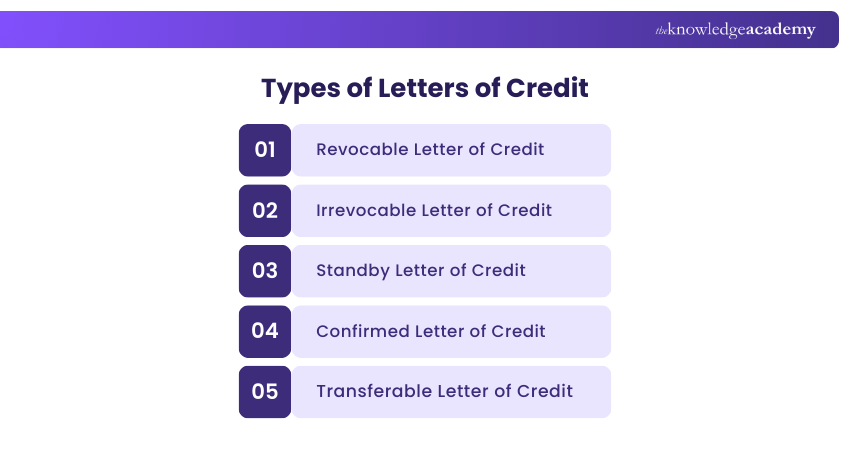
1) Revocable Letter of Credit
A Revocable Letter of Credit is a kind that the issuing bank can modify or cancel at any time without providing prior notification to the beneficiary (the seller). However, it's important to note that this type of Letter of Credit is seldom used in practice due to the high level of uncertainty it introduces into the transaction process. Its lack of security for the seller makes it less popular in international trade scenarios.
2) Irrevocable Letter of Credit
An Irrevocable Letter of Credit, on the other hand, provides a higher level of security for both the buyer and the seller. Once issued, it cannot be altered or cancelled without the agreement of all parties involved. This type of Letter of Credit assures the seller that, if they meet the specified conditions, payment will be made, instilling confidence and trust in the transaction. However, it's important to consider the Advantages and Disadvantages of Letter of Credit, as there can be certain limitations, such as complexity and costs, that may impact the overall transaction process.
3) Standby Letter of Credit
A Standby Letter of Credit serves as the secondary payment mechanism, coming into play if the primary payment method fails. It functions as a guarantee that the seller will receive payment if the buyer is unable to fulfil their financial obligations. This type is often used in situations where there is a higher risk of default or non-payment.
Improve your financial planning and control with the Cash Management Course to advance your career today
4) Confirmed Letter of Credit
In case of a Confirmed Letter of Credit, a second bank, typically in the seller's country, adds some extra assurance by confirming the Letter of Credit issued by the buyer's bank. This confirmation serves to reduce the risk for the seller, especially when dealing with a lesser known issuing bank. It provides an additional level of security in international transactions.
5) Transferable Letter of Credit
A Transferable Letter of Credit offers a unique level of flexibility. The initial beneficiary, often an intermediary, has the authority to transfer part or all of the credit to another party. This type is advantageous in complex trade scenarios involving multiple intermediaries, allowing for the distribution of risk and responsibilities among different entities.
6) Revolving Letter of Credit
A revolving Letter of Credit lets a business use the same LC for multiple shipments or transactions over an agreed time period. The system automatically replenishes the credit balance whenever a user makes a withdrawal which streamlines documentation processes for businesses that maintain continuous trading partnerships.
7) Commercial Letter of Credit
The commercial Letter of Credit serves as the primary LC that most international trade operations use to guarantee payments for sellers who submit their required documentation. The agreement secures payment for one particular transaction between the two trading parties.
What is the Key Difference Between a Revolving Letter of Credit and Commercial Letter of Credit?
A Commercial Letter of Credit is primarily used in international trade, where the issuing bank directly pays the seller upon verification of all agreed-upon documents. A Revolving Letter of Credit enables the buyer to make multiple draws within a specified period under the same agreement. It automatically renews after each payment cycle.

How to Apply for a Letter of Credit
A Letter of Credit (LC) is used to facilitate transactions and reduce delayed payments or mistakes. The application may be different based on the kind of LC and the requirements of the industry, but the overall procedure is the same.
In the case of an import export:
a) The sales agreement is concluded between the importer and the exporter.
b) The Letter of Credit is issued by the importer in his own bank and forwarded to the bank of the exporter, where it is verified.
c) The approving LC is checked by the banks of the exporter and sent to the exporter.
d) The exporter transfers the goods on the terms of the LC and provides the required documents to his/her bank.
e) The bank checks by the exporter that all the documentation is in line with the LC requirements and submits it to the bank of the importer.
f) After confirmation, the bank of the importer will deposit the money into the bank of the exporter, and the importer will get the goods shipped to them.
g) This is done to make sure that both sides of the international trade make safe and punctual payment and minimise risks.
Control the credit and empower your business. Sign up for our Introduction to Credit Control Course now!
Real-world Example of a Letter of Credit
Imagine a furniture retailer in the United Kingdom purchasing £500,000 worth of custom-made furniture from a manufacturer in Italy. The Italian supplier is hesitant to start production without assurance of payment, especially since the buyer is overseas. To resolve this, the UK retailer arranges a Letter of Credit with their bank.
The bank issues the letter to the Italian manufacturer’s bank, guaranteeing payment once the supplier provides the required shipping documents such as the inspection certificate and bill of lading. This proves the goods have been shipped.
Once the documents are verified, the Italian manufacturer’s bank releases payment, and the goods are shipped. This process ensures trust on both sides: the supplier knows they will be paid, and the buyer only pays once the goods are shipped by the agreed-upon terms.
Pros and Cons of Letters of Credit
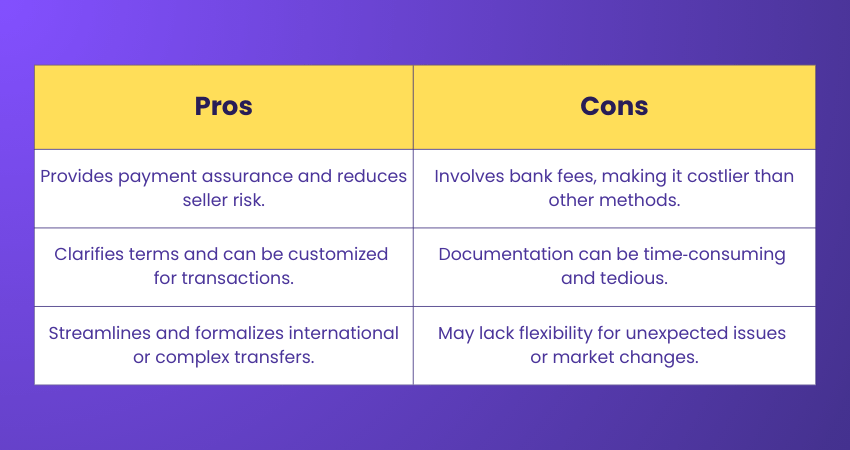
Letters of credit provide businesses financial protection through their structured payment methods yet require businesses to evaluate the associated expenses and operational difficulties which accompany these instruments.
Conclusion
A Letter of Credit is an essential aspect of transactions in the modern global trade world, and it guarantees both safety and security in transactions. This is because, through understanding the functioning of the system, its benefits and drawbacks, businesses are able to make wise decisions that safeguard both consumers and traders. We hope this blog has helped you acquire all the knowledge you need to handle letters of credit with confidence.
Enhance your financial acumen with our Accounting Courses for a brighter career ahead!
Frequently Asked Questions
How Long is a Letter of Credit Valid for?

A Letter of Credit becomes invalid after its predetermined validity period, which typically lasts between 30 to 180 days according to the specific agreement between parties involved.
What are the Key Standards and Legal Frameworks Governing Letters of Credit?
Letters of Credit are mainly governed by the ICC’s UCP 600, International Standby Practices (ISP 98), and Uniform Rules for Bank-to-Bank Reimbursements (URR 725). They set global rules on issuance, documentation and payment to ensure secure and standardised trade practices.
What are the Other Resources and Offers Provided by The Knowledge Academy?
The Knowledge Academy takes global learning to new heights, offering over 3,000+ online courses across 490+ locations in 190+ countries. This expansive reach ensures accessibility and convenience for learners worldwide.
Alongside our diverse Online Course Catalogue, encompassing 17 major categories, we go the extra mile by providing a plethora of free educational Online Resources like Blogs, eBooks, Interview Questions and Videos. Tailoring learning experiences further, professionals can unlock greater value through a wide range of special discounts, seasonal deals, and Exclusive Offers.
What is The Knowledge Pass, and How Does it Work?
The Knowledge Academy’s Knowledge Pass, a prepaid voucher, adds another layer of flexibility, allowing course bookings over a 12-month period. Join us on a journey where education knows no bounds.
What are the Related Courses and Blogs Provided by The Knowledge Academy?
The Knowledge Academy offers various Accounting Courses, including the Project Accounting Course, Introduction To Credit Control Trainng, and Cash Flow Management Course. These courses cater to different skill levels, providing comprehensive insights into Double-Entry Bookkeeping.
Our Accounting and Finance Blogs cover a range of topics related to Letter of Credit, offering valuable resources, best practices, and industry insights. Whether you are a beginner or looking to advance your Accounting and Finance skills, The Knowledge Academy's diverse courses and informative blogs have got you covered.

Olivia Taylor


Chartered Accountant and Financial Training Specialist
Olivia Taylor is a qualified chartered accountant with over a decade of experience in financial management, auditing and corporate reporting. Having worked with leading firms in both the public and private sectors, Olivia brings clarity to complex financial topics. Her writing focuses on helping professionals build confidence in key areas of accounting, compliance and financial planning.
View Detail
Upcoming Business Skills Resources Batches & Dates
Date
 Letter of Credit Course
Letter of Credit Course
Fri 22nd May 2026
Letter of Credit Course
Fri 21st Aug 2026
Letter of Credit Course
Fri 20th Nov 2026

 If you wish to make any changes to your course, please


