


 Top Rated Course

We may not have the course you’re looking for. If you enquire or give us a call on +44 1344 203 999 and speak to our training experts, we may still be able to help with your training requirements.
ISO 17025 Guidelines and Laboratory Requirements
Michael Jones 15 July 2026The primary function of the ISO 17025 Guidelines is to ensure the competence of testing and calibration laboratories, resulting in valid and reliable results. Understanding the key features, use cases and benefits of this global ISO standard is essential for anyone running a testing and calibration laboratory.

Training Outcomes Within Your Budget!
We ensure quality, budget-alignment, and timely delivery by our expert instructors.
Table of Contents

Every time you trust a medical report or a product test, there’s a high chance ISO 17025 is working behind the scenes. It’s the gold standard that ensures labs deliver accurate, consistent, and reliable results. Be it for testing food, medicine, or materials; this standard keeps labs sharp and globally trusted. In this blog, we’ll explore the ISO 17025 Guidelines, their key benefits, and how they power confidence in labs.
Table of contents
1) What are ISO 17025 Guidelines?
2) Key Features of ISO 17025 Guidelines
3) What are the Benefits of Implementing the 17025 Guidelines?
4) Use Cases of 17025 Guidelines
5) Conclusion
What are ISO 17025 Guidelines?
ISO 17025 is a global standard created by ISO for testing and calibration labs. It provides a clear framework to help labs demonstrate their high-quality standards. Getting ISO 17025 certified proves a lab is competent and focused on quality. It boosts trust, ensures reliable test results, meets regulations, and improves customer satisfaction.
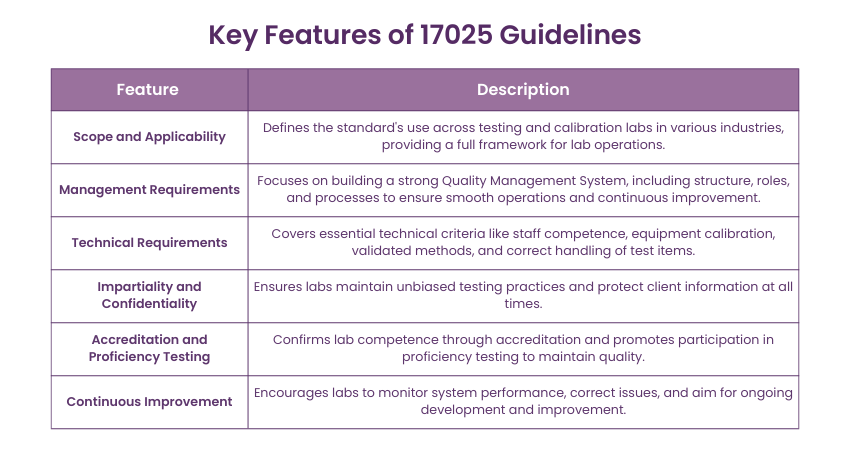
Key Features of 17025 Guidelines
The Guidelines of ISO 17025 encompass a set of key features that laboratories must adhere to achieve compliance and demonstrate their competence. These features include the following:
Ensure high standards of accuracy and reliability in your laboratory operations with our ISO 17025 Training Sign up now!
What are the Benefits of Implementing the 17025 Guidelines?
Implementing the Guidelines of ISO 17025 offers several significant benefits for laboratories and organisations involved in testing and calibration activities. By following an ISO 17025 Checklist, organisations can ensure compliance and fully realise the following benefits:

1) Enhanced Credibility and Trust
ISO 17025 assures customers that the laboratory operates according to internationally recognised standards and follows robust Quality Management practices.
2) Improved Quality and Reliability of Test Results
By adhering to 17025 guidelines, laboratories can improve the quality and reliability of their test results. The standard emphasises the use of validated testing methods, properly calibrated equipment, and competent personnel, ensuring accurate and precise measurements.
3) Compliance with Regulatory Requirements
Compliance with regulatory requirements is crucial for laboratories seeking to operate legally and serve industries with stringent quality and safety regulations.
4) Better Customer Satisfaction
By implementing the guidelines, laboratories can provide reliable and accurate test results, thereby enhancing customer confidence and satisfaction.
5) International Recognition
Obtaining ISO 17025 Certification allows laboratories to gain international recognition, enabling them to compete in the global market and attract customers worldwide.
6) Improved Efficiency and Effectiveness
Implementing the 17025 guidelines helps laboratories streamline processes, optimise resource allocation, and improve overall laboratory performance.
7) Risk Management and Decision-Making
By identifying and addressing potential risks, laboratories can make informed decisions, reduce errors, and mitigate potential effects.
8) Continuous Improvement
ISO 17025 also encourages laboratories to embrace a culture of continuous improvement. By regularly reviewing and enhancing their Quality Management System, laboratories can stay updated with the latest industry practices.
Become an ISO 17025 Lead Implementer and drive laboratory excellence with our ISO 17025 Lead Implementer Course now!
Use cases of 17025 Guidelines
ISO 17025 Guidelines apply to various laboratories and organisations involved in testing and calibration activities. These guidelines serve as the benchmark for ensuring quality and competence. Some common use cases are in the following organisations:
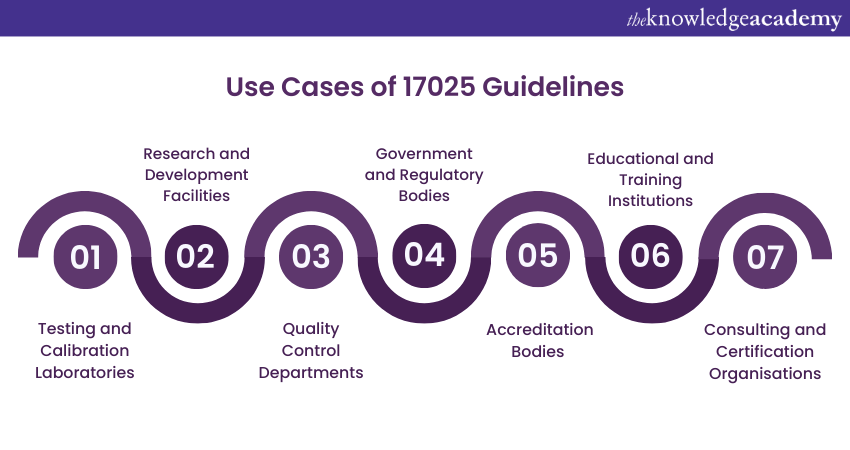
1) Testing and Calibration Laboratories
a) ISO 17025 is designed for testing and calibration laboratories.
b) It applies across numerous industries like aerospace, automotive, food and beverages, textiles and electronics.
c) Following these guidelines improves the testing accuracy and reliability.
d) It helps labs deliver consistent and trustworthy results.
2) Research and Development Facilities
a) Research and development labs depend on accurate test results.
b) ISO 17025 helps them build strong Quality Management Systems.
c) It ensures their experiments and analysis are always reliable.
d) This improves the trust and quality of their research findings.
3) Quality Control Departments
a) ISO 17025 is helpful for quality control departments in organisations.
b) It helps ensure the accuracy and reliability of test results.
c) These results help you check raw materials, in-process items and final products.
d) Following the standard supports better quality monitoring and control.
4) Government and Regulatory Bodies
a) Government agencies and regulatory bodies often utilise ISO 17025 guidelines.
b) They assess the competence of labs which offer testing and calibration services.
c) These results support essential regulatory and compliance decisions.
5) Accreditation Bodies
a) Accreditation bodies are tasked with evaluating labs for compliance with ISO 17025.
b) They check the lab’s competence, impartiality and overall performance.
c) The guidelines help assess if labs meet the required standards.
d) Successful evaluation results in official accreditation.
6) Educational and Training Institutions
a) Educational institutions and training providers can benefit a lot from ISO 17025.
b) It’s useful for courses related to testing and calibration.
c) Adding the guidelines to the curriculum improves the learning quality.
d) Students can gain extensive knowledge of internationally recognised standards and practices.
7) Consulting and Certification Organisations
a) Consulting firms and certification bodies support labs with ISO 17025 implementation.
b) They specialise in Quality Management Systems.
c) These organisations offer guidance, training, and certification services.
d) Their support helps labs achieve compliance and accreditation.
Auditing excellence leads to laboratory excellence! Sign up for our ISO 17025 Internal Auditor Course and elevate your laboratory's status!
Conclusion
In essence, ISO 17025 Guidelines turn ordinary labs into trusted sources of truth. They are the quiet force behind accurate results, global credibility, and consistent quality. Be it for testing food, fuel, or pharmaceuticals, these guidelines help labs deliver with confidence and that’s what truly sets them apart.
Take your laboratory to new heights of excellence with our comprehensive ISO 17025 Foundation Course – Sign up now!
Frequently Asked Questions
What are the Main Components of ISO 17025?

ISO 17025 has two main parts: Management and technical requirements. The management part covers quality systems, keeping records, and regular reviews. The technical part focuses on staff skills, checking and approving test methods, calibrating equipment, and properly handling test or calibration items.
Who Needs to be ISO 17025 Certified?
ISO 17025 certification is needed by any laboratory that performs testing, calibration, or sampling and wants to demonstrate its technical competence.

Michael Jones


Health and Safety Consultant and Compliance Trainer
Michael Jones is a seasoned health and safety expert with more than 15 years of experience in workplace safety, risk management, and compliance training. He has worked across construction, manufacturing, and corporate sectors, helping organisations meet legal requirements and create safer working environments. Michael’s training and writing are known for being practical, clear, and aligned with UK regulations.
View Detail


 If you wish to make any changes to your course, please


