


 Top Rated Course


We may not have the course you’re looking for. If you enquire or give us a call on + 800 908601 and speak to our training experts, we may still be able to help with your training requirements.
Types of Counselling: Exploring Different Approaches
The Knowledge Academy 13 April 2026Types of counselling include approaches like CBT, person-centred, and psychodynamic therapy, along with specialisations like family and children's counselling. Each Counselling method offers unique benefits. They help individuals understand their emotions, overcome personal challenges, and build resilience in their lives.

Training Outcomes Within Your Budget!
We ensure quality, budget-alignment, and timely delivery by our expert instructors.
Table of Contents
When people look for ways to improve their mental well-being, Counselling is often the first thing that comes to mind. Whether it’s achieving emotional balance, resolving conflicts, or facing life’s challenges, Counselling can make a real difference. However, with so many Types of Counselling available, choosing the right one can often feel confusing.
In this blog, we’ll explore the different Types of Counselling and help you discover which one suits you best. It’s your first step toward better mental and emotional well-being. Let’s get started!
Table of Contents
1) What is Counselling?
2) What are the Different Types of Counselling?
3) What are the Different Formats of Counselling?
4) What are the 3 C’s in Counselling?
5) What is the ABC of Counselling?
6) Conclusion
What is Counselling?
Counselling is a form of therapy that allows individuals to express their thoughts, feelings, and concerns in a safe and supportive environment. By talking to a trained professional, people can better understand their emotions, gain perspective on challenges, and find healthier ways to cope with them. It offers a confidential space where one can share openly without judgment.
The idea behindCounselling Psychology, is that guided conversations and self-reflection help individuals develop a clearer sense of self and emotional awareness. Through this process, people can build resilience, improve relationships, and enhance their overall well-being.
What are the Different Types of Counselling?
Now let’s discuss the Types of Counselling that can help you in addressing your personal and emotional issues and enhancing overall life satisfaction:
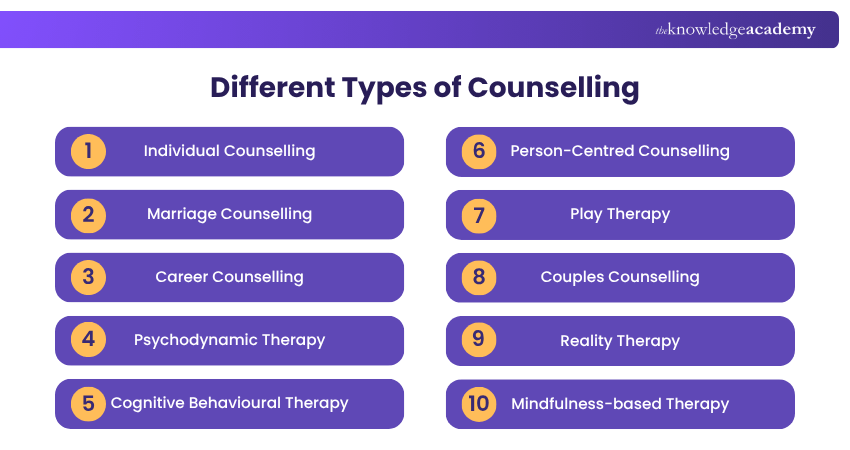
1) Individual Counselling
Individual Counselling is also known as Personal Counselling. A trained professional provides one-on-one Counselling where individuals seek help for their struggles or emotional imbalances in life. People looking for Individual Counselling will be mostly struggling with depression, anxiety, stress, bullying, grief, low self-esteem or past trauma.
This approach enables individuals to manage difficulties using appropriate strategies tailored to their personal circumstances.
2) Marriage Counselling
The main focus of Marriage Counselling is to understand the underlying issues of relationships between partners and improve communication. The reasons people look for marriage Counselling are lack of communication, trust issues, jealousy, parenting challenges, financial issues and infidelity issues within the marriage.
Seeking help from a counsellor can help you overcome these challenges and improve yourMental Healthand bonding with your partner. This will result in a happy life where you can communicate easily.
Unlock your true potential - join our Psychology of Personal Growth Training today!
3) Career Counselling
Career Counselling is one of the different Types of Counselling where people seek help to choose the right career path. Usually, there are two types of people who seek help from a career counsellor: one who has just finished their education and is stepping into their career life and the other who is looking for a career transition.
People mostly seek career Counselling when they are uncertain about whether they have the skills to work in this role, whether they enjoy this career, what options are available for them and their real value.
4) Psychodynamic Therapy
A deep-oriented talking therapy is psychodynamic therapy, which helps you in overcoming past relationships and unconscious processing affecting your current behaviour. In a confidential safe space, you and your Therapist will be exploring hidden causes, coping strategies, and emotional stability to build change and self-understanding.
This therapy is suitable for individuals who doubt their self-being, who face problems in their current relationship due to past experience and difficulty in upholding themselves during loss.
5) Cognitive Behavioural Therapy
Cognitive Behavioural Therapy (CBT) is another approach from different Types of Counselling that helps people change the way they think and act. This Counselling method helps in resolving various mental health problems, including anxiety, depression, Post-traumatic Stress Disorder (PTSD), and different types of personality disorders.
During the Counselling sessions, you will explore the issues affecting your thoughts, learning strategies and practising them on a daily basis to improve your mental well-being.
Discover more about Mindfulness and healing with our Mindfulness Training - Join now!
6) Person-centred Counselling
This type of therapy is most commonly approached among different Types of Counselling. It is a human-centric approach which believes that each individual has their own inner ability that helps them to reach their full potential. In this Counselling session, the clients take the lead, exploring their emotions, thoughts, and character while the Therapist supports their self-discovery journey.
The Therapist will continuously offer support and will be valuing your world in the viewpoint of as if they were you. This Counselling suits those individuals who are on the path towards discovering their abilities or who are struggling to understand their inner talents.
7) Play Therapy
Play Therapy is a highly effective form of therapy that assists children and adolescents in managing past traumas, adjusting their behaviour, gaining clarity about their self-image, and building positive relationships, all while incorporating essential Counselling Skills to support emotional growth and development.
The therapy involves a dynamic relationship between the client and Therapist, allowing clients to express themselves, explore their experiences, and make sense of any difficult or painful situations they may have gone through. Play Therapy is a powerful tool that can help individuals address their emotional and psychological needs, leading to personal growth and healing.
Download the Ageing and Mental Health PDF for helpful tips on ageing well.
8) Couples Counselling
Couple's Therapy, also known as Relationship Therapy or Relationship Counselling, where issues within a romantic relationship, marriage, and family are addressed. It is an effective approach for individuals who have persistent relational difficulties that cannot be resolved through Individual Counselling.
The main intention of couples therapy is to achieve a healthy relationship by using techniques drawn from traditional and contemporary marriage Counselling approaches. It aims to enhance communication, emotional connection, and intimacy between partners. Couple Counselling is similar to Family Counselling, with a focus on the couple. It provides specialised relationship therapy to help couples overcome obstacles in their present and future and improve their relationship. For a deeper understanding of the process, referring to the 7 Stages of Counselling Process PDF can offer valuable insights on how to approach and guide couples through their challenges.
9) Reality Therapy
Just like other forms of Therapy, Reality Therapy is centred around the idea that individuals have the ability to regain control over their lives, even if they have Mental Health issues. The main goal of this therapy is to assist patients in gaining more control over their lives and developing fulfilling and effective relationships.
Instead of concentrating on symptoms, Reality Therapy emphasises personal responsibility for one's actions. It encourages individuals to focus on present behaviour and make better choices that align with their goals and values.
10) Mindfulness-based Therapy
Mindfulness is a Type of Therapy that encourages patients to adopt a mental state characterised by non-judgmental awareness of their current experiences, including their bodily sensations, thoughts, consciousness, and environment.
The Therapist aims to promote openness, curiosity, and acceptance in the patient. Their goal is to help the patient avoid impulsive reactions to emotional triggers and instead respond thoughtfully, which allows them to take control of their emotions and regulate their response to the situation.
Boost team performance through psychology insights — join our Psychology of Behaviour at Work Training now.
What are the Different Formats of Counselling?
Since you have learned about different Types of Counselling, now let’s look into different formats of Counselling. These formats are nothing but a medium through which therapy is provided. So, let’s have a look at them in detail:
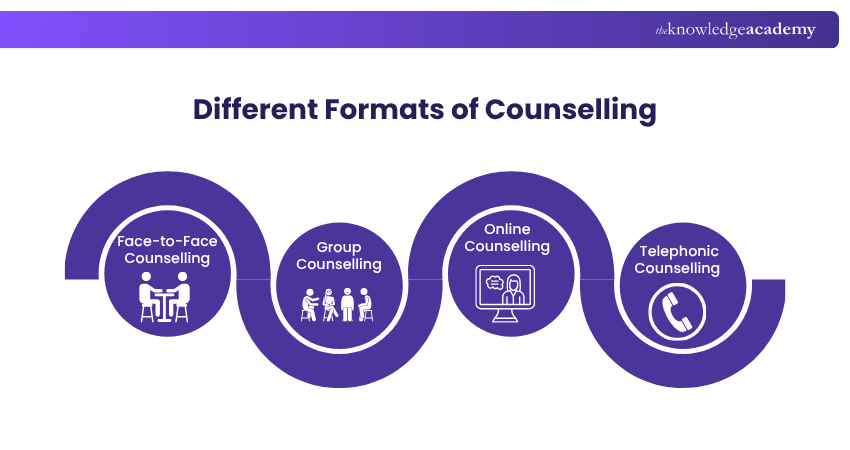
1) Face-to-Face Counselling
Face-to-Face Counselling is one of the most common forms. Here, the patients meet with the Counsellor in their office and discuss how they can solve their problems.
Here, the Counsellor directly converses with the patients, providing them with a comfortable and judgement-free environment. They ask them about their family background and medical history, then dive into their problems.
Learn how to deal with patients face-to-face with our Mental Capacity Training - join today!
2) Group Counselling
This format of Counselling generally takes place when the patients require the help of a support group. The patients may undergo Group Counselling to recover from the loss of a loved one or to combat addiction problems.
The Counselling group is generally comprised of six to eight people who meet face-to-face with a trained group Therapist. Here, they talk about the problems they are facing and how these problems are affecting them.
3) Online Counselling
If you had read the news, you would have noticed that during the pandemic, there were several Counsellors who were providing their services online. Online Counselling is conducted via the internet. Here, the patient who cannot travel far for their treatment can get easy access to their treatment through online platforms.
Moreover, people who are suffering from Social Anxiety also prefer this format of Counselling. This is because they want to protect their identity and safeguard themselves from any kind of judgment.
4. Telephonic Counselling
Also known as Phone Therapy. It is a form of counselling where Therapists help individuals through phone calls. These types of Counselling are really convenient and easy to access.
Often, this form of counselling turns out to be really helpful for some individuals facing location issues and are unable to travel. You can opt for this to address various mental and psychological issues.
Enhance your child psychology expertise by registering for our Child Psychology Course today!
What are the 3 C's in Counselling?
The 3 C’s of Counselling are Catching, Checking, and Changing. This is a cognitive technique to challenge your negative thoughts. To keep the people engaged in their therapy sessions, the Therapists often play this detective game to investigate their inner thoughts.
1) Catching: The first action is to catch the thoughts that are related to the negative emotion you are experiencing.
2) Checking: Check the finding, whether the thought you found is accurate and distressing.
3) Changing: Finally, learn to change your thoughts. The Therapist helps in changing the thoughts and developing more helpful thoughts to overcome the distressing situations.
What is the ABC of Counselling?
The ABC of Counselling is a therapy model used to change irrational beliefs to develop a healthier reaction. The ABC model is used as part of Cognitive Behavioural Therapy (CBT). This helps people to understand stress, anxiety, and other mental health factors by learning how they take in and approach life events. The ABC stands for:
1) Adversity: The reaction to the situation that you are handling or facing. For example, a reaction to someone arguing with you.
2) Beliefs: Your beliefs or thoughts about the situation. This factor is core as it determines how this reaction impacts you.
3) Consequences: The emotional and behavioural response to the situation in accordance with your belief.
Conclusion
Understanding the different Types of Counselling is a vital step towards fostering emotional resilience, managing stress and mental clarity. Each method offers unique tools to help you navigate life’s challenges, promote personal growth, and overcome depression and stress. By embracing the right Counselling approach, you can create a positive impact on your overall well-being and lead a more balanced, fulfilling life.
Join our Mental Health Course and take the next step in supporting mental wellness.
Frequently Asked Questions

The Knowledge Academy


Global Training Provider
The Knowledge Academy is a world-leading provider of professional training courses, offering globally recognised qualifications across a wide range of subjects. With expert trainers, up-to-date course material, and flexible learning options, we aim to empower professionals and organisations to achieve their goals through continuous learning.


 If you wish to make any changes to your course, please


