


 Top Rated Course

We may not have the course you’re looking for. If you enquire or give us a call on + 800 908601 and speak to our training experts, we may still be able to help with your training requirements.
MSP Risk Management: A Complete Beginner’s Guide
Grace Mitchell 15 July 2026This blog will help the readers to gain a comprehensive understanding of what MSP Risk Management is and why it is essential for your organisation, including the MSP Risk Management framework, its key benefits and more in detail. Read more to learn managing and delivering complex programmes in your organisation.

Training Outcomes Within Your Budget!
We ensure quality, budget-alignment, and timely delivery by our expert instructors.
Table of Contents
Understanding Risk Management is essential for the success of any programme or project. Whether you're embarking on a complex transformation initiative or launching a new business venture, identifying, assessing, and mitigating risks is essential in achieving desired outcomes. This is where Managing Successful Programmes or MSP Risk Management comes into play.
MSP is a globally recognised methodology designed to guide organisations in managing and delivering complex programmes. Within MSP, Risk Management plays a vital role in identifying potential threats and opportunities and proactively addressing them to safeguard programme success. This blog explores MSP Risk Management, its benefits, and its framework. Read ahead to learn more!
Table of Contents
1) What is MSP?
2) The MSP Risk Management Framework
a) Identify
b) Assess
c) Plan
d) Implement
3) Benefits of MSP Risk Management
4) Conclusion
What is MSP?
Managing Successful Programmes (MSP) is a widely adopted framework that gives a structured approach to managing and delivering complex programmes. It offers a set of MSP principles, best practices, and techniques to guide organisations in achieving their strategic objectives through effective programme management.
It operates on the understanding that programmes are temporary, unique endeavours that bring about significant change. These programmes typically consist of a group of related projects, activities, and business changes aimed at achieving a specific goal. It also recognises the inherent complexity and uncertainty that come with managing such programmes.
One of the key aspects of MSP is the emphasis it places on governance and leadership. It promotes the establishment of a programme board consisting of senior executives and key stakeholders who provide strategic direction, decision-making authority, and oversight throughout the programme lifecycle.

The MSP Risk Management Framework
The MSP framework for Risk Management forms a critical component of the overall MSP methodology. By integrating Risk Management throughout the programme lifecycle, it ensures that risks are proactively managed, enabling successful programme delivery. This framework consists of four stages, Identify, Assess, Plan, and Implement. Let's explore each stage in detail:
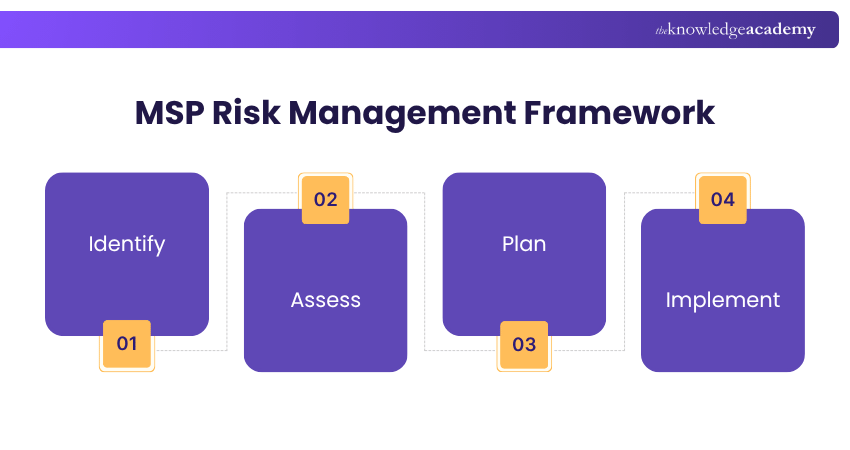
1) Identify
The first stage, Identify - involves identifying potential risks that may impact the programme's objectives. By comprehensively identifying risks, programme teams can gain a clear understanding of potential threats and opportunities, allowing for appropriate risk response strategies. Here are the key aspects of identifying risks within MSP:
a) Engaging stakeholders
b) Comprehensive risk assessment
c) Utilising risk identification techniques
d) Documentation
2) Assess
Once risks are identified, they need to be assessed regarding their potential impact and likelihood. It involves evaluating the potential impact and probability of identified risks to specify their significance and prioritise them for further action. The assessment stage provides valuable insights that enable programme teams to make informed decisions about risk response strategies. Here are its key aspects:
a) Impact and likelihood evaluation
b) Qualitative risk analysis
c) Quantitative risk analysis
d) Risk prioritisation
e) Regular review and updating
Preparing for a risk management interview? Check out our Risk Management Interview Questions and Answers to help you land the job!
3) Plan
Planning and mitigating risks is crucial, and this stage involves developing a comprehensive Risk Management plan and implementing strategies to address identified risks. Programme teams can minimise potential negative impacts and maximise opportunities by proactively planning and mitigating risks. The critical aspects of planning and mitigating risks include:
a) Risk Management plan development
b) Mitigation strategies
c) Resource allocation
d) Contingency planning
e) Regular monitoring
Ready to launch your Managed Services business? Grab the MSP Startup Guide now!
4) Implement
Implementing Risk Management is the final stage of the framework. It involves executing the plan for managing risks, monitoring identified risks, and taking necessary actions to address them. Programme teams can proactively respond to emerging threats and ensure programme success by embedding effective practices aimed at managing risk into programme processes. Here are the key aspects of implementing it:
a) Risk monitoring
b) Risk response execution
c) Communication and reporting
d) Escalation
e) Continuous improvement
Learn to manage programmes that deliver real change and business value with the MSP® Training – Join today!
Benefits of MSP Risk Management
Implementing effective practices for managing risks within the MSP framework offers numerous Benefits of MSP to organisations undertaking complex programmes. Here are some key advantages of it:
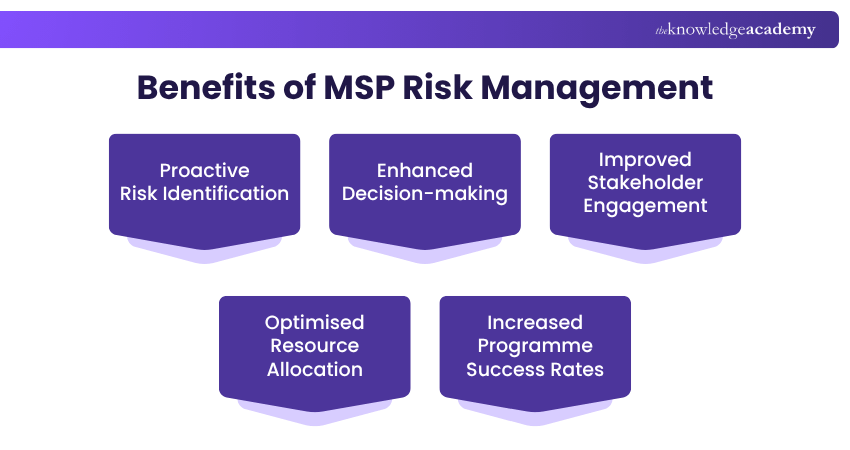
1) Proactive Risk Identification: Risk Management in MSP encourages a systematic approach to identifying risks early in the programme lifecycle. This proactive identification allows programme teams to anticipate potential issues, assess their impact, and develop appropriate response strategies. By addressing risks upfront, organisations can mitigate their negative consequences and maximise opportunities.
2) Enhanced Decision-making: Programme Managers gain a comprehensive understanding of the risks associated with their programmes through the MSP framework for Risk Management. This knowledge enables informed decision-making, as risks and their potential impacts are considered during strategic planning and resource allocation. Decision-makers can weigh the benefits, costs, and risks associated with different options, leading to more effective decision-making.
3) Improved Stakeholder Engagement: Risk Management in MSP Process promotes stakeholder engagement throughout the process of managing risk. Involving stakeholders in risk identification and assessment helps to gather diverse perspectives and insights. It fosters a shared understanding of programme risks among stakeholders, enhances communication, and increases their commitment and support for activities devoted to managing risks.
4) Optimised Resource Allocation: By proactively managing risks, organisations can allocate resources more efficiently. Managing risks enables the identification of critical risks that may require additional resources or contingency plans. This ensures that resources are appropriately allocated, minimising unnecessary expenditure while effectively addressing the risks that pose the most significant threats.
5) Increased Program Success Rates: Risk Management in MSP significantly contributes to the overall success of programmes. Organisations can reduce the likelihood and impact of adverse events by systematically addressing risks.
Mitigating risks and capitalising on opportunities increases the probability of achieving programme objectives, delivering intended benefits, and ultimately realising strategic goals. This skill is valuable to include in your Risk Management Resume, showcasing your expertise in risk mitigation and strategic planning.
Conclusion
In conclusion, adopting MSP Risk Management practices offers tangible benefits to organisations undertaking complex programmes. By integrating Risk Management within the MSP framework, organisations can confidently navigate uncertainties and achieve their desired outcomes. For those seeking further insights into pricing structures that complement Risk Management, our MSP Pricing Guide provides valuable guidance. We hope this blog has helped you learn more about MSP Risk Management.
Gain advanced knowledge and practical techniques to manage complex programmes effectively – Register for the MSP® Practitioner Course today!
Frequently Asked Questions
What are the Four Types of Risk Management?

The four main Risk Management techniques are risk acceptance, where minor risks are tolerated; risk avoidance, where risky activities are eliminated; risk limitation, which reduces impact through controls; and risk transference, where risks are shifted to third parties like insurers or vendors.
Why is Risk Management Important in MSP?
Risk Management is important in Managing Successful Programmes (MSP) because it helps organisations identify potential threats and opportunities early, reduce uncertainty, and maintain control over programme delivery.

Grace Mitchell


Senior Project Management Consultant and Author
Grace Mitchell is a highly experienced project management professional with over 15 years of expertise in leading large-scale projects across industries, including construction, IT, and finance. With qualifications in PRINCE2®, PMP®, AgilePM®, and MSP®, Grace specialises in delivering complex programmes with precision and clarity. Her writing is grounded in real-world application and focuses on helping learners build confidence in project delivery and stakeholder management.
View Detail

 If you wish to make any changes to your course, please


