


 Top Rated Course

We may not have the course you’re looking for. If you enquire or give us a call on + 800 908601 and speak to our training experts, we may still be able to help with your training requirements.
How to Write Short Story: A Step-by-Step Guide
The Knowledge Academy 31 March 2026Writing a Short Story involves creating a brief narrative with a clear idea, few characters, and a conflict, structured with a beginning, middle, and end. It focuses on a well-defined theme or moment, allowing the story to stay clear and easy to follow. Strong descriptions and dialogue bring scenes to life, making the narrative engaging.

Training Outcomes Within Your Budget!
We ensure quality, budget-alignment, and timely delivery by our expert instructors.
Table of Contents
Storytelling is a powerful way to express ideas, emotions, and imagination in a compact form. A well-written short story captures attention quickly and leaves a lasting impression, making every word count.
If you’re wondering How to Write a Short Story, it starts with a clear idea, strong characters, and a focused narrative. With the right approach, you can turn simple concepts into compelling stories that engage readers. Let’s explore the key steps to get started.
Table of Contents
1) What is a Short Story?
2) Key Elements of a Short Story
3) Steps to Writing a Short Story
4) Common Mistakes to Avoid When Writing a Short Story
5) Conclusion
What is a Short Story?
A short story is a brief work of fiction, usually 1,000–7,000 words, that focuses on a single event, moment, or idea. It revolves around a few characters and aims to convey a clear, powerful theme. Brevity creates an intense, concentrated reading experience.
Unlike novels, short stories leave little room for multiple subplots or lengthy backstories. Every sentence must advance the plot, reveal character, or highlight the theme. The story often concludes with a strong, thought-provoking ending that lingers with the reader.

Key Elements of a Short Story
Authors often experiment with various formats and styles in their Short Stories, but they generally incorporate five key elements to create a coherent narrative and captivate the reader. These elements include:
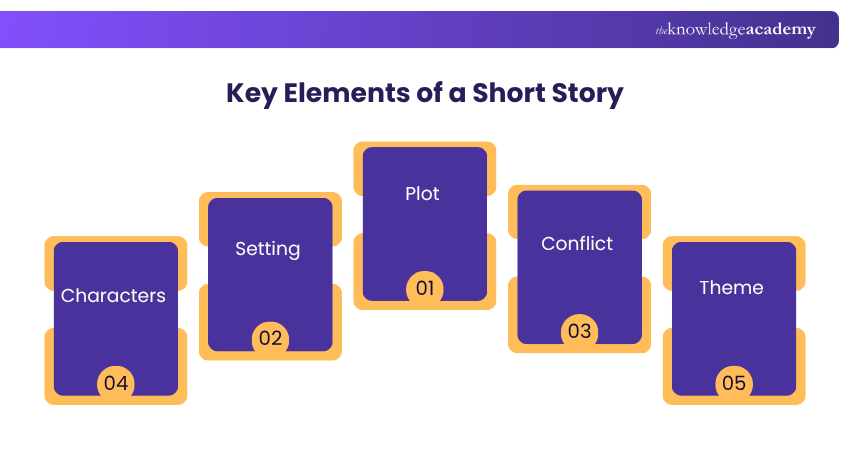
1) Characters
Characters are the individuals in a story, often used by writers to drive the plot forward through their actions and dialogue. Common types include the protagonist, the main character whom readers are generally meant to support, and the antagonist, who stands in opposition. Additionally, there are supporting characters who help develop the story by aiding either the protagonist or the antagonist.
2) Setting
Setting indicates the time and place in which a story unfolds. It can range from real-world locations and historical periods to entirely fictional worlds. To demonstrate the setting effectively, writers often include details about the weather, season, physical landscape, and cultural environment.
3) Plot
The plot refers to the series of events in a story, usually structured with an explicit origin, middle, and ending. Generally, the origin introduces the characters and setting, the middle presents the central conflict, and the ending reveals its resolution. However, this system can differ based on the author's approach; for example, some plots may start in the middle of the action rather than at the beginning.
4) Conflict
Conflicts are the central challenges in a story. They can arise from a character's internal struggles, such as emotions or fears that hinder their goals, or from external sources, like opposition from another character or a challenging environment. Most stories rely on some form of conflict to drive the plot forward.
5) Theme
A theme is an underlying idea or message woven throughout a story. Rather than stating it outright, authors often use other vital elements, like plot and characters, to subtly express the theme. Themes can vary from comprehensive topics, such as friendship, to more specific viewpoints, such as the belief that friendship holds more significant value than romantic love.
Build skills for independent career success with Personal Development Courses now!
Steps to Writing a Short Story
Steps do not define creativity, nor can rules confine it. The best step to writing a Short Story is to pick up your pen, typewriter, or laptop, get yourself going, and let your thoughts flow. However, if you are sceptical, a short story can emerge from various inspirations, a vivid image, a compelling character, or a memorable incident.
At its core, however, it often begins with a simple premise that holds the potential for a deeper narrative. About where to start, don't worry! We are here for you. You can follow the following steps to get started:
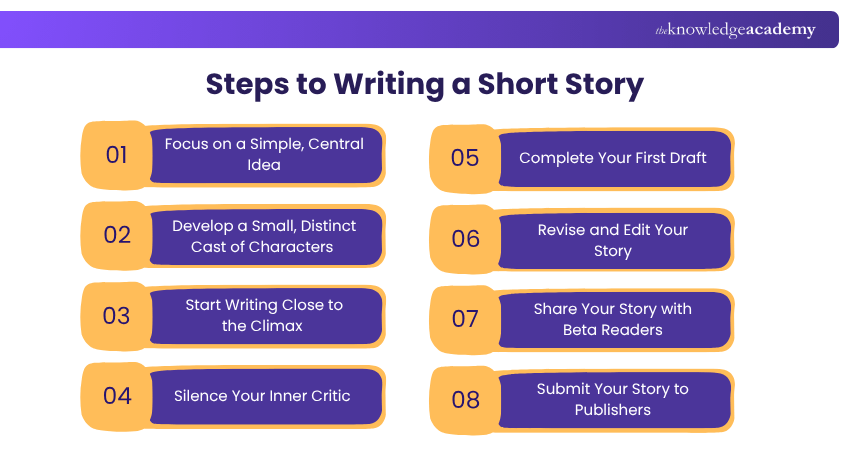
1) Focus on a Simple, Central Idea
A Short Story can emerge from various inspirations, a vivid image, a compelling character, or a memorable incident. At its core, however, it often begins with a simple premise that holds the potential for a deeper narrative.
For instance, Kafka’s The Metamorphosis explores human relationships through the transformation of its protagonist, while Melville’s Bartleby the Scrivener uses a clerk's refusal to work to explore complex themes of individuality and society.
2) Develop a Small, Distinct Cast of Characters
Short Stories generally feature fewer characters than novels, and readers often need less information about them, which can add intrigue. However, creating memorable, distinct characters is key. Each should stand out through appearance, behaviour, or speech patterns.
For instance, in The Yellow Wallpaper, Charlotte Perkins Gilman distinguishes her narrator, while Poe's The Tell-Tale Heart uses speech to define characters. Flannery O'Connor's A Good Man Is Hard to Find achieves character uniqueness, especially with The Misfit.
3) Start Writing Close to the Climax
Kurt Vonnegut advised starting stories close to the end, skipping lengthy exposition. Jump straight into the action to engage readers quickly. An impactful opening line should raise questions and spark curiosity, much like "A shot rang out," which introduces danger and intrigue. Readers seek answers, and an opening that invites questions encourages them to keep reading.
4) Silence Your Inner Critic
When drafting, embrace the "anything goes" mindset. Silence your inner editor and let creativity flow. Don’t worry about overwriting, refinement comes later. If stuck, leave gaps and revisit them, or jot down rough notes instead of full sentences.
Whether you plan or write spontaneously, the key is completing the first draft, regardless of its imperfections.
5) Complete Your First Draft
A powerful ending is important for any Short Story, as it can elevate or undermine the entire narrative. Whether you plan or improvise, aim for an ending that aligns with the story's internal logic without being predictable. Avoid conclusions that leave readers thinking, “Is that it?” or “What just happened?”, both indicate unresolved or confusing endings.
Boost your focus with our Attention Management Training - Join now!
6) Revise and Edit Your Story
Once you have a first draft, the real work begins: revising and refining. Read it multiple times, asking yourself which narrative threads need development, which to add, and which to cut. The final polish focuses on scrutinising every word and sentence: Is it clear, concise, and free of clichés? This stage brings the story to life, adding the final touches.
7) Share Your Story with Beta Readers
After countless rewrites, you may reach a point where you can’t stand to look at your story. When this happens, set it aside for a while. Upon returning, you’ll see it with fresh eyes, making it easier to cut unnecessary parts and improve the piece. Once you’re confident, share it with beta readers for feedback. This step is best done when the story feels complete, minimising revisions afterwards.
8) Submit Your Story to Publishers
How do you know when your story is finished? The answer is: when you can't see how to improve it. That's when you can finally step back, be satisfied with your work, and submit it for others to read. However, there's rarely a "final" draft. Even after acceptance, you might find small tweaks you'd like to make, which a sympathetic editor can usually accommodate before publication.
Common Mistakes to Avoid When Writing a Short Story
Writers often make the mistake of using too many words or unnecessary details, which weakens the impact of a short story. Strong short stories are concise, focusing only on elements that serve the narrative.
Another common issue is a lack of conflict or trying to limit ideas too much, resulting in a flat or underdeveloped story. A compelling short story should explore meaningful conflict and suggest a larger world beyond what is shown.
Writers may also avoid experimentation or fail to write regularly, which limits growth and creativity. Practising consistently and taking creative risks helps improve storytelling and develop a unique voice.
Conclusion
Learning how to write a short story starts with understanding the essential elements that make a narrative clear, engaging, and meaningful. By focusing on structure, character, and purposeful storytelling, you can create short fiction that connects with readers. We hope this blog has helped you feel more confident as you continue developing your writing skills.
Ensure understanding across professional and personal interactions with our Active Listening Training – Join now!
Frequently Asked Questions
What is the Format of a Short Story?

A Short Story follows a structure with a clear beginning, middle, and end. It includes essential elements like characters, plot, setting, conflict, and theme, all delivered concisely within a limited word count.
What Are the Three Most Famous Short Story Types?
The three most famous Short Story types are literary, flash fiction, and genre fiction (such as mystery, fantasy, or science fiction). Each focus on distinct narrative techniques and word limits, catering to different storytelling styles.
What are the Other Resources and Offers Provided by The Knowledge Academy?
The Knowledge Academy takes global learning to new heights, offering over 3,000+ online courses across 490+ locations in 190+ countries. This expansive reach ensures accessibility and convenience for learners worldwide.
Alongside our diverse Online Course Catalogue, encompassing 17 major categories, we go the extra mile by providing a plethora of free educational Online Resources like Blogs, eBooks, Interview Questions and Videos. Tailoring learning experiences further, professionals can unlock greater value through a wide range of special discounts, seasonal deals, and Exclusive Offers.
What is The Knowledge Pass, and How Does it Work?
The Knowledge Academy’s Knowledge Pass, a prepaid voucher, adds another layer of flexibility, allowing course bookings over a 12-month period. Join us on a journey where education knows no bounds.
What are the Related Courses and Blogs Provided by The Knowledge Academy?
The Knowledge Academy offers various Personal Development Courses, including the Attention Management Training, Dealing with Difficult People Training, and Email Etiquette Training. These courses cater to different skill levels, providing comprehensive insights into Effective Communication Strategies.
Our Business Skills Blogs cover a range of topics related to Writing Short Stories, offering valuable resources, best practices, and industry insights. Whether you are a beginner or looking to advance your Creative Thinking skills, The Knowledge Academy's diverse courses and informative blogs have got you covered.

The Knowledge Academy


Global Training Provider
The Knowledge Academy is a world-leading provider of professional training courses, offering globally recognised qualifications across a wide range of subjects. With expert trainers, up-to-date course material, and flexible learning options, we aim to empower professionals and organisations to achieve their goals through continuous learning.

Upcoming Business Skills Resources Batches & Dates
Date
 Fiction Writing Course
Fiction Writing Course
Fri 26th Jun 2026
Fiction Writing Course
Fri 14th Aug 2026
Fiction Writing Course
Fri 18th Sep 2026

 If you wish to make any changes to your course, please


