


 Top Rated Course


We may not have the course you’re looking for. If you enquire or give us a call on + 800 908601 and speak to our training experts, we may still be able to help with your training requirements.
10 Key Benefits of Blockchain: How it’s Transforming Business
Richard Harris 29 April 2026The Benefits of Blockchain include security, transparency, speed, lower costs, immutability, and trusted automation without central control. Blockchain's benefits have extended to numerous sectors, including government, healthcare, logistics, supply chain, food chain, banking and finance, pharmaceuticals and insurance.

Training Outcomes Within Your Budget!
We ensure quality, budget-alignment, and timely delivery by our expert instructors.
Table of Contents
A digital ledger that’s tamper-proof, transparent and decentralised; this is the dream that Blockchain Technology has brought to life. While mostly known for Cryptocurrency, this groundbreaking technology is reshaping how various industries exchange and verify data, ranging from finance to healthcare.
Essentially, it’s trust, speed and security redefined through the power of innovation. In this blog, we will explore the top 10 Benefits of Blockchain Technology, from improved trust and decentralisation to automation and cost reduction. So read on and learn why Blockchain is quickly and rightfully becoming the backbone of the digital economy!
Table of Contents
1) 10 Important Benefits of Blockchain Technology
2) Blockchain Applications Across Several Industries
3) What are the Strengths and Weaknesses of Blockchain?
4) What are the Barriers to Blockchain Adoption?
5) Conclusion
10 Important Benefits of Blockchain Technology
Before exploring the Benefits of Blockchain, it is important to understand that although all Blockchains use the same core technology, their performance can differ greatly. Large Blockchains may operate more slowly and cost more to run, while smaller Blockchains often offer faster and more efficient processing. With that in mind, here are the key Benefits of Blockchain:
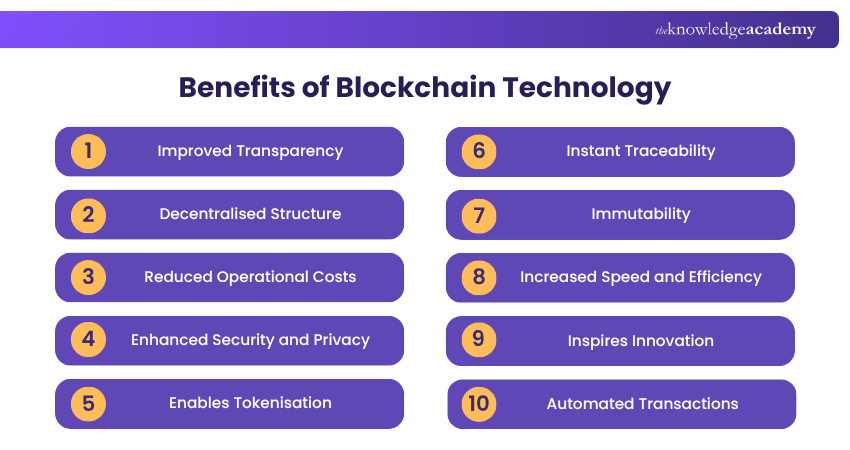
1) Transparency
Blockchain enhances transparency by storing identical copies of data across all nodes in the network. Every transaction is recorded and visible to participants, which makes tampering extremely difficult. Any update is instantly reflected across the entire network, ensuring strong accountability.

2) Decentralised Structure
Blockchain removes the need for a central authority and enables data sharing within an open ecosystem. For example, in supply chains, multiple organisations can securely access shared data without relying on a single entity. This promotes trust and seamless information exchange.
3) Cost Reduction
Blockchain significantly reduces operational costs. This is done by streamlining transactions, automating reporting and minimising manual intervention. It removes intermediaries and third-party dependencies, particularly in financial services. This helps cut the costs associated with settlement and auditing while improving overall efficiency.
4) Enhanced Security and Privacy
Blockchain’s encrypted and distributed structure takes data integrity to the next level. Since information is stored across a network of computers, hacking is nearly impossible. By anonymising data and enforcing permission-based access, Blockchain delivers much better privacy protection than traditional systems.
5) Enables Tokenisation
Tokenisation converts digital or real assets into digital tokens, which are stored on the Blockchain. Beyond NFTs and digital art, tokenisation supports practical applications such as Carbon Credit Trading and Asset Management. This helps businesses streamline their transactions and find new economic opportunities.
6) Instant Traceability
Blockchain creates an unalterable audit trail by tracking the assets throughout their lifecycle. This is invaluable for any industry combating fraud, counterfeiting or ethical concerns. It provides the customers with verified product origins and helps companies pinpoint inefficiencies and delays in their supply chains.
Redefine digital trust by building scalable dApps. Our comprehensive Ethereum Developer Training will show you how - Sign up now!
7) Immutability
Once recorded, Blockchain transactions cannot be altered or deleted. This ensures a permanent, tamper-proof record. Each entry is time-stamped, which supports transparent audits and historical tracking. This immutable nature makes Blockchain ideal for applications like property records and regulatory compliance.
8) Increased Speed and Efficiency
Blockchain accelerates transactions by replacing manual, paper-heavy processes with automated digital workflows. It reduces reconciliation efforts, thus allowing for faster settlements and more efficient business processes across industries.
9) Innovation
Blockchain sparks innovation across industries by solving long-standing inefficiencies. For example, academic institutions can store verified credentials on the Blockchain. This enables employers to validate degrees instantly, thus reducing fraud and improving trust in recruitment and verification processes.
10) Automated Transactions
Smart Contracts in Blockchain enable self-executing agreements that are triggered by predefined conditions. They eliminate manual intervention, reduce human error and deliver faster outcomes. For example, insurance claims can be automatically processed and paid once the required documentation is submitted and verified.
Blockchain Applications Across Several Industries
While Blockchain’s benefits extend across virtually every business sector, certain industries are particularly well-suited for its adoption, like Blockchain Accounting. Organisations are now moving beyond experimentation to real-world implementations. Let's explore some applications:
1) Benefits of Blockchain in Government
1) Proper Identity Management:
Governments can use Blockchain to establish secure digital identities for citizens. This can enable the safe management of personal data, credentials and transactions while reducing the risk of fraud or duplication.
2) Fair Elections:
Blockchain can drive tamper-proof voting systems. This can ensure election transparency and eliminate the possibility of manipulation or voter fraud.
3) Finance Management:
Blockchain allows governments to manage public finances more efficiently. This enables transparent fund allocation, reduces risks of corruption and ensures accountability in financial operations.
From Blockchain basics to the power of Bitcoin, learn about it all in our Bitcoin and Cryptocurrency Course - Register now!
2) Benefits of Blockchain in Healthcare
1) Patient Profile Privacy: Using decentralised ledger results in a uniform patient profile. Since everything can be exchanged and saved through a secure ledger, patients are no longer required to take their paperwork around with them.
2) Drug Traceability: Blockchain also benefits drug tracing. In a decentralised network where everything is tracked in real-time, there are virtually no ways for it to be compromised.
3) Better Clinical Trials: Patient data is protected and kept on a decentralised network for better clinical trials. Public health information can be used to conduct better clinical trials and research, increasing the likelihood that new medications will be discovered to treat various ailments.
3) Benefits of Blockchain in Logistics
1) Better Freight Tracking: Blockchain provides a reliable channel for authentication that also includes verification; no one can tamper with the information that is made public on the network. This can aid in tracking down all deliveries and maintaining them in real-time.
2) Vehicle-to-Vehicle Communication: Blockchain can help businesses efficiently optimise the information and swiftly secure all the data from vehicle-to-vehicle communication operations.
3) Security for the Internet of Things (IoT) Devices: This technology can provide security for IoT Devices (used in the logistics sector) and keep track of all the data they generate.
4) Blockchain Benefits in Supply Chain and Food Chain
1) Increased Trust: By securely sharing verified data, Blockchain cultivates transparency and trust among trading partners.
2) End-to-End Visibility: It provides real-time tracking of goods and ensures full visibility across every stage of the supply chain.
3) Process Efficiency: Streamlined operations and faster issue resolution create more resilient supply networks.
4) Enhanced Food Safety: In the food industry, Blockchain ensures the freshness of the products, reduces waste and allows contamination sources to be traced in seconds.
5) Banking and Financial Industry Blockchain Benefits
1) Process Optimisation: Replacing traditional paper-based workflows with Blockchain is key to streamlining financial operations and reducing manual intervention.
2) Faster Transactions: Blockchain removes friction and delays. This enables near-instant processing of payments, settlements and transfers.
3) Operational Efficiency: Financial institutions achieve greater efficiency across areas such as global trade, trade finance, clearing, consumer banking, and lending.
6) Pharmaceutical Blockchain Benefits
1) Comprehensive Tracking: Every action within the pharmaceutical supply chain is recorded on the Blockchain. This creates a transparent and secure digital ledger.
2) End-to-End Traceability: The complete audit trail allows the products to be traced properly from their origin to pharmacies or retailers.
3) Greater Safety: Such traceability helps prevent counterfeit drugs and helps manufacturers quickly identify and recall affected products when necessary.
7) Insurance Blockchain Benefits
1) Process Automation: Blockchain and smart contracts help automate labour-intensive tasks like underwriting and claims settlement.
2) Faster Transactions: Automation through Blockchain accelerates claim processing, reduces delays and improves customer experience.
3) Fraud Prevention: Blockchain’s secure, verifiable data exchange helps insurers detect and prevent fraud and abuse.
What are the Strengths and Weaknesses of Blockchain?
Here are the strengths of Blockchain:
1) Every transaction is recorded on a public ledger, allowing complete visibility and trust among users.
2) Advanced Data Encryption and decentralisation make Blockchain resistant to fraud, hacking and data tampering.
3) Once recorded, the transactions in Blockchain cannot be altered or deleted.
4) Blockchain eliminates the reliance on central authorities, thus reducing the risks of single-point failures.
5) Blockchain automates processes like payments and contracts, which reduces delays and human errors.
6) Blockchain enables precise tracking of assets, thus improving accountability in supply chains and finance.
Weaknesses of Blockchain:
1) Large networks can experience slow transaction speeds and high energy use.
2) Setting up Blockchain infrastructure and training staff can be expensive.
3) Integrating Blockchain into existing legacy systems can be a big challenge.
4) Lack of clear global regulations can create compliance and legal risks.
5) Proof-of-work mechanisms in some Blockchains require substantial computational power.
6) Public ledgers may expose transaction details, raising privacy concerns.
What are the Barriers to Blockchain Adoption?
One of the biggest challenges to Blockchain adoption is its technical complexity, which demands huge upfront investment in time, skilled talent and infrastructure. Many organisations find this initial commitment overwhelming. On top of that, there are ongoing concerns about data security and regulatory clarity. This continues to slow down the widespread implementation of Blockchain Technology.
Conclusion
The numerous Benefits of Blockchain Technology are undeniably powerful catalysts for global transformation. By harnessing the synergy of transparency, security and decentralisation, it fuels businesses towards building trust and efficiency like never before. As adoption of this technology grows, Blockchain’s true potential will continue to unfold, redefining how the world transacts and connects.
Master the tech behind Crypto, smart contracts and digital transformation. Sign up for our range of Blockchain Courses now!
Frequently Asked Questions
What are Some Examples of Blockchain Technology Across Industries?

Here are some examples:
1) JPMorgan’s Onyx unit develops Blockchain-based financial solutions
2) Brands like Gucci and Nike use NFTs to elevate digital ownership experiences
3) Synaptic Health Alliance explores Blockchain for secure provider Data Management
4) IBM and Mediaocean formed a Blockchain consortium for Digital Advertising
What are the Five Layers of the Blockchain?
Blockchain is built on five primary layers:
1) Hardware infrastructure
2) Data
3) Network
4) Consensus layer
5) Application
Each layer serves a distinct function, working together to build a comprehensive system, from managing data on the backend to fuelling user-facing applications.
What are the Other Resources and Offers Provided by The Knowledge Academy?
The Knowledge Academy takes global learning to new heights, offering over 3,000+ online courses across 490+ locations in 190+ countries. This expansive reach ensures accessibility and convenience for learners worldwide.
Alongside our diverse Online Course Catalogue, encompassing 17 major categories, we go the extra mile by providing a plethora of free educational Online Resources like Blogs, eBooks, Interview Questions and Videos. Tailoring learning experiences further, professionals can unlock greater value through a wide range of special discounts, seasonal deals, and Exclusive Offers.
What is The Knowledge Pass, and How Does it Work?
The Knowledge Academy’s Knowledge Pass, a prepaid voucher, adds another layer of flexibility, allowing course bookings over a 12-month period. Join us on a journey where education knows no bounds.
What are the Related Courses and Blogs Provided by The Knowledge Academy?
The Knowledge Academy offers various Blockchain Courses, including the Bitcoin and Cryptocurrency Course, Blockchain Training and the Ethereum Developer Training. These courses cater to different skill levels, providing comprehensive insights into Blockchain Security.
Our Advanced Technology Blogs cover a range of topics related to Benefits of Blockchain, offering valuable resources, best practices, and industry insights. Whether you are a beginner or looking to advance your Blockchain expertise, The Knowledge Academy's diverse courses and informative blogs have got you covered.

Richard Harris


Senior Full Stack Developer and Technology Educator
Richard Harris is a highly experienced full-stack developer with deep expertise in both frontend and backend technologies. Over his 12-year career, he has built scalable web applications for startups, enterprises and government organisations. Richard’s writing combines technical depth with clear explanations, ideal for developers looking to grow in modern frameworks and tools.


 If you wish to make any changes to your course, please


