


 Top Rated Course

We may not have the course you’re looking for. If you enquire or give us a call on + 800 908601 and speak to our training experts, we may still be able to help with your training requirements.
AI Risk Management: Importance, Types, and Best practices
Scarlett Adams 25 April 2026AI Risk Management identifies, assesses, and mitigates risks in AI systems to ensure responsible use, security, fairness, compliance, and reliable performance. It also addresses challenges such as bias, data privacy, and lack of transparency. Through continuous monitoring, organisations can ensure ethical outcomes while building trust.

Training Outcomes Within Your Budget!
We ensure quality, budget-alignment, and timely delivery by our expert instructors.
Table of Contents
Artificial Intelligence is now part of everyday life, from personalised recommendations to critical business decisions. While it makes processes faster and smarter, it can also go wrong in unexpected ways. This is where AI Risk Management becomes essential, helping organisations identify potential issues before they turn into serious problems.
A biased output, data breach, or incorrect prediction can quickly impact trust and outcomes. With AI Risk Management, organisations can stay in control, ensure responsible use, and reduce risks effectively. In this blog, you will explore its importance, types, challenges, and best practices. Let’s get started!
Table of Contents
1) What is AI Risk Management?
2) Why is AI Risk Management Important?
3) Types of Artificial Intelligence Risks
4) What is the Role of AI in Risk Management?
5) Challenges of AI in Risk Management
6) Why Do Companies Need AI Risk Management?
7) AI in Risk Management Examples
8) Best Practices for Implementing AI in Risk Management
9) Conclusion
What is AI Risk Management?
AI Risk Management refers to the structured approach organisations use to identify, assess, and reduce risks linked to Artificial Intelligence systems. It goes beyond traditional Risk Management by addressing AI-specific challenges such as algorithmic bias, lack of transparency, data privacy concerns, and unpredictable system behaviour.
It involves continuous monitoring throughout the AI lifecycle, from design and development to deployment and ongoing use. This includes checking data quality, testing system reliability, and tracking performance over time. The aim is to support innovation while ensuring safe, ethical, and reliable AI use.
Why is AI Risk Management Important?
AI Risk Management is important because it ensures AI systems are used safely, ethically, and effectively across critical processes. As AI adoption grows, unmanaged risks can lead to serious consequences. Here are the key reasons it matters:
1) Prevent AI Failures and Unexpected Outcomes
AI systems can fail in unpredictable ways compared to traditional software systems. Without proper risk management, these failures may lead to harmful or unintended outcomes. In high-risk sectors such as healthcare, autonomous vehicles, and finance, such failures can impact safety, finances, and organisational reputation.
2) Promote Ethical and Responsible AI Usage
As AI systems grow more advanced, ethical concerns become more significant. AI Risk Management helps organisations ensure that systems follow ethical principles, such as fairness, transparency, and respect for human decisions. This ensures AI is used responsibly and aligns with organisational values.
3) Protect Against Bias and Discrimination
AI systems depend on historical data, which may contain biases. Without proper controls, AI can reinforce or increase discrimination. AI Risk Management helps identify and reduce bias at every stage, from data collection to deployment, ensuring fair and inclusive outcomes.
Types of Artificial Intelligence Risks
AI systems introduce a wide range of risks beyond traditional IT challenges, impacting performance, security, operations, ethics, and compliance. Understanding these helps organisations manage AI effectively and reduce harm. Here are the key types to consider:
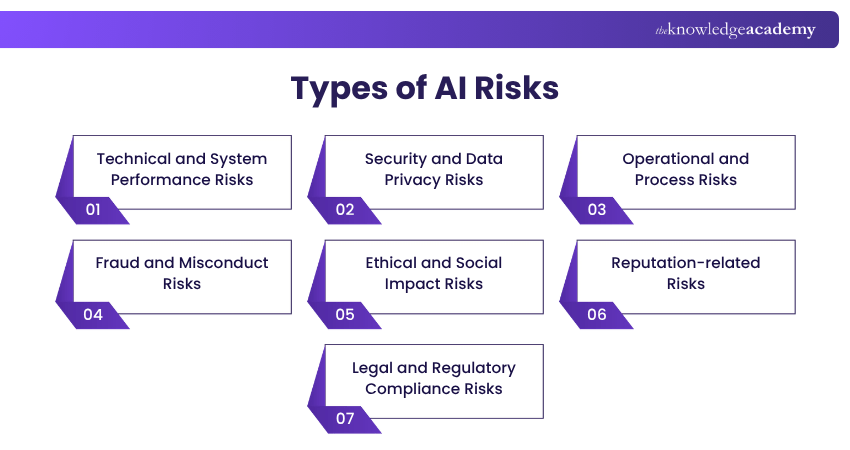
1) Technical and System Performance Risks
These risks occur when AI systems fail to deliver accurate, stable, or consistent results. Issues like model errors, performance drift, or unreliable outputs can reduce system effectiveness and lead to incorrect decisions or outcomes.
2) Security and Data Privacy Risks
AI systems rely heavily on large datasets, making them vulnerable to cyberattacks, data breaches, and misuse of sensitive information. Weak security controls can compromise data privacy, system integrity, and organisational trust.
3) Operational and Process Risks
These risks arise when AI systems are poorly integrated into existing workflows. Lack of clear processes, inadequate oversight, or human errors can disrupt operations, reduce efficiency, and create confusion across teams and systems.
4) Fraud and Misconduct Risks
AI can be exploited for malicious activities such as generating fake content, automating scams, or manipulating data. Without proper safeguards, it may enable unethical behaviour and increase the risk of fraud and misuse.
5) Ethical and Social Impact Risks
AI systems may raise concerns about fairness, transparency, and accountability. If not properly managed, they can reinforce bias, negatively affect individuals or groups, and create broader societal challenges and trust issues.
6) Reputation-related Risks
Failures or misuse of AI systems can damage an organisation’s reputation. Biased outputs, inaccurate decisions, or unethical practices may reduce public confidence, harm brand image, and impact long-term customer relationships.
7) Legal and Regulatory Compliance Risks
AI systems must comply with laws related to data protection, fairness, and accountability. Failure to meet regulatory requirements can result in legal penalties, financial losses, and restrictions on business operations and AI deployment.
Gain theoretical knowledge regarding the different Machine Learning algorithms with our Machine Learning Course – Register now!
What is the Role of AI in Risk Management?
AI plays a critical role in modern Risk Management by improving how organisations identify, analyse, and respond to risks. It enhances traditional methods with speed, accuracy, and data-driven insights. Here are the key roles AI performs:
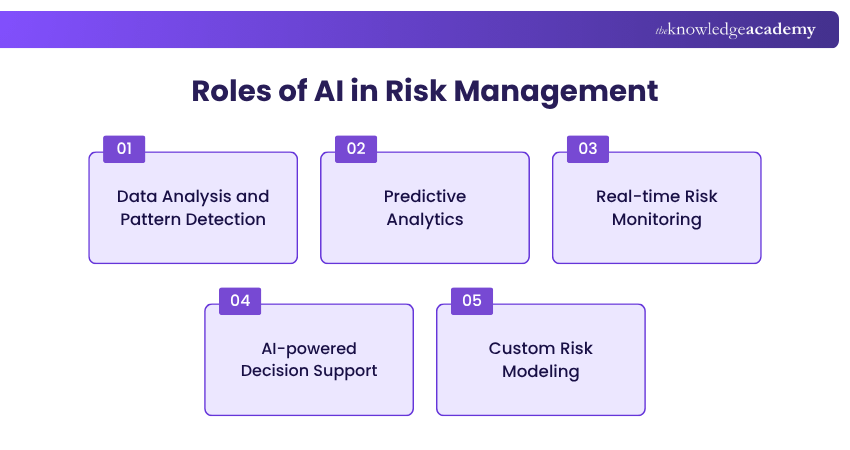
1) Data Analysis and Pattern Detection
AI processes large volumes of structured and unstructured data with high speed and accuracy. It identifies hidden patterns, trends, and anomalies that may go unnoticed, helping organisations detect potential risks early and act proactively.
2) Predictive Analytics
AI uses historical data and Machine Learning models to forecast potential risks and their impact. This allows organisations to take preventive actions in advance, reducing uncertainty and minimising the chances of negative outcomes.
3) Real-time Risk Monitoring
AI systems continuously monitor data and risk factors instead of relying on periodic checks. This real-time tracking enables organisations to detect sudden changes quickly and respond to risks before they escalate into serious issues.
4) AI-powered Decision Support
AI supports decision-making by providing data-driven insights and recommendations. It evaluates multiple risk scenarios and outcomes, helping decision-makers choose the best course of action with greater confidence and reduced human error.
5) Custom Risk Modeling
AI enables organisations to build customised risk models based on their specific needs. These models consider unique business environments and risk factors, offering more accurate and relevant risk assessments compared to traditional approaches.
Challenges of AI in Risk Management
While AI offers many benefits, it also brings challenges that organisations must manage carefully. Issues such as data quality, bias, and system complexity can affect outcomes. Here are the key challenges to consider:
1) Data Quality and Accuracy
AI systems rely on large volumes of data, and poor-quality, incomplete, or biased data can lead to unreliable outcomes. Organisations must ensure strong data governance through regular audits, validation checks, and data cleansing processes.
2) Algorithm Bias and Fairness Issues
AI models can unintentionally reflect or amplify biases present in training data, leading to unfair decisions. Addressing this requires bias detection frameworks, diverse data sources, and continuous monitoring to ensure fairness across all stages.
3) Limited Transparency in AI Systems
Many AI models, especially deep learning systems, lack transparency, making it difficult to know how decisions are made. Organisations should adopt explainable AI approaches to improve clarity, trust, and accountability in decision-making processes.
4) Integration with Legacy Systems
Integrating AI into existing systems can be complex due to compatibility issues with legacy infrastructure. A phased implementation approach helps ensure smooth integration while minimising disruptions to current processes and maintaining operational continuity.
5) Regulatory and Compliance Uncertainty
AI regulations are evolving across industries and regions, creating uncertainty for organisations. Staying updated with legal requirements and aligning AI systems with compliance standards requires close collaboration between legal, IT, and Risk Management teams.
Gain hands-on experience using AI to visualise complex datasets efficiently with our AI With Power BI Course – Register today!
Why Do Companies Need AI Risk Management?
As organisations increasingly rely on AI, managing risks becomes essential for safe and effective use. Without proper controls, AI systems can create ethical, legal, and operational challenges. AI Risk Management helps reduce these risks and maximise value. Here are the key reasons:
1) Protect Brand Reputation:
AI systems directly influence public perception. Effective Risk Management helps prevent failures or biases that could damage trust, harm brand image, and create negative publicity.
2) Reduce Legal and Financial Risks:
AI-related issues like data breaches or discrimination can lead to lawsuits and fines. Risk Management ensures compliance with laws, reducing penalties and preventing costly liabilities.
3) Ensure Safe and Ethical AI Use:
AI Risk Management frameworks promote fairness, transparency, and safety. This helps organisations avoid biased or harmful decisions while ensuring responsible use of AI technologies.
4) Build Trust with Stakeholders:
By managing AI risks effectively, companies demonstrate accountability and transparency. This builds confidence among customers, regulators, and stakeholders, supporting long-term relationships and future AI adoption.
AI in Risk Management Examples
AI is increasingly used across industries to identify risks early and respond proactively. Analysing large datasets and recognising patterns helps organisations reduce uncertainty and improve decision-making. Here are some common real-world examples:
1) Healthcare: Prediction in Patient Risks
In healthcare, AI helps identify patients who may face higher risks, such as readmission. By analysing medical records, current conditions, and lifestyle factors, it enables timely interventions and improves overall patient care outcomes.
2) Manufacturing: Equipment Failure Prevention
AI is used in manufacturing to monitor machinery and detect early warning signs of failure. By analysing sensor data, it helps schedule maintenance in advance, reducing downtime, lowering costs, and improving operational efficiency.
3) Retail: Managing Supply Chain Risks
In retail, AI helps identify potential disruptions in the supply chain by analysing data like weather, logistics, and market trends. This helps businesses take proactive steps and ensure smooth operations
Learn the linear regression method to find relationships between two variables with our AI and ML with Excel Training – Join today!
Best Practices for Implementing AI in Risk Management
To use AI effectively in Risk Management, organisations must follow structured practices that reduce risks while maximising value. These practices ensure safe, ethical, and reliable AI adoption. Here are some key best practices to follow:
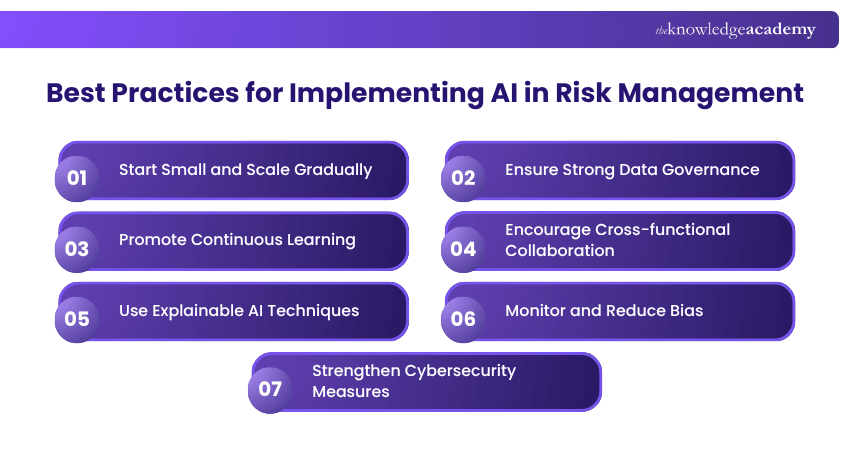
1) Start Small and Scale Gradually:
Begin with pilot projects to test AI in controlled environments. This allows organisations to evaluate performance, learn from challenges, and expand implementation with reduced risk.
2) Ensure Strong Data Governance:
Maintain high data quality through clear standards, regular audits, and data cleansing. This improves the accuracy and reliability of AI-driven risk assessments.
3) Promote Continuous Learning:
Encourage teams to stay updated with AI advancements through training, workshops, and knowledge-sharing. This helps organisations adapt to new tools and improve Risk Management practices.
4) Encourage Cross-functional Collaboration:
Involve teams from IT, legal, and business functions to ensure AI systems are technically sound, compliant, and aligned with organisational goals.
5) Use Explainable AI Techniques:
Adopt models that provide transparency in decision-making. Explainable AI helps stakeholders understand outcomes, improving trust and accountability.
6) Monitor and Reduce Bias:
Regularly review AI systems to detect bias and ensure fairness. Use diverse datasets and update models to maintain ethical and unbiased decision-making.
7) Strengthen Cybersecurity Measures:
Protect AI systems with robust security controls to prevent data breaches and cyber threats, ensuring the safety and integrity of sensitive information.
Conclusion
AI Risk Management is essential for organisations aiming to use AI safely and effectively. By understanding risks, applying best practices, and ensuring ethical use, businesses can build trust, improve decisions, and reduce harm. A proactive approach not only protects operations but also unlocks the full potential of AI for long-term success.
Gain practical experience with AI tools and automation technologies with our Artificial Intelligence Courses – Join now!
Frequently Asked Questions
How are AI Risks Classified?

AI risks are classified into categories such as technical, security, operational, ethical, reputational, and regulatory risks. These groups help organisations identify potential issues, assess impact, and apply appropriate controls to manage risks effectively.
What is the Difference Between AI Governance and AI Risk Management?
AI governance sets the policies, standards, and oversight for how AI is developed and used responsibly within an organisation. AI Risk Management focuses on identifying, assessing, and reducing specific risks such as bias, errors, and security issues across the AI system lifecycle.
What are the Other Resources and Offers Provided by The Knowledge Academy?
The Knowledge Academy takes global learning to new heights, offering over 3,000+ online courses across 490+ locations in 190+ countries. This expansive reach ensures accessibility and convenience for learners worldwide.
Alongside our diverse Online Course Catalogue, encompassing 17 major categories, we go the extra mile by providing a plethora of free educational Online Resources like Blogs, eBooks, Interview Questions and Videos. Tailoring learning experiences further, professionals can unlock greater value through a wide range of special discounts, seasonal deals, and Exclusive Offers.
What is The Knowledge Pass, and How Does it Work?
The Knowledge Academy’s Knowledge Pass, a prepaid voucher, adds another layer of flexibility, allowing course bookings over a 12-month period. Join us on a journey where education knows no bounds.
What are the Related Courses and Blogs Provided by The Knowledge Academy?
The Knowledge Academy offers various Artificial Intelligence Courses, including the Artificial Intelligence (AI) For Project Managers Training, AI with Power BI Course, and the Machine Learning Course. These courses cater to different skill levels, providing comprehensive insights into Industries AI Will Disrupt.
Our Data, Analytics & AI Blogs cover a range of topics related to AI Risk Management, offering valuable resources, best practices, and industry insights. Whether you are a beginner or looking to advance your Artificial Intelligence skills, The Knowledge Academy's diverse courses and informative blogs have got you covered.
Upcoming Data, Analytics & AI Resources Batches & Dates
Date
 Artificial Intelligence (AI) for Project Managers
Artificial Intelligence (AI) for Project Managers
Fri 14th Aug 2026
Artificial Intelligence (AI) for Project Managers
Fri 18th Sep 2026

 If you wish to make any changes to your course, please


