


 Top Rated Course


We may not have the course you’re looking for. If you enquire or give us a call on +44 1344 203 999 and speak to our training experts, we may still be able to help with your training requirements.
What is Nominal Data? The Ultimate Guide With Examples
William Brown 19 February 2026Nominal Data is categorical qualitative information that labels variables like names or types without order or ranking, useful for classification. It groups items into clear, distinct categories for easier comparison and understanding. Researchers often use it in surveys, questionnaires, and basic statistical data analysis studies.

Training Outcomes Within Your Budget!
We ensure quality, budget-alignment, and timely delivery by our expert instructors.
Table of Contents
Data helps organisations and researchers understand patterns, behaviour, and trends more clearly. Different data types serve different purposes, especially in analysis and decision-making. In this blog, we’ll explore What Is Nominal Data and why it matters in statistics and research. Let’s start by looking at how it is defined and its characteristics.
Table of Contents
1) What is Nominal Data?
2) Characteristics of Nominal Data
3) Examples of Nominal Data
4) How to Collect Nominal Data?
5) How to Analyse Nominal Data?
6) Difference Between Nominal and Ordinal Data
7) Conclusion
What is Nominal Data?
Nominal Data is a qualitative, categorical type of data used to describe attributes of people, objects, or events using labels or names. These categories do not carry any numerical value or natural order, so they cannot be ranked meaningfully.
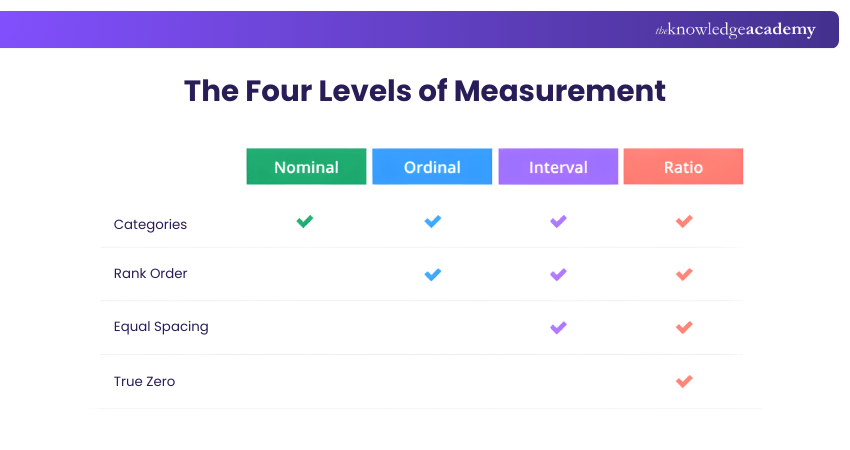
It represents the first level of measurement in statistics and is commonly used to classify observations into distinct groups. Researchers often combine it with other data types to better understand research questions and study populations.

Characteristics of Nominal Data
Nominal Data is a fundamental type of data characterised by several distinct features:
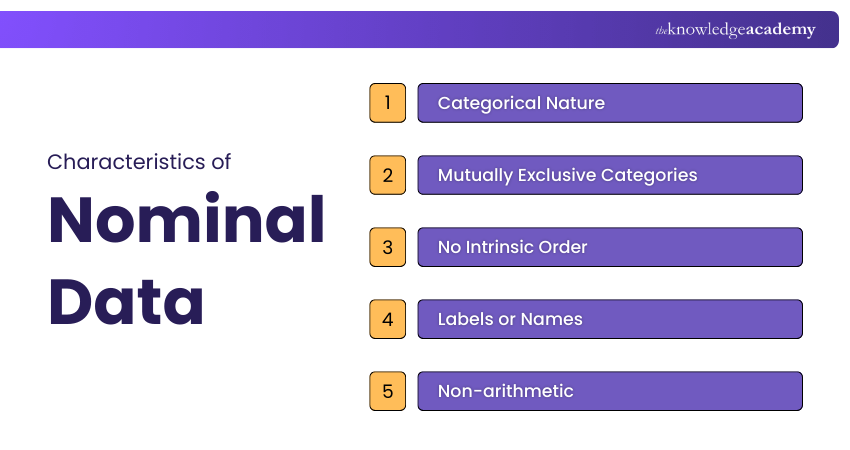
a) Categorical Nature: Nominal Data is entirely categorical, meaning it represents discrete categories without any associated numerical values. It’s used for sorting data into distinct groups based on qualitative attributes rather than quantitative measures.
b) Mutually Exclusive Categories: Each data point can belong to only one category at a time. For example, in a survey on preferred pet types, a respondent can choose only one pet type, such as “dog” or “cat,” but not both simultaneously.
c) No Intrinsic Order: The categories in Nominal Data do not have any inherent order or ranking. For instance, the categories “red,” “blue,” and “green” in a colour preference survey do not imply a sequence or hierarchy.
d) Labels or Names: Nominal Data is often represented by labels or names, such as “male” and “female” for gender, or “urban,” “suburban,” and “rural” for residential areas. These labels simply identify different categories without implying any order.
e) Non-arithmetic: Arithmetic operations like addition, subtraction, multiplication, and division are not applicable to Nominal Data. The data is used purely for classification and comparison, not for quantitative analysis.
Understand core principles of business analysis methodologies with Certified Business Analyst Professional (CBA-PRO) Course – Join now!
Examples of Nominal Data
Nominal Data groups observations into categories where each item belongs to only one label and the categories cannot be ranked. Common examples include gender, ethnicity, political preference, or student identification numbers, all used to classify responses rather than measure quantity.
It can also appear in everyday variables such as preferred transport type, employment status (employed or unemployed), literary genres, or zip codes. Even when numbers are assigned as labels, they still act only as names and cannot be ordered or used for calculations.
How to Collect Nominal Data?
Nominal Data is commonly collected using survey questions, which may be either open-ended or closed-ended depending on the number of possible categories. When the variable has a limited set of labels, closed-ended questions are used so respondents can choose from predefined options.
Closed-ended questions work best when all possible responses are known in advance. For example, respondents may select their gender, smartphone ownership (yes/no), or favourite movie genre from a list of options.
If a variable has many possible labels or cannot be predicted, open-ended questions are more appropriate. Participants provide their own answers, such as a student ID number, zip code, or native language.
Unlock the power of data with our Introduction to Statistics Course. Join now and start your journey towards data-driven decision-making!
How to Analyse Nominal Data
Nominal Data is analysed by organising responses into categories and examining how often each label appears. The following steps explain how researchers summarise and interpret these categorical results clearly.
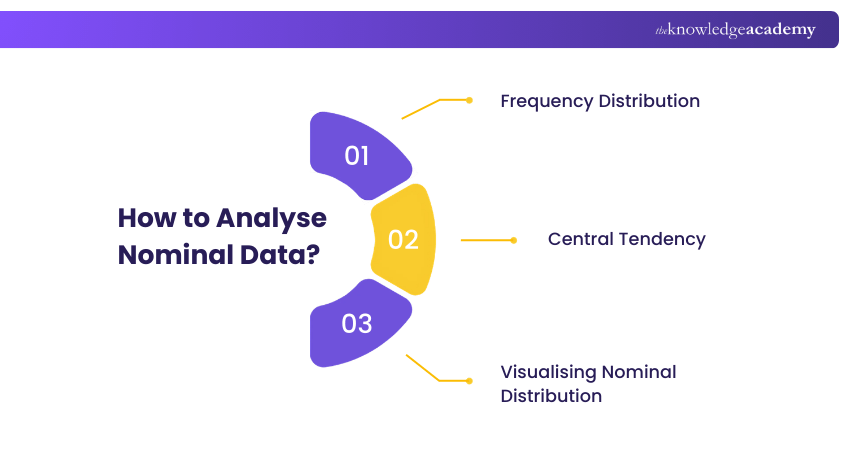
Frequency Distribution
Nominal Data is organised into categories and counted to see how often each label appears. A frequency distribution table lists every category with its number of responses. Frequencies can also be converted into percentages for clearer comparison.
Central Tendency
The only useful measure of central tendency for nominal data is the mode. It identifies the category that appears most frequently in the dataset. Mean and median cannot be calculated because the data has no order or numeric value.
Visualising Nominal Distribution
Nominal Data can be displayed using bar charts or pie charts. Bar charts compare category frequencies, while pie charts show proportions of each group. The order of categories does not matter because they have no ranking.
Maximise efficiency and profits—Join our Mathematical Optimisation for Business Problems Course and master the art of optimal decision-making.
Difference Between Nominal and Ordinal Data
Nominal and ordinal data are both types of categorical data, but they have distinct differences.
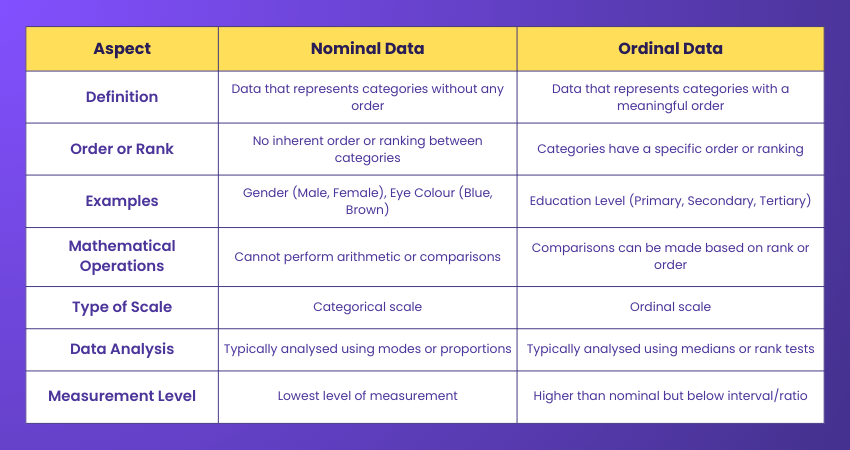
Nominal Data represents categories without any intrinsic order or ranking. Each category is unique and mutually exclusive, such as gender, race, or colour preferences. The primary purpose is to classify data into distinct groups where no category is considered higher or lower than another. Arithmetic operations are not applicable.
Ordinal Data, on the other hand, involves categories with a meaningful order or ranking. The categories indicate a progression or level of intensity, such as educational attainment (e.g., high school, bachelor’s, master’s) or Customer Satisfaction ratings (e.g., poor, fair, good, excellent).
While the exact differences between categories are not quantified, the order is significant and reflects relative position. Unlike Nominal Data, ordinal data allows for some level of comparison based on the ranking of categories.
Conclusion
Understanding data becomes much easier once you know What Is Nominal Data and how it actually works in real life. From surveys to simple classifications, these labels quietly power many everyday analyses. Hopefully this blog helped make the topic clearer and a lot less intimidating!
Enhance Quality Management — Sign up for our Statistical Process Control Training today!
Frequently Asked Questions
What is Nominal vs Real Data?

Nominal Data comprises categorical labels that lack numerical value or inherent order (e.g., colors, gender, brands). In contrast, real data (also known as ratio data) includes measurable quantities with a true zero point, enabling meaningful comparisons (e.g., height, weight, income).
How do I Decide Which Level of Measurement to use?
Choosing a level of measurement depends on how precisely you want to record your variable and whether it can be ranked. Some variables are fixed, like gender or ethnicity, while others (such as income) can be measured in grouped categories or exact values depending on the analysis needed.
What are the Other Resources and Offers Provided by The Knowledge Academy?
The Knowledge Academy takes global learning to new heights, offering over 3,000+ online courses across 490+ locations in 190+ countries. This expansive reach ensures accessibility and convenience for learners worldwide.
Alongside our diverse Online Course Catalogue, encompassing 19 major categories, we go the extra mile by providing a plethora of free educational Online Resources like Blogs, eBooks, Interview Questions and Videos. Tailoring learning experiences further, professionals can unlock greater value through a wide range of special discounts, seasonal deals, and Exclusive Offers.
What is The Knowledge Pass, and How Does it Work?
The Knowledge Academy’s Knowledge Pass, a prepaid voucher, adds another layer of flexibility, allowing course bookings over a 12-month period. Join us on a journey where education knows no bounds.
What are the Related Courses and Blogs Provided by The Knowledge Academy?
The Knowledge Academy offers various Business Analyst Courses, including the Certified Business Analyst Professional (CBA-PRO) Course, Business Process Mapping Training and Business Analyst Fundamentals Training. These courses cater to different skill levels, providing comprehensive insights into Statistical Modeling.
Our Business Analysis Blogs cover a range of topics related to Nominal Data, offering valuable resources, best practices, and industry insights. Whether you are a beginner or looking to advance your Statistical Analysis skills, The Knowledge Academy's diverse courses and informative blogs have got you covered.

William Brown


Senior Business Analyst and Strategic Advisor
William Brown is a senior business analyst with over 15 years of experience driving process improvement and strategic transformation in complex business environments. He specialises in analysing operations, gathering requirements and delivering insights that support effective decision making. William’s practical approach helps bridge the gap between business goals and technical solutions.
View Detail

 If you wish to make any changes to your course, please


