


 Top Rated Course

We may not have the course you’re looking for. If you enquire or give us a call on +44 1344 203 999 and speak to our training experts, we may still be able to help with your training requirements.
Emotional Awareness: Definition, Levels and Benefits
The Knowledge Academy 18 March 2026Emotional Awareness is the ability to recognise and understand your emotions and others’, identify their causes, and manage reactions to improve relationships. It helps people respond calmly in challenging situations and communicate clearly. This skill also supports better decisions and stronger relationships.

Training Outcomes Within Your Budget!
We ensure quality, budget-alignment, and timely delivery by our expert instructors.
Table of Contents
Emotions are a silent language, quietly shaping your thoughts, actions, and relationships every day. But how often do you truly stop to understand what they’re telling you? Emotional Awareness goes beyond simply recognising happiness or sadness, it’s about uncovering the deeper emotions that influence your decisions and overall wellbeing.
In this blog, we’ll explore the importance of Emotional Awareness, its different levels, and practical ways to harness its potential. Whether your aim is to improve communication, manage stress, or strengthen your connections with others, developing emotional insight is the key. Let’s get started!
Table of Contents
1) What is Emotional Awareness?
2) Why is Emotional Awareness Important?
3) Levels of Emotional Awareness
4) Why Do you Lack Emotional Awareness?
5) Tips for Improving Emotional Awareness
6) Emotional Awareness vs Emotional Intelligence
7) Benefits of Emotional Awareness
8) How Does Emotional Awareness Differ from Empathy?
9) Conclusion
What is Emotional Awareness?
Emotional Awareness is the skill to identify, know and detect feelings in others and yourself. It is the ability to notice how you are experiencing something at a given time and correctly label what those feelings are instead of calling them good or bad.
It also involves learning how emotions affect your thinking, behaviour and decision making. Through Emotional Awareness, individuals who have a high emotional intelligence can control their emotions, communicate better, and have a better relationship management.

Why is Emotional Awareness Important?
Emotional Awareness plays a crucial role in understanding and managing our feelings, significantly impacting our personal and professional lives. It enhances Emotional Intelligence, improves empathy, and promotes better mental well-being.
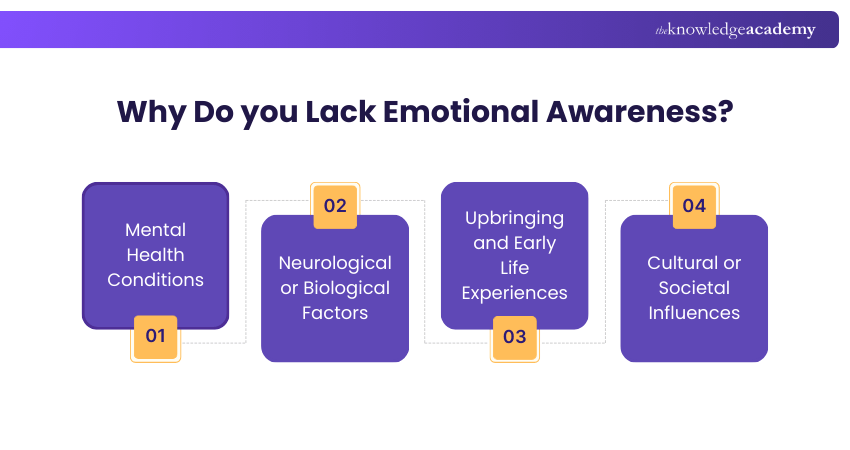
1) Foundation for Emotional Intelligence: Emotion awareness is the basis for forming Emotional Intelligence and, on that basis, affects all a person's relations with society, as well as in the professional environment.
2) Better Emotion Regulation: Being aware of your emotions enhances your Emotional Control, enabling you to regulate them more effectively, preventing impulsive reactions and encouraging thoughtful responses to challenges.
3) Enhanced Empathy: Emotional Awareness improves empathy, allowing you to understand and share the feelings of others, fostering stronger and healthier relationships.
4) Improved Communication: Recognising emotional cues in others leads to better communication, as it helps you respond appropriately in various social situations.
5) Mental Health Benefits: Emotional Awareness supports Mental Health by allowing individuals to process emotions instead of suppressing them, which reduces stress and anxiety.
Discover the secrets behind gestures and postures! Register for our Understanding Body Language Training to refine your non-verbal communication skills today.
Levels of Emotional Awareness
The development of Emotional Awareness is a slow process. Psychologists identify five degrees of Emotional Awareness which reveals how individuals progress in perceiving emotions in the body to obtaining in-depth understanding of more complicated emotional processes. Each level reflects a deeper ability to recognise and interpret feelings in ourselves and others.
Following are the levels of Emotional Awareness:
1) Level 1: Physical Sensations
At the first level, emotions are usually perceived as bodily sensations. One can experience some physical responses like rapid heartbeat, tension in the muscles or nervous stomach but cannot relate these feelings to a particular emotion.
2) Level 2: Action Tendencies
Emotions at this level manifest as the urge or impulse to act. Rather than labelling the emotion, an individual might focus on what they want to do, such as leaving a situation, arguing, or avoiding someone.
3) Level 3: Single Emotions
The third level consists of persons being able to identify and name certain emotions. They may identify feelings such as anger, sadness, happiness, or fear. But emotions are generally perceived individually.
4) Level 4: Mixed Emotions
At this level, individuals start to realise that various emotions may co-exist simultaneously. Emotions are more sophisticated, and people learn that it is possible that emotional responses are contradictory.
5) Level 5: Complex Emotional Awareness
The top level is the advanced knowledge of emotional experiences not only in oneself but also in other people. Individuals in this level are able to identify complex emotional patterns and comprehend how various people might experience the same situation differently.
Why Do you Lack Emotional Awareness?
While some people consider it to be a natural occurrence to be naturally extremely emotional aware, others may not. Recognising why you might lack Emotional Awareness can sometimes be the first step toward improving this condition.
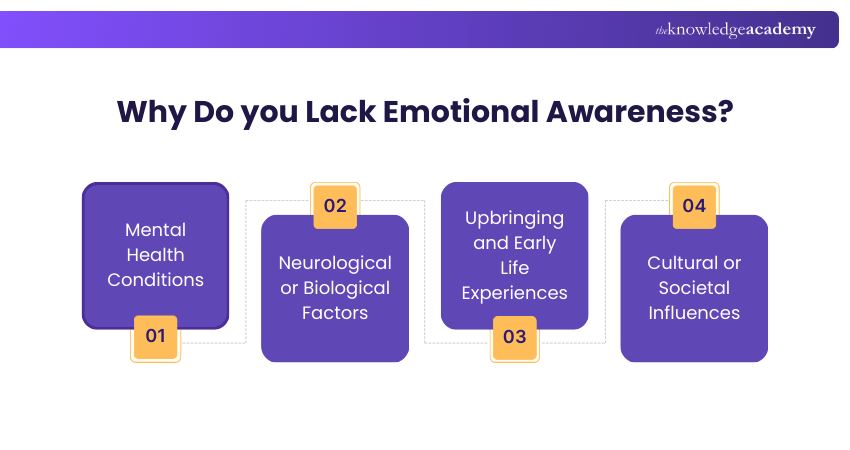
1) Mental Health Conditions
Mental disorders such as depression, anxiety, or alexithymia (a condition that makes it hard to identify or describe emotions) can affect Emotional Awareness. They will then lose contact with emotions or fail to verbalise them in the most effective manner. This makes the individual lose their feelings or remain confused emotionally.
2) Neurological or Biological Factors
Some forms of neurological disorders or brain injury may lead to difficulties with emotion processing. For instance, the prefrontal cortex injury causes harm to emotional regulation, while imbalance in neurotransmitters may influence an individual's mood or changing emotional reaction. Fluctuations in hormones, such as during puberty, pregnancy, or menopause, can also cause imbalances in Emotional Awareness.
3) Upbringing and Early Life Experiences
The cultural context in which you grew up plays an important role in determining what your depth of Emotional Awareness might be. Kids who grow up in a culture that rejects or denies emotions and live may learn how to check out of their emotions. Also, those children who have experienced some form of childhood trauma might not comprehend or be able to work through it as adults.
4) Cultural or Societal Influences
Cultural norms and social expectations can often suppress Emotional Awareness. For example, in some cultures, emotional display is believed to be a weakness for men, making people feel repressed. People may also be socially conditioned to be happier or strong with others.
Tips for Improving Emotional Awareness
Improving your Emotional Awareness is a process that takes time through reflection and practice. Here are some effective tips to help develop this valuable ability.
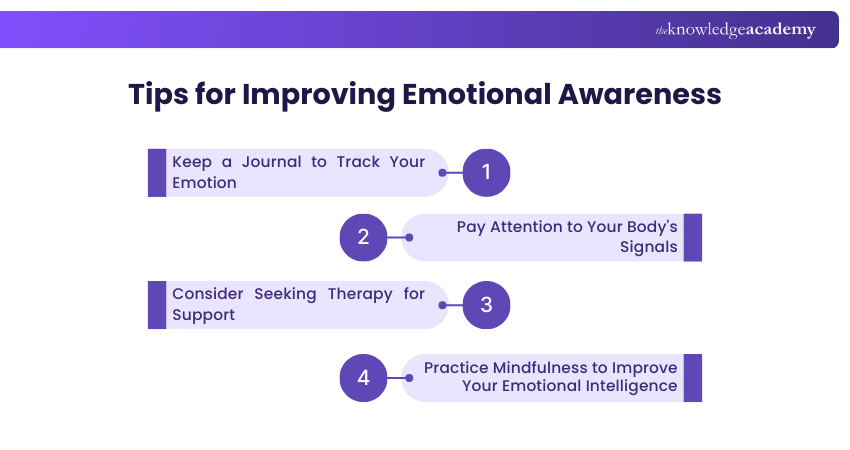
1) Keep a Journal to Track Your Emotion
Writing about emotions is a very effective technique for heightening awareness. By keeping a daily journal, you can record when you felt this way, how you got there, and what you did with it. You'll notice patterns and get a clearer sense of what that emotional landscape looks like.
2) Pay Attention to Your Body's Signals
You often feel before you think. Pay close attention to your body, noticing tension in your muscles, a racing heart, or shallow breathing. These somatic signals are golden indicators of how you are feeling emotionally.
3) Consider Seeking Therapy for Support
If you are not going to listen to your inner experience, therapy will offer a secure environment where you can express your emotions with a trained professional. Cognitive-behavioural therapy, among others, will attune you to pay more attention to your inner experience and then teach you how to handle those appropriately.
4) Practice Mindfulness to Improve Your Emotional Intelligence
Mindfulness is the ability to be fully present in the present without judgment. You'll pay attention to all your feelings as they arise through mindfulness exercise such as meditating or deep breathing exercises. Mindfulness teaches you how to regard your feelings without allowing those feelings to overpower you.
Strengthen the art of managing challenging interactions! Join our Dealing with Difficult People Course and enhance your communication skills.
Emotional Awareness vs Emotional Intelligence
Emotional Intelligence and Emotional Awareness are two similar but distinct concepts. Emotional Awareness refers to one knowing and understanding his own feelings and the feelings of other people. It is primarily concerned with understanding what you feel and what makes you feel that way.
Emotional Intelligence, however, goes beyond perception. It is the application of Emotional Awareness to direct emotions, be responsive and develop good relationships with others. In simple terms, Emotional Awareness is the foundation, while emotional intelligence is the ability to apply that understanding in real-life situations.
Benefits of Emotional Awareness
Emotional Awareness enables individuals to know their emotions and those of others better. This skill enhances communication, leadership, and relationships and it becomes easier to react calmly and make better decisions in various circumstances.
1) Stronger Leadership Qualities
Leaders with Emotional Awareness can recognise how their team members feel and respond appropriately. This assists them in making more appropriate decisions, managing disagreements without tension, and leading their teams with greater efficiency. Consequently, leaders who are sensitive to emotions tend to build positive and efficient working conditions.
2) Able to Motivate Teams More Effectively
When leaders are aware of how members of the team feel, they are able to motivate them better. Emotional awareness enables leaders to identify when employees are stressed, frustrated or discouraged and support or encourage them in a way that enhances morale and productivity.
3) Build Trust
Emotional awareness also helps individuals listen attentively and understand the emotions of other people. Trust is built when people are treated with understanding and respect and this creates stronger professional and personal relationships.
4) Lower Levels of Social Anxiety
Interpreting and identifying feelings can enhance misunderstandings and doubt when in social contexts. Emotionally conscious people tend to be in better control of their emotional reactions which reduces anxiety feelings, and confidence in social contexts increases.
5) Better Relationships with Friends and Family
Emotional awareness enables one to communicate their emotions and to comprehend those of others. This leads to more open communication, fewer misunderstandings, and healthier relationships with friends and family members.
How Does Emotional Awareness Differ from Empathy?
Both Emotional Awareness and empathy are concerned with emotion but concentrate on different aspects. Emotional awareness is having the capability to perceive and comprehend your emotions and their impact on your behaviour.
Empathy on the other hand is the skill to empathise and feel what others feel. In simple terms, Emotional Awareness focuses on your emotions, while empathy focuses on the emotions of other people.
Conclusion
Emotional Awareness is a vital skill that impacts every aspect of life, from personal relationships to professional success. By understanding the levels of awareness and recognising the reasons behind a lack of emotional understanding, you can take proactive steps to enhance this skill. Remember, building awareness about emotions is a lifelong journey, but it's a rewarding one that leads to a more fulfilling and connected life.
Boost your communication skills with our Active Listening Training - Join now!
Frequently Asked Questions
How do Your Emotions Impact Others?

Positive emotions tend to lift people from misery while negative emotions are likely to create tension or stress. With Emotional Awareness, you can become aware of this impact hence leading to positive communication with healthy relationships.
How to Deal with Someone Who Lacks Emotional Intelligence?
Be sensitive and sympathetic while dealing with the issue. Make sure you communicate your emotions, set appropriate boundaries, and attempt to open communication to them. They may learn about the emotional nature of their actions through your honest feedback without judgment as enhanced communication can thus be made with them over time.
What are the Other Resources and Offers Provided by The Knowledge Academy?
The Knowledge Academy takes global learning to new heights, offering over 3,000+ online courses across 490+ locations in 190+ countries. This expansive reach ensures accessibility and convenience for learners worldwide.
Alongside our diverse Online Course Catalogue, encompassing 17 major categories, we go the extra mile by providing a plethora of free educational Online Resources like Blogs, eBooks, Interview Questions and Videos. Tailoring learning experiences further, professionals can unlock greater value through a wide range of special discounts, seasonal deals, and Exclusive Offers.
What is The Knowledge Pass, and How Does it Work?
The Knowledge Academy’s Knowledge Pass, a prepaid voucher, adds another layer of flexibility, allowing course bookings over a 12-month period. Join us on a journey where education knows no bounds.
What are the Related Courses and Blogs Provided by The Knowledge Academy?
The Knowledge Academy offers various Personal Development Courses, including the Anti-Social Behaviour Management Training, Introduction To Managing People, and Personal & Organisational Development. These courses cater to different skill levels, providing comprehensive insights into Behaviour Management.
Our Business Skills Blogs cover a range of topics related to Behaviour Management, offering valuable resources, best practices, and industry insights. Whether you are a beginner or looking to advance your Business Skill. The Knowledge Academy's diverse courses and informative blogs have got you covered.

The Knowledge Academy


Global Training Provider
The Knowledge Academy is a world-leading provider of professional training courses, offering globally recognised qualifications across a wide range of subjects. With expert trainers, up-to-date course material, and flexible learning options, we aim to empower professionals and organisations to achieve their goals through continuous learning.

Upcoming Business Skills Resources Batches & Dates
Date
 Understanding Body Language Training
Understanding Body Language Training
Fri 7th Aug 2026
Understanding Body Language Training
Fri 2nd Oct 2026

 If you wish to make any changes to your course, please


