


 Top Rated Course

We may not have the course you’re looking for. If you enquire or give us a call on +44 1344 203 999 and speak to our training experts, we may still be able to help with your training requirements.
What is Continuous Development? A Complete Guide
Amelia Williams 04 February 2026Continuous development is a software approach that integrates, tests, and releases small changes continuously for faster delivery and rapid user feedback. It improves software quality, reduces risks, enhances productivity, ensures quicker fixes, and keeps development aligned with business goals and user needs.

Training Outcomes Within Your Budget!
We ensure quality, budget-alignment, and timely delivery by our expert instructors.
Table of Contents

Have you ever wondered how top tech companies release updates so quickly without disrupting users? Continuous Development makes this possible by enabling small, frequent changes that keep systems reliable and responsive. Just like maintaining a healthy routine through daily habits, this approach reduces risks, boosts productivity, and ensures high-quality results. By embracing it, businesses can stay aligned with evolving goals and deliver consistent value. Discover how this powerful method can transform your workflow, let’s dive in!
Table of Contents
1) What is Continuous Development?
2) Key Practices in Continuous Development
3) Why is Continuous Development Important?
4) What Are the Benefits of Continuous Development?
5) Is Continuous Development the Same as Continuous Improvement?
6) 4 Best Practices for Integrating Testing into a Continuous Development Pipeline
7) Conclusion
What is Continuous Development?
Continuous Development is a process where software and systems are constantly updated and improved. Instead of making big changes all at once, small updates are made regularly. This helps keep the software running smoothly, fix issues quickly, and introduce new features without major delays. It ensures that users always have access to the best and latest version of the system.
In this approach, developers write code, test it, and release updates in small steps. For example, a mobile app company might add small improvements each week, like fixing a bug or adding a new feature. This prevents large problems from building up and keeps the app working well. Businesses benefit because they can respond quickly to user needs and fix issues before they become big problems.

Key Practices in Continuous Development
Continuous Development relies on interconnected practices that streamline software creation, testing, and delivery, ensuring faster releases and higher-quality outcomes:

Continuous Integration
Continuous Integration (CI) is the process where developers frequently merge code changes into a shared repository. Each integration is automatically tested and built, ensuring early detection of errors. This practice improves collaboration, reduces integration conflicts, and keeps the codebase in a deployable state. By running frequent tests, CI accelerates feedback cycles and helps maintain high-quality software.
Continuous Deployment
Continuous Deployment automates the release process by moving code changes directly into production after passing all tests. Unlike manual releases, this eliminates bottlenecks and ensures that new features and fixes reach users faster. It requires strong test automation and monitoring to minimise risks. With this approach, organisations deliver value continuously while maintaining reliability.
Continuous Delivery
Continuous Delivery focuses on ensuring that software is always ready for deployment. After CI verifies and integrates changes, CD ensures these builds are packaged, tested, and production-ready. While actual deployment may still be a manual decision, the system guarantees reliability and consistency. This reduces release-related risks and shortens the time between idea and delivery.
Continuous Testing
Continuous Testing integrates automated tests at every stage of development, from code commits to deployment. It ensures rapid feedback on quality, performance, and security, allowing teams to identify defects early. By aligning tests with business needs, Continuous Testing minimises risks and safeguards user experience, creating a strong foundation for CI/CD pipelines.
Why is Continuous Development Important?
Here are the key reasons why Continuous Development matters, highlighting how it strengthens feedback, detects issues earlier, maintains quality standards, and bridges the gap between development and production:
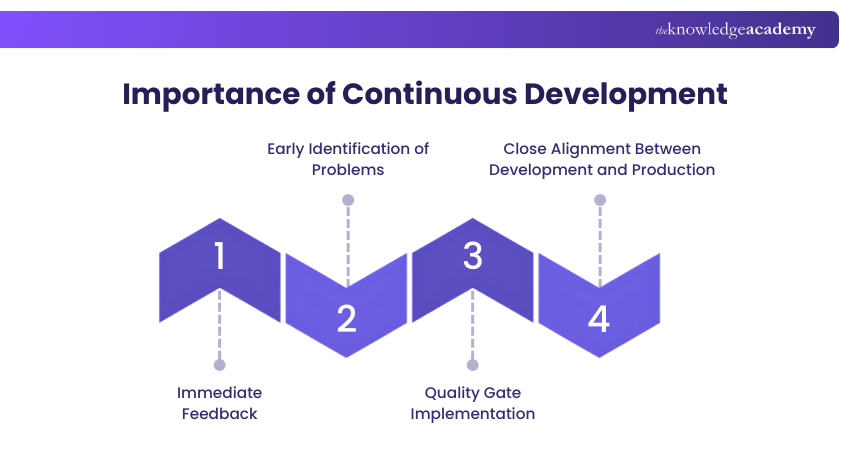
Immediate Feedback
With automated builds and tests, teams receive instant feedback on code quality and functionality. This helps developers detect issues as soon as they are introduced, fostering quicker fixes, smoother workflows, and stronger confidence in the stability of the software.
Early Identification of Problems
Continuous Development ensures that bugs and integration issues are discovered at the earliest stages of development. By addressing problems early, teams minimise rework, reduce costs, and prevent small issues from escalating into critical failures later in the release cycle.
Quality Gate Implementation
Quality gates act as checkpoints within the development pipeline, ensuring that only code meeting defined standards progresses further. This safeguards software quality by enforcing rigorous testing, security scans, and compliance checks, leading to more reliable and production-ready releases.
Close Alignment Between Development and Production
By maintaining automated pipelines and real-time monitoring, Continuous Development keeps development and production environments closely aligned. This reduces deployment risks, streamlines handovers, and ensures that new features or fixes reach users quickly without compromising stability.
Develop practical strategies for workplace excellence with our Organisational Skills Course – Join now!
What Are the Benefits of Continuous Development?
Here are the main benefits of adopting Continuous Development, showing how it enhances quality, reduces risks, and boosts overall efficiency throughout the software lifecycle.
Improves Software Quality
By integrating frequent testing and reviews, Continuous Development ensures that code quality remains consistently high. It enables early detection of defects, encourages clean coding practices, and maintains a stable, reliable product that meets both technical and business standards.
Makes it Easier to Fix Software Errors, Vulnerabilities, and Bugs
Continuous Development allows teams to identify and resolve issues swiftly due to shorter release cycles. With rapid feedback and automated testing, errors, vulnerabilities, and bugs are caught early, making fixes easier, faster, and less costly to implement.
Reduces Project Risk
Breaking down development into smaller, manageable increments reduces the chance of major failures. Continuous monitoring and testing ensure risks are identified and mitigated early, improving predictability, minimising costly setbacks, and creating more reliable delivery timelines.
Improved Productivity
Automated processes, streamlined workflows, and quick feedback loops help developers spend less time on repetitive tasks and more on innovation. This efficiency not only accelerates delivery but also increases team morale and productivity by simplifying collaboration and reducing bottlenecks.
Strengthen your strategic workplace influence with our Certified Training And Development Manager Course – Register Today!
Is Continuous Development the Same as Continuous Improvement?
While the two concepts are related, they are not the same. Continuous Development focuses on delivering software through ongoing integration, testing, and deployment practices. Continuous Improvement, on the other hand, is a broader philosophy aimed at enhancing processes, performance, and outcomes across an organisation. Continuous Development can be seen as a practical approach within the wider principle of Continuous Improvement.
4 Best Practices for Integrating Testing into a Continuous Development Pipeline
Integrating testing into a Continuous Development pipeline ensures higher quality and faster feedback. Here are four best practices to follow:
1) Automate Testing Across Stages: Implement unit, integration, performance, and security tests at every phase.
2) Shift Testing Left: Involve testing earlier in the development cycle to detect and resolve issues quickly.
3) Use Production-like Environments: Replicate real-world conditions to ensure tests are accurate and outcomes are reliable.
4) Monitor and Refine Continuously: Analyse test results, track metrics, and improve test coverage to maintain quality over time.
Conclusion
We hope this blog has helped you understand what Continuous Development is and why it matters. This approach keeps the software updated and ensures smooth performance. By using continuous improvement methods, businesses can stay competitive and meet customer needs faster. Adopting Continuous Development helps companies grow, improve quality, and deliver better products over time.
Advance career potential and efficiency with our Learning and Development Courses – Sign-up Today!
Frequently Asked Questions
What is the continuous development methodology?

Continuous development is a software approach that ensures frequent updates, integration, testing, and deployment throughout the lifecycle. It focuses on automation, rapid feedback, and collaboration to deliver high-quality features faster and adapt quickly to changes.
What tools help with continuous development testing?
Popular tools include Jenkins, GitLab CI/CD, Travis CI, CircleCI, and Bamboo for automation, while Selenium, JUnit, and TestNG support testing. These tools streamline integration, testing, and deployment, enabling teams to maintain efficiency and deliver reliable software continuously.
What are the Other Resources and Offers Provided by The Knowledge Academy?
The Knowledge Academy takes global learning to new heights, offering over 3,000+ online courses across 490+ locations in 190+ countries. This expansive reach ensures accessibility and convenience for learners worldwide.
Alongside our diverse Online Course Catalogue, encompassing 19 major categories, we go the extra mile by providing a plethora of free educational Online Resources like Blogs, eBooks, Interview Questions and Videos. Tailoring learning experiences further, professionals can unlock greater value through a wide range of special discounts, seasonal deals, and Exclusive Offers.
What is The Knowledge Pass, and How Does it Work?
The Knowledge Academy’s Knowledge Pass, a prepaid voucher, adds another layer of flexibility, allowing course bookings over a 12-month period. Join us on a journey where education knows no bounds.
What are Related Courses and Blogs Provided by The Knowledge Academy?
The Knowledge Academy offers a wide range of Learning and Development Courses, including Training Needs Analysis Course, Organisational Skills Course, and Certified Training Professional Course. These courses are designed for different experience levels, providing comprehensive insights into continuous learning.
Our HR Resources Blogs cover a range of topics related to Continuous Development, offering valuable resources, best practices, and industry insights. Whether you are a beginner or looking to advance your Continuous Development knowledge, The Knowledge Academy's diverse courses and informative blogs have got you covered.

Amelia Williams


Senior Human Resources Consultant and Learning Specialist
Amelia Williams is a highly respected HR professional with over 12 years of experience in human capital management, talent development and workplace policy. She has worked across sectors including education, healthcare and corporate services, focusing on aligning people strategies with organisational goals. Amelia’s writing blends current HR trends with practical solutions for modern workplace challenges.

Upcoming HR Resources – Learn about Human Resources Batches & Dates
Date
 Software Development Lifecycle Training
Software Development Lifecycle Training
Thu 25th Jun 2026
Software Development Lifecycle Training
Thu 10th Sep 2026
Software Development Lifecycle Training
Thu 26th Nov 2026

 If you wish to make any changes to your course, please


