


 Top Rated Course

We may not have the course you’re looking for. If you enquire or give us a call on +44 1344 203 999 and speak to our training experts, we may still be able to help with your training requirements.
Actuarial Science: Understanding Risk and Financial Analysis
William Brown 08 May 2026Actuarial Science uses maths, statistics, and finance to evaluate risk, set insurance prices, and drive informed decisions across finance-focused careers. It supports forecasting, stability, and smarter planning in uncertain markets, opening pathways into insurance, investment, pensions, and data-led strategy roles worldwide.

Training Outcomes Within Your Budget!
We ensure quality, budget-alignment, and timely delivery by our expert instructors.
Table of Contents

Behind every insurance policy and pension plan exists a fundamental inquiry about what will happen in the future, and this very question defines What is Actuarial Science. Actuarial Science exists as a scientific field that provides methodological answers to questions through logical reasoning and data analysis and future predictions.
Table of Content
1) What is Actuarial Science?
2) Importance of Actuarial Science
3) Applications of Actuarial Science
4) Universities and Professional Certifications
5) What Skills are Required to Become an Actuary?
6) Benefits of a Career in Actuarial Science
7) Challenges of a Career in Actuarial Science
8) Conclusion
What is Actuarial Science?
Every major financial decision carries a quiet question beneath it: what could go wrong tomorrow? From insurance policies to retirement plans, the future is never certain. That is where What Is Actuarial Science begins, turning uncertainty into insight and helping organisations make sense of risk before it becomes reality.
Traditionally, this field focused on mortality rates, life tables, and compound interest. Today, it has grown far beyond that. Actuarial Science now combines analytical thinking with practical judgement, helping businesses make informed decisions, plan for the future, and manage risk with clarity and confidence.

Importance of Actuarial Science
Actuarial Science serves an essential purpose for organisations because it helps them develop their plans and security measures while simultaneously achieving their business expansion goals in unpredictable circumstances. The following list displays essential reasons which demonstrate the importance of this field in contemporary financial systems, insurance protection methods, and risk assessment practices.
1) Helps organisations estimate and control financial risk with confidence
2) Helps with the fair pricing of insurance products and financial services
3) Directs long-term planning for pensions, healthcare, and investments
4) Reduces uncertainty in business decisions through data-driven forecasting
5) Shields companies from unexpected losses and financial instability
6) Builds trust by ensuring sustainable and transparent financial models
7) Promotes smarter responses to economic change and future uncertainty
Applications of Actuarial Science
Actuarial Science goes beyond numbers, it secures financial futures! By analysing data, probability, and risks, Actuaries help businesses make informed decisions. From fair insurance premiums to stable pension funds, their expertise shapes financial security in everyday life.
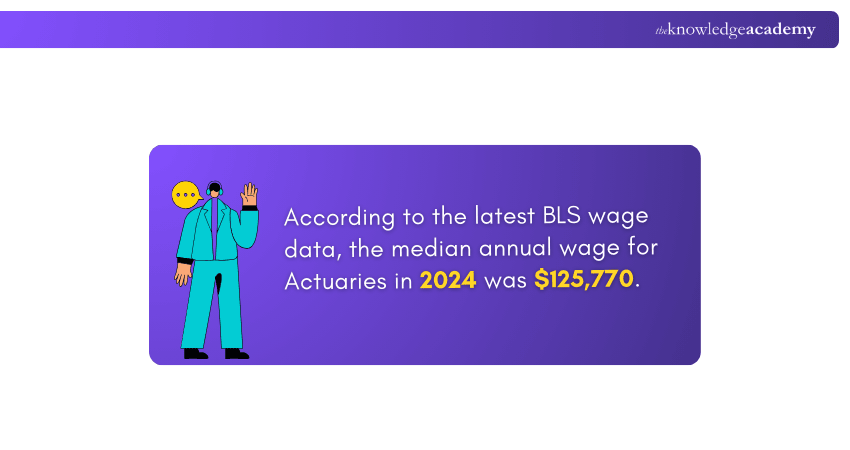
Actuarial Science isn’t just about complex equations, it plays a crucial role in shaping financial security across industries. Let’s explore two key areas where Actuaries work their magic:
1) Pensions
a) Securing Your Future: Actuaries establish pension stability by determining the funds required in present times to maintain sufficient future financial security. Through their calculations, Actuaries safeguard people from nightmare scenarios by determining present-day necessary reserves for future pension stability.
b) Longevity Predictions: Actuaries study life expectancy trends to ensure pension funds remain sustainable. With people living longer, funds must adapt to avoid running out of money.
c) Managing Investments: Pension funds don’t just sit in a vault! Actuaries help invest them wisely in stocks, bonds, and other assets, balancing risk and return to grow the fund safely.
d) Adjusting Contributions: If market conditions change or life expectancy increases, Actuaries determine whether pension contributions need to rise to keep the fund financially sound.
2) Insurance
a) Fair Premiums for Everyone: Ever wonder how insurers decide what you pay for car, health, or life insurance? Actuaries assess risks—like your age, health, and driving history—to set fair and sustainable premiums.
b) Predicting Future Claims: Insurance companies need to know how much they’ll likely pay in claims. Actuaries use past data and statistical models to estimate these costs and ensure the company remains profitable.
c) Reducing Fraud Risks: The annual costs of fake insurance claims amount to billions of dollars. Insurance Actuaries build analytical frameworks used to find questionable claims, which help defend the system against illicit practices.
d) Preparing for Catastrophes: Through disaster impact analysis, Actuaries help insurers prepare for widespread emergencies, including hurricanes and wildfires and economic downturns.
Unlock a high-paying career with Statistical Process Control Training - take the first step today!
Universities and Professional Certifications
The demand for Actuaries is rapidly growing, with the U.S. Bureau of Labor Statistics projecting a 23% increase in employment from 2022 to 2032. To support this growth, many universities now offer specialised degree programmes and courses in Actuarial Science. These academic paths not only prepare students for industry challenges but also align with professional exam requirements.
1) Universities
The foundational element of Actuarial education exists through the educational system of universities. Many institutions align their programmes with professional Actuarial standards, ensuring learners develop the mathematical and analytical depth the field demands. The Society of Actuaries (SOA) establishes university recognition through the evaluation of its curriculum content, which matches the material used in professional examinations.
Some institutions offer introductory alignment, covering coursework for early professional exams. The program provides advanced pathways which help students prepare for multiple exam levels. Academic institutions which achieve Centre of Actuarial Excellence status demonstrate their academic excellence through their research capabilities and faculty expertise, and their connections to the business world.
These universities create environments which allow students to apply theoretical knowledge while studying Actuarial Science because this field requires both analytical and practical expertise.
2) Professional Designations and Credentials
Professional credentials define progression in Actuarial careers. Bodies such as the Society of Actuaries (SOA) and the Casualty Actuarial Society (CAS) offer structured certification paths that validate expertise and readiness for responsibility.
Early designations establish a strong foundation in probability, finance, and data analysis. Advanced credentials demonstrate deeper specialisation in areas such as life insurance, pensions, health systems, and enterprise risk management. Each level represents growth in judgement, technical mastery, and professional standing.
These certifications transform academic knowledge into recognised capability. They reflect what Actuarial Science truly represents: disciplined preparation, continuous learning, and the ability to guide real-world decisions in uncertain environments.
Unlock Lucrative Career Opportunities with our Business Analyst Courses – Get Started Now!
What Skills are Required to Become an Actuary?
Actuarial work is not only about being good with numbers. It is about thinking clearly under uncertainty and helping others make sense of complex outcomes. An actuary needs the ability to analyse risk with precision and the confidence to explain what that risk truly means in real terms.
What Technical Skills Do Actuaries Need?
Let's discuss what technical skills are required:
• A strong grasp of mathematics, especially probability, statistics, and financial modelling
• Comfort working with data using tools such as Excel, R, Python, or SQL
• The ability to build models that predict and measure future risk
• An understanding of finance and economics for pricing and long-term planning
• Logical problem-solving to turn complex figures into clear conclusions
• close attention to detail, where accuracy is never optional
What Soft Skills Do Actuaries Need?
Let's discuss what soft skills are required:
• The ability to explain complex ideas in simple, meaningful language
• Critical thinking to question assumptions and test different outcomes
• Business awareness to connect analysis with real organisational needs
• Adaptability in a field shaped by changing markets and regulations
• Collaboration when working across finance, operations, and leadership teams
• Ethical judgment when decisions carry long-term financial impact
These skills bring What Is Actuarial Science to life. They show that being an actuary is not only about solving equations, but about guiding people and organisations through uncertainty with clarity and trust.
Benefits of a Career in Actuarial Science
A career in Actuarial Science offers a unique blend of intellectual challenge, job security, and high earning potential, making it one of the most rewarding professions for analytical minds. Here are a few benefits of a career in Actuarial Science:
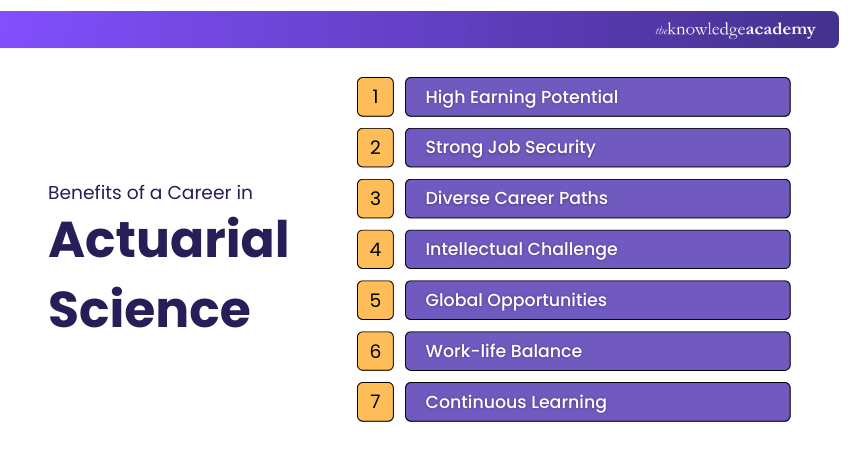
a) High Earning Potential: Actuaries are among the best-paid professionals, with salaries growing as you gain experience. Think of it as a financial reward for mastering numbers!
b) Strong Job Security: Actuary jobs deliver dependable job security because risk management is an essential operational requirement, rendering Actuaries immune to economic downturns.
c) Diverse Career Paths: Graduates have multiple professional paths, including insurance and banking and pensions administration, as well as investments alongside tech fields consisting of Data Science and Artificial Intelligence.
d) Intellectual Challenge: Professional educators will find Actuarial Science stimulates their thinking through its unique daily challenges in analysis and problem resolution.
e) Global Opportunities: Actuarial qualifications hold international appeal through recognised standards which let you seek career advancement opportunities from country to country.
f) Work-life Balance: Actuarial roles provide both flexible scheduling options alongside remote work flexibility to help you manage your work-life balance successfully.
g) Continuous Learning: Actuaries maintain an exciting career path through professional growth through testing and industry certifications, together with engagement in emerging sector patterns.
Step Into a High-Paying Career with our Business Analyst Black Belt Course – Join the Course Today!
Challenges of a Career in Actuarial Science
Actuarial Science creates professional satisfaction because it offers different career pathways. The profession demands experts who possess exceptional cognitive abilities, together with the capability to solve problems and the determination to handle intricate financial challenges. The profession contains various difficulties which need to be studied. Let us examine those difficulties in detail:
a) Tough Exams: It requires diligence and persistence to learn to become an Actuary.
b) Continuous Learning: Market trends, regulations, and financial models evolve, demanding constant upskilling.
c) High Responsibility: Critical decisions made by actuaries may affect businesses and individuals, increasing the pressure always to be right.
d) Data-Heavy Work: The position requires the analysis of large datasets, which contain difficult mathematical computations. The role requires someone who possesses strength and determination to face challenging tasks.
e) Slow Career Progression:Growing in the field depends on clearing exams, which can delay occupational growth.
f) Limited Social Interaction: Actuaries often work independently on analytical duties, making it less active than client-facing roles.
g) Technical Demands: Beyond numbers, Actuaries must learn programming, data analysis, and financial modelling.
Conclusion
Actuarial Science isn’t just about numbers; it’s about using them to make real-life decisions that matter. Whether it is helping people plan or guiding companies through uncertainty, it’s a career that blends logic, purpose, and impact. Now that you’ve got a clearer picture of What is Actuarial Science, maybe it doesn’t seem so complex after all. And who knows? It might just be the kind of path that suits the way your mind works.
Become a Professional with our Introduction To Business Analytics Training – Start Learning
Frequently Asked Questions
What Exactly Does an Actuary Do?

An Actuary uses math, statistics, and financial theory to assess and manage risk in areas like insurance, pensions, and healthcare. They help companies make data-driven decisions by predicting future events, such as potential losses or claims, and developing strategies to manage them.
What Type of Math Do Actuaries Use?
Actuaries use a variety of math including probability theory, statistics, calculus, and financial mathematics. They apply these techniques to analyse risk, predict future events, and calculate premiums, reserves, and pension plans. Strong quantitative skills are essential for this role.
What are the Other Resources and Offers Provided by The Knowledge Academy?
The Knowledge Academy takes global learning to new heights, offering over 3,000+ online courses across 490+ locations in 190+ countries. This expansive reach ensures accessibility and convenience for learners worldwide.
Alongside our diverse Online Course Catalogue, encompassing 19 major categories, we go the extra mile by providing a plethora of free educational Online Resources like Blogs, eBooks, Interview Questions and Videos. Tailoring learning experiences further, professionals can unlock greater value through a wide range of special discounts, seasonal deals, and Exclusive Offers.
What is The Knowledge Pass, and How Does it Work?
The Knowledge Academy’s Knowledge Pass, a prepaid voucher, adds another layer of flexibility, allowing course bookings over a 12-month period. Join us on a journey where education knows no bounds.
What are the Related Courses and Blogs Provided by The Knowledge Academy?
The Knowledge Academy offers various Business Analyst Course, including the Certified Business Analyst Professional (CBA-PRO) Course and Business Process Mapping Training, and the Business Analyst Fundamentals Training Course. These courses cater to different skill levels, providing comprehensive insights into Statistical Process Control .
Our Business Analysis Blogs cover a range of topics related to Actuarial Science, offering valuable resources, best practices, and industry insights. Whether you are a beginner or looking to advance your Actuarial Skills, The Knowledge Academy's diverse courses and informative blogs have got you covered.

William Brown


Senior Business Analyst and Strategic Advisor
William Brown is a senior business analyst with over 15 years of experience driving process improvement and strategic transformation in complex business environments. He specialises in analysing operations, gathering requirements and delivering insights that support effective decision making. William’s practical approach helps bridge the gap between business goals and technical solutions.
View Detail
Upcoming Business Analysis Resources Batches & Dates
Date
 Certified Business Analyst Professional (CBA-PRO)
Certified Business Analyst Professional (CBA-PRO)
Thu 2nd Jul 2026
Certified Business Analyst Professional (CBA-PRO)
Thu 29th Oct 2026

 If you wish to make any changes to your course, please


