
CCSP Training

Online Instructor-led (5 days)

Online Self-paced (40 hours)

Certified Cloud Security Professional Course Outline

Domain 1: Cloud Concepts, Architecture and Design

Module 1: Understand Cloud Computing Concepts
  • Cloud Computing Essentials
  • Cloud Roles and Responsibilities 
  • Building Block Technologies
Module 2: Describe Cloud Reference Architecture
  • Cloud Computing Activities 
  • Cloud Service Capabilities
  • Cloud Service Categories 
  • Cloud Deployment Models 
  • Cloud Shared Considerations
  • Impact of Related Technologies 
Module 3: Understand Security Concepts Relevant to Cloud Computing
  • Cryptographic Key Management 
  • Identity and Access Control 
  • Data and Media Sanitisation
  • Integrated Network and Virtualisation Security
  • Common Threats
  • Security Hygiene 
Module 4: Understand Design Principles of Secure Cloud Computing
  • Cloud Secure Data Lifecycle
  • Cloud-Based Business Continuity (BC) 
  • Disaster Recovery (DR)
  • Business Impact Analysis (BIA) 
  • Functional Security Requirements 
  • Security Considerations and Responsibilities for Different Cloud Categories
  • Cloud Design Patterns 
  • DevOps Security 
Module 5: Evaluate Cloud Service Providers
  • System and Subsystem Product Certification

Domain 2: Cloud Concepts, Architecture and Security

Module 1: Describe Cloud Data Concepts
  • Cloud Data Lifecycle Phases
  • Data Dispersion 
  • Data Flows 
Module 2: Design and Implement Cloud Data Storage Architectures
  • Storage Types and Their Threats
  • General Threats to Cloud Storage and Mitigations
Module 3: Design and Apply Data Security Technologies and Strategies
  • Integrated Encryption and Key Management
  • Hashing
  • Data Obfuscation
  • Tokenisation
  • Data Loss Prevention (DLP)
Module 4: Implement Data Discovery
  • Structured Data 
  • Unstructured Data 
  • Semi-structured Data
  • Data Location
Module 5: Implement Data Classification
  • Data Classification Policies 
  • Data Mapping 
Module 6: Design and Implement Information Rights Management (IRM)
  • Objective
  • Appropriate Tools 
Module 7: Plan and Implement Data Retention, Deletion, and Archiving Policies
  • Data Retention Policies 
  • Data Deletion Procedures and Mechanisms 
  • Data Archiving Procedures and Mechanisms 
  • Legal Hold
Module 8: Design and Implement Auditability, Traceability, and Accountability of Data Events
  • Definition of Event Sources and Requirement of Event Attributes
  • Logging, Storage and Analysis of Data Events 
  • Chain of Custody and Non-repudiation 

Domain 3: Cloud Platform and Infrastructure Security

Module 1: Comprehend Cloud Infrastructure Components
  • Cloud Infrastructure 
  • Physical Environment
  • Network and Communications
  • Computing and Storage
  • Virtualisation 
  • Management Plane
Module 2: Design a Secure Data Center
  • Logical Design
  • Physical Design
  • Environmental Design
  • Design Resilient
Module 3: Analyse Risks Associated with Cloud Infrastructure
  • Risk Assessment
  • Cloud Vulnerabilities, Threats and Attacks
  • Risk Mitigation Strategies
Module 4: Design and Plan Security Controls
  • Physical and Environmental Protection
  • Cloud Security: Systems and Access Protection
  • Audit Mechanisms
Module 5: Plan Disaster Recovery (DR) and Business Continuity (BC)
  • Business Continuity/ Disaster Recovery Strategy
  • Business Requirements
  • Implementing a BCDR Plan

Domain 4: Cloud Application Security

Module 1: Advocate Training and Awareness for Application Security
  • Cloud Development Basics
  • Common Pitfalls
  • Common Cloud Vulnerabilities
Module 2: Describe the Secure Software Development Lifecycle (SDLC)
  • Business Requirements
  • Phases and Methodologies
Module 3: Apply the Secure Software Development Life Cycle (SDLC)
  • Cloud Threat and Vulnerability Mitigation
  • Verification Standard (ASVS), Software Assurance Forum for Excellence in Code (SAFECode)
  • Software Configuration Management and Versioning
Module 4: Apply Cloud Software Assurance and Validation
  • Functional and Non-functional Testing
  • Security Testing Methodologies
  • Quality Assurance (QA)
  • Abuse Case Testing
Module 5: Use Verified Secure Software
  • Securing Application Programming Interfaces (API)
  • Supply-chain Management
  • Third-party Software Management
  • Validated Open-source Software
Module 6: Comprehend the Specifics of Cloud Application Architecture
  • Supplemental Security Components
  • Cryptography
  • Sandboxing
  • Application Virtualisation and Orchestration
Module 7: Design Appropriate Identity and Access Management (IAM) Solutions
  • Federated Identity
  • Identity Providers (IdP)
  • Single Sign-on (SSO)
  • Multi-factor Authentication (MFA)
  • Cloud Access Security Broker (CASB)
  • Secrets Management

Domain 5: Cloud Security Operations

Module 1: Build and Implement Physical and Logical Infrastructure for Cloud Environment
  • Virtual Hardware Specific Security Configuration Requirements
  • Hardware Specific Security Configuration Requirements
  • Installation and Configuration of Management Tools
  • Installation of Guest Operating System (OS) Virtualisation Toolsets
Module 2: Operate and Maintain Physical and Logical Infrastructure for Cloud Environment
  • Access Controls for Local and Remote Access
  • Integrated Network Security Management
  • Operating System (OS) Hardening through the Application of Baselines, Monitoring and Remediation
  • Patch Management
  • Infrastructure as Code (IaC) Strategy
  • Availability of Clustered Hosts
  • Availability of Guest Operating System
  • Performance and Capacity Monitoring
  • Configuration of Host and Guest Operating System (OS) Backup and Restore Functions
  • Management Plane
Module 3: Implement Operational Controls and Standards
  • Incident Management
  • Problem Management
  • Release and Deployment Management
  • Configuration Management
  • Service Level Management
  • Availability Management
  • Capacity Management
Module 4: Support Digital Forensics
  • Forensic Data Collection Methodologies
  • Evidence Management
  • Collect, Acquire, and Preserve Digital Evidence
Module 5: Manage Communication with Relevant Parties
  • Vendors
  • Customers and Partners
  • Regulators and Other Stakeholders
Module 6: Manage Security Operations
  • Security Operations Center (SOC)
  • Intelligent Monitoring of Security Controls
  • Log Capture and Analysis
  • Vulnerability Assessments

Domain 6: Legal, Risk, and Compliance

Module 1: Articulate Legal Requirements and Unique Risks Within the Cloud Environment
  • Conflicting International Legislation
  • Evaluation of Legal Risks Specific to Cloud Computing
  • Legal Framework and Guidelines
  • eDiscovery and Forensics Requirements
Module 2: Understand Privacy Issues
  • Difference between Contractual and Regulated Private Data
  • Country-Specific Legislation Related to Private Data
  • Jurisdictional Differences in Data Privacy
Module 3: Understand Audit Process, Methodologies, and required Adaptations for a Cloud Environment
  • Internal and External Audit Control 
  • Impact of Audit Requirements
  • Identify Assurance Challenges of Virtualisation and Cloud
  • Audit Reporting: Types, Scope, and Gap Analysis
  • Audit Planning
  • Internal Information Security Management System (ISMS)
  • Internal Information Security Controls System
  • Policies and Identification and Involvement of Relevant Stakeholders
  • Specialised Compliance Requirements for Highly-Regulated Industries
  • Impact of Distributed IT Models
Module 4: Understand Implications of Cloud to Enterprise Risk Management
  • Assess Providers Risk Management Programs
  • Difference and Regulatory Transparency Requirements
  • Risk Treatment and Different Risk Frameworks
  • Assessment of the Risk Environment
Module 5: Understand Outsourcing and Cloud Contract Design
  • Business Requirements
  • Vendor Management and Contract Management
  • Supply Chain Management
  • Implementation of Network Security Controls
  • Management Plan
     

Show moredown

Who Should Attend this CCSP Certified Cloud Security Professional Course?

This CCSP Certified Cloud Security Professional Training is aimed at IT professionals who are involved with cloud computing and security management or want to enhance their knowledge of Cloud Security protocols and strategies. This course will be beneficial for the following professionals:

  • IT Auditors
  • Risk and Compliance Professionals
  • Database Administrators
  • Security Analysts
  • Systems Engineers
  • Information Security Officers
  • Cloud Security Architects

Prerequisites of the CCSP Certified Cloud Security Professional Course

There are no formal prerequisites for attending the CCSP Certified Cloud Security Professional Training. However, understanding cloud computing concepts and basic knowledge of IT security practices will be beneficial for the delegates.

CCSP Certified Cloud Security Professional Course Overview

This CCSP Training focuses on securing cloud-based systems through governance, risk management, and technical security controls. It covers cloud architecture, data protection, platform security, and compliance to support effective cloud security design and oversight.

This training strengthens delegates capability to manage cloud security risks and implement robust security practices across enterprise environments. It supports practical upskilling in cloud operational security, and decision-making to enhance organisational resilience.

This 5-Day course offered by The Knowledge Academy enables delegates to apply cloud security principles confidently using real-world scenarios and practical examples. It supports informed security decisions when designing, managing, and protecting cloud environments.

CCSP Certified Cloud Security Professional Course Objectives

  • To understand Cloud Computing concepts and architectures
  • To learn about Cloud data security techniques and best practices
  • To gain insights into Cloud platform and infrastructure security
  • To comprehend Cloud application security and its importance
  • To explore Cloud Security operations and incident response
  • To grasp legal, risk, and compliance issues in Cloud environments

After completing the CCSP Certified Cloud Security Professional Course, delegates will gain expertise in Cloud Security. This training demonstrates their ability to implement and manage Cloud Security, enhancing their professional credibility and career opportunities in the Cybersecurity domain.

Introduction to CCSP Training

The Knowledge Academy’s CCSP (Certified Cloud Security Professional) Training helps learners develop advanced skills in designing, securing, and managing cloud environments. Below are the key concepts covered in CCSP Training:

  • Cloud Concepts, Architecture and Design: Learners understand cloud computing models, reference architectures and secure design principles required to build trusted cloud environments.
  • Cloud Data Security: Professionals learn how to classify, protect, store and manage data securely throughout its lifecycle within cloud platforms.
  • Cloud Platform and Infrastructure Security: Professionals explore how to secure cloud infrastructure, virtualisation layers, networks and the physical and logical components that support cloud services.
  • Cloud Application Security: Learners gain insight into secure software development, application controls and methods for protecting applications deployed in cloud environments.
  • Cloud Security Operations: Professionals develop an understanding of monitoring, logging, incident response, change management and business continuity for secure cloud operations.
  • Legal, Risk and Compliance in the Cloud: Learners explore regulatory requirements, shared responsibility models, auditing expectations and risk-management practices specific to cloud services.
     

Reasons to Pursue CCSP Course

Pursuing The Knowledge Academy’s CCSP (Certified Cloud Security Professional) Course helps security and cloud professionals validate their expertise and stay ahead in an environment where cloud security skills are in high demand. Below are the key reasons to pursue CCSP Course:

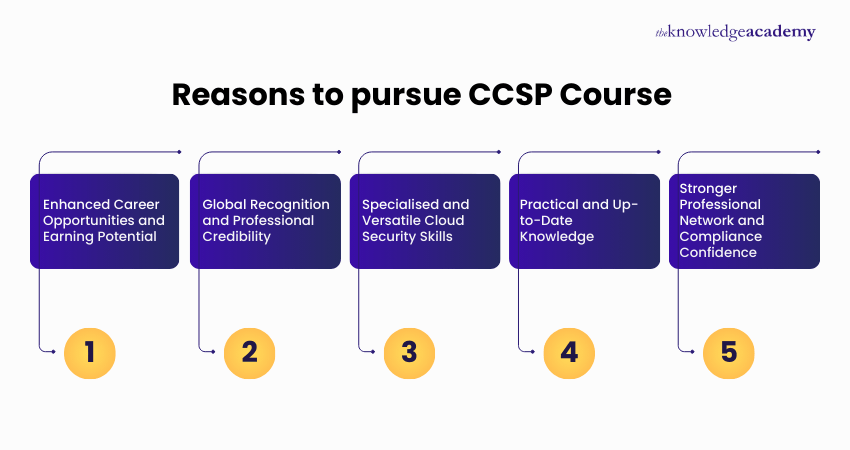
Reasons to pursue CCSP Course

  • Enhanced Career Opportunities and Earning Potential: Organisations across industries are moving to the cloud, increasing demand for certified cloud security professionals and creating opportunities for senior roles and higher salaries.
  • Global Recognition and Professional Credibility: CCSP demonstrates recognised expertise in cloud security, helping professionals showcase trusted, vendor-independent capabilities to employers, clients, and stakeholders worldwide.
  • Specialised and Versatile Cloud Security Skills: The course covers core domains such as architecture, data security, platform and infrastructure security, application security, operations, and legal and compliance, giving you a broad yet deep skill set.
  • Practical and Up-to-Date Knowledge: CCSP learning emphasises real-world application and ongoing professional development, ensuring your skills keep pace with evolving cloud technologies, threats, and best practices.
  • Stronger Professional Network and Compliance Confidence: Earning CCSP connects you to a global community of security professionals and equips you to help organisations meet regulatory and compliance expectations in cloud environments.

Show moredown

What’s Included in this CCSP Certified Cloud Security Professional Course?

  • World-Class Training Sessions from Experienced Instructors
  • Interactive Learning with 24*7 Support
  • Digital Delegate Pack

Show moredown

Not sure which course to choose?

Speak to a training expert for advice if you are unsure of what course is right for you. Give us a call on +44 1344 203 999 or Enquire.

CCSP Training FAQs

CCSP Training focuses on securing cloud environments through governance, risk management, and compliance practices. It builds the knowledge required to design, manage, and protect cloud-based systems effectively.

The training covers Cloud Concepts and Architecture, Cloud Data Security, Cloud Platform Security, Cloud Application Security, Cloud Security Operations, Legal, Risk, and Compliance. These domains provide a complete view of cloud security management.

The prerequisites for the CCSP Courses are based on the course specifications. Check the respective course page of the course that you are planning to take to know about its prerequisites.

Our CCSP Training is ideal for Cloud Security Professionals, IT Managers, Security Architects, and Risk or Compliance Specialists. It also suits professionals responsible for securing cloud-based systems.

In this CCSP Courses, delegates will receive intensive training from our experienced instructors, along with a digital delegate pack containing key notes to assist in completing the training.

The duration of CCSP Courses varies. Please visit our course pages for specific information.

Delegates gain practical knowledge of cloud security, improve risk and compliance oversight, and strengthen their ability to manage secure cloud environments. The training supports confident decision-making in cloud-focused roles.

Delegates can pursue roles such as Cloud Security Specialist, Security Architect, Risk and Compliance Lead, or Cloud Governance Manager. These roles focus on protecting cloud platforms and organisational data.

Yes, The Knowledge Academy offers support via phone & email before attending, during, and after the CCSP Training. Our customer support team is available to assist and promptly resolve any issues you may encounter.

Delegates learn how to secure cloud platforms, manage cloud risk, implement governance controls, and protect sensitive data. The course also addresses operational security and compliance requirements.

CCSP Training is delivered through instructor-led classroom sessions and live virtual learning. Flexible delivery options allow delegates to choose the format that best suits their needs.

If you are unable to access your CCSP Courses, contact the support team at The Knowledge Academy via our customer service email or phone number provided on our website for prompt assistance and resolution of your issue.

CCSP training covers cloud security frameworks, data protection, compliance, threat mitigation, and risk management, making it essential for professionals securing cloud-based environments.

The Knowledge Academy in Mali stands out as a prestigious training provider known for its extensive course offerings, expert instructors, adaptable learning formats, and industry recognition. It's a dependable option for those seeking this course.

Please see our CCSP Training available in Mali

The Knowledge Academy is one of the Leading global training provider for CCSP Training.

The training fees for CCSP Training in Mali starts from $4695

Show more down

Why we're the go to training provider for you

icon

Best price in the industry

You won't find better value in the marketplace. If you do find a lower price, we will beat it.

icon

Trusted & Approved

Recognised by leading certification bodies, we deliver training you can trust.

icon

Many delivery methods

Flexible delivery methods are available depending on your learning style.

icon

High quality resources

Resources are included for a comprehensive learning experience.

barclays Logo
deloitte Logo
Thames Water Logo

"Really good course and well organised. Trainer was great with a sense of humour - his experience allowed a free flowing course, structured to help you gain as much information & relevant experience whilst helping prepare you for the exam"

Joshua Davies, Thames Water

santander logo
bmw Logo
Google Logo
cross

Exclusive Deals Big Savings This March!

Grab up to 40% OFF and level up your skills this spring! march-madness

WHO WILL BE FUNDING THE COURSE?

close

close

Thank you for your enquiry!

One of our training experts will be in touch shortly to go over your training requirements.

close

close

Press esc to close

close close

Back to course information

Thank you for your enquiry!

One of our training experts will be in touch shortly to go overy your training requirements.

close close

Thank you for your enquiry!

One of our training experts will be in touch shortly to go over your training requirements.