


 Top Rated Course

We may not have the course you’re looking for. If you enquire or give us a call on +44 1344 203 999 and speak to our training experts, we may still be able to help with your training requirements.
Music Production Equipment: A Beginner’s Guide to Key Tools
The Knowledge Academy 03 March 2026Essential music production equipment includes a computer with DAW software, an audio interface, studio headphones, and tools to create music. These essentials support recording, editing, and mixing with clarity. They help producers work efficiently and achieve professional sound quality. Ideal for beginners and experienced creators alike.

Training Outcomes Within Your Budget!
We ensure quality, budget-alignment, and timely delivery by our expert instructors.
Table of Contents
The right tools and an unpretentious creative vision are the foundation of great music. Music Production Equipment has a say in the whole process of turning ideas into sounds, and it all depends on the complexity of the setup or the level of the studio. Let's take a look at the basics that, at each stage, give you trust in creating, recording, and polishing your tracks.
Table of Contents
1) What is the Importance of Music Production Equipment?
2) Different Types of Music Production Equipment
3) What Equipment do Music Producers Need?
4) The Four Key Stages of Building Your Studio
5) What are the top 3 Hardest Instrument to Play?
6) Conclusion
What is the Importance of Music Production Equipment?
Music Production Equipment is essential for creating professional-quality sound. It enables artists and producers to accurately capture, edit, and refine audio with precision. Also, proper equipment reduces unwanted noise, maintains sound integrity, and supports efficient production across various genres.
Whether in a home studio or professional setting, reliable gear is important for achieving industry-standard results and bringing musical ideas to life with depth and balance. Beyond technicalities, the right equipment also acts as an enabler for creativity.

Different Types of Music Production Equipment
Here is a curated list of some of the key Music Production Equipment that every producer should have in their studio:
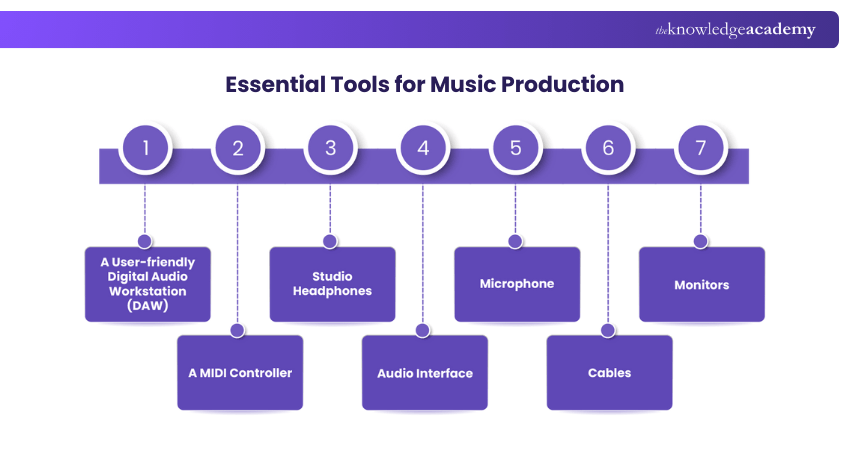
1) A User-friendly Digital Audio Workstation (DAW)
Choosing your first user-friendly Digital Audio Workstation (DAW) is vital in your Music Production journey. It is software that allows you to record, arrange, edit, mix, and master your tracks. User-friendly DAWs like Ableton Live, FL Studio, or Logic Pro offer intuitive interfaces and powerful features, making them ideal for everyone.
They provide a digital canvas where creativity comes to life. Consider your Music style, whether electronic, hip-hop, or acoustic, when choosing your DAW. You can also explore their trial versions to determine your comfort level with their workflows.
2) A MIDI Controller
Selecting the right Musical Instrument Digital Interface (MIDI) controller is a pivotal decision for any Music Producer, as it's a direct extension of your creative expression. The choice largely depends on your production style and preferences.
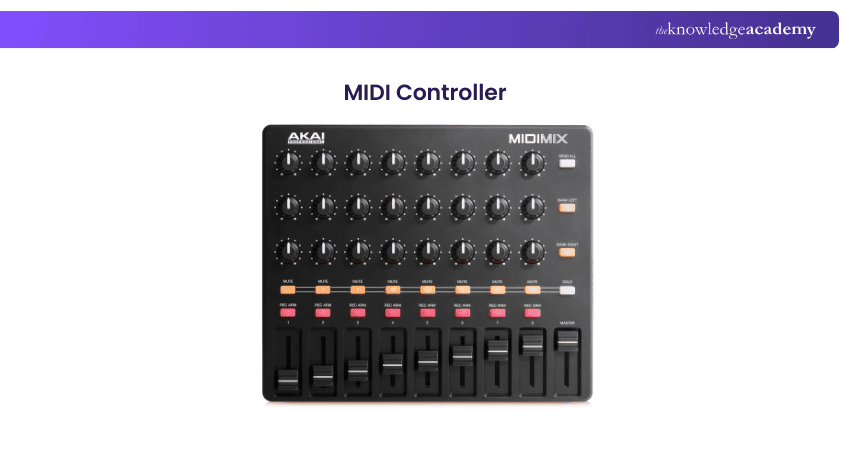
A MIDI keyboard controller with various keys and responsive action is essential for keyboard enthusiasts. Look for models that offer velocity sensitivity and aftertouch for nuanced playing. If you're into electronic Music Production, a controller with pads and knobs is invaluable for tactile control over virtual instruments and effects.
Learn basic Piano skills to compose music with a MIDI keyboard with our Piano Course – Sign up now!
3) Studio Headphones
Studio headphones are one of the significant Music Production Equipment for beginners for accurate monitoring during recording, mixing, and editing. Unlike consumer headphones, they offer a flat frequency response, allowing you to hear every detail in your mix without coloration. They also provide excellent isolation, helping you focus on the sound without being distracted by external noise.
Closed-back headphones are ideal for tracking vocals, while open-back models are often preferred for mixing due to their natural sound. Investing in a reliable pair of headphones can improve the quality and consistency of your music production over time.
4) Audio Interface
An audio interface converts analogue signals from microphones or instruments into digital data that your computer can process. It improves sound quality, reduces latency, and offers necessary inputs and outputs for various gear. Choosing a reliable interface ensures smooth recording sessions and better overall audio performance.
Many interfaces also include built-in preamps that enhance signal clarity and reduce the need for external gear. Additionally, they support higher sample rates and bit depth, resulting in more detailed and professional-sounding recordings.
5) Microphone
A good studio microphone captures vocals and acoustic instruments with clarity and depth, preserving the nuances and emotion of each performance. Condenser microphones are commonly used for studio vocals due to their sensitivity, wide frequency response, and ability to pick up subtle details. They also capture breathiness, tone, and expression.
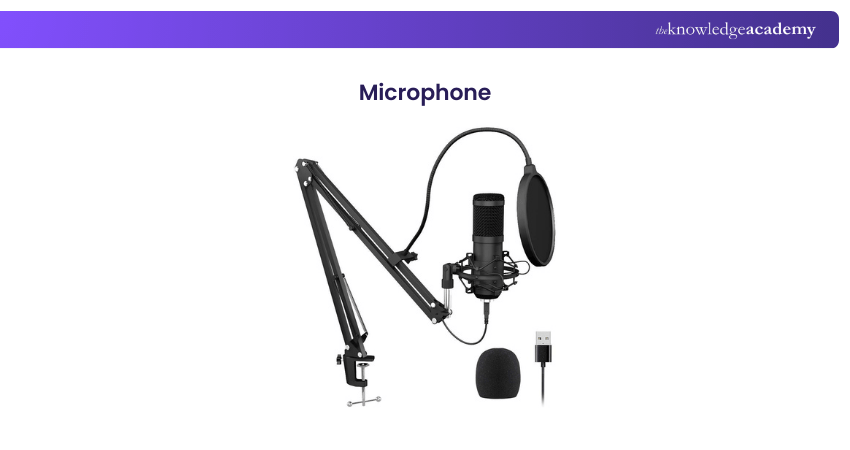
Many studio microphones offer selectable polar patterns like cardioid or omnidirectional, enabling flexible setups for different recording needs. A quality mic enhances warmth and presence, delivering cleaner tracks that need minimal post-processing.
6) Cables
Though often overlooked, quality cables are the backbone of any reliable studio setup. They connect microphones, instruments, and monitors to your interface or mixer. Poor-quality or damaged cables can introduce unwanted noise or signal loss, so investing in durable, shielded options is essential for maintaining audio integrity.
Balanced cables, such as XLR or TRS, are especially important in studio environments, as they help reduce hum and electromagnetic interference. Investing in high-quality cables might seem minor, but it highly contributes to long-term performance and consistency in your music.
7) Monitors
Studio monitors (speakers) are designed to reproduce sound as accurately and transparently as possible, making them an essential tool for mixing and mastering. Unlike consumer-grade speakers that often enhance bass or treble frequencies for a more “pleasing” sound, studio monitors deliver a flat frequency response.
Accurate monitoring allows producers to make critical decisions about levels, EQ, panning, and effects with confidence. The goal is to create mixes that translate well across all listening environments, from headphones and car stereos to home theatre systems.
Acquire Guitar skills to compose music digitally with our Guitar Course – Register today!
What Equipment do Music Producers Need?
Numerous hardware and software platforms serve music producers who work on track generation and recording through track mixing and mastering. Essential Music Production Equipment includes:
a) Digital Audio Workstation (DAW): This functions as Music Production Software which enables users to record music and edit different aspects (Ableton Live, FL Studio, Logic Pro among others are examples of DAWs).
b) Audio Interface: An audio interface serves as a tool that converts analogue signals to digital signals then back to analogue signals thus enhancing sound quality.
c) Studio Monitors: It represents high-end speaker systems with exact sound reproduction capabilities.
d) Music Instrument Digital Interface: MIDI controllers work as keyboard interfaces or pad controllers that enable users to perform as well as develop virtual instruments.
e) Microphones: Essential for recording vocals and live instruments. Recording studios make use of condenser mics for their operations.
f) Headphones: The recording process requires closed-back headphones while the mixing task requires open-back headphones.
g) External Storage: Large project files along with samples need to be stored through external storage platforms which include Solid-state Drives (SSDs) or hard drives.
h) Acoustic Treatment: Sound improvement throughout the studio is achieved by installing foam panels together with bass traps and diffusers.
The Four Key Stages of Building Your Studio
The Music Producer equipment list varies based on their studio level. From home setups to professional studios, each stage needs specific tools to match the complexity and quality of production. Here's a breakdown of what is typically required at each level.

1) Entry-level Recording Space
An entry-level setup is perfect for beginners learning the ropes of music production or those working with a limited budget. It generally includes:
1) A user-friendly DAW such as FL Studio or GarageBand
2) A basic USB Audio Interface (e.g., Focusrite Scarlett Solo)
3) A condenser microphone for vocals and acoustic recordings
4) Closed-back studio headphones for tracking and basic mixing
5) A compact MIDI keyboard/controller for composing melodies
6) Access to free or affordable sample packs and VST plugins
This setup allows producers to record, edit, and experiment with ideas in a home environment.
2) Permanent Recording Space
A permanent recording space offers more room and better organisation, allowing for a more refined workflow. Producers at this stage often upgrade or add:
1) A more powerful DAW and audio interface with multiple inputs
2) Studio monitors for more accurate sound reproduction
3) Basic acoustic treatment to minimise room reflections and noise
4) A mic stand, pop filter, and shock mount for stable vocal recordings
5) A selection of quality XLR and TRS cables for clean signal connections
6) A growing library of sample packs, loops, and virtual instruments
This level provides a more comfortable and professional environment for consistent production work.
3) Semi-pro Studio
At this level, producers begin handling commercial work or more advanced personal projects. Equipment typically includes:
1) High-end audio interface with advanced preamps and multiple outputs
2) Multiple microphones for different recording needs
3) A wide range of MIDI controllers and hardware synths
4) Dual monitor screens for enhanced workflow and visual editing
5) Advanced monitoring systems and speaker isolation pads
6) Dedicated external hard drives for project backups and large sample libraries
A semi-pro setup supports multi-track recording and higher production demands with improved audio fidelity.
4) Professional-grade Studio
A professional studio is designed for high-end commercial production, client work, and often mastering services. These studios are acoustically treated, and their equipment involve:
1) Top-tier DAWs like Pro Tools Ultimate or Cubase Pro
2) Industry-standard audio interfaces and AD/DA converters
3) A wide selection of outboard gear, including compressors, EQs, and preamps
4) A comprehensive microphone locker for varied recording scenarios
5) Dedicated vocal booths and live rooms
6) Professional patch bays, mixing consoles, and monitor controllers
This level is ideal for record labels, production companies, and full-time producers seeking pristine sound and flexible recording capabilities.
Transform your tracks from rough to radio-ready with our Mixing and Mastering Course – Register soon!
What are the Top 3 Hardest instruments to Play?
There are musical instruments that require extraordinary skill, patience, and hand-eye coordination as their minimum to be mastered. The following list contains three instruments that are mostly accepted as the hardest to learn and play well.
a) Violin: Often considered one of the toughest to grasp, the violin has no frets to teach finger placement, demanding precision by ear and intense coordination between bowing and fingering. Many professionals start learning very young because producing a good sound takes years of practice.
b) French Horn: This brass instrument is notoriously challenging due to its complex breath control, precise lip positioning, and tightly spaced notes, making accuracy difficult even for experienced musicians.
c) Organ: More than just keyboards, the organ requires simultaneous use of hands and feet across multiple manuals and pedals, demanding high levels of coordination and focus to play smoothly.
What are Some Popular DAWs for Music Production?
In the field of electronic music, the two software applications, Ableton Live and FL Studio continue to be the best options. While Ableton is a specialist in building tracks in real-time, FL Studio is a perfect fit for beat-making thanks to its user-friendly pattern-based workflow.
Logic Pro, Cubase, and Reaper are strong contenders in MIDI support and are thus the best for those who compose music with live instruments and VSTs in a professional setup.
Conclusion
Creativity, practice, and the right setup led to the making of great tracks. The selection of dependable Music Production Equipment eases the whole procedure and even makes it more enjoyable. Begin with the basics, try new things repeatedly, and allow your sound to develop with each session.
Partake in more activities for your relaxation by joining our Hobbies & Interests Course now!
Frequently Asked Questions
What Device is Best for Music Production?

A major Music Production device comes down to personal requirements but must essentially have a Mac or Personal Computer (PC) with high-speed processing along with abundance of Random Access Memory (RAM) and Solid-state Drive (SSD) storage.
What are the Essential Pieces of Equipment for Beginner Music Producers?
A computer, a DAW, an audio interface, studio monitors, headphones, and a microphone are the basic tools for beginner music producers to create a home studio and start making tracks.
What are the Other Resources and Offers Provided by The Knowledge Academy?
The Knowledge Academy takes global learning to new heights, offering over 3,000+ online courses across 490+ locations in 190+ countries. This expansive reach ensures accessibility and convenience for learners worldwide.
Alongside our diverse Online Course Catalogue, encompassing 17 major categories, we go the extra mile by providing a plethora of free educational Online Resources like Blogs, eBooks, Interview Questions and Videos. Tailoring learning experiences further, professionals can unlock greater value through a wide range of special discounts, seasonal deals, and Exclusive Offers.
What is The Knowledge Pass, and How Does it Work?
The Knowledge Academy’s Knowledge Pass, a prepaid voucher, adds another layer of flexibility, allowing course bookings over a 12-month period. Join us on a journey where education knows no bounds.
What are the Related Courses and Blogs Provided by The Knowledge Academy?
The Knowledge Academy offers various Hobbies & Interests Courses, including the Mixing And Mastering Course, Guitar Course, and Piano Course. These courses cater to different skill levels, providing comprehensive insights into Types of Pianos.
Our Business Skills Blogs cover a range of topics related to Music Production Equipment, offering valuable resources, best practices, and industry insights. Whether you are a beginner or looking to advance your Business skills, The Knowledge Academy's diverse courses and informative blogs have got you covered.

The Knowledge Academy


Global Training Provider
The Knowledge Academy is a world-leading provider of professional training courses, offering globally recognised qualifications across a wide range of subjects. With expert trainers, up-to-date course material, and flexible learning options, we aim to empower professionals and organisations to achieve their goals through continuous learning.

Upcoming Business Skills Resources Batches & Dates
Date
 Music Production Course
Music Production Course
Fri 22nd May 2026
Music Production Course
Fri 21st Aug 2026
Music Production Course
Fri 13th Nov 2026

 If you wish to make any changes to your course, please


