
ACCA Applied Skills

accredited by

Our ACCA course is accredited by ACCA

Online Self-paced (400 hours)

Financial Reporting (FR) Course Outline

Module 1: Conceptual and Regulatory Framework for Financial Reporting

  • Need for a Conceptual Framework and the Characteristics of Useful Information
  • Recognition and Measurement
  • Regulatory Framework
  • Concepts and Principles of Groups and Consolidated Financial Statements

Module 2: Accounting for Transactions in Financial Statements

  • Tangible Non-Current Assets
  • Intangible Assets
  • Impairment of Assets
  • Inventories and Agriculture
  • Financial Instruments
  • Leasing
  • Provisions and Events after the Reporting Period
  • Taxation
  • Reporting Financial Performance
  • Revenue
  • Government Grants
  • Foreign Currency Transactions

Module 3: Analysing and Interpreting the Financial Statements of Single Entities and Groups

  • Limitations of Financial Statements
  • Calculation and Interpretation of Accounting Ratios and Trends
  • Limitations of Interpretation Techniques
  • Not-for-Profit and Public Sector Entities

Module 4: Preparation of Financial Statements

  • Preparation of Single Entity Financial Statements
  • Preparation of Consolidated Financial Statements for a Simple Group

Module 5: Employability and Technology Skills

  • Use Computer Technology to Access and Manipulate Information
  • Work on Response Options Using Functions and Technology
  • Navigate Screens to Create and Amend Exam Responses
  • Present Data and Information Effectively, Using the Appropriate Tools

Show moredown

Who Should Attend this Financial Reporting (FR) Course?

This course is ideal for individuals seeking expertise in Financial Reporting, including financial statements, compliance, and reporting standards. It helps delegatess make informed decisions and ensure transparency across industries. This course benefits a wide range of professionals, including:

  • Financial Analysts
  • Auditors
  • Accountants
  • Finance Managers
  • Compliance Officers
  • Investment Analysts
  • Tax Consultants
  • Corporate Finance Executives

Prerequisites of the Financial Reporting (FR) Course

There are no formal prerequisites for this Financial Reporting (FR) Course, though a basic awareness of accounting concepts is helpful.
 

Financial Reporting (FR) Course Overview

Financial Reporting is a critical aspect of accounting that ensures transparency, compliance, and informed decision-making within organisations. This course provides a strong foundation in financial statement preparation, analysis, and regulatory standards, helping delegatess understand the importance of accurate Financial Reporting for business performance and stakeholder trust.

Proficiency in Financial Reporting is essential for ensuring compliance with IFRS, GAAP, and regulatory requirements. Professionals involved in finance, auditing, corporate accounting, and compliance need to master this skill to maintain financial integrity, assess business performance, and provide accurate financial data to investors and decision-makers.

This Financial Reporting (FR) Course by The Knowledge Academy equips delegates with expertise in financial statement preparation, interpretation, and compliance. Delegatess will develop practical skills in applying accounting standards, analysing financial reports, and understanding regulatory frameworks. By the end of the course, delegates will be confident in ensuring financial accuracy and making data-driven decisions.

Course Objectives

  • To understand Financial Reporting principles and their role in business decision-making
  • To prepare, analyse, and interpret financial statements accurately
  • To apply IFRS, GAAP, and other accounting standards effectively
  • To ensure compliance with financial regulations and reporting frameworks
  • To assess business performance using financial statement analysis
  • To manage financial disclosures and corporate reporting requirements

Upon completing this course, delegates will receive a Financial Reporting Certification, validating their expertise in financial statement preparation, compliance, and financial analysis. This certification enhances career prospects in finance, accounting, and auditing, equipping delegatess with the necessary skills to excel in professional financial roles.

Show moredown

What’s included in this Financial Reporting (FR) Course?

  • World-Class Training Sessions from Experienced Instructors
  • Financial Reporting (FR) Certificate
  • Digital Delegate Pack

Show moredown

accredited by

Our ACCA course is accredited by ACCA

Online Self-paced (400 hours)

Financial Management Course Outline

Module 1: Financial Management Function 

  • Nature and Purpose of Financial Management 
  • Financial Objectives and Relationship with Corporate Strategy 
  • Stakeholders and Impact on Corporate Objectives 
  • Financial and Other Objectives in Not-for-Profit Organisations 

Module 2: Financial Management Environment 

  • Economic Environment for Business 
  • Nature and Role of Financial Markets and Institutions 
  • Nature and Role of Money Markets 

Module 3: Working Capital Management 

  • Nature, Elements and Importance of Working Capital 
  • Management of Inventories, Accounts Receivable, Accounts Payable and Cash 
  • Determining Working Capital Needs and Funding Strategies 

Module 4: Investment Appraisal 

  • Investment Appraisal Techniques 
  • Allowing for Inflation and Taxation in DCF 
  • Adjusting for Risk and Uncertainty in Investment Appraisal 
  • Specific Investment Decisions  

Module 5: Business Finance 

  • Sources of, and Raising, Business Finance 
  • Estimating Cost of Capital 
  • Sources of Finance and Their Relative Costs 
  • Capital Structure Theories and Practical Considerations 
  • Finance for Small- and Medium-Sized Entities (SMEs) 

Module 6: Business Valuations 

  • Nature and Purpose of Valuation of Business and Financial Assets 
  • Models for Valuation of Shares 
  • Valuation of Debt and Other Financial Assets 
  • Efficient Market Hypothesis (EMH) and Practical Considerations in Valuation of Shares 

Module 7: Risk Management 

  • Nature and Types of Risk and Approaches to Risk Management 
  • Causes of Exchange Rate Differences and Interest Rate Fluctuations 
  • Hedging Techniques for Foreign Currency Risk 
  • Hedging Techniques for Interest Rate Risk 

Module 8: Employability and Technology Skills 

  • Use Computer Technology to Efficiently Access and Manipulate Relevant Information 
  • Work on Relevant Response Options, Using Available Functions and Technology as Required in Workplace 
  • Navigate Windows and Computer Screens to Create and Amend Responses to Exam Requirements, Using Appropriate Tools 
  • Present Data and Information Effectively, Using Appropriate Tools 

Show moredown

Who Should Attend this Financial Management Course? 

This course is ideal for individuals seeking to develop expertise in Financial Management. It is designed for those looking to enhance their skills in budgeting, financial planning, risk management, and decision-making, helping them drive business growth and financial efficiency. 

  • Finance Executives 
  • Investment Analysts 
  • Risk Managers 
  • Corporate Finance Professionals 
  • Financial Consultants 
  • Business Owners 
  • Wealth Managers 
  • Banking Professionals

Prerequisites of the Financial Management Course 

There are no formal prerequisites for this Financial Management Course. However, a basic understanding of mathematics and business principles is recommended for smoother progression. A strong command of English is essential, as all course materials, assessments, and discussions are conducted in English. 

Financial Management (FM)  Course Overview

Financial Management is essential for ensuring the efficient use of financial resources, maximising profitability, and driving business success. This course provides a strong foundation in budgeting, investment analysis, risk management, and financial planning, equipping delegates with the knowledge to make informed financial decisions in a competitive business environment.

Proficiency in Financial Management is crucial for maintaining financial stability, optimising resources, and achieving organisational goals. Professionals involved in finance, corporate strategy, and business planning must master these skills to manage risk, assess financial health, and contribute to long-term business growth and sustainability.

This Financial Management Course offered by The Knowledge Academy helps delegates develop expertise in financial decision-making, cash flow management, and investment planning. Delegates will gain practical skills in budgeting, financial analysis, and risk assessment, enabling them to contribute effectively to financial strategy and business success in various industries.

Course Objectives

  • To analyse financial statements and assess business performance
  • To identify and mitigate financial risks effectively
  • To optimise resource allocation to enhance profitability
  • To evaluate investment opportunities and capital financing options
  • To ensure compliance with financial regulations and ethical practices
  • To apply Financial Management principles in real-world business scenarios

Upon completion, delegates will receive a Financial Management Certification, validating their expertise in budgeting, financial planning, and risk management. This certification enhances career opportunities in finance, accounting, and corporate strategy, equipping delegates with the essential skills to drive business success.

Show moredown

What’s included in this Financial Management Course?

  • World-Class Training Sessions from Experienced Instructors
  • Financial Management Certificate
  • Digital Delegate Pack

Show moredown

accredited by

Our ACCA course is accredited by ACCA

Online Self-paced (400 hours)

Performance Management (PM) Course Outline

Module 1: Management Information Systems and Data Analytics

  • Understanding the role and control of information systems in organisations
  • Exploring the use of big data and data analytics in performance management

Module 2: Specialist Cost and Management Accounting Techniques

  • Activity-Based Costing (ABC)
  • Target Costing
  • Life-Cycle Costing
  • Throughput Accounting
  • Accounting for Environmental and Sustainability Factors

 Module 3: Decision-Making Techniques

  • Relevant Cost Analysis
  • Cost-Volume-Profit (CVP) Analysis
  • Limiting Factors
  • Pricing Decisions
  • Make-or-Buy and Other Short-Term Decisions
  • Dealing with Risk and Uncertainty in Decision-Making

 Module 4: Budgeting and Control

  • Budgetary Systems and Types of Budgets
  • Analytical Techniques in Budgeting and Forecasting
  • Standard Costing and Variance Analysis
  • Performance Analysis

Module 5: Performance Measurement and Control

  • Performance Analysis in Private, Public, and Not-for-Profit Organisations
  • Divisional Performance and Transfer Pricing
  • Specific Performance Analysis Issues in Not-for-Profit Organisations and the Public Sector

Module 6: Employability and Technology Skills

  • Utilising computer technology to access and manipulate information efficiently
  • Presenting data and information effectively using appropriate tools

Show moredown

Who should attend this Performance Management (PM) Course?

This Performance Management (PM) Training Course is ideal for individuals with a keen interest in enhancing their understanding of performance measurement, budgeting, and strategic decision-making. It is particularly beneficial for:

  • Finance and Accounting Professionals
  • HR Managers and Business Leaders
  • Operations and Project Managers
  • Data Analysts and MIS Specialists
  • Consultants and Performance Analysts
  • Management Accountants
  • Supervisors and Team Leaders
  • Entrepreneurs and Business Owners

Prerequisites Performance Management (PM) Course Training

There are no formal prerequisites to attend this Performance Management (PM) Course Training.

Performance Management (PM) Course Overview

ACCA's Performance Management (PM) Course is designed to equip individuals with essential skills to analyse and manage performance within organisations. This course helps delegates understand key financial and non-financial indicators, ultimately enhancing their decision-making abilities and ability to contribute to the success of businesses.

This course is aimed at individuals aiming to advance in management and finance roles. It is particularly beneficial for those looking to optimise performance, improve financial control, and develop strong strategic planning abilities. Mastering these skills will help delegates stand out in competitive job markets and enhance career growth.

This Performance Management (PM) Course provided by The Knowledge Academy offers comprehensive training, delivered by experienced professionals, to ensure delegates gain practical knowledge and expertise. It’s designed to boost your confidence and provide a solid foundation in performance management, equipping you with the tools to drive success in your career.

Course Objectives

  • To understand performance management techniques and strategies.
  • To analyse key financial and non-financial performance indicators
  • To enhance decision-making through effective performance evaluation
  • To optimise the use of financial information in business processes
  • To develop strategic planning and forecasting skills
  • To improve risk management practices within organisations

Upon completion, delegates will be equipped with the necessary skills to effectively evaluate and improve performance in an organisational setting. They will be able to analyse financial and operational data, making informed decisions that contribute to business success.

Show moredown

What’s included in this Performance Management (PM) Course

  • World-Class Training Sessions from Experienced Instructors
  • Performance Management (PM) Certificate
  • Digital Delegate Pack

Show moredown

accredited by

Our ACCA course is accredited by ACCA

Online Self-paced (400 hours)

Taxation (TX-UK) Course Outline

Taxation (TX-UK) Course Outline

Module 1: The UK Tax System and its Administration    
Module 2: Income Tax and NIC Liabilities 
Module 3: Chargeable Gains for Individuals
Module 4: Inheritance Tax
Module 5: Corporation Tax Liabilities
Module 6: Value Added Tax (VAT)
Module 7: Employability and Technology Skills
 

Show moredown

Who should attend this Taxation (TX-UK) Course?

This course is ideal for individuals seeking to understand UK taxation, its principles, and its application in various contexts. It is suitable for anyone aiming to enhance their knowledge of tax systems and compliance in the UK. The following professionals will find the benefit of this course:

  • Accountants
  • Financial Analysts
  • Tax Consultants
  • Business Advisors
  • Auditors
  • Legal Advisors
  • Corporate Finance Specialists
  • Payroll Managers

Prerequisites of the Taxation (TX-UK) Course

No prior taxation knowledge is required; however, an understanding of basic accounting principles is beneficial.

Taxation (TX-UK) Course Overview

ACCA's Taxation (TX-UK) Course equips delegates with essential knowledge of UK tax laws and compliance. It covers key topics like income tax, VAT, corporation tax, and more. The course enables delegates to understand tax systems, which is crucial for businesses and individuals seeking tax efficiency and compliance.

This course is ideal for those looking to deepen their understanding of tax in the UK. It helps those in accounting, finance, and advisory roles stay ahead in their careers by providing the skills to navigate complex tax regulations and offer informed advice, boosting their professional credibility and expertise.

This Taxation (TX-UK) Course provided by The Knowledge Academy offers a comprehensive approach to taxation, making complex tax principles understandable and applicable. By learning from expert instructors, delegates gain valuable knowledge that enhances their tax advisory skills and opens doors to career advancement. The course's practical application of tax principles prepares delegates for real-world challenges.

Course Objectives

  • To understand key UK tax regulations and principles
  • To apply taxation knowledge to real-world scenarios
  • To analyse income, VAT, and corporation tax implications
  • To stay updated on tax legislation and its changes
  • To develop skills for effective tax planning and compliance
  • To gain confidence in managing tax-related issues for businesses and individuals

Upon completion, delegates will have a solid understanding of UK tax laws and their application. They will be able to manage tax responsibilities, advise clients, and ensure tax compliance efficiently, making them valuable assets in any organisation.

Show moredown

What’s Included in this Taxation (TX-UK) Course?

  • World-Class Training Sessions from Experienced Instructors
  • Taxation (TX-UK) Certificate
  • Digital Delegate Pack

Show moredown

accredited by

Our ACCA course is accredited by ACCA

Online Self-paced (400 hours)

Audit and Assurance (AA) Course Outline

Module 1: Audit Framework and Regulation

  • Concept of Audit and Other Assurance Engagements
  • External Audits
  • Corporate Governance
  • Professional Ethics and ACCA’s Code of Ethics and Conduct

Module 2: Planning and Risk Assessment

  • Obtaining, Accepting and Continuing Audit Engagements
  • Objective and General Principles
  • Assessing Audit Risks
  • Understanding the Entity and its Environment and the Applicable Financial Reporting Framework
  • Fraud, Laws and Regulations
  • Audit Planning and Documentation

Module 3: Internal Control

  • Systems of Internal Control
  • Use and Evaluation of Systems of Internal Control by Auditors
  • Tests of Controls
  • Communication on Internal Control
  • Internal Audit and Governance and the Differences Between External Audit and Internal Audit
  • Scope of the Internal Audit Function, Outsourcing and Internal Audit Assignments

Module 4: Audit Evidence

  • Assertions and Audit Evidence
  • Audit Procedures
  • Audit Sampling and Other Means of Testing
  • Audit of Specific Items
  • Automated Tools and Techniques
  • Work of Others
  • Not-for-Profit Organisations

Module 5: Review and Reporting

  • Subsequent Events
  • Going Concern
  • Written Representations
  • Audit Finalisation and the Final Review
  • Independent Auditor’s Report

Module 6: Employability and Technology Skills

  • Use Computer Technology to Efficiently Access and Manipulate Relevant Information
  • Work on Relevant Response Options Using Available Functions and Technology as Required in the Workplace
  • Navigate Windows and Computer Screens to Create and Amend Responses to Exam Requirements Using the Appropriate Tools
  • Present Data and Information Effectively Using the Appropriate Tools

Show moredown

Who Should Attend This Audit and Assurance (AA) Training Course?

This Audit and Assurance (AA) Training Course is ideal for individuals with a keen interest in strengthening their expertise in auditing, governance, and financial reporting practices. It is particularly beneficial for:

  • Audit Professionals
  • Accountants and Finance Executives
  • Internal Auditors
  • External Auditors
  • Compliance Officers
  • Risk Management Professionals
  • Corporate Governance Specialists
  • Financial Analysts

Prerequisites for Audit & Assurance (AA) Training

The ACCA Audit and Assurance (AA) course requires completion of ACCA Applied Knowledge exams (BT, MA, FA), ACCA Diploma in Accounting and Business, or a relevant finance degree. No prior auditing experience is needed, but a basic understanding of accounting principles is recommended.

Audit and Assurance (AA) Training Course Overview

Audit and Assurance (AA) is the process of evaluating financial information, systems, and controls to provide assurance on accuracy and compliance. It is important because it strengthens transparency, builds trust with stakeholders, and ensures adherence to governance and ethical standards. For organisations, this training enhances audit quality, risk management, and regulatory compliance, leading to improved efficiency and credibility. For individuals, it develops technical expertise, professional ethics, and practical skills essential to succeed in audit and assurance roles. The training provides delegates with significant career benefits by equipping them with globally recognised ACCA-accredited knowledge, increasing employability and advancement opportunities in the finance and audit profession.

In this Audit and Assurance (AA) training, delegates will gain a comprehensive understanding of audit frameworks, governance structures, and professional ethics. They will learn how to plan and assess audit risks, evaluate internal controls, and apply appropriate audit procedures. Delegates will also explore how to gather and assess audit evidence, finalise reports, and understand the role of technology in auditing. The course ensures that participants develop both the technical and employability skills required to succeed in modern audit environments.

Audit and Assurance (AA) Training Course Objectives

  • To develop understanding of audit frameworks and regulations
  • To enhance knowledge of professional ethics and governance practices
  • To apply principles of planning and risk assessment effectively
  • To evaluate internal control systems and their effectiveness
  • To conduct audit procedures and gather reliable audit evidence
  • To review financial statements and prepare accurate audit reports

After attending this training, delegates will be able to conduct audits with greater confidence and precision, ensuring compliance with regulatory and ethical standards. They will be capable of identifying, assessing, and addressing risks effectively while applying appropriate audit procedures. Delegates will also be able to evaluate internal control systems, provide valuable recommendations, and finalise audit reports with accuracy.

Show moredown

What’s included in this Audit & Assurance (AA) Course?

  • World-Class Training Sessions from Experienced Instructors
  • Audit & Assurance (AA) Certificate
  • Digital Delegate Pack

Show moredown

accredited by

Our ACCA course is accredited by ACCA

Online Self-paced (400 hours)

Corporate and Business Law (LW) Course Outline

Module 1: Essential Elements of the Legal System

  • Law and the Legal System
  • Source of Law

Module 2: Law of Obligations

  • Formation of Contract
  • Content of Contracts
  • Breach of Contract and Remedies
  • Law of Torts and Professional Negligence

Module 3: Employment Law

  • Contract of Employment
  • Dismissal and Redundancy

Module 4: Formation and Constitution of Business Organisations

  • Agency Law
  • Partnerships
  • Corporations and Legal Personality
  • Formation and Constitution of a Company

Module 5: Capital and Financing of Companies

  • Share Capital
  • Loan Capital
  • Capital Maintenance and Dividend Law

Module 6: Management, Administration and Regulation of Companies

  • Company Directors
  • Other Company Officers
  • Company Meetings and Resolutions

Module 7: Insolvency Law

  • Insolvency and Administration

Module 8: Corporate Fraudulent and Criminal Behaviour

  • Fraudulent and Criminal Behaviour

Show moredown

Who should attend this Corporate and Business Law (LW) Course?

This course is ideal for individuals seeking a comprehensive understanding of corporate and business law. It is perfect for those aiming to enhance their knowledge of legal principles, contracts, regulations, and their application in business settings:

  • Legal advisors
  • Business consultants
  • Compliance officers
  • Managers
  • Entrepreneurs
  • Business analysts
  • Contract managers
  • Company secretaries

Prerequisites of the Corporate and Business Law (LW) Course

No prior experience is required; however, a basic understanding of business concepts and law will aid in smoother progression through the course.

Corporate and Business Law (LW) Course Overview

The ACCA's Corporate and Business Law (LW) Course equips individuals with the knowledge needed to understand legal principles in business. It focuses on laws impacting the corporate world, contracts, and legal structures. This understanding is vital for navigating legal complexities and ensuring businesses comply with relevant regulations.

This course is ideal for professionals seeking to enhance their legal expertise in the corporate field. It benefits those involved in business operations, law, or finance, helping them to better manage legal risks, ensure compliance, and make informed decisions, giving them a competitive edge in their profession.

This Business Law (LW) Course, provided by The Knowledge Academy, offers practical insights into corporate and business law that can be directly applied in the workplace. It enhances delegates' ability to handle legal issues in business transactions, fostering confidence in dealing with legal challenges and boosting career prospects by expanding legal knowledge.

Course Objectives

  • To understand the fundamentals of business law
  • To gain knowledge of contract law, including formation and breach
  • To comprehend the legal frameworks governing business organisations
  • To explore the impact of company law on business operations
  • To identify key areas of liability in business transactions
  • To develop skills in resolving legal disputes effectively

By the end of the course, delegates will have a clear understanding of the key aspects of corporate and business law, enabling them to navigate complex legal issues and apply this knowledge confidently in their professional roles.

Show moredown

What is included in this Corporate and Business Law (LW) Course?

  • World-Class Training Sessions from Experienced Instructors
  • Corporate and Business Law (LW) Certificate
  • Digital Delegate Pack

Show moredown

Not sure which course to choose?

Speak to a training expert for advice if you are unsure of what course is right for you. Give us a call on +44 1344 203 999 or Enquire.

Skills Gained from ACCA Applied Skills

Completing the ACCA Applied Skills stage helps learners strengthen the technical and professional abilities needed for real-world roles in accounting and finance. Key skills gained include:

  • Financial reporting and analysis: Learners develop the ability to prepare, interpret, and analyse financial statements for companies and groups using established reporting standards.
  • Audit and assurance: Learners develop skills in audit planning, risk assessment, evidence gathering, and completing assurance activities to support reliable financial reporting.
  • Financial management: Delegates strengthen their understanding of investment decisions, treasury activities and long-term financial strategies.
  • Taxation and compliance: Professionals build an understanding of tax calculations, regulatory requirements, and how taxation affects financial planning and organisational activities.
  • Performance management and cost control: Delegates gain competence in costing methods, variance analysis and performance measurement techniques that support business decision making.
  • Corporate and business law awareness: Delegates develop practical knowledge of business law principles and their influence on accounting, contracts and organisational decision making.
     

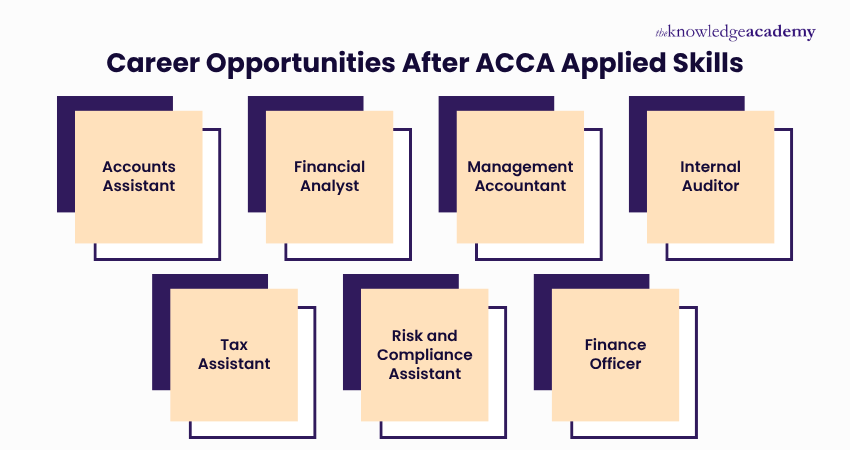
Career Opportunities After ACCA Applied Skills

Completing the ACCA Applied Skills stage enables learners to pursue a wide range of career opportunities in accounting and finance, such as:

Career Opportunities After ACCA Applied Skills

  • Accounts Assistant: Support bookkeeping, invoicing, reporting tasks and gain hands on experience within finance teams.
  • Financial Analyst: Assist with financial planning, data analysis, and preparing reports that support decision making.
  • Management Accountant: Contribute to budgeting, forecasting, cost analysis, and performance reporting activities.
  • Internal Auditor: Review internal controls, assess risks and support assurance work within organisations.
  • Tax Assistant: Prepare tax calculations, maintain compliance documentation, and support advisory tasks in tax departments or accounting firms.
  • Risk and Compliance Assistant: Help identify financial risks, support compliance activities and assist in monitoring organisational controls.
  • Finance Officer: Support cash management, monitor financial transactions, and assist with treasury or financial operations in corporate environments.
Show more blue-arrow

ACCA Applied Skills FAQs

There hasn't been any questions asked about this Topic

Please see our available in Monaco

The Knowledge Academy is one of the Leading global training provider for .

The training fees for in Monaco starts from €1995

Show more down

Why we're the go to training provider for you

icon

Best price in the industry

You won't find better value in the marketplace. If you do find a lower price, we will beat it.

icon

Trusted & Approved

Recognised by leading certification bodies, we deliver training you can trust.

icon

Many delivery methods

Flexible delivery methods are available depending on your learning style.

icon

High quality resources

Resources are included for a comprehensive learning experience.

barclays Logo
deloitte Logo
Thames Water Logo

"Really good course and well organised. Trainer was great with a sense of humour - his experience allowed a free flowing course, structured to help you gain as much information & relevant experience whilst helping prepare you for the exam"

Joshua Davies, Thames Water

santander logo
bmw Logo
Google Logo

Looking for more information on ACCA Applied Skills

cross

Exclusive Deals Big Savings This March!

Grab up to 40% OFF and level up your skills this spring! march-madness

WHO WILL BE FUNDING THE COURSE?

close

close

Thank you for your enquiry!

One of our training experts will be in touch shortly to go over your training requirements.

close

close

Press esc to close

close close

Back to course information

Thank you for your enquiry!

One of our training experts will be in touch shortly to go overy your training requirements.

close close

Thank you for your enquiry!

One of our training experts will be in touch shortly to go over your training requirements.