Who should attend this BCS International Diploma in Business Analysis Course?
This course is also perfect for those professionals who wish to understand the principles of business analysis in a very holistic manner and would also like to get a globally recognised qualification in the area.
You are eligible to attend this BCS International Diploma in Business Analysis Course if you are:
- Business Analyst: Moving your career and gaining a credential that is respected in the industry.
- Project Manager: Enhancing your business requirements definition, analysis and management.
- Business Change Manager: Nurturing successful change with systematic analysis.
- Consultant: Providing insights and recommendations that are based on analysis to clients.
- IT Professional: The match between technical and business goals and needs.
- Aspiring Business Analyst: Building a strong background in business analysis.
Prerequisites of the BCS International Diploma in Business Analysis Course
Although there are no fixed set of prerequisites for the course, there are certain eligibility criteria that the delegates must adhere to. For registering in such Business Analysis Courses, the candidates typically need:
- Work experience, ideally in a business field
- Prior Business Analysis experience
- Basic IT and systems knowledge
- Proficiency in the instruction language, usually English
- Possibly, the BCS Business Analysis Foundation Certificate
In addition to the above, candidates must pass four written examinations, each granting an individual certificate, before attending an oral interview with two BCS examiners. This final interview assesses their technical knowledge, business understanding, and interpersonal competencies to qualify for the diploma.
BCS International Diploma in Business Analysis Overview
The BCS International Diploma in Business Analysis Course is a globally recognised professional qualification equipping learners with advanced principles, techniques, and the Business Analysis Framework to deliver strategic change and value in complex organisations.
Mastering analysis at this level supports innovation, operations, and change initiatives. Ideal for Analysts, Consultants, and Project Managers, it includes four modules and an oral exam within the BCS International Diploma in Business Analysis.
This 10-day course by The Knowledge Academy blends theory, practice, and exam prep, covering lifecycle, process modelling, requirements, and solution evaluation. It builds confidence to apply the Business Analysis Framework in real-world contexts.
BCS International Diploma in Business Analysis Course Objectives
- To understand the full scope and strategic impact of business analysis
- To apply industry-standard business analysis principles and techniques
- To manage stakeholders and requirements effectively across projects
- To use business process modelling to map and improve business operations
- To prepare thoroughly for the oral examination and achieve diploma success
Completing all modules and exams awards the BCS International Diploma in Business Analysis, a globally recognised professional qualification from BCS, The Chartered Institute for IT, proving readiness for advanced roles and professional excellence.
Sectors Employing the Power of Business Analysis
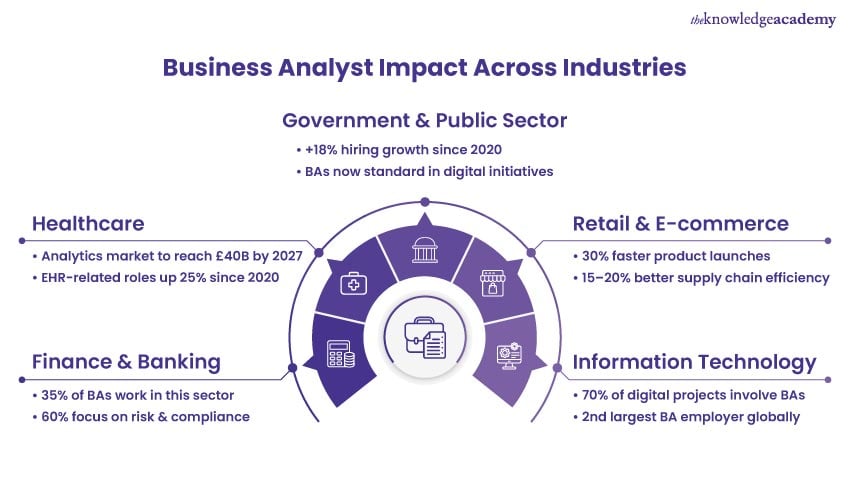
Through this course you can become a Business Analyst (BAs) who drives measurable impact across major industries. From healthcare to government, the demand for analytical expertise continues to grow; making BA skills highly valuable across sectors.
- Government & Public Sector:
- +18% hiring growth since 2020; BAs are now central to digital transformation initiatives.
- Retail & E-commerce:
- Enable 30% faster product launches and improve supply chain efficiency by up to 20%.
- Information Technology:
- 70% of digital projects require BAs; IT is the second largest global employer of business analysts.
- Finance & Banking:
- 35% of all BAs work in this field; 60% are involved in risk and compliance operations.
- Healthcare:
- The analytics market is projected to reach £40B by 2027; EHR (Electronic Health Record) roles up 25% since 2020.


 If you miss out, enquire to get
yourself
on the waiting list for the next day!
If you miss out, enquire to get
yourself
on the waiting list for the next day!













 If you wish to make any changes to your course, please


