


 Top Rated Course

We may not have the course you’re looking for. If you enquire or give us a call on +352 20 33 17 60 and speak to our training experts, we may still be able to help with your training requirements.
ITIL 4 Practices: A Complete Guide
John Davies 09 June 2026The ITIL 4 Practices include General, Service, Technical Management practices and Continual Improvement that help organisations align IT services with business. They deliver valuable service quality, manage risks, and promote improvement. It helps organisations plan, deliver, support, and enhance their IT services.

Training Outcomes Within Your Budget!
We ensure quality, budget-alignment, and timely delivery by our expert instructors.
Table of Contents
We’ve all been there; broken systems, frustrated users, and 3 AM calls. However, it doesn’t have to be that way. This is because ITIL 4 practices are here to help you build IT services that just work. No more guesswork, just clear, flexible methods for handling everything from daily issues to long-term improvements. How do they stay on top of everything?
Spoiler: They’re using ITIL 4 practices. These tried-and-tested methods help you manage problems, improve performance, and keep your users smiling. If you want less stress, more control, and a roadmap to IT success, this blog is for you. Let’s explore the tools that help smart teams work smarter.
Table of Contents
1) What is ITIL 4?
2) Let's Talk About the ITIL 4 Areas of Management
3) What are the ITIL 4 Certification Levels?
4) What are the Five Elements of ITIL?
5) Conclusion
What is ITIL 4?
ITIL 4 was released as an update to ITIL 3 that was launched in 2007. It helps companies adapt to the recent developments in IT and software development. The focus is to establish an end-to-end management practice, turning demand into value. It serves as an adept response to frameworks like FitSM, SIAM®, and VeriSM™.
Service Management Practices like ITSM vs ITIL have been developed in the IT Asset Management Software industries. They are applicable to services being deployed, developed, supported, and delivered in an organisation. The SIAM Operating Model enhances these practices by ensuring seamless integration and governance across multiple service providers.It also includes best practices to work with Agile, Lean, and DevOps.
Let’s Talk About the ITIL 4 Areas of Management
The previous ITIL versions focused on processes. ITIL 4 focuses on practices. These practices are spread over three areas of management:
1) General Management Practices
2) Service Management Practices
3) Technical Management Practices
Let’s discuss these further.
General Management Practices
From risk and Project Management to talent, strategy, and supplier handling, each practice supports effective service delivery and continuous improvement.

These practices collectively ensure that organisations maintain control over their processes while adapting to changing business needs. By integrating governance, risk and resource management, they create a strong foundation for consistent service delivery, improved decision-making and long-term value creation across IT operations.
Register for our ITIL Certification today to get started on your journey towards becoming an ITIL Specialist!
Service Management Practices
The ITIL 4 framework includes several practices that ensure efficient Service Management across an organisation. Below is a concise overview of key practices focused on service delivery, improvement, and resilience.

These practices play a crucial role in ensuring that IT services are designed, delivered and supported effectively to meet user and business expectations. By focusing on service quality, performance, and resilience, they help organisations maintain consistency, minimise disruptions and continuously improve service outcomes.
Technical Management Practices
These practices focus on building, deploying, and maintaining reliable technology solutions that support the organisation’s services and business goals.
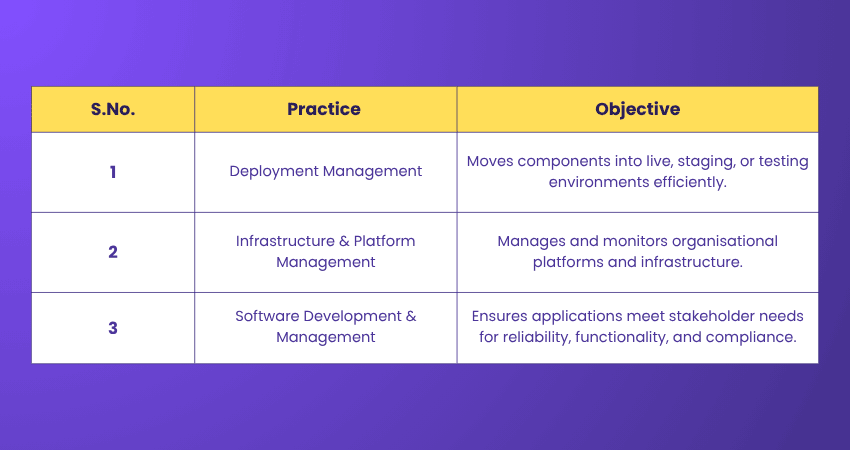
These practices focus on the technical backbone of IT services, ensuring systems, platforms and applications are built and maintained effectively. By supporting reliable deployment, infrastructure management, and software development, they help organisations deliver stable, secure, and high-performing technology solutions.
Create seamless and value-driven user experiences with ITIL® 5 Experience Certification Training – Sign up soon!
What are the ITIL 4 Certification Levels?
The ITIL 4 Certification levels follow a structured path designed to build IT Service Management expertise. The journey begins with the ITIL 4 Foundation, which introduces key concepts and terminology. Next, learners can pursue ITIL 4 Specialist, Strategist, or Leader modules, depending on their career focus.
What are the Five Elements of ITIL?
The five elements of ITIL, also known as the five stages of the ITIL service lifecycle, are Service Strategy, Service Design, Service Transition, Service Operation, and Continual Service Improvement. Together, these are known to provide a structured approach for managing IT services across their entire lifecycle.
Conclusion
ITIL 4 Practices help organisations manage their services better by providing clear methods for planning, delivering, and improving IT services. Each practice focuses on a different area, like managing risks, handling changes, supporting customers, or improving business processes. By using these practices, companies can work more efficiently, meet customer needs, and stay flexible in a changing world.
Manage and optimise IT services effectively with ITIL® 5 Service Certification Training – Join now!
Frequently Asked Questions
What are the Seven ITIL 4 Practices?

The seven key ITIL 4 practices include Incident Management, Problem Management, Change Enablement, Service Request Management, Service Desk, Service Level Management, and Continual Improvement. They are known to help organisations in effectively delivering reliable, efficient, and customer-focused IT services.
What are the Four Pillars of ITIL?
The four pillars of ITIL, known as the Four Dimensions, are Organisations and People, Information and Technology, Partners and Suppliers, and Value Streams and Processes. They ensure a balanced, holistic approach to designing, delivering, and improving IT services effectively. These are very important, especially in the IT sector.
What are the Other Resources and Offers Provided by The Knowledge Academy?
The Knowledge Academy takes global learning to new heights, offering over 3,000+ online courses across 490+ locations in 190+ countries. This expansive reach ensures accessibility and convenience for learners worldwide.
Alongside our diverse Online Course Catalogue, encompassing 17 major categories, we go the extra mile by providing a plethora of free educational Online Resources like Blogs, eBooks, Interview Questions and Videos. Tailoring learning experiences further, professionals can unlock greater value through a wide range of special discounts, seasonal deals, and Exclusive Offers.
What is The Knowledge Pass, and How Does it Work?
The Knowledge Academy’s Knowledge Pass, a prepaid voucher, adds another layer of flexibility, allowing course bookings over a 12-month period. Join us on a journey where education knows no bounds.
What are the Related Courses and Blogs Provided by The Knowledge Academy?
The Knowledge Academy offers various ITIL® Certification Courses, including ITIL® 5 Foundation Certification Training, ITIL® 5 Service Certification Training and ITIL® 5 Strategy Certification Training. These courses cater to different skill levels, providing comprehensive insights into IT Service Management Metrics.
Our IT Service Management Blogs cover a range of topics related to ITIL 4 Practices, offering valuable resources, best practices, and industry insights. Whether you are a beginner or looking to advance your IT Service Management skills, The Knowledge Academy's diverse courses and informative blogs have got you covered.

John Davies


Cyber Security Governance & Assurance Specialist
John Davies is a cybersecurity expert specialising in governance, risk management, and compliance. With over 15 years in the field, he has led enterprise-wide security programmes across finance, healthcare and public sector organisations. His content provides practical guidance on building secure environments, managing risk and aligning with regulatory frameworks.

Upcoming IT Service Management Resources Batches & Dates
Date
 ITIL® 5 Foundation Certification
ITIL® 5 Foundation Certification
Mon 29th Jun 2026
ITIL® 5 Foundation Certification
Wed 1st Jul 2026
ITIL® 5 Foundation Certification
Mon 6th Jul 2026
ITIL® 5 Foundation Certification
Wed 8th Jul 2026
ITIL® 5 Foundation Certification
Mon 13th Jul 2026
ITIL® 5 Foundation Certification
Wed 15th Jul 2026
ITIL® 5 Foundation Certification
Mon 20th Jul 2026
ITIL® 5 Foundation Certification
Wed 22nd Jul 2026
ITIL® 5 Foundation Certification
Mon 27th Jul 2026
ITIL® 5 Foundation Certification
Wed 29th Jul 2026
ITIL® 5 Foundation Certification
Mon 3rd Aug 2026
ITIL® 5 Foundation Certification
Wed 5th Aug 2026
ITIL® 5 Foundation Certification
Mon 10th Aug 2026
ITIL® 5 Foundation Certification
Wed 12th Aug 2026
ITIL® 5 Foundation Certification
Mon 17th Aug 2026
ITIL® 5 Foundation Certification
Wed 19th Aug 2026
ITIL® 5 Foundation Certification
Mon 24th Aug 2026
ITIL® 5 Foundation Certification
Wed 26th Aug 2026
ITIL® 5 Foundation Certification
Tue 1st Sep 2026
ITIL® 5 Foundation Certification
Mon 7th Sep 2026
ITIL® 5 Foundation Certification
Wed 9th Sep 2026
ITIL® 5 Foundation Certification
Mon 14th Sep 2026
ITIL® 5 Foundation Certification
Wed 16th Sep 2026
ITIL® 5 Foundation Certification
Mon 21st Sep 2026
ITIL® 5 Foundation Certification
Wed 23rd Sep 2026
ITIL® 5 Foundation Certification
Mon 28th Sep 2026
ITIL® 5 Foundation Certification
Wed 30th Sep 2026
ITIL® 5 Foundation Certification
Mon 5th Oct 2026
ITIL® 5 Foundation Certification
Wed 7th Oct 2026
ITIL® 5 Foundation Certification
Mon 12th Oct 2026
ITIL® 5 Foundation Certification
Wed 14th Oct 2026
ITIL® 5 Foundation Certification
Mon 19th Oct 2026
ITIL® 5 Foundation Certification
Wed 21st Oct 2026
ITIL® 5 Foundation Certification
Mon 26th Oct 2026
ITIL® 5 Foundation Certification
Wed 28th Oct 2026
ITIL® 5 Foundation Certification
Mon 2nd Nov 2026
ITIL® 5 Foundation Certification
Wed 4th Nov 2026
ITIL® 5 Foundation Certification
Mon 9th Nov 2026
ITIL® 5 Foundation Certification
Wed 11th Nov 2026
ITIL® 5 Foundation Certification
Mon 16th Nov 2026
ITIL® 5 Foundation Certification
Wed 18th Nov 2026
ITIL® 5 Foundation Certification
Mon 23rd Nov 2026
ITIL® 5 Foundation Certification
Wed 25th Nov 2026
ITIL® 5 Foundation Certification
Mon 30th Nov 2026
ITIL® 5 Foundation Certification
Wed 2nd Dec 2026
ITIL® 5 Foundation Certification
Mon 7th Dec 2026
ITIL® 5 Foundation Certification
Wed 9th Dec 2026
ITIL® 5 Foundation Certification
Mon 14th Dec 2026
ITIL® 5 Foundation Certification
Mon 21st Dec 2026
ITIL® 5 Foundation Certification
Wed 23rd Dec 2026
ITIL® 5 Foundation Certification
Tue 29th Dec 2026

 If you wish to make any changes to your course, please


