


 Top Rated Course

We may not have the course you’re looking for. If you enquire or give us a call on +352 8002-6867 and speak to our training experts, we may still be able to help with your training requirements.
Benefits of Strategic Workforce Planning: An Overview
James Smith 03 March 2026Benefits of Strategic Workforce Planning include aligning talent with goals, closing skill gaps, boosting productivity, and improving agility. It also strengthens succession planning and enables smarter hiring decisions. Together, these efforts support long-term stability and sustainable organisational growth.

Training Outcomes Within Your Budget!
We ensure quality, budget-alignment, and timely delivery by our expert instructors.
Table of Contents
Have you ever thought about why some companies always seem to do well, even when things get tough in the business world? What sets them apart is often their adept use of Strategic Workforce Planning (SWP). From hiring the right people to managing costs, the Benefits of Strategic Workforce Planning are plenty in an organisation.
According to Mordor Intelligence, the size of the Workforce Management Software Market is projected to increase from 6.35 billion GBP in 2023 to 8.53 billion GBP by 2028, reflecting a CAGR of 6.07% during the years 2023-2028. So, it’s time to discover the Benefits of Strategic Workforce Planning. Learn how this approach optimises employee utilisation, enhances decision-making, and prepares businesses for future success.
Table of Contents
1) What is Strategic Workforce Planning?
2) Top Benefits of Strategic Workforce Planning
3) Key Components of Strategic Workforce Planning
4) Why is Strategic Workforce Planning Important?
5) What Does Strategic Workforce Planning Involve?
6) Conclusion
What is Strategic Workforce Planning?
Strategic Workforce Planning means studying your current workforce to figure out the hiring needs in the future. This helps you to frame a strategic plan to achieve your business goals. It's important to find solutions by figuring out the gap in talent which exists between the present and the future.
Every company needs the correct blend of skilled individuals and efficient employment structures to reach its objectives. Strategic Workforce Planning provides HR with the necessary details to recruit candidates who can actively contribute to the future success of the business, ensuring consistent staffing levels in every department. Today, where unpredictability is more and more likely, it is crucial for organisations to secure suitable talent that aligns with their evolving priorities.

Top Benefits of Strategic Workforce Planning
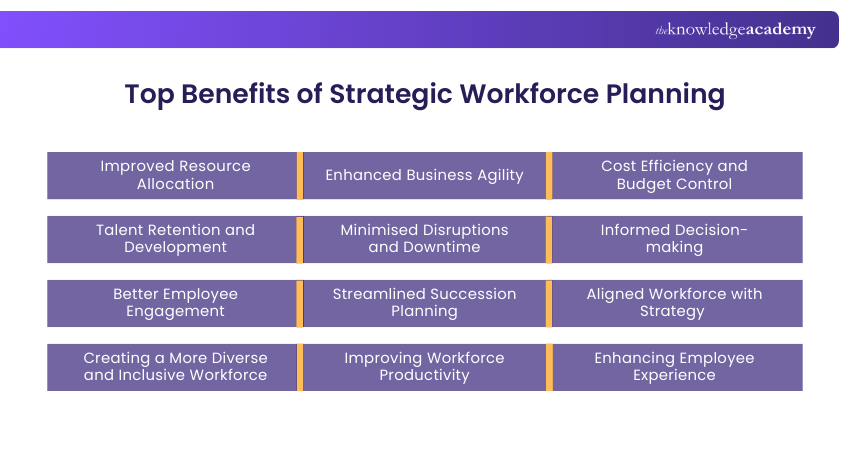
Strategic Workforce Planning (SWP) isn't just another management concept; it's a powerful tool that can revolutionise how businesses operate. Let's explore the top Benefits of Strategic Workforce Planning and understand why it's becoming increasingly important:
1) Improved Resource Allocation
One of the primary Benefits of Strategic Workforce Planning is that it enables businesses to allocate their workforce resources more efficiently. By analysing the company's objectives and future needs, SWP helps determine where and when specific skills will be required. This prevents overstaffing or understaffing situations. As a result, it reduces unnecessary costs and ensures that the right people are available for the right tasks at the right time.
2) Enhanced Business Agility
In this fast-growing era, adaptability is key. SWP equips companies with the agility to respond swiftly to shifts in the market, industry trends, or unforeseen challenges. Having a workforce that can be easily reshaped according to evolving needs gives businesses a competitive edge.
3) Cost Efficiency and Budget Control
Effective SWP contributes to cost savings by minimising inefficient resource use. One of the key Benefits of Workforce Planning is improved budget accuracy, allowing organisations to allocate resources more effectively and avoid unnecessary spending. This results in leaner, more focused expenditure that closely aligns with strategic objectives.
4) Talent Retention and Development
A well-thought-out workforce plan considers not only the present but also the future growth of employees. By offering opportunities for skill development, career progression, and a supportive work environment, companies can enhance employee satisfaction and retention. This saves recruitment costs while nurturing a skilled and loyal workforce.
5) Minimised Disruptions and Downtime
Employee turnover, unexpected absences, and skill shortages can lead to disruptions in business operations. SWP anticipates these challenges and offers proactive solutions, such as cross-training employees or having a pool of potential replacements ready. This reduces downtime and ensures business continuity.
6) Informed Decision-making
Strategic Workforce Planning relies on data-driven insights, ensuring decisions are based on accurate information rather than assumptions. One of the major Benefits of Strategic Workforce Planning is improved decision-making across hiring, training, promotions, and business expansion. This ensures actions remain aligned with the company’s long-term strategy.
7) Better Employee Engagement
When employees understand that the company invests in their growth and development, their engagement levels naturally increase. SWP fosters a culture of continuous learning and improvement, where employees feel motivated and valued to contribute effectively.
8) Streamlined Succession Planning
Preparing for the future means having capable leaders ready to step into higher roles. SWP identifies potential leaders within the organisation and provides targeted development opportunities, ensuring a smooth transition when key positions become vacant.
9) Aligned Workforce with Strategy
Perhaps one of the most crucial Benefits of Strategic Workforce Planning is that it aligns the workforce with the strategic direction of the business. It ensures that every hire, every training session, and every decision made regarding human resources is in harmony with the company's goals.
10) Creating a More Diverse and Inclusive Workforce
Strategic Workforce Planning helps organisations identify representation gaps and reduce unconscious bias in hiring. By attracting talent from diverse backgrounds, companies increase the variety of skills, experiences, and perspectives within teams. This strengthens creativity, supports innovation, and enables businesses to better serve a diverse customer base.
11) Improving Workforce Productivity
By aligning headcounts with business demand, organisations prevent overwork and reduce the risk of burnout. Employees can focus on high-value tasks that match their roles and strengths. This balanced workload improves efficiency, enhances performance, and helps the organisation achieve its strategic objectives more effectively.
12) Enhancing Employee Experience
Strategic Workforce Planning enhances the employee journey from recruitment to career growth. Clear hiring criteria improve onboarding, while balanced staffing ensures the right skills are in place. Training, development, and recognition help employees feel valued, motivated, and engaged.
Learn how to support employee growth and career development effectively with our Talent Management Training – Join now!
Key Components of Strategic Workforce Planning
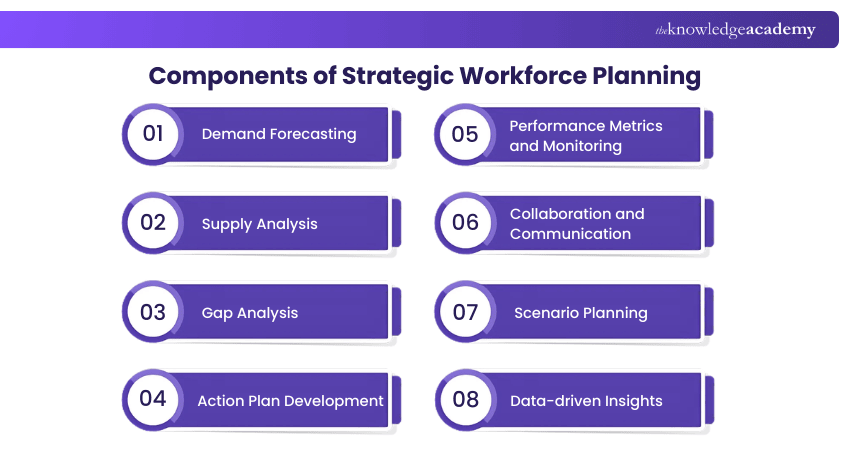
Strategic Workforce Planning (SWP) is a process that involves several interconnected components, each playing a crucial role in aligning an organisation's human resources with its strategic goals. Let us take a closer look at these key components:
1) Demand Forecasting
This means figuring out how many employees a company will need in the future. It's like predicting how much help the company will require based on its growth and what's happening in the market. This way, the company can make sure it has the right number of people when it needs them.
2) Supply Analysis
The company looks at all the workers currently employed. We're trying to see who is good at different things and who might need some more training. This helps the company understand the skills its employees have and where it might need to hire more people.
3) Gap Analysis
Gap analysis is where the demand and supply components intersect. By comparing the projected workforce demand with the current workforce supply, organisations can identify gaps in terms of skills, roles, and capacities. These gaps provide valuable insights into where the organisation might face talent shortages or surpluses. This analysis lays the foundation for strategic decisions related to recruitment, training, upskilling, and workforce restructuring.
4) Action Plan Development
With a clear understanding of demand, supply, and gaps, organisations can formulate action plans to bridge those gaps effectively. These action plans encompass various strategies, such as recruitment initiatives, training programmes, and talent development pathways. Action plans also account for potential changes in the business environment, ensuring that the workforce remains adaptable to evolving circumstances.
5) Performance Metrics and Monitoring
An integral part of SWP is the establishment of performance metrics and continuous monitoring mechanisms. These metrics assess the effectiveness of the implemented strategies and measure the progress made in closing workforce gaps. Regular monitoring allows organisations to make timely adjustments. It ensures that their Workforce Planning remains aligned with changing business needs.
6) Collaboration and Communication
SWP isn't just something that the Human Resources (HR) department does alone. It needs people from different parts of the company to work together. This means that the HR team, the finance team, the operations team, and others collaborate and share information.
This is very important because it helps the company figure out how many workers it will need and make good decisions. When people from different teams work together, SWP becomes better because everyone understands what the company wants to achieve and the challenges it faces.
7) Scenario Planning
Given the dynamic nature of the business landscape, SWP involves scenario planning. This means creating different scenarios based on potential changes in the market, technology, or industry regulations. By considering a range of possible futures, organisations can prepare for various emergencies, making them more resilient in the face of uncertainty.
8) Data-driven Insights
Data-driven insights mean using real facts and information to understand things better. It's like looking at numbers, like how many workers we have and what they're good at, to make smart decisions. When we use these numbers, we can see patterns and trends that help us know what's working well and what needs improvement. So, it's about using real information to make our plans and choices smarter.
Enhance skills in Workforce Planning, sourcing, and candidate assessment with our Talent Acquisition Training – Register today!
Why is Strategic Workforce Planning Important?
Strategic Workforce Planning helps organisations assess current talent, identify skills gaps, and predict future workforce needs. By aligning people strategy with business goals, it ensures the right individuals are in the right roles at the right time. This reduces recruitment costs, prevents staffing imbalances, and supports smarter hiring and development decisions.
It also improves flexibility, helping businesses respond to market and demographic changes. Through collaboration between leadership, HR, and finance, organisations can manage succession, protect critical knowledge, strengthen talent pipelines, and enhance employee experience, supporting long-term growth and stability.
What Does Strategic Workforce Planning Involve?
Strategic Workforce Planning involves gaining valuable insights into your business's present situation and leveraging this data to meet future requirements. Workforce Planning Tools play a crucial role in analysing this information and formulating initiatives to strengthen the existing workforce and expand the company to meet the desired demand. Workforce Planning comprises two aspects that aid in dissecting primary areas of focus.
a) Soft Workforce Planning: Soft Workforce Planning emphasises building a strategic framework for analysing business data. Flexibility and responsiveness to business needs are important, along with identifying and optimising key performance drivers. Prior to implementing actions influenced by changing circumstances, managers should anticipate various potential outcomes.
b) Hard Workforce Planning: Hard Workforce Planning relies on crucial data to anticipate the necessary hiring to address future skill shortages. Yet, numerical and statistical information alone is inadequate for a successful Workforce Planning strategy. It is important to analyse and comprehend the data in its context to ensure that business objectives are achieved within budget constraints.
Conclusion
Businesses leveraging the Benefits of Strategic Workforce Planning complete tasks efficiently. It also helps organisations adapt to changes in the market and technology, staying ahead of the curve. Through Strategic Workforce Planning, organisations can enhance their performance, save costs, and ensure they have the right people with the right skills at the right time. It's a strategy that contributes to the overall success and sustainability of businesses.
Gain tools to support employee development and create a positive work culture through the People Management Courses – Join today!
Frequently Asked Questions
What are the Challenges of Strategic Workforce Planning?

Strategic Workforce Planning faces challenges such as inaccurate data, weak forecasting, rapid technological change, skills shortages, budget limits, resistance to change, and limited leadership support. Aligning workforce strategies with overall business goals also remains difficult, affecting long-term growth and stability.
What are the Seven Reasons Why Workforce Planning is Important?
Here are the key reasons Workforce Planning is important:
1) Aligns workforce with business goals
2) Reduces skills gaps
3) Controls staffing costs
4) Supports succession planning
5) Improves productivity
6) Prepares for market changes
7) Strengthens data-driven decisions
What are the Other Resources and Offers Provided by The Knowledge Academy?
The Knowledge Academy takes global learning to new heights, offering over 3,000+ online courses across 490+ locations in 190+ countries. This expansive reach ensures accessibility and convenience for learners worldwide.
Alongside our diverse Online Course Catalogue, encompassing 17 major categories, we go the extra mile by providing a plethora of free educational Online Resources like Blogs, eBooks, Interview Questions and Videos. Tailoring learning experiences further, professionals can unlock greater value through a wide range of special discounts, seasonal deals, and Exclusive Offers.
What is The Knowledge Pass, and How Does it Work?
The Knowledge Academy’s Knowledge Pass, a prepaid voucher, adds another layer of flexibility, allowing course bookings over a 12-month period. Join us on a journey where education knows no bounds.
What are the Related Courses and Blogs Provided by The Knowledge Academy?
The Knowledge Academy offers various People Management Courses, including the Workforce Resource Planning Training, Talent Acquisition Training, and Talent Management Training. These courses cater to different skill levels, providing comprehensive insights into Matrix Organisational Structure.
Our HR Blogs cover a range of topics related to Strategic Workforce Planning, offering valuable resources, best practices, and industry insights. Whether you are a beginner or looking to advance your HR skills, The Knowledge Academy's diverse courses and informative blogs have got you covered.

James Smith


Digital Marketing Manager and Trainer
James Smith is a digital marketing professional with over a decade of experience in SEO, content strategy, paid media and analytics. He has supported both SMEs and global brands in transforming their digital presence. James’s writing and training are rooted in results-driven tactics and the latest marketing trends.
View Detail
Upcoming Business Skills Resources Batches & Dates
Date
 Workforce Resource Planning Training
Workforce Resource Planning Training
Fri 20th Mar 2026
Workforce Resource Planning Training
Fri 15th May 2026
Workforce Resource Planning Training
Fri 14th Aug 2026
Workforce Resource Planning Training
Fri 13th Nov 2026

 If you wish to make any changes to your course, please


