


 Top Rated Course

We may not have the course you’re looking for. If you enquire or give us a call on +800 312616 and speak to our training experts, we may still be able to help with your training requirements.
What is Market Segmentation? A Complete Overview
James Smith 22 April 2026Market Segmentation is the process of dividing a wide target market into smaller groups based on shared characteristics like needs, behaviours, or demographics. By segmenting the market, businesses can allocate resources more efficiently, personalise their marketing efforts and ultimately increase customer satisfaction and sales.

Training Outcomes Within Your Budget!
We ensure quality, budget-alignment, and timely delivery by our expert instructors.
Table of Contents

Market Segmentation is like drawing a detailed map of your audience. Instead of treating all customers the same, it divides them into meaningful groups based on shared needs, habits or traits. This is why it feels like your favourite brands get you like nobody else. Knowing What is Market Segmentation is vital for Marketers because it helps businesses design products people genuinely want.
In short, from boosting sales to refining marketing strategies, this approach turns scattered audiences into clearly defined opportunities. This blog explores What is Market Segmentation in detail, covering both its benefits and challenges to help you weigh your options for your next campaign. So read on and fuel your marketing magic!
Table of Contents
1) What Is Market Segmentation?
2) Why is Market Segmentation Important?
3) Types of Market Segmentation
4) Characteristics of Market Segmentation
5) Steps When Implementing Market Segmentation
6) What are the Key Benefits of Market Segmentation?
7) Challenges of Market Segmentation
8) Examples of Market Segmentation Use Cases
9) Market Segmentation vs Customer Segmentation
10) Conclusion
What is Market Segmentation?
Market Segmentation is a strategic approach through which businesses tailor their products, services and marketing efforts to specific customer groups for better results. It plays a key role in driving profitability and customer satisfaction. The process involves dividing potential customers into distinct segments based on shared traits such as demographics, behaviours, geography, or psychographics.
By understanding these differences, businesses can craft targeted marketing strategies and even unique products that resonate with each group’s specific needs and preferences. Additionally, companies apply segmentation principles to guide decisions on pricing, distribution and overall market positioning.

Why is Market Segmentation Important?
Market Segmentation turbocharges the effectiveness of marketing, advertising and sales efforts. Instead of addressing a broad audience with generic messages, it allows businesses to create offers tailored to the unique needs and preferences of specific customer groups.
For instance, when an advertising campaign is designed around a well-defined segment, the brand can use targeted criteria to reach the most relevant audience. This precision ensures that marketing messages resonate more deeply and drive better engagement.
Types of Market Segmentation
Businesses use several methods to divide their target audience into distinct groups. Below are the most common types:
1) Demographic
This approach groups customers based on attributes such as age, gender, income, education, occupation, or family size. It helps identify who the customers are and what they value.
Example: A luxury car brand targeting high-earning professionals based on sales data and income levels.
2) Geographic
Based on the principle that people in different locations have different preferences and needs, this type focuses on tailoring marketing to specific regions or climates.
Example: McDonald’s adapts its menu globally, offering the McAloo Tikki burger in India and the Teriyaki Chicken Filet-O in Japan to suit local tastes.
3) Behavioural
This method classifies consumers according to their habits, brand interactions, and purchasing behaviour. It focuses on understanding how people act rather than who they are.
Example: When a shopper abandons an online cart, they may later see ads for the same product through a process known as ad retargeting.
4) Firmographic
Used primarily in B2B marketing, this strategy segments businesses based on attributes like industry, company size, revenue, or location.
Example: Amazon Web Services (AWS) tailors its Cloud solutions to different industries and business sizes using firmographic insights.
5) Psychographic
Consumers are grouped by psychological and lifestyle factors such as beliefs, interests, values, and social class. This approach helps align marketing with customer motivations.
Example: Patagonia appeals to eco-conscious consumers through its use of recycled materials and sustainability-focused initiatives.

Characteristics of Market Segmentation
For Market Segmentation to deliver meaningful results, it should meet several essential characteristics including the following:
1) Viable
The market segment should consist of customers who can realistically afford the product or service. For instance, a company selling high-premium homeowner’s insurance can refine its target segment by combining behavioural data with demographic factors like income level to ensure affordability.
2) Quantifiable
The market segment’s performance must be measurable in financial terms. Being able to track the revenue generated from each segment helps with better decision-making about future marketing investments and resource allocation.
3) Accessible
The target audience must be reachable through available marketing channels. For example, Digital Marketing would be ineffective for a segment living in areas with limited internet or mobile coverage.
4) Measurable
A company should be able to assess the size, characteristics, and profit potential of its target segments. This allows for accurate forecasting, efficient budget use and consistent performance tracking.
5) Relevant
Each market segment should align closely with the company’s products or services. Such relevance ensures that the chosen audience truly benefits from the offering, thus leading to better engagement and stronger brand loyalty.
Learn how product content drives conversions in the e-commerce world. Sign up for our Product Content for E-Commerce Training now!
Steps in Implementing Market Segmentation
Market Segmentation is a structured process that helps businesses better understand and target their audience. Here are the five key steps:
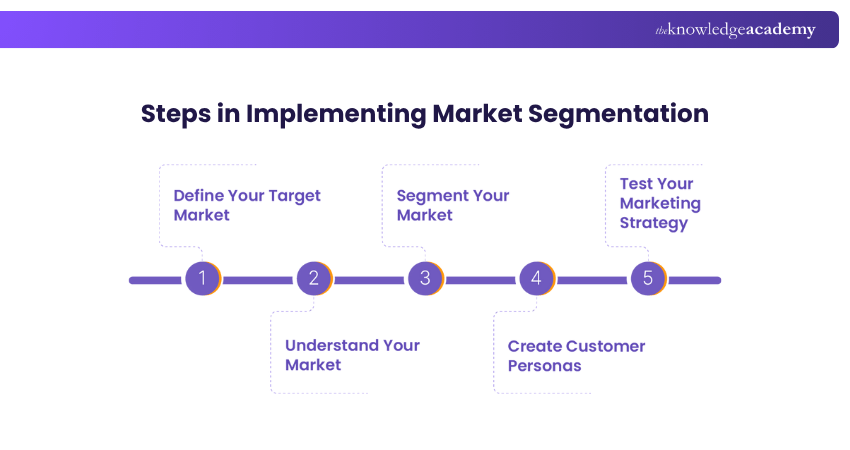
1) Define Your Target Market
1) Identify the broader audience your business aims to serve.
2) Research current industry trends and emerging opportunities.
3) Analyse customer needs, preferences, and pain points.
4) Evaluate how effectively your product or service addresses these needs.
5) Use insights to establish a clear foundation for further Market Segmentation.
2) Understand Your Market
1) Gather insights through data-driven research for accurate segmentation.
2) Conduct surveys and focus groups to understand customer preferences.
3) Analyse online behaviour and engagement patterns across digital platforms.
4) Review purchase histories to identify recurring buying trends and motivations.
5) Combine quantitative and qualitative data to build a clear picture of customer behaviour.
3) Segment Your Market
1) Divide your broader audience into distinct segments based on shared characteristics.
2) Use criteria such as demographics, behaviour, geography, or psychographics for clarity.
3) Make sure that each segment reflects the unique needs or motivations for accurate targeting.
4) Avoid overgeneralising because people with similar demographics may still differ in preferences.
5) Focus on creating only those segments that are relevant to your business goals.
4) Create Customer Personas
1) Develop detailed profiles that represent each market segment.
2) Include key details like name, age, occupation, goals, and challenges.
3) Identify each persona’s motivations, preferences and buying habits.
4) Use the personas to design marketing messages and product offerings.
5) Boost customer engagement by addressing each segment’s specific needs and interests.
5) Test Your Marketing Strategy
1) Create targeted Marketing Campaigns for each defined segment.
2) Use A/B testing to compare different messages, visuals or offers.
3) Track key performance metrics like engagement, click-throughs and conversions.
4) Analyse the results to narrow down what resonates best with each audience.
5) Continuously refine and optimise strategies to boost effectiveness and maximise ROI.
Register for our Conversion Rate Optimisation Training and transform your website into a sales powerhouse - Join today!
What are the Key Benefits of Market Segmentation?
By categorising customers and prospects according to their shared traits, Market Segmentation offers numerous strategic business advantages:
1) Improved Marketing Efficiency and Higher ROI
Segmentation allows businesses to identify high-value audiences most likely to convert. This helps ensure precise targeting and optimal use of marketing resources. This focus increases ROI and eliminates the inefficiency of broad, untargeted campaigns.
2) More Effective Product Planning and Development
With detailed insight into customer needs and preferences, companies can refine their existing products and design new offerings. These can be better aligned with audience expectations and evolving market trends.
3) Better Customer Communication and Engagement
Segmentation reveals preferred communication channels and message types for each customer group. This helps Marketers deliver more relevant, compelling campaigns that strengthen engagement.
4) Increased Upselling and Cross-selling Opportunities
Analysing purchase patterns helps identify customers likely to be interested in related products or upgrades. This drives additional sales across the product portfolio.
5) Greater Customer Loyalty and Lower Churn Rates
By recognising and rewarding repeat customers, businesses can strengthen brand loyalty and reduce turnover. This cultivates long-term customer relationships.
6) Real-time Segmentation for Higher Conversion Rates
Instant segmentation during live interactions (online or over the phone) enables tailored offers that resonate with customer interests. This significantly boosts conversions and revenue potential.
Challenges of Market Segmentation
While Market Segmentation offers plenty of advantages, it also presents several challenges that businesses need to manage carefully:
1) Higher Costs: Creating and managing multiple customer segments can increase expenses. Conducting in-depth research and designing personalised campaigns requires more time, resources and investment than broad marketing strategies.
2) Risk of Excluding Potential Customers: By concentrating only on the most profitable segments, businesses can unintentionally overlook other audiences who could become valuable customers in the long run.
3) Increased Complexity: Proper segmentation demands extensive data analysis. This can complicate understanding customer needs and make strategic decisions harder to execute efficiently.
4) Ethical Concerns and Stereotyping: Categorising the customers based on demographics or behaviour can sometimes lead to stereotypes. This can raise ethical issues in marketing practices.
5) Shifting Market Dynamics: Consumer preferences and market conditions evolve over time. This could potentially render existing segments outdated or less effective in driving engagement.
6) Measuring Effectiveness: Tracking and evaluating the performance of multiple segmentation strategies can be difficult. This makes it challenging to determine which segments deliver the best return on investment.
Learn about the secrets of smart marketing with our hands-on Business Marketing Strategies Training. Sign up now and transform your brand!
Examples of Market Segmentation Use Cases
Below are some practical examples showing how segmentation can enhance different business functions and strategies across an organisation:
1) Evaluating Market Potential and Opportunities
When exploring new markets and identifying growth opportunities, segmentation helps estimate potential sales and refine research. By mapping the findings to specific audience groups, businesses can better anticipate how target customers will respond to new products or services.
2) Segmentation and Targeting
Dividing your market into clearly defined customer groups based on demographics, interests, behaviours, or priorities helps with precise targeting. This ensures that the products, services and marketing messages stay aligned with the values and preferences of each audience segment.
3) Customer Needs Research
In-depth segmentation supports customer needs, habits and practices research. It reveals where your offerings meet customer expectations and where improvements are required. These insights help identify unmet needs and guide future product or service enhancements.
4) Product Development
Developing successful products depends on understanding what your audience values most. Market Segmentation provides a clearer view of customer lifestyles and challenges. This allows businesses to design solutions that genuinely meet their needs, thus saving both time and development costs.
5) Campaign Optimisation
For marketing and content teams, segmentation presents the foundation for personalisation. When campaign messages resonate with different audience groups, teams can boost conversion rates. When combined with compelling calls to action, this approach drives audiences directly toward the desired outcomes.
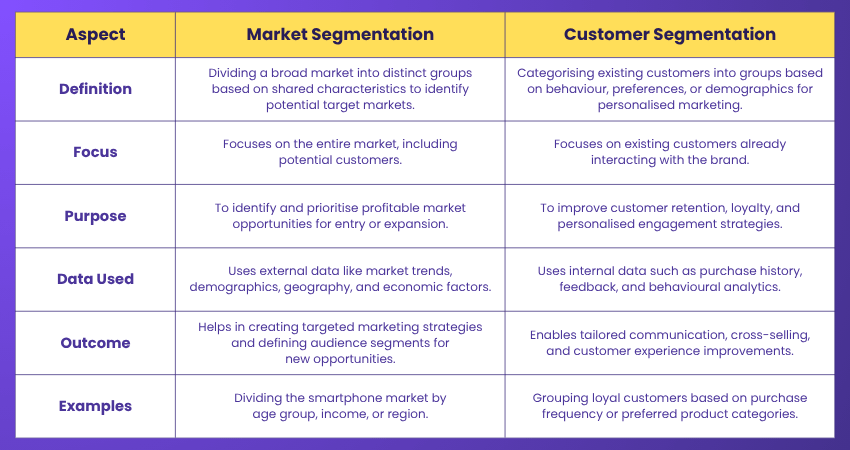
Market Segmentation vs Customer Segmentation
Here are the key differences between Market Segmentation and customer segmentation:
Conclusion
Market Segmentation gives businesses the power to understand their audiences more deeply and deliver products that resonate. It’s not just about dividing a market; it’s about discovering connections, preferences and opportunities. By understanding What is Market Segmentation and mastering it, companies can turn relationships into long-term success.
Our wide range of Marketing Courses are your launchpad to brand brilliance. Sign up now!
Frequently Asked Questions
What is Segmenting in Business?

Segmenting in business means categorising potential customers based on factors like demographics, behaviour, interests, or geography. This approach allows companies to properly align their marketing efforts and improve customer satisfaction.
Which of the Following is an Essential Step in the STP Process?
An essential step in the Segmentation, Targeting, Positioning (STP) process is targeting. After dividing the market into segments, businesses must select the most suitable segment(s) to focus on. Then they must position their products to meet those customers’ needs effectively.
What are the Other Resources and Offers Provided by The Knowledge Academy?
The Knowledge Academy takes global learning to new heights, offering over 3,000+ online courses across 490+ locations in 190+ countries. This expansive reach ensures accessibility and convenience for learners worldwide.
Alongside our diverse Online Course Catalogue, encompassing 17 major categories, we go the extra mile by providing a plethora of free educational Online Resources like Blogs, eBooks, Interview Questions and Videos. Tailoring learning experiences further, professionals can unlock greater value through a wide range of special discounts, seasonal deals, and Exclusive Offers.
What is The Knowledge Pass, and How Does it Work?
The Knowledge Academy’s Knowledge Pass, a prepaid voucher, adds another layer of flexibility, allowing course bookings over a 12-month period. Join us on a journey where education knows no bounds.
What are the Related Courses and Blogs Provided by The Knowledge Academy?
The Knowledge Academy offers various Marketing Courses, including the Strategic Marketing Course, Introduction to Marketing Training and the Business Marketing Strategies Training. These courses cater to different skill levels, providing comprehensive insights into Customer Journey Mapping.
Our Digital Marketing Blogs cover a range of topics related to Market Segmentation, offering valuable resources, best practices, and industry insights. Whether you are a beginner or looking to advance your Marketing skills, The Knowledge Academy's diverse courses and informative blogs have got you covered.

James Smith


Digital Marketing Manager and Trainer
James Smith is a digital marketing professional with over a decade of experience in SEO, content strategy, paid media and analytics. He has supported both SMEs and global brands in transforming their digital presence. James’s writing and training are rooted in results-driven tactics and the latest marketing trends.
View Detail
Upcoming Digital Marketing Resources Batches & Dates
Date
 Strategic Marketing Course
Strategic Marketing Course
Thu 6th Aug 2026
Strategic Marketing Course
Thu 5th Nov 2026

 If you wish to make any changes to your course, please


