


 Top Rated Course

We may not have the course you’re looking for. If you enquire or give us a call on +800 312616 and speak to our training experts, we may still be able to help with your training requirements.
What is DMAIC: Exploring the 5 Stages of Lean Six Sigma
The Knowledge Academy 16 July 2026DMAIC is a structured method used in Six Sigma to find, fix and prevent problems, improving quality and efficiency in businesses. It stands for Define, Measure, Analyse, Improve, and Control, helping teams solve issues with data-driven decisions. By following DMAIC, organisations can reduce errors and achieve long-term improvements.

Training Outcomes Within Your Budget!
We ensure quality, budget-alignment, and timely delivery by our expert instructors.
Table of Contents

Picture this: your team is stuck grappling with persistent customer complaints about product quality. You’ve tried quick fixes, yet the issues keep resurfacing. Frustrating, isn’t it? What if there was a proven roadmap to not only solve such problems but ensure they don’t happen again? That’s where DMAIC comes in—a cornerstone of the Six Sigma methodology designed to drive continuous improvement. But What is DMAIC, and why does it matter?
In this blog, we’ll talk about What is DMAIC, share its benefits, and show you how it can transform your processes. Ready to get started? Let’s dive in!
Table of Contents
1) What is DMAIC?
2) Five Phases of DMAIC
3) Benefits of the DMAIC Model
4) How to Use the DMAIC Process for Problem-solving?
5) Is DMAIC the Same as Kaizen?
6) Is DMAIC Part of Agile?
7) Conclusion
What is DMAIC?
DMAIC is a step-by-step method used to improve processes and solve problems. It stands for Define, Measure, Analyse, Improve, and Control. This method helps businesses find problems, fix them, and make sure they do not happen again. It is mainly used in Six Sigma, a system for improving quality and efficiency.
A company making mobile phones might use DMAIC to reduce defects. First, they define the issue (too many faulty phones). Next, they measure the number of defects and analyse their reasons. After that, they improve the process by fixing errors in production. Finally, they control the process by setting quality checks to ensure long-term success.

Five Phases of DMAIC
Here are the five key phases of DMAIC and how they help improve processes.
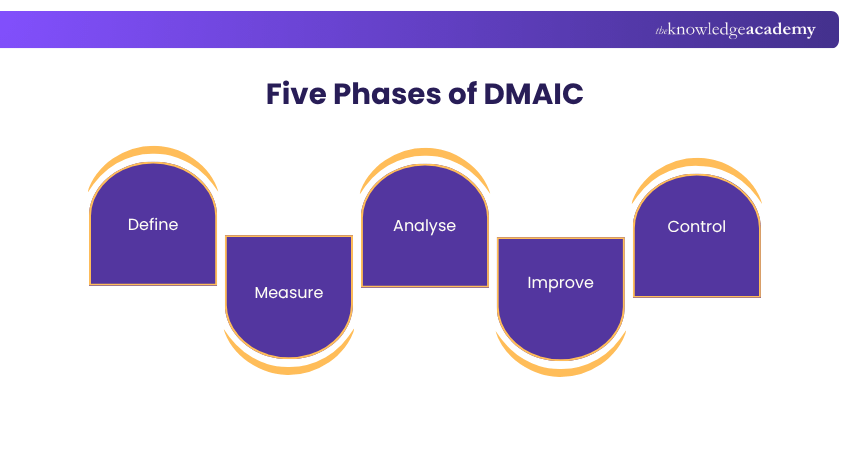
1) Define
The first step is to clearly state the problem and set goals. The team identifies what needs to be fixed and how it affects the business. A clear problem statement helps everyone focus on the right solution.
a) Identifies the main issue to solve
b) Sets clear goals for improvement
c) Helps the team understand the problem
2) Measure
This step collects data to understand the size of the problem. The team measures current performance to see how serious the issue is. Accurate data helps in making the right decisions.
a) Collects data to study the problem
b) Finds out how big the issue is
c) Helps in comparing progress later
3) Analyse
In this step, the team looks at the data to find the root cause of the problem. They use tools to identify patterns and issues. Understanding the cause helps in creating an effective solution.
a) Finds out what is causing the problem
b) Uses data to look for patterns and errors
c) Helps avoid guessing and focus on real issues
Build a strong success-driven foundation with our Lean Six Sigma Yellow Belt Training - Join now!
4) Improve
This phase develops and tests solutions to fix the problem. The team makes changes and checks if they work. The goal is to create a lasting improvement.
a) Creates and tests solutions
b) Makes changes to improve the process
c) Ensures the fix works before full use
5) Control
The final step ensures the improvements stay in place. The team sets up rules and checks to prevent the issue from happening again. Regular monitoring helps maintain success.
a) Keeps improvements working over time
b) Uses checks and reviews to prevent problems
c) Ensures the process stays on track
Benefits of the DMAIC Model
Using the DMAIC Model can help enhance your organisation's efficiency and effectiveness. This structured problem-solving approach offers numerous benefits that can help drive substantial improvements. The advantages of the DMAIC Model are given below:
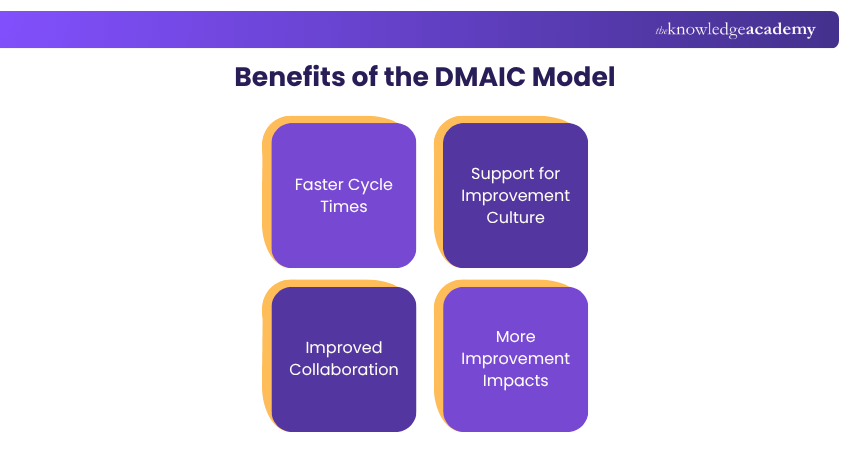
1) Faster Cycle Times: By following a structured approach, the DMAIC Model helps streamline processes, leading to quicker completion times and more efficient operations.
2) Support for Improvement Culture: DMAIC implementation fosters a continuous improvement culture within an organisation. It encourages teams to seek out and address inefficiencies regularly.
3) Improved Collaboration: The DMAIC process helps to promote teamwork and collaboration. By involving various stakeholders in each phase, you can ensure that all the different perspectives are considered in a thorough manner.
4) More Improvement Impacts: The data-driven DMAIC nature ensures that improvements are based on concrete evidence instead of Pseudo-science. This leads to changes that are more effective and impactful, further enhancing the overall performance of the businesses.
Learn to lead projects efficiently with our Lean Six Sigma Green Belt Course – Join today!
How to Use the DMAIC Process for Problem-solving?
Here’s how you can use the DMAIC Process for problem-solving:
1) Define Phase: Start with problem defining. Create a problem statement to ensure you have all the necessary resources and goal statement development. SIPOC Diagrams and Flowcharts, among other tools, can help you provide a robust high-level processing overview.
2) Measure Phase: This includes quantifying the problem by measuring its extent. This involves collecting data to establish baselines for comparison.
3) Analyse Phase: This includes identifying the problem’s root cause. Use tools like Pareto charts to represent numerical data, fishbone diagrams to capture process knowledge, and the five Whys technique to analyse the root causes.
4) Improve Phase: Develop and implement solutions. Create an impact-effort matrix for solution implementation to offer the best impact with the least cost, which can be effectively guided by comparing PDCA vs DMAIC, as both approaches emphasise efficient problem-solving and continuous improvement. Use the PDCA (Plan, Do, Check, Act) cycle to explore and select the best solution.
5) Control Phase: Sustain the improvements made in the Improve phase. Develop a monitoring plan to track the improvements and a response plan for any drops in performance.
Is DMAIC the Same as Kaizen?
No, DMAIC and Kaizen are different, but both help improve processes. DMAIC is a step-by-step method used in Six Sigma to solve problems and prevent them from happening again. Kaizen focuses on small, continuous improvements made by employees to improve work over time.
Is DMAIC Part of Agile?
No, DMAIC is not part of Agile, but both aim to improve processes. DMAIC is a structured method used in Six Sigma to find and fix problems. Agile is a flexible way of working that helps teams adapt quickly and improve through short work cycles.
Conclusion
We hope this blog has helped you understand What is DMAIC and how it improves processes. DMAIC follows a simple five-step method to find, fix, and prevent problems. It helps businesses reduce errors, improve quality, and work more efficiently. By using DMAIC, teams can create long-term solutions instead of quick fixes. This structured approach leads to better performance and continuous improvement in any organisation.
Learn to implement process improvements with our Six Sigma Black Belt Course – Join today!
Frequently Asked Questions
Who Uses DMAIC?

DMAIC is used by businesses, factories, and service companies to improve quality and efficiency. It helps teams reduce mistakes, save time, and make better products or services. Many industries, including manufacturing, healthcare, and finance, use DMAIC to fix problems and improve processes.
Is DMAIC the Same as Six Sigma?
No, DMAIC is not the same as Six Sigma. DMAIC is a Six Sigma methodology for process improvement. While Six Sigma is a broader quality management approach. It focuses on defect reduction and process improvement. In addition, DMAIC is the structured, five-phase process used to achieve those goals.

The Knowledge Academy


Global Training Provider
The Knowledge Academy is a world-leading provider of professional training courses, offering globally recognised qualifications across a wide range of subjects. With expert trainers, up-to-date course material, and flexible learning options, we aim to empower professionals and organisations to achieve their goals through continuous learning.


 If you wish to make any changes to your course, please


