


 Top Rated Course

We may not have the course you’re looking for. If you enquire or give us a call on +800 312616 and speak to our training experts, we may still be able to help with your training requirements.
What is a Metaphor: A Creative Guide For Writers
Charlotte Wilson 04 February 2026A Metaphor is a figure of speech that compares two unlike things by saying one is the other, to create meaning or vivid imagery. It makes language more emotional and memorable, enabling readers to see familiar concepts from a fresh perspective. From literature and poetry to everyday communication, it shapes how we experience language.

Training Outcomes Within Your Budget!
We ensure quality, budget-alignment, and timely delivery by our expert instructors.
Table of Contents
Have you ever described time as a thief or life as a journey? If yes, without realising it, you were using a metaphor. Metaphors explain complex ideas in simple and creative ways, making language more expressive and memorable. It is a powerful tool that brings emotions, images, and meaning to life. If you have ever wondered What is a Metaphor, understanding it can transform the way you write and communicate.
Metaphor makes stories more vivid, messages more impactful, and ideas easier to understand. Whether you are a student or a creative writer, understanding What is a Metaphor can help you connect with people on a deeper level. In this blog, you will learn about Metaphors, their different types, how to write one, and more!
Table of Contents
1) What is a Metaphor?
2) Different Types of Metaphors
3) How to Write a Metaphor?
4) Metaphor Prompts and Ideas to Get You Writing
5) Metaphors vs Simile and Analogy
6) What Words are Used in a Metaphor?
7) How Do I Identify a Metaphor?
8) Conclusion
What is a Metaphor?
A Metaphor is a figure of speech that compares two unrelated things by stating that one is the other. It can use objects, actions, or ideas to represent something else. Metaphors are a type of figurative language where words mean more than their literal definition.
They help us explain abstract ideas by comparing them to something that the majority of us are familiar with. Metaphors appear in literature, music and everyday speech. When someone says, “metaphorically speaking,” it’s a clue not to take their words literally but as a mere expression of an idea.

Different Types of Metaphors
Metaphors come in different forms, each offering a creative way to express ideas. Understanding the various types of Metaphors helps you choose the most suitable style for your writing and communicate ideas more effectively. Let’s explore them to gain a clearer understanding of What is a Metaphor.

1) Direct Metaphor
A Direct Metaphor clearly states that one thing is another by using a form of the verb “be.” It directly compares two unrelated things to highlight a similarity between them. This type of Metaphor is easy to recognise and commonly used in everyday language.
Examples of Direct Metaphor:
1) “Her voice was music to my ears.”
2) “The city is a concrete jungle.”
3) “My brother is a walking encyclopaedia.”
2) Implied Metaphor
An Implied Metaphor refers to the suggestion of a comparison without directly stating it. Here, the similarity is emphasised through action or description.
Examples of Implied Metaphor:
1) “He slammed his ideas into the discussion.” (ideas compared to weapons)
2) “The car coughed and refused to start.” (car is compared to a sick person)
3) “The wind whispered through the trees.” (wind compared to a person)
3) Extended Metaphor
An Extended Metaphor develops a comparison over several sentences, lines, or even an entire paragraph. The idea is expanded in detail to create strong imagery and deeper meaning. This type is widely used in literature, poetry, speeches, and storytelling.
Example of Extended Metaphor:
1) “All the world’s a stage,
And all the men and women merely players.
They have their exits and their entrances,
And one man in his time plays many parts”
The above excerpt is taken from Shakespeare’s famous play “As You Like It.” Here, the Metaphor compares life to a stage and people to actors. The comparison continues across multiple lines.
2) “No man is an island,
Entire of itself;
Every many is a piece of the continent,
A part of the main.”
The above lines are taken from John Donne’s “No Man Is an Island.” he suggests that people are isolated beings but connected with others. This highlights the idea of human interdependence and shared existence.
Great conversations can build great careers. Sign up for our Communication Skills Training and master the art of clear, impactful communication!
4) Mixed Metaphor
A Mixed Metaphor combines two or more different Metaphors in a way that does not logically fit together. This creates confusion or an unintentional humorous effect. This usually happens by mistake and can make writing unclear.
Examples of Mixed Metaphor:
1) “Put your ducks in a row and do not count them before they hatch.”
2) “She is a rising star, and with the right guidance, she will spread her wings.”
3) “Life is a rollercoaster; you need to take it one step at a time.”
5) Dead Metaphor
A Dead metaphor is used so often that people no longer notice it as a Metaphor. It feels like a normal expression instead of a creative comparison. It is commonly used in everyday speech or communication.
Examples of Dead Metaphor:
1) “There is a small village at the foot of the mountain.”
2) “The guest of honour sat at the head of the table.”
3) “On the last leg of the journey, the travellers faced several obstacles.”
How to Write a Metaphor?
Consider these steps to excel at writing Metaphors:
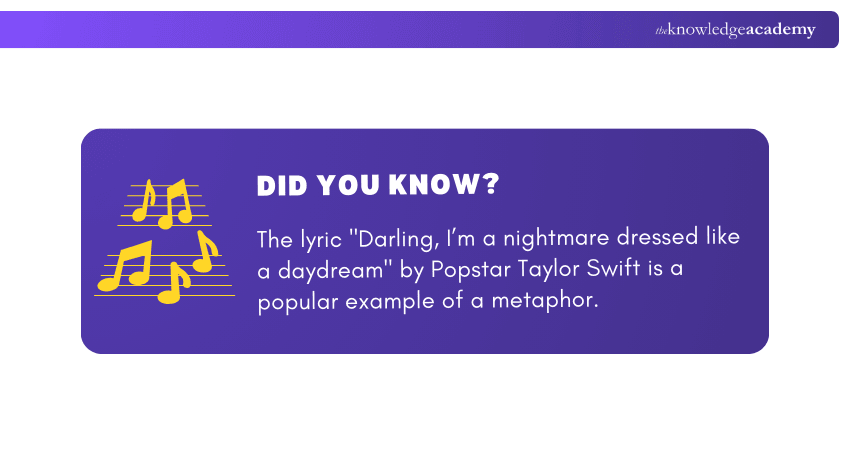
1) Identify Your Subject: Start by defining the person, idea or object you want to describe. Know what qualities or emotions you want to highlight.
2) Brainstorm Related Images: Think of other things, such as objects, animals, and settings that share similar traits with your subject. These comparisons form the base of your Metaphor.
3) Choose the Right Tone: Pick a lane when it comes to your Metaphors. Decide if it should be humorous, serious, dark, or whimsical. This helps you filter out ideas that don’t match the mood of your writing.
4) Draft Descriptive Comparisons: Write a few sentences linking your subject to your brainstormed images. Don’t worry about being perfect and explore different options.
5) Read and Revise: Say your Metaphors out loud. Tweak the wording to make it sharper, clearer, or more vivid.
6) Condense for Impact: Turn your best comparison into one striking sentence. Make it original and attention-grabbing, like “Todd is a cheese-hoarding ship rat” instead of simply saying “Todd is greedy.”
7) Use Metaphors Purposefully: Don’t overuse them. Use Metaphors where they add depth, especially to convey emotion, abstract ideas, or themes that are hard to explain directly.
8) Consider Extended Metaphors: For deeper storytelling, create Metaphors throughout your narrative. Recurring images, lines, or settings can reinforce your theme and engage readers.
Make sure you're speaking and writing with no glitches! Sign up for our comprehensive English Grammar Course - Register now!
Metaphor Prompts and Ideas to Get You Writing
Metaphors are powerful ways to spark your creativity. When you use Metaphors as prompts, you can turn simple ideas into vivid stories, emotional reflections, and imaginative scenes. Let’s look at some creative ideas you can use to deepen your understanding of What is a Metaphor.
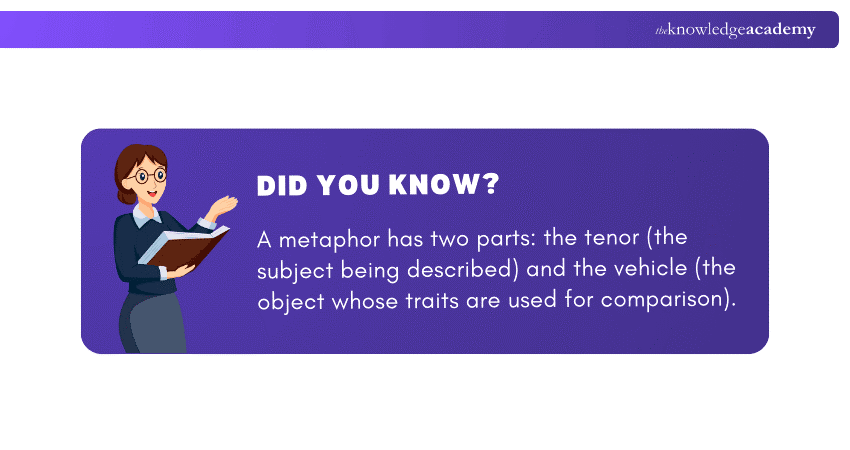
1) The City is a Living Creature
Imagine the city as a living being with its own personality and emotions. This prompt helps to personify places and brings settings to life. In this metaphor, focus on:
1) Describe how the city “breathes” during rush hour.
2) Show what the city “eats” through traffic, lights, and crowds.
3) Explore what the city “fears” at night or during silence.
2) Time is a Thief
Think of time as something that steals moments, memories, or opportunities. This Metaphor is ideal for an emotional and reflective piece of writing. In this metaphor, focus on:
1) Write a story where time steals something from the protagonist.
2) Describe what the character loses and how it changes their life.
3) Explore whether the character tries to stop or chase time.
3) The Classroom was a Battlefield
Turn an ordinary school day into an intense battle scene. This prompt helps you make daily experiences dramatic and engaging. In this Metaphor, focus on:
1) Describe students as warriors and teachers as commanders.
2) Show moments of tension, strategy, and unexpected victories.
3) Highlight conflicts, challenges, and triumphs in learning.
4) Love is a Mirror
Explore love as a reflection of identity and emotions. This prompt works well for character-driven and emotional stories. In this metaphor, focus on:
1) Show how two characters see themselves through each other.
2) Describe how love reveals hidden strengths or flaws.
3) Reflect on how relationships change perception and self-awareness.
5) Dreams are Paper Boats
Imagine dreams as fragile boats sailing across uncertain waters. This prompt encourages poetic and imaginative storytelling. In this Metaphor, focus on:
1) Describe how dreams set sail and face storms.
2) Show what happens when some boats sink while others survive.
3) Explore the journey of hope, failure, and persistence.
The power of words is yours to master! Sign up for our Creative Writing Course and own the adventurous journey from ideas to words!
Metaphor vs Simile and Analogy
Some of the key differences between Metaphor and simile are provided in the table below.
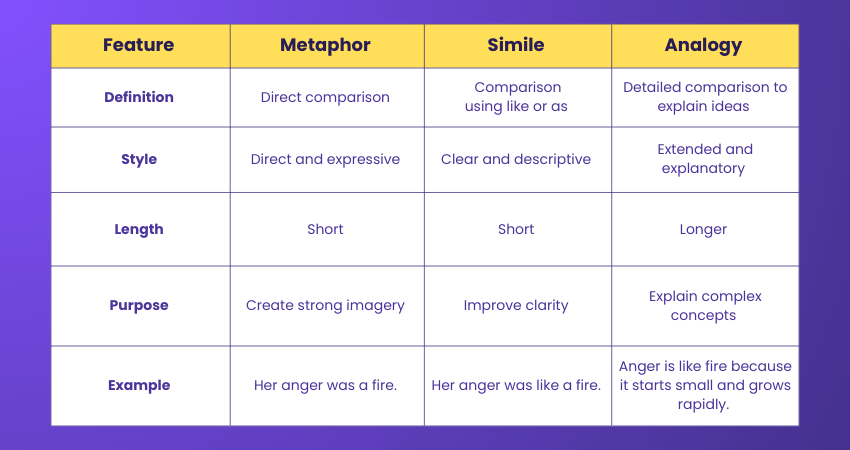
A Metaphor is a direct comparison between two unrelated things. Metaphors are often dramatic and emotional because they merge two ideas into one strong image. For example, “her anger was a fire, hot and raging.” Here, anger becomes fire. This makes emotion feel intense, dangerous, and immediate.
A simile is also a comparison, but it uses words, such as “like” or “as.” Unlike a Metaphor, it keeps two things separate and makes the comparison more explicit. Similes are often used to make descriptions clearer to understand. For example, “her anger was like a fire, hot and raging.” Here, anger is compared to a fire, but it is not literally described as fire; this creates a bit of distance between the emotion and the image.
Express ideas with confidence and speak clearly with Effective Communication Skills Training today!
What Words are Used in a Metaphor?
A Metaphor doesn’t rely on special words such as 'like' or 'as' because those belong to similes. Instead, it directly states that one thing is another. Words such as 'is', 'are', 'was' or 'were' are often used to make this comparison.
How Do I Identify a Metaphor?
Here’s how you identify a Metaphor:
1) Look for a Direct Comparison Without “like” or “as”: A Metaphor states that one thing is another (for example, “life is a journey”) rather than saying something is like something else.
2) Check Whether the Phrase Implies Qualities: The Metaphor bestows certain attributes on the thing it describes. For example, “life is a journey” gives life the qualities of a journey, such as ups and downs, a path and a destination.
3) Contrast with Similes: If the comparison uses words like “like” or “as,” it’s a simile, not a Metaphor. Metaphors don’t use those words.
4) Ask What Meaning the Metaphor Adds: Think about why the speaker has chosen this Metaphor and what new understanding or emotion it brings. Contemplate on what deeper theme is being hinted at through the comparison.
Conclusion
Metaphors have the power to turn simple words into vivid images and ordinary ideas into memorable experiences. Understanding What is a Metaphor is the key to bringing language to life and connecting with readers on a deeper level. With practice and creativity, you can use Metaphors to strengthen your voice, enrich your storytelling, and make your writing more powerful.
Break any hesitation, build fluency and open up your communication skills with our comprehensive English Speaking Course – Sign up now!
Frequently Asked Questions
Why is a Metaphor Important?

A Metaphor is important because it helps us create meaning and shape how we see the world. When we accept a Metaphor, we focus on what it highlights while overlooking other aspects. The Metaphors we choose can change our behaviour, influence decisions and inspire us to act in powerful, lasting ways.
Is Drowning in Money a Metaphor?
Yes, "drowning in money" is a Metaphor. It's used to describe someone with excessive wealth or resources. The Metaphor implies being overwhelmed or burdened by the sheer volume of money.
What are the Other Resources and Offers Provided by The Knowledge Academy?
The Knowledge Academy takes global learning to new heights, offering over 3,000+ online courses across 490+ locations in 190+ countries. This expansive reach ensures accessibility and convenience for learners worldwide.
Alongside our diverse Online Course Catalogue, encompassing 19 major categories, we go the extra mile by providing a plethora of free educational Online Resources like Blogs, eBooks, Interview Questions and Videos. Tailoring learning experiences further, professionals can unlock greater value through a wide range of special discounts, seasonal deals, and Exclusive Offers.
What is The Knowledge Pass, and How Does it Work?
The Knowledge Academy’s Knowledge Pass, a prepaid voucher, adds another layer of flexibility, allowing course bookings over a 12-month period. Join us on a journey where education knows no bounds.
What are the Related Courses and Blogs Provided by The Knowledge Academy?
The Knowledge Academy offers various Communication Skills Courses, including the English Speaking Course, Effective Communication Skills Course and the Public Speaking Training. These courses cater to different skill levels, providing comprehensive insights into Written Communication.
Our Business Skills Blogs cover a range of topics related to Metaphors and Creative Writing, offering valuable resources, best practices, and industry insights. Whether you are a beginner or looking to advance your English and communication skills, The Knowledge Academy's diverse courses and informative blogs have got you covered.

Charlotte Wilson


Soft Skills and Business Training Manager
Charlotte Wilson is an expert in soft skills development, with over 14 years of experience helping individuals and teams improve communication, productivity and emotional intelligence in the workplace. Her training content is focused on enhancing interpersonal effectiveness and fostering positive, collaborative environments across all levels of an organisation.
View Detail
Upcoming Business Skills Resources Batches & Dates
Date
 English Speaking Course
English Speaking Course
Fri 24th Jul 2026
English Speaking Course
Fri 16th Oct 2026

 If you wish to make any changes to your course, please


