


 Top Rated Course

We may not have the course you’re looking for. If you enquire or give us a call on +800 312616 and speak to our training experts, we may still be able to help with your training requirements.
What Is Computer Architecture? Definition, Types, and Components
The Knowledge Academy 07 April 2026Computer Architecture defines how a computer system is designed and operates, including the CPU, memory, and I/O, and how hardware and software interact to run programs. It helps optimise performance, improve efficiency, and ensure seamless execution of instructions across modern computing systems and applications.

Training Outcomes Within Your Budget!
We ensure quality, budget-alignment, and timely delivery by our expert instructors.
Table of Contents

Every application you run relies on a carefully designed system working behind the scenes. Understanding what Computer Architecture is essential to see how hardware and software interact to execute instructions efficiently.
In this blog, we explore Computer Architecture, its key types, and core components such as the CPU, memory, and I/O systems. You will also learn how it influences system performance, functionality, and overall computing efficiency.
Table of Contents
1) What is Computer Architecture?
2) The Importance of Computer Architecture
3) How Does Computer Architecture Work?
4) Key Components of Computer Architecture
5) Fundamental Principles of Computer Architecture
6) Emerging Trends in Computer Architecture
7) Major Types of Computer Architecture
8) Examples of Computer Architecture
9) Computer Architecture vs Computer Organisation
10) Conclusion
What is Computer Architecture?
Computer Architecture is the conceptual design and core operational structure of a computer. It is the blueprint for the computer design, its hardware, how it interacts, and how it executes software. In simple terms, Computer Architecture means how a computer is built and how it works.

The Importance of Computer Architecture
Computer Architecture is the backbone of today’s computing, as it allows efficient and reliable computing to function at a scale. It is a fundamental component of using hardware and software to provide performance and security. The key importance are:
1) Ensures efficient performance and optimal use of system resources
2) Enhances system reliability and scalability across applications
3) Supports advancements in technologies like AI, cloud computing, and IoT
4) Strengthens system security and overall network protection
5) Enables innovation and development of modern computing solutions
6) Provides opportunities for building high-performance and future-ready systems
How Does Computer Architecture Work?
Computer Architecture work by controlling how data and instructions move and executed through computer. When a programme runs, it starts from simple series of instructions that the processor handles one at a time. These instructions can be anything like do calculations, move data, or save information.
Key Components of Computer Architecture
The key components of Computer Architecture are as follows:
1) Input Unit
The input unit includes all devices that allow data and instructions to be fed into the computer. Common input devices include keyboards, mice, and scanners. This unit converts human-readable data into machine-readable format.
2) Output Unit
This unit takes processed data from the computer and converts it into a human-readable form. Typical output devices include monitors, printers, and speakers.
3) Storage Unit / Memory
Memory stores data and instructions before, during, and after processing. It is divided into primary memory Random Access Memory (RAM) and Read Only Memory (ROM) and secondary storage, hard drives and Solid-State Drive (SSD). Efficient memory access and administration are critical for performance. BIOS plays a key role here by helping the system load instructions stored in ROM during the boot process.
4) Central Processing Unit (CPU)
The Central Processing Unit (CPU) is the core of the computer which is responsible for executing commands and processing data. It includes the Arithmetic Logic Unit (ALU), which handles all arithmetic and logical operations; the Control Unit (CU), which manages and directs the activities of the processor and registers, which are small, fast storage areas within the CPU used to temporarily hold data and instructions during processing.
Enhance user confidence and maximise system efficiency with our End User Training- Join today!
Fundamental Principles of Computer Architecture
Given are the fundamental Principles of Computer Architecture:
1) Von Neumann Architecture
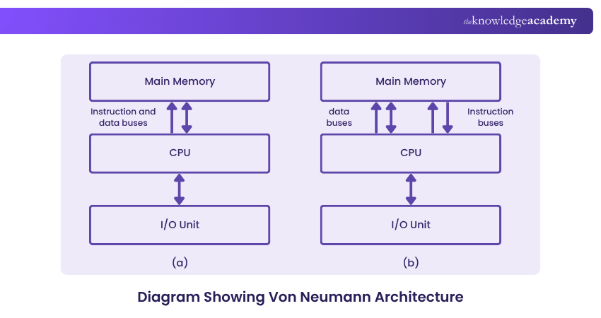
Computers built according to the Von Neuman Architecture principle separate memory data from programming instructions. They use a single medium to transport data from memory to CPU.
2) Instruction Set Architectures
Instruction Set Architecture (ISA) defines the set of instructions a CPU can comprehend and execute. It acts as the interface between software and hardware, guiding how a processor interprets commands from a programme.
3) Parallel Processing
Parallel processing enables multiple instructions to be executed simultaneously. This uses multiple processors or cores. This enhances performance, especially in data-intensive tasks like scientific simulations and multimedia processing.
Emerging Trends in Computer Architecture
Here are the emerging trends in Computer Architecture:
1) Machine Learning and Artificial Intelligence (AI)
Modern computer designs are being customised to speed up Machine Learning (ML) and Artificial Intelligence (AI tasks). Specialised hardware like Graphic Processing Units (GPU) and Tensor Processing Units (TPU) are designed to handle massive computations involved in training and deploying AI models.
2) Quantum Computing
Quantum computer differs radically from classical architecture. It uses qubits instead of bits, enabling simultaneous processing of multiple states. Though still on trial, it promises breakthroughs in areas like cryptography and complex simulations.
3) Neuromorphic Computing
This model is Inspired by the human brain; neuromorphic computing uses architectures to mimic human neural structures. It excels in tasks that require pattern recognition, such as voice and image processing.
4) Memristors
Memristors are non-volatile memory elements that remember their resistance state even after power is turned off. They offer a faster and more efficient memory storage systems in modern computers.
5) 3D Stacked Memory
This technology stacks memory chips vertically, reducing latency and power consumption while increasing bandwidth. It allows for more compact and powerful computing systems.
Learn to design and deliver dynamic, data-driven dashboards that communicate insights clearly with our Building Interactive Dashboards Training- Sign up today!
Major Types of Computer Architecture
There are different types of Computer Architecture. The major types are mentioned below:
1) Von Neumann Architecture
Named after mathematician John Von Neuman, this is the most widely used type of architecture. It uses a single memory for both data and instructions. The system fetches and executes instructions one after another, which simplifies the system. However, this sequential design causes bottlenecks in the system known as “Von Newman Bottlenecks.
2) Harvard Architecture
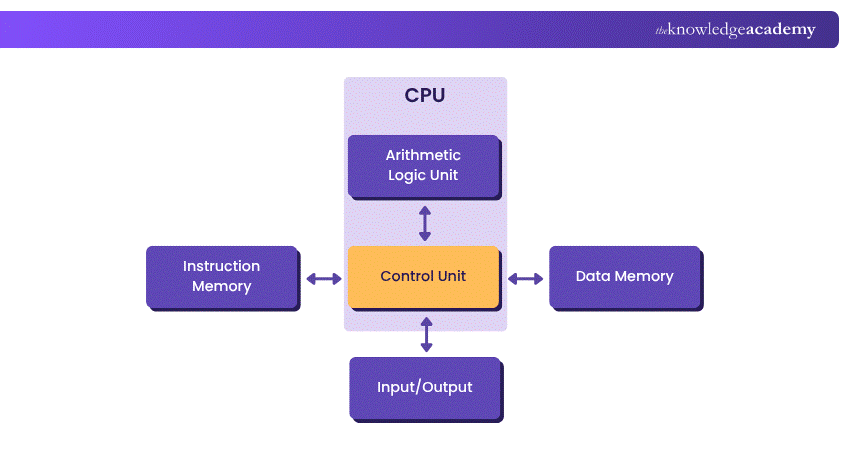
Harvard Architecture uses separate memory for data and instructions. This enables a simultaneous access to both, increasing speed and efficiency. It is commonly used in embedded systems and microcontrollers where performance and efficiency are critical.
3) Modified Harvard Architecture
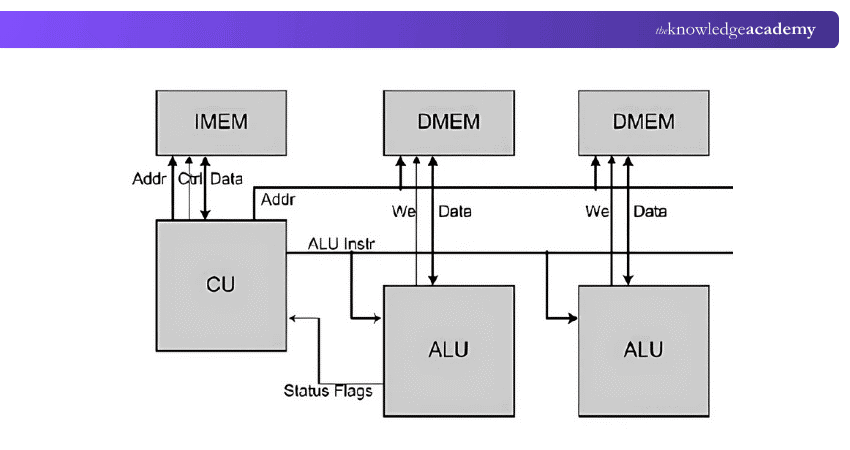
The modified Harvard Architecture allows separate caches for data and instructions while maintaining a unified main memory. This approach improves performance without significantly increasing complexity or cost.
4) RISC & CISC Architectures
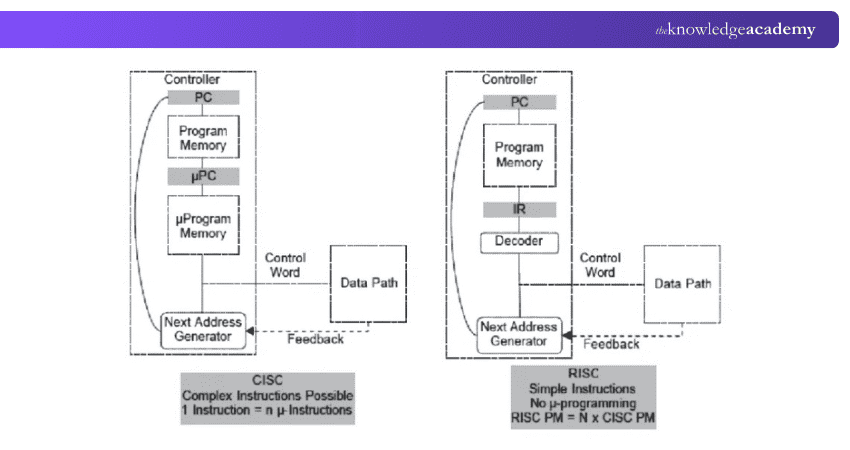
Reduced Instruction Set Computer (RISC) architectures use a small, highly optimised set of instructions that can be executed rapidly. This simplicity often leads to faster execution and lower power usage.
Complex Instruction Sey Computer (CISC) architectures have a larger set of instructions, some of which can perform complex tasks in a single command. This can make programming easier and reduce the number of instructions per programme, but it may be slower and more power-hungry.
Examples of Computer Architecture
Here are two examples of Computer Architecture:
1) Von Neumann Architecture
The Von Neumann Architecture is the earliest and most widely adopted models of computer design. It uses a single memory space to store both data and programme instructions, which are processed sequentially by the CPU. This linear approach simplifies the design and reduces hardware costs.
2) Harvard Architecture
Harvard architecture, in contrast, separates memory into two distinct storage spaces: one for instructions and one for data. This allows the CPU to access both simultaneously, improving speed and efficiency. It is commonly used in systems where performance and reliability are critical.
Computer Architecture vs Computer Organisation
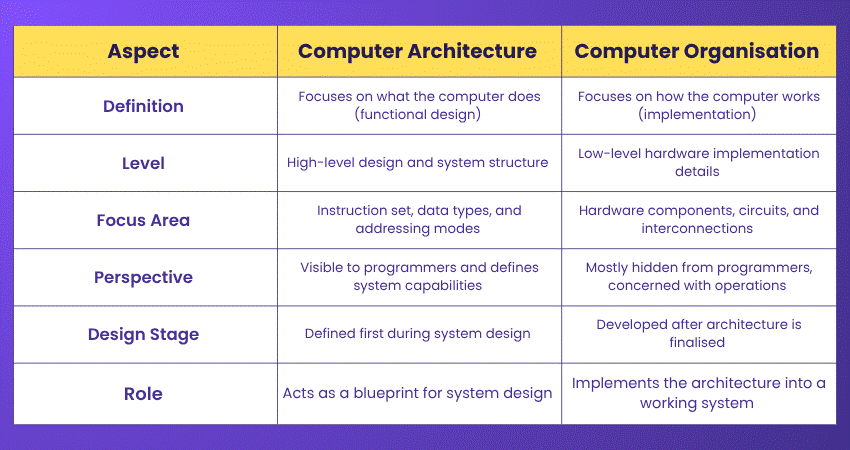
Computer Architecture and Computer Organisation are closely related concepts, but they focus on different aspects of a computer system’s design and operation. While architecture defines the system’s functionality and behaviour, organisation deals with how that design is physically implemented.
The key differences are mentioned in the table below:
Conclusion
Computer Architecture plays a vital role in defining how computer systems function, perform, and evolve. Understanding its types, components, and relationship with organisation helps in building efficient and reliable systems. It also supports advancements in modern technologies and innovation. Mastering this concept is essential for developing high-performance computing solutions.
Develop practical skills to diagnose, fix, and maintain computer hardware effectively with our Computer Hardware Troubleshooting Course - Join now!
Frequently Asked Questions
What are the 7 Different Types of Architecture?

Computer architecture refers to the design and functionality of a computer system, including instruction sets and data processing. Computer organisation focuses on how these designs are implemented using hardware components, ensuring the system operates efficiently and executes tasks as intended.
What is Computer Architecture and Organisation?
Computer architecture refers to the design and structure of a computer system, including how its components such as the CPU, memory, and input/output devices are arranged and interact. Computer organisation focuses on how these components operate and work together to execute instructions. Together, they define how a computer processes data efficiently.
What are the Other Resources and Offers Provided by The Knowledge Academy?
The Knowledge Academy takes global learning to new heights, offering over 3,000+ online courses across 490+ locations in 190+ countries. This expansive reach ensures accessibility and convenience for learners worldwide.
Alongside our diverse Online Course Catalogue, encompassing 17 major categories, we go the extra mile by providing a plethora of free educational Online Resources like Blogs, eBooks, Interview Questions and Videos. Tailoring learning experiences further, professionals can unlock greater value through a wide range of special discounts, seasonal deals, and Exclusive Offers.
What is The Knowledge Pass, and How Does it Work?
The Knowledge Academy’s Knowledge Pass, a prepaid voucher, adds another layer of flexibility, allowing course bookings over a 12-month period. Join us on a journey where education knows no bounds.
What are the Related Courses and Blogs Provided by The Knowledge Academy?
The Knowledge Academy offers various End User Training, including Keynote Training, Introduction to Mac Pages, and Computer Science Course. These courses cater to different skill levels, providing comprehensive insights into 10 Most Powerful Supercomputers in the World.
Our Office Application Blogs cover a range of topics related to Computer Architecture, offering valuable resources, best practices, and industry insights. Whether you are a beginner or looking to advance your Computing knowledge, The Knowledge Academy's diverse courses and informative blogs have got you covered.

The Knowledge Academy


Global Training Provider
The Knowledge Academy is a world-leading provider of professional training courses, offering globally recognised qualifications across a wide range of subjects. With expert trainers, up-to-date course material, and flexible learning options, we aim to empower professionals and organisations to achieve their goals through continuous learning.

Upcoming Office Applications Resources Batches & Dates
Date
 Computer Science Course
Computer Science Course
Fri 10th Jul 2026
Computer Science Course
Fri 9th Oct 2026

 If you wish to make any changes to your course, please


