


 Top Rated Course

We may not have the course you’re looking for. If you enquire or give us a call on +44 1344 203 999 and speak to our training experts, we may still be able to help with your training requirements.
What is Counselling? A Path to Personal Growth and Support
The Knowledge Academy 30 October 2025Counselling is a type of talking therapy where a trained therapist provides a safe, confidential, and non-judgemental space to discuss personal problems. It can get you out of messy thoughts, bring stress under control, enable resilience, and make informed decisions, promote self-awareness, and enduring development in life.

Training Outcomes Within Your Budget!
We ensure quality, budget-alignment, and timely delivery by our expert instructors.
Table of Contents
Counselling is not just a conversation process; rather, it is a journey with guidance towards self-understanding and emotional stability. You know, a secure zone where you can say everything you want without fear of judgment can be a lifesaver in a world where stress and personal troubles remain to haunt a person's everyday life.
Understanding What is Counselling? This blog presents the insights behind empowering personal development.
Table of Contents
1) What is Counselling?
2) Types of Counselling?
3) Benefits of Counselling
4) Skills Required for Counselling
5) What is the Process of Counselling?
6) Conclusion
What is Counselling?
Counselling is a talking therapy where a trained therapist carefully listens and helps you to analyse your emotional problems. It provides an atmosphere of non-judgmental and confidential support to share thoughts and feelings without coercion.
As opposed to advice-giving, the counsellor going to be assisting you in understanding your feelings and way of thinking, assist you in discovering your own solutions, and create tools to cope with the challenges of life more efficiently.
It is open-ended or short-term sessions which may be conducted as a single person, in groups and even online or by phone. Emotional strength and self-development can be enhanced over time through counselling.
Types of Counselling?
There are numerous types of Counselling, which are based on the objectives and problems of life. Six of the key types that you will come across include:
a) Individual Counselling: This is a one-on-one therapy with a counsellor. It enables you to identify about personal thoughts, feelings and behaviours in a confidential, comfortable way and at an individual pace.
b) Marriage and Family Counselling: This counselling is focused on the relationships and dynamics in partnerships or families and aims to enhance effective communication, conflict resolution and emotional attachments.
c) Career Counselling: In this case, Counselling therapists are helping you to refocus on your career aspirations, deal with job changes and education choices. These counselling sessions help you in work-life balancing through values and strengths.
d) Rehabilitation Counselling: This type of counselling specifically deals with addiction and recovery. It assists people in knowing triggers, understanding self-coping mechanisms, and support systems to remain sober.
e) Educational Counselling: This counselling is targeted at students and supports them by offering academic, social and emotional support. Counsellors can assist in the management of stress, goals, learning problems and in making transitions, such as college or career planning.
f) Mental Health Counselling: A more extensive version of treatment covering such conditions as anxiety, depression, stress, and emotional instability, which ensures people gain resilience and become mentally clear in life.
Understand the benefits of cultivating positive emotions in your daily life - sign up for our Positive Psychology Course now!
Benefits of Counselling
Counselling provides a supportive environment to explore emotions and develop healthier coping strategies. It not only helps in overcoming challenges but also enhances overall personal growth.
Key Benefits:
1) Improves communication and interpersonal skills
2) Boosts self-acceptance and self-esteem
3) Helps in identifying and changing self-defeating behaviours
4) Enhances emotional expression and management
5) Provides relief from anxiety, stress, and depression
6) Builds confidence and better decision-making skills
7) Strengthens conflict-resolution and problem-solving abilities
Skills Required for Counselling
Professional Counsellors possess certain skills that enable them to effectively handle clients who are dealing with Mental Health problems. The main skills required by a professional Counsellors are:
a) Effective Listening: A Counsellor is a patient listener, which enables them to handle clients' issues delicately. Without hearing the problems in detail, it becomes difficult to identify the root cause of the issue. Therefore, effective listening becomes a vital skill in the Counselling process.
b) Effective Communicator: The process of Counselling requires Counsellors to listen, analyse, and design action plans to achieve goals. Good Communication Skills are essential to make clients feel comfortable and to carry forward with the Counselling process.
c) Analysis: Apart from being good listeners and communicators, Counsellors are skilled at analysis. The analysis is a crucial part of the Counselling process to identify, examine, and suggest a suitable action plan to assist the client. Without proper analysis, Counselling would not yield satisfactory outcomes.
d) Non-verbal Communication: Counsellors must be adept at their non-verbal communication. Their body language and personality convey a lot of information, especially when they are with clients. Counsellors need to be aware about these signals so that clients in any way should not feel threatened or uncomfortable.
e) Problem-solving Skills: Counsellors may face a lot of different problems given the dynamic nature of their clients. Every problem requires different solutions. Hence, they need to be updated with the latest ethical and cultural norms, think creatively, and outside the box. To assist with this, referring to resources like the 7 Stages of the Counselling Process PDF can provide valuable insights and guidance in handling diverse challenges effectively.
What is the Process of Counselling?
Counselling is a delicate process, as it involves individuals dealing with serious issues related to Mental Health, emotional difficulties, or family problems. Within the realm of Counselling Psychology, the Counselling process incorporates a systematic approach to identifying the problem and providing a suitable solution without rushing the client and always ensuring their comfort. Below are the five stages of the Counselling process:
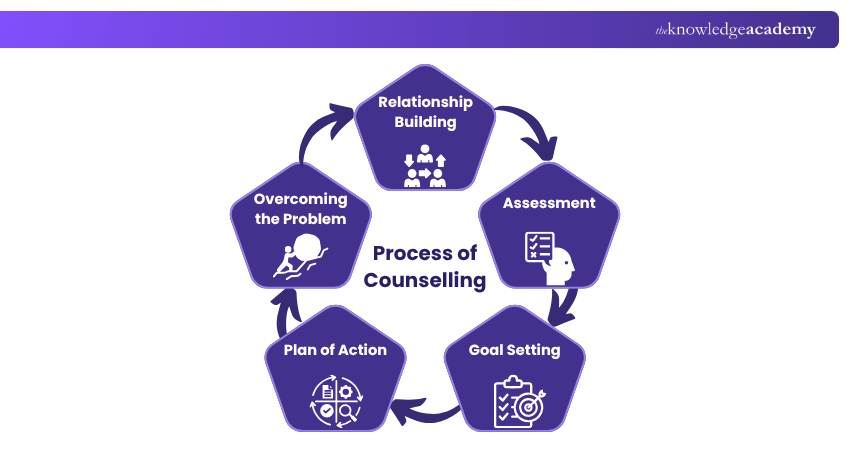
a) Relationship Building: The first stage of Counselling involves a Counsellor building a warm relationship with the client. Since the focus is to resolve the personal issues of the client, Counsellor must first make the client comfortable. Developing mutual trust helps the client to speak about his/her problems without hesitation.
b) Assessment: In the second stage, the Counsellor encourages the client to speak about their problems in detail. This enables the Counsellor to identify the root cause of the problems. During the session, the Counsellor observes every detail, such as the manner in which the problem is being described and the client's reactions.
c) Goal Setting: After evaluating the client's problems, the Counsellor's focus shifts to setting a goal with respect to each issue. The aim here is to establish an approach towards finding a solution to the problem.
d) Plan of Action: The fourth stage involves the Counsellor setting a plan of action for the client to follow. The Counsellor provides certain tasks to practise, which allows the Counsellor to evaluate their client's improvement over a period. Based on the results, the Counsellor decides to take the session to the next stage or to design a different approach.
e) Overcoming the Problem: This is the final stage of Counselling. Based upon previous stages of Counselling, if the results are positive, the goal of Counselling is achieved. However, if the problem isn’t resolved entirely, the Counsellor may choose to continue the sessions with the client's consent. Moreover, the client may choose to come back to the Counsellor as and when they feel the need.
Keen on getting better understanding on psychological skills then join our Human Wellness Training.
Conclusion
Now you know What is Counselling? It’s not merely a support process, but rather a process where one gets to know himself/herself, heal, and become emotionally stronger individual. Through proper guidance people may learn to appreciate their emotions, to be clear in communication and how to have a better relationship with themselves and those around them. Counselling as one of the most empowering moves to a more balanced and satisfying life can only be investment into the mental well-being.
Gain an in-depth understanding of Counselling skills; sign up for a Counselling Course now!
Frequently Asked Questions
What are the 7 Principles of Short-term Counselling?

Short-term counselling is guided by seven key principles focusing on clear goals, structured progress, active involvement, self-reflection, effective change strategies, regular reviews, and fostering self-reliance in personal growth.
What is the Difference Between Therapy and Counselling?
Counselling normally dwells on the challenges in the present lives and seeks to offer direction, emotional assistance, and coping measures in a relatively shorter duration. Therapy, conversely, usually digs deeper and investigates the past experiences, behavioural tendencies, childhood traumas and emotional origins to facilitate the long-term healing of the psyche and personality.
What are the Other Resources and Offers Provided by the Knowledge Academy?
The Knowledge Academy takes global learning to new heights, offering over 3,000 online courses across 490+ locations in 190+ countries. This expansive reach ensures accessibility and convenience for learners worldwide.
Alongside our diverse Online Course Catalogue, encompassing 19 major categories, we go the extra mile by providing a plethora of free educational Online Resources like Blogs, eBooks, Interview Questions and Videos. Tailoring learning experiences further, professionals can unlock greater value through a wide range of special discounts, seasonal deals, and Exclusive Offers.
What is Knowledge Pass, and How Does It Work?
The Knowledge Academy’s Knowledge Pass, a prepaid voucher, adds another layer of flexibility, allowing course bookings over a 12-month period. Join us on a journey where education knows no bounds.
What are Related Mental Health Courses and Blogs Provided by the Knowledge Academy?
The Knowledge Academy offers various Mental Health Courses, including the Counselling Course, Mental Capacity Training and Positive Psychology Course. These courses cater to different skill levels, providing comprehensive insights into What is Counselling Psychology.
Our Health & Safety Blogs cover a range of topics related to Types of Counselling, offering valuable resources, best practices, and industry insights. Whether you are a beginner or looking to advance your Health & Safety skills, The Knowledge Academy's diverse courses and informative blogs have got you covered.

The Knowledge Academy


Global Training Provider
The Knowledge Academy is a world-leading provider of professional training courses, offering globally recognised qualifications across a wide range of subjects. With expert trainers, up-to-date course material, and flexible learning options, we aim to empower professionals and organisations to achieve their goals through continuous learning.

Upcoming Health & Safety Resources Batches & Dates
Date
 Counselling Course
Counselling Course
Fri 26th Jun 2026
Counselling Course
Fri 2nd Oct 2026
Counselling Course
Fri 11th Dec 2026

 If you wish to make any changes to your course, please


