


 Top Rated Course

We may not have the course you’re looking for. If you enquire or give us a call on +44 1344 203 999 and speak to our training experts, we may still be able to help with your training requirements.
What Is The Greenhouse Gas (GHG) Protocol? Definition, Types, Scope
Scarlett Adams 11 December 2025The Greenhouse Gas Protocol is a globally recognised framework for measuring, managing and reporting Greenhouse Gas emissions. It is used by businesses and governments to guide them across three scopes. This helps promote accountability and transparency while addressing climate change in the present and future.

Training Outcomes Within Your Budget!
We ensure quality, budget-alignment, and timely delivery by our expert instructors.
Table of Contents

Climate change has posed a threat to the sustenance of humanity not only today but for the future as well. To respond to this challenge, the Greenhouse Gas Protocol provides a global framework designed to create meaningful climate impact. As a result, it has reshaped the way businesses and governments operate, making the tracking and management of emissions more crucial than ever.
In this blog, we will explore the GHG Protocol, along with its various types and scopes. So, keep reading to discover more!
Table of Contents
1) What is Greenhouse Gas Protocol?
2) What Does the GHG Protocol Do?
3) What are the Different GHG Protocol Standards?
4) What are Greenhouse Gas Protocol Scope 1 2 3 Emissions?
5) Who Uses the GHG Protocol?
6) What are the Benefits of Greenhouse Gas Protocol (GHG)?
7) How to Comply with the GHG Protocol?
8) Conclusion
What is Greenhouse Gas Protocol?
The Greenhouse Gas (GHG) Protocol is a globally recognised framework for tracking and managing greenhouse gas emissions. It was launched in 1998 by the World Resources Institute (WRI) and the World Business Council for Sustainable Development (WBCSD) to establish standards that help organisations manage their emissions effectively.
The protocol provides standards, tools, and guidance that enable businesses, cities, and government bodies to measure and report their emissions. A key feature is the classification of emissions into Scope 1, Scope 2, and Scope 3, which helps identify emission sources and develop strategies for reduction.

What Does the GHG Protocol Do?
The Greenhouse Gas (GHG) Protocol provides a comprehensive framework for:
1) Measuring Emissions:
It helps organisations quantify greenhouse gas emissions across operations, supply chains, and products.
2) Classifying Emissions:
It defines Scope 1, Scope 2, and Scope 3 emissions, making it easier to identify both direct and indirect sources.
3) Reporting and Transparency:
It offers standardised reporting guidelines that ensure consistency and promote transparency in climate disclosures.
4) Setting Reduction Targets:
Organisations use the protocol to set targets based on scientific evidence and track progress toward emission reduction goals.
5) Supporting Policy and Strategy:
Governments and businesses use it to develop climate policies, sustainability strategies, and carbon management plans.
What are the Different GHG Protocol Standards?
The GHG Protocol has tailored the standards to help different types of organisations navigate their way in measuring, managing and reporting their Greenhouse Gas emissions. This gives a systematic and thorough framework for keeping account of their emissions.
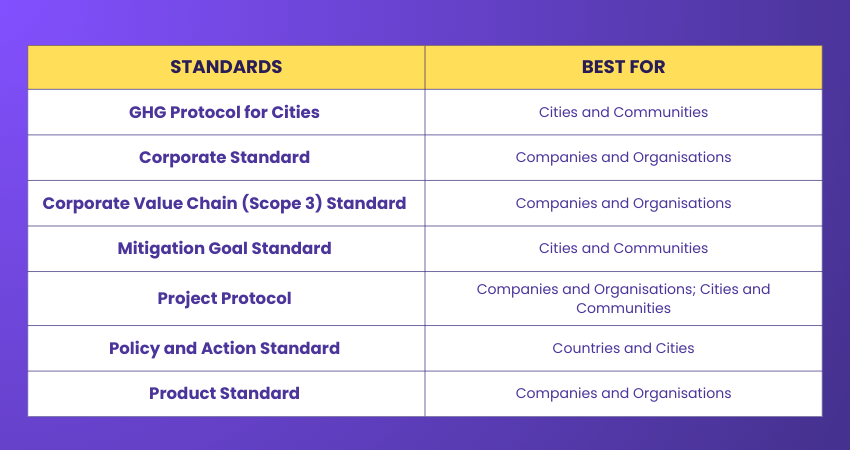
1) GHG Protocol for Cities
The Global Protocol for Community-Scale Greenhouse Gas Emission Inventories (GPC) offers a robust framework for urban areas to measure and report city-wide emissions. This helps cities identify major hotspots and plan targeted climate actions.
2) Corporate Standard
The GHG Protocol Corporate Accounting and Reporting Standard provides a framework for organisations to prepare a greenhouse gas emissions inventory. It includes step-by-step guidance to quantify and report emissions consistently.
3) Corporate Value Chain (Scope 3) Standard
This standard recognises that many emissions occur outside a company’s direct control. It enables businesses to assess their entire value chain, identify where most emissions arise, and determine where reductions are needed.
4) Mitigation Goal Standard
The Mitigation Goal Standard guides nations and cities in setting and evaluating mitigation goals. It helps them track progress towards climate objectives through consistent assessment and reporting methods.
5) Project Protocol
The GHG Protocol for Project Accounting provides a methodology for quantifying greenhouse gas reductions from specific projects. It ensures results are transparent, consistent, and comparable across different initiatives.
6) Policy and Action Standard
This standard is designed for nations and cities to estimate the greenhouse gas effects of policies and actions. It supports the development of effective strategies to mitigate climate change.
7) Product Standard
The Product Standard assesses the greenhouse gas emissions of products across their life cycle, from raw materials to disposal. This helps organisations evaluate product impact and identify opportunities for sustainable design.
Learn about Environmental Sustainability by signing up with the IEMA Environmental Sustainability Skills for Managers Course - Sign up now!
What are Greenhouse Gas Protocol Scope 1 2 3 Emissions?
The Greenhouse Gas Protocol classifies Greenhouse Gas emissions into three distinct categories- Scope 1, Scope 2 and Scope – to assist organisations in identifying and managing their emissions across different arenas of their value chain.
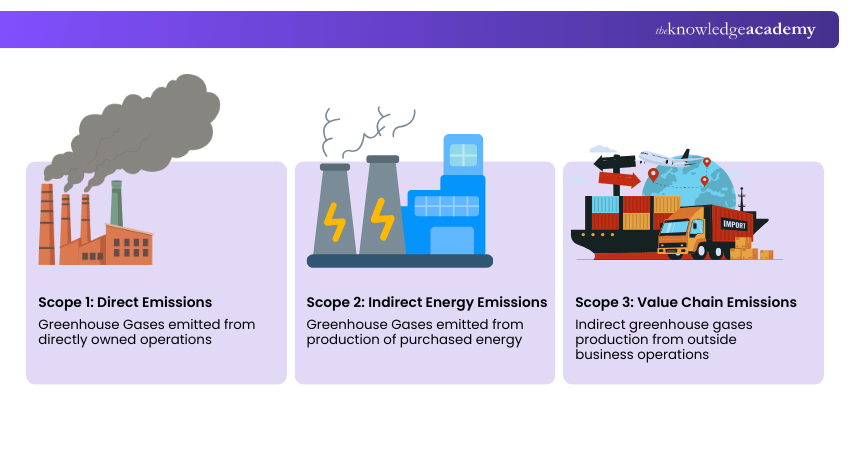
Scope 1: Direct Emissions
These emissions are directly released from sources owned or controlled by an organisation. They are usually the first targets for reducing carbon emissions. Examples include fuel combustion in company-owned vehicles, on-site heating systems, and chemical processes from manufacturing.
Scope 2: Indirect Energy Emissions
These refer to indirect emissions from the generation of purchased energy, such as electricity, heating, or steam consumed by the organisation. They occur off-site but are included in the company’s carbon footprint. To reduce Scope 2 emissions, organisations often adopt renewable energy sources, such as wind power or solar panels.
Scope 3: Value Chain Emissions
This category is the broadest and most complex. It covers emissions not directly produced by the company but resulting from its wider value chain activities. Examples include the production of raw materials, business travel, waste disposal, and transportation of goods. Scope 3 is often the most challenging to manage due to its wide coverage.
Master Environmental Management with our ISO 14001 Foundation Certification – Register now!
Who Uses the GHG Protocol?
The GHG Protocol is widely used by organisations ranging from various sectors to nations and their cities. Being a globally recognised framework, adoption of the GHG Protocol standardises the approaches for managing, measuring and reporting Greenhouse Gas emissions from an organisation’s value chain and carried out operations.
1) Governments
Government bodies around the world utilise the protocol to track emissions, design climate policies, and set national or regional regulations, using Carbon Accounting methods to ensure accurate measurement and reporting of greenhouse gas emissions.
2) Companies
Companies, particularly multinational corporations, adopt the GHG Protocol to disclose emissions, meet regulatory requirements, and support sustainability goals. It is applied across industries such as energy, transportation, manufacturing, and consumer goods.
3) Standards Organisation
The GHG Protocol works in alignment with other frameworks and standards, including the ISO 14000 series (specifically ISO 14064), the Task Force on Climate-related Financial Disclosures (TCFD), and the Carbon Trust Standard.
4) NGOs
Non-governmental organisations use the GHG Protocol to measure and report emissions from their operations, promoting transparency and accountability.
5) Investors
Investors and financial institutions apply the GHG Protocol to assess climate risks and opportunities linked to companies. It helps them evaluate carbon footprints and make informed decisions regarding investment portfolios.
What are the Benefits of Greenhouse Gas Protocol (GHG)?
The adoption of the Greenhouse Gas (GHG) Protocol requires organisations in various sectors to execute the best suitable practices to minimise, measure, manage and account for their amount of Greenhouse Gas emissions. Such a protocol brings together various benefits for sustaining the state of climate change.
1) Improved Credibility
Adapting a globally recognised framework enhances the credibility of an organisation’s data and reporting of its emissions. Such credibility allows stakeholders, investors and regulators to gain the trust of a particular organisation.
2) Enhanced Transparency
Since the GHG Protocol is a standardised framework, this builds a sense of transparency which results in building trust with stakeholders, customers and investors. Along with building and gaining trust, transparency brings credibility to an organisation’s overall operations.
3) Regulatory Compliance
Adherence to the GHG Protocol aligns organisations with reporting requirements and prepares them for future regulations in relation to climate change. This approach builds compliance with current policies and readiness to adapt to the changing scenario.
4) Preparation for Future Regulation
By adhering to the protocol, organisations can be equipped with the readiness to prepare for future regulations and policies related to climate change, such as carbon pricing. This helps to safeguard the best interests of future climate change issues.
5) Improved Relationship with Stakeholders
Such adherence speaks boldly about an organisation's commitment to address climate change, value sustainable approaches and reduce emissions. This fosters strong relationships with stakeholders, building trust with respective customers, regulators and investors.
6) Futureproofing Your Business
The identification of Greenhouse Gas emissions can make organisations proactive in preparing for stricter regulations and shifts in market trends in the future. This brings in stability for businesses in a rapidly changing world.
7) Better Risk Management
The GHG Protocol helps organisations understand and manage risks associated with climate change, such as physical impacts, regulatory compliance and reputational damage. By understanding such risks, organisations can develop strategies to mitigate risk, ensuring operations can carry their momentum.
8) Competitive Advantage
The changing landscape of climate requires companies to incorporate measures that are in vogue. Such adoption of measures can differentiate them from their respective competitors, paving the way for them to stand out in the market.
Master ISO 14001 skills today and empower your organisation to achieve sustainable business growth with our ISO 14001 Certification - sign up today!
How to Comply with the GHG Protocol?
The compliance of organisations with the GHG Protocol is critical for measuring and managing emissions. Such compliance also ensures transparency and credibility, along with making meaningful decisions to create a difference in climate change. Below are the important reasons behind complying with the GHG Protocol:
1) Accuracy
Organisations are responsible for systematically approaching the quantification of GHG emissions to maintain accuracy in their report. Along with it, measures need to be implemented to eradicate uncertainties as much as possible. Once it is done, progress can be tracked in a credible manner.
2) Relevance
Relevance is crucial since the GHG inventory accounting built by the organisation must reflect what matters most- from your operations to stakeholders. It must serve both internal and external users to allow for affirmative decision-making to take place.
3) Transparency
This refers to giving a transparent audit trail, meaning addressing the source of where data is coming from, emission factors being utilised, assumptions made on what basis and boundaries maintained with regard to crucial information. Basically, it means to provide a vivid picture of where and how the quantification is derived.
4) Completeness
Organisations must be accountable for providing every emission source and activities within the boundaries they have set. Additionally, they need to disclose any significant GHG emissions and removals that have been excluded.
5) Consistency
To maintain compliance with the GHG Protocol, methodologies, data sources, assumptions and boundaries should remain consistent. In case of any change, organisations must document them to make important comparisons over a specific period.
Conclusion
The Greenhouse Gas Protocol is a global standardised framework responsible for measuring, managing and reducing Greenhouse Gas emissions for the sustainability of our climate. This is incorporated by various organisations, from the private and public spheres to monitor their progress towards creating a sustainable, low-carbon future.
Get familiar with Greenhouse Gas Management frameworks by signing up for our ISO 14097 Training now!
Frequently Asked Questions
What is the Paris Agreement in Relation to GHGP?

The Paris Agreement, signed in 2015 under the United Nations Framework Convention on Climate Change (UNFCCC), aims to limit global warming to below 2°C, preferably 1.5°C. It sets global climate goals, with organisations using the GHG Protocol to align reporting and support these international climate targets.
Is the GHG Protocol Mandatory?
The GHG Protocol is not legally mandatory, and its adoption depends on a country’s policies. However, it is a widely recognised framework that many organisations voluntarily adopt to improve transparency, reduce emissions, and support a low-carbon future.
What Are the Other Resources and Offers Provided by The Knowledge Academy?
The Knowledge Academy takes global learning to new heights, offering over 3,000+ online courses across 490+ locations in 190+ countries. This expansive reach ensures accessibility and convenience for learners worldwide.
Alongside our diverse Online Course Catalogue, encompassing 19 major categories, we go the extra mile by providing a plethora of free educational Online Resources like Blogs, eBooks, Interview Questions and Videos. Tailoring learning experiences further, professionals can unlock greater value through a wide range of special discounts, seasonal deals, and Exclusive Offers.
What is The Knowledge Pass, and How Does it Work?
The Knowledge Academy’s Knowledge Pass, a prepaid voucher, adds another layer of flexibility, allowing course bookings over a 12-month period. Join us on a journey where education knows no bounds.
What are the Related Courses and Blogs Provided by The Knowledge Academy?
The Knowledge Academy offers various ISO 14097 Training, including ISO 14097 Greenhouse Gas Management Training. This course caters to different skill levels, providing comprehensive insights into Types of Greenhouses.
Our Health & Safety Blogs cover a range of topics related to Environmental Sustainability, offering valuable resources, best practices, and industry insights. Whether you are a beginner or looking to advance your Health & Safety skills, The Knowledge Academy's diverse courses and informative blogs have got you covered.
Upcoming Health & Safety Resources Batches & Dates
Date
 ISO 14097 Greenhouse Gas Management Training
ISO 14097 Greenhouse Gas Management Training
Fri 10th Apr 2026
ISO 14097 Greenhouse Gas Management Training
Fri 26th Jun 2026
ISO 14097 Greenhouse Gas Management Training
Fri 16th Oct 2026

 If you wish to make any changes to your course, please


