


 Top Rated Course

We may not have the course you’re looking for. If you enquire or give us a call on +44 20 4538 6376 and speak to our training experts, we may still be able to help with your training requirements.
What is Critical Path Analysis (CPA)? Types, Uses, and Process
David Evans 23 April 2026Critical Path Analysis is a Project Management technique used to identify the longest sequence of tasks that determines the time required to complete a project. It helps plan, schedule, and allocate resources efficiently. It improves coordination, decision-making, and ensures projects are completed on time and within budget.

Training Outcomes Within Your Budget!
We ensure quality, budget-alignment, and timely delivery by our expert instructors.
Table of Contents

Every project and task will have a goal. You will have a timeline and countless moving parts that need to work together to complete the projects and tasks. But how do you make sure everything stays on track, and the timeline is not missed? That’s where Critical Path Analysis (CPA) comes in.
It offers a clear, structured way to take control of your goals because managing time can feel overwhelming at times. This powerful technique helps you identify important tasks, predict possible delays, and keep your project on track. In this blog, we’ll explain what CPA is, how it works, why it is important, and how to use it. Read on!
Table of Contents
1) What is Critical Path Analysis (CPA)?
2) How Critical Path Analysis Works?
3) Why is Critical Path Analysis Important?
4) Steps in the CPM Process
5) How to Use Critical Path Analysis?
6) Advantages and Disadvantages of Critical Path Analysis
7) What is an Example of Critical Path Analysis?
8) Conclusion
What is Critical Path Analysis (CPA)?
Critical Path Analysis (CPA), also known as the Critical Path Method (CPM), is a popular Project Management technique. It is used to identify the longest chain of dependent tasks that determines a project’s total duration.
In simple terms, it helps you find out which tasks are most critical for meeting your deadline; that is if any of them are delayed, the entire project will be pushed back. CPA helps managers plan, schedule, and monitor progress by showing which activities are essential for meeting deadlines.
How Critical Path Analysis Works?
Critical Path Analysis works by breaking a project into smaller, manageable tasks and mapping out how each task connects to the others. This helps you identify the sequence of activities that must be completed on time for the project to stay on schedule, as well as the tasks that allow for some flexibility.
In simple terms, it shows which steps are most important and which ones have room to move. There are two kinds of tasks:
1) Critical Tasks: These are essential for completing the project on time. If one of them is delayed, the whole project will be delayed.
2) Non-critical Tasks: These tasks can be delayed a little without affecting the overall project completion date.
Why is Critical Path Analysis Important?
Critical Path Analysis is important because it helps you understand your Project’s Timeline. You will get to know the whole flow and understand how the project is going to be executed. It becomes easier to separate critical tasks and non-critical tasks in your project.
CPA also helps you track and monitor the project from start to finish. If there are any new changes or something that is unclear, you can give extra time to such tasks while compromising with other tasks. Overall, it gives you a clear roadmap to understand dependencies and keeps everyone focused on completing the project on time.
Steps in the CPM Process
Now that you know what Critical Path Analysis is and how it works, let’s check the steps involved in doing it:
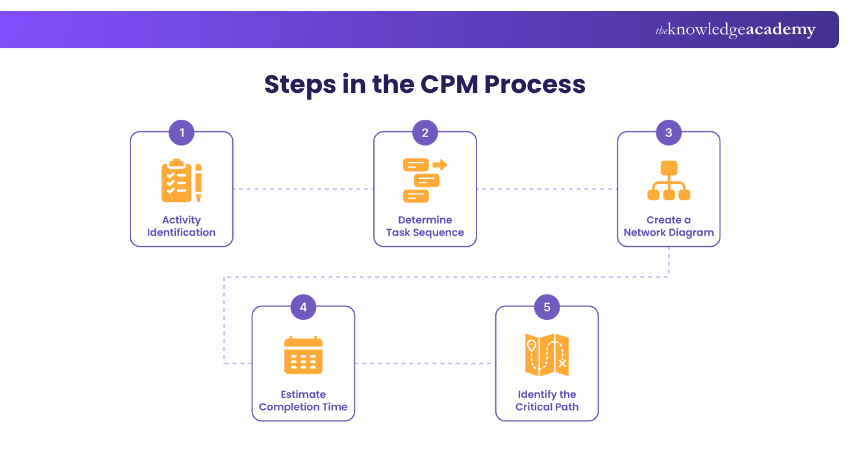
1) Activity Identification
First, make a list of all the tasks needed to complete the project. Many teams use the Benefit of Work Breakdown Structure (WBS) to break the project into manageable parts. You need to add the main deliverables and key tasks, so the schedule stays clear.
2) Determine Task Sequence
Next, find out the order of the tasks. Some will start only after others are finished, while some can be done at the same time. Understanding this order (called dependencies) helps create a smooth workflow. The different types of dependencies are:
1) Finish-to-Start (FS): Task B starts only after Task A finishes
2) Start-to-Start (SS): Task B starts when Task A starts
3) Finish-to-Finish (FF): Task B finishes when Task A finishes
4) Start-to-Finish (SF): Task B finishes only after Task A starts
Learn proven planning methods with our Project Planning and Control™ (PPC) Foundation Course – Register now!
3) Create a Network Diagram
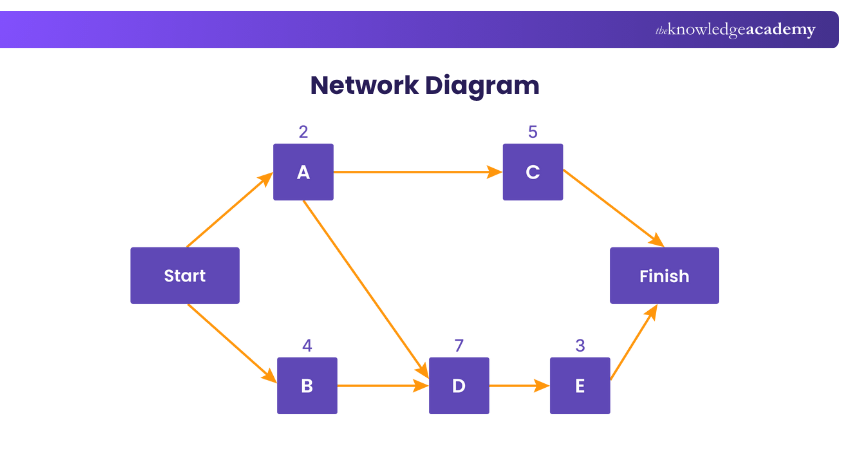
Once you know the order of tasks, you can now draw a Network Diagram. This is a simple flowchart showing all tasks and how they connect. There are two main ways to draw it:
1) Activity-on-Node (AON): Tasks are put in boxes with arrows connecting them
2) Activity-on-Arrow (AOA): Tasks are shown as arrows, and circles mark the start or end
4) Estimate Completion Time
Now, for each task, estimate how long it will take. These time estimates are very important because they affect the whole project schedule. You can use data from past projects to make these estimates more accurate.
5) Identify the Critical Path
Finally, calculate the Critical Path which is the longest chain of tasks from start to finish. These are the tasks that must be done on time, or the entire project will be delayed.
How to Use Critical Path Analysis?
Once you understand the steps involved, you can begin applying Critical Path Analysis to plan your project more effectively. Here’s a simple, practical way to do it:
1) List Involved Tasks in the Project
Start by writing down every task you need to complete your project. Add small tasks also because they can sometimes delay bigger tasks.
2) Assign Each Task With a Letter
Give a label to each task such as A, B, C, and so on. This makes it easier to track and refer to tasks when drawing diagrams or calculating timings.
3) Identify Sequential Tasks and Their Order
Here, find out the tasks that are dependent on others. For example, you can’t test a website before you develop it. However, some tasks can happen side by side, while others can be done one after another.
4) Assign Time Estimates
Estimate how long each task will take to complete. Adding realistic timings helps you plan the overall project duration and ensures your schedule aligns with actual working conditions.
5) Find the Longest Path (Critical Path)
Calculate the total time for each possible path from the start of the project to the end. The path with the longest duration is the Critical Path. This shows you which tasks must stay on schedule to avoid delays in the final deadline.
6) Chart the Path
Now turn your information into a simple visual chart. You can use a Gantt Chart, a PERT diagram, or any kind of network diagram. Keep updating this chart as the project moves forward.
Stand out with advanced planning and control skills with our Project Planning and Control™ (PPC) Foundation and Practitioner Training – Sign up soon!
Advantages and Disadvantages of Critical Path Analysis
Let’s check the advantages and disadvantages of Critical Path Analysis:
Advantages of Critical Path Analysis
1) Helps you plan the project clearly by showing all tasks
2) Makes it easier to estimate how long the project will take and its expense
3) Helps you track progress and find delays early
4) Shows which tasks are most important, so you can organise your team better
5) Gives a simple visual overview of the whole project
Disadvantages of Critical Path Analysis
1) CPA works only if your time estimates are correct, which is not always easy
2) Unexpected problems, like delays or missing materials, may not be included in the plan
3) It doesn’t always show whether you have enough people or resources for tasks
4) Can take a lot of time for big projects with many tasks
What is an Example of Critical Path Analysis?
Here is a simple example to show how CPA works in real life. For that, imagine you’re managing a project to build a new company website. These are the tasks:
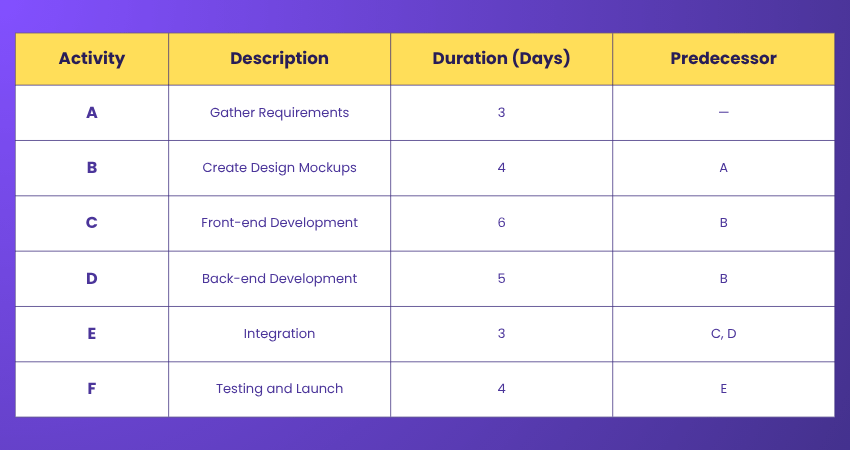
Now, calculate the duration for each path:
1) A → B → C → E → F = 20 days
2) A → B → D → E → F = 19 days
The Critical Path is A–B–C–E–F because it takes 20 days. If any of these tasks are delayed, the whole project will be delayed. Task D is non-critical because it has a one-day slack time.
Conclusion
Critical Path Analysis is a significant part of your Project Management. It gives you a clear understanding of which tasks are very important, how long the project will take, and where risks can come. Whether you’re managing a construction job or a marketing campaign, understanding CPA can make the difference between success and failure.
Gain practical planning and scheduling skills with our Project Planning and Control™ Training – Start today!
Frequently Asked Questions
What are the Three Main Objectives of Critical Path Analysis?

The three main objectives include:
1) To find the order of tasks
2) To calculate the project duration
3) To plan and use resources effectively
What is a Critical Pathway and Why is it Used?
A Critical Pathway is the longest sequence of tasks in a project. It is used to identify important tasks, plan scheduling, and ensure on time project delivery by avoiding delays.
What are the Other Resources and Offers Provided by The Knowledge Academy?
The Knowledge Academy takes global learning to new heights, offering over 3,000 online courses across 490+ locations in 190+ countries. This expansive reach ensures accessibility and convenience for learners worldwide.
Alongside our diverse Online Course Catalogue, encompassing 17 major categories, we go the extra mile by providing a plethora of free educational Online Resources like Blogs, eBooks, Interview Questions and Videos. Tailoring learning experiences further, professionals can unlock greater value through a wide range of special discounts, seasonal deals, and Exclusive Offers.
What is The Knowledge Pass, and How Does it Work?
The Knowledge Academy’s Knowledge Pass, a prepaid voucher, adds another layer of flexibility, allowing course bookings over a 12-month period. Join us on a journey where education knows no bounds.
What are the Related Courses and Blogs Provided by The Knowledge Academy?
The Knowledge Academy offers various Project Planning and Control™ Training, including Project Planning and Control™ (PPC) Practitioner Training, Project Planning and Control™ (PPC) Foundation Course and Project Planning and Control™ (PPC) Foundation and Practitioner Training. These courses cater to different skill levels, providing comprehensive insights into Resource Allocation.
Our Project Management Blogs cover a range of topics related to Critical Path Analysis, offering valuable resources, best practices, and industry insights. Whether you are a beginner or looking to advance your Project Management skills, The Knowledge Academy's diverse courses and informative blogs have got you covered.

David Evans


Certified Project Trainer and Agile Delivery Expert
David Evans brings over a decade of hands-on experience in project delivery, Agile transformation, and team leadership. With a background in technology and business consulting, David has led cross-functional teams through Agile and Waterfall projects in both public and private sectors. He combines technical knowledge with practical insights to help readers navigate the challenges of modern project environments.

Upcoming Project Management Resources Batches & Dates
Date
 Project Planning and Control™ (PPC) Practitioner
Project Planning and Control™ (PPC) Practitioner
Thu 6th Aug 2026
Project Planning and Control™ (PPC) Practitioner
Thu 8th Oct 2026
Project Planning and Control™ (PPC) Practitioner
Thu 17th Dec 2026

 If you wish to make any changes to your course, please


