


 Top Rated Course

We may not have the course you’re looking for. If you enquire or give us a call on +44 1344 203999 and speak to our training experts, we may still be able to help with your training requirements.
Music Theory: Complete Guide for Beginners
The Knowledge Academy 15 July 2026Music Theory is the grammar of Music, helping musicians understand, create, and communicate sound with structure rather than relying only on instinct. It helps beginners understand notes, scales, chords, rhythm, and harmony in a simple and structured way, making it easier to play instruments, write songs, and communicate musical ideas.

Training Outcomes Within Your Budget!
We ensure quality, budget-alignment, and timely delivery by our expert instructors.
Table of Contents

From the catchiest simplicity of a pop melody to the most complex piece of avant-garde rock Music, every great song you've ever heard has a blueprint behind it. It's called Music Theory. It’s the art and science of how Music works, from the notes that form melodies to the rhythms that make you tap your feet. It reveals the patterns and relationships between notes, chords and rhythms.
It transforms simple sounds into expressive and meaningful art. When you understand the fundamentals, you build the ability to create, interpret and enjoy Music. In this blog, you will learn about what is Music Theory, its importance, benefits, and more to improve your musical skills and turn them into a powerful language of creativity and emotion.
Table of Contents
1) What is Music Theory?
2) Why is Music Theory Important?
3) The Basics of Music Theory
4) The Rudiments of Music Theory
5) How to Learn Music Theory?
6) What is Rhythm in Music?
7) What is Harmony in Music?
8) What is Melody in Music?
9) Benefits of Learning Music Theory
10) Some Challenges and Misconceptions
11) What are the 4Ts in Music?
12) How Long Does It Take to Learn Music Theory?
13) Conclusion
What is Music Theory?
Music Theory is the framework that helps you understand how Music works. Much like grammar in language, it provides the rules and structures that drive musical expression. By studying Music Theory, you can gain insight into the elements that make Music so expressive. It allows us to appreciate different compositions more deeply and even create our own with greater confidence.
Basic Music Theory explores several key components such as notes and scales, rhythm and meter, melody and form, and chords and harmony. Together, these elements form the language of Music, allowing for both analysis and creativity. These building blocks help Musicians to communicate ideas, shape emotions, and bring musical pieces to life.

Why is Music Theory Important?
Music Theory is important because it helps you understand how Music works and gives you a clear way to express ideas through sound. It enables musicians and producers to communicate effectively and make informed creative decisions. This helps you confidently choose the right notes, chords, and structures to create the desired mood and emotion.
From building chord progressions to shaping sounds and effects, it plays a key role in Music creation and production by guiding decisions at every stage. With a strong understanding of Music Theory, you can experiment more freely, solve creative challenges, and bring your musical ideas to life with clarity and purpose.
The Basics of Music Theory
The basics of Music Theory are built on three core elements that work together to create Music. Let’s look at them below:
1) Melody: It refers to single notes that forms a tune. It is the core part of a song that expresses emotions, such as happiness, sadness or excitement. Melody carries the message with the combination of lyrics.
2) Harmony: The combination of multiple notes played at the same time. It supports and enriches the melody through chords and chord progressions. This helps to add depth and shape the overall Music mood.
3) Rhythm: It refers to the pattern of beats and timing in music. It provides structure and flow, ensuring that melody and harmony stay in sync. Rhythm helps create movement and keeps the music organised and engaging.
The Rudiments of Music Theory
The rudiments of Music Theory cover the essential building blocks that help you read, understand, and create Music. Let’s look at them below:
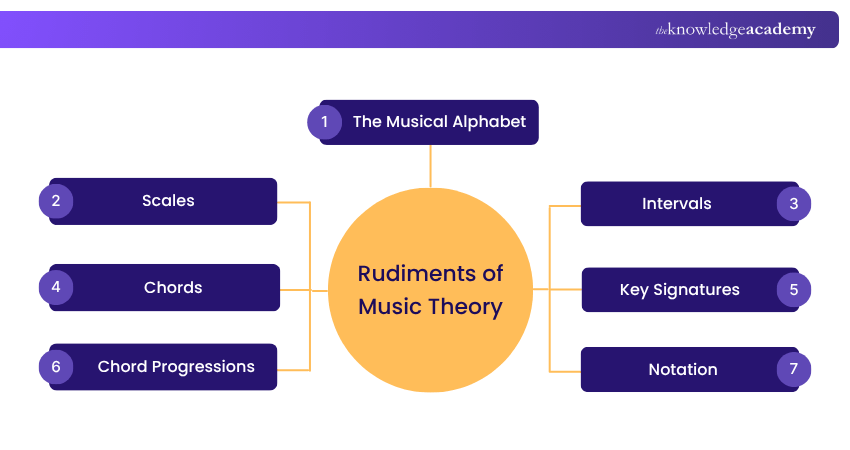
1) The Musical Alphabet: Music uses 12 basic notes. It starts from C and moves forward. Some notes are sharp (#) or flat (♭). A few notes have two names. For example, F# and G♭ sound the same. They are written differently based on use.
2) Scales: A scale is a group of notes in order. The most common one is the major scale. It follows a set pattern of steps. Scales are important. They help create songs, tunes, and chords.
3) Intervals: An interval is the gap between two notes. Some intervals sound smooth and calm. Others sound tense. They help shape how music feels.
4) Chords: Chords are made by playing notes together. They come from scales. Common types are major and minor chords. Each type gives a different mood.
5) Key Signatures: A key tells you which notes to use. It also shows which notes are sharp or flat. This helps you read and play music easily.
6) Chord Progressions: These are chords played in a set order. They build the structure of a song. They also help create flow and feeling.
7) Notation: Notation is how music is written. It uses symbols like notes and rests. This helps people read and share music.
Take the first step towards your Music career with the Music Courses today!
How to Learn Music Theory?
Learning Music Theory is a rewarding endeavour that deepens your understanding of the language of Music. Whether you're a beginner or have some Musical background, here's step-by-step instruction for mastering this theory.
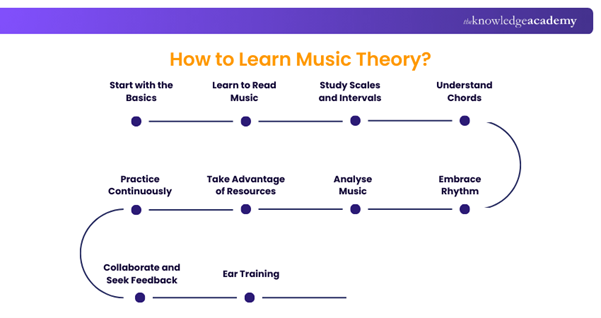
1) Start with the Basics: Start by learning the fundamental concepts of basic Music Theory. Understand the Musical alphabet, notes and the layout of the Musical staff. Learning the foundation makes everything else easier to grasp.
2) Learn to Read Music: Master the basics of Music notation. This includes clefs, key signatures, time signatures, and rhythmic values. This will help you interpret sheet Music accurately.
3) Study Scales and Intervals: Dive into scales and intervals because they are the building blocks of melodies and harmonies. Start with major and minor scales and grasp how intervals create different Musical distances.
4) Understand Chords: In Music Theory for beginners, explore chord structures, chord progressions and their relationships. Learn about major and minor chords, triads, seventh chords, and their inversions.
5) Embrace Rhythm: Study rhythm patterns, time signatures, and syncopation. Practice clapping or tapping along with different rhythms to internalise them. Solid rhythms help you to stay in time and perform confidently.
6) Analyse Music: Listen to various Types of Music and analyse them using your newfound knowledge. Identify key signatures, chord progressions, and rhythmic patterns. This practice sharpens your analytical skills in Music.
7) Take Advantage of Resources: Utilise resources such as textbooks, tutorials, video lessons, and Music Theory apps. Websites offer interactive exercises to reinforce your learning.
8) Practice Continuously: Apply theory to practical scenarios. Play instruments, compose melodies, and experiment with harmonies. Regular practice solidifies your understanding. With consistent repetition, musical knowledge turns into a refined skill.
9) Collaborate and Seek Feedback: Apply theory to practical scenarios. Play instruments, compose melodies, and experiment with harmonies. Regular practice solidifies your understanding. With consistent repetition, musical knowledge turns into a refined skill.
10) Ear Training: Develop your ear by recognising intervals, chords, and melodies by ear. Ear training strengthens your ability to connect theoretical concepts to actual sounds. A strong ear helps to improvise and compose effectively.
11) Analyse Famous Compositions: SStudy the Music of renowned Composers across genres. Analyse their compositions to understand how theory is applied creatively. This will help to discover patterns and techniques by the very best.
12) Create Your Own Music: Apply your knowledge by composing your own Music. Experiment with different chord progressions, melodies, and rhythmic patterns. This will not only foster creativity but also help you remember concepts better.
13) Engage with Music Communities: Join Music forums, attend workshops, or participate in local Music groups. Engage with others who share your passion can enhance your learning experience.
14) Follow a Structured Learning Path: Engage with a step-by-step approach to Music theory through books, videos, or guided resources. A structured path ensures thorough understanding, builds your skills progressively, and helps you stay focused. 15) Be Patient and Persistent: Learning Music Theory takes time. Stay patient, persistent, and celebrate your progress along the way. By making incremental improvements, it adds up to big musical achievements.
15) Be Patient and Persistent: Learning Music Theory takes time. Stay patient and persistent and celebrate your progress along the way.
Learning Music Theory is a and fulfilling journey. Remember that it's not about rules but understanding the language that Musicians use to communicate and create.
Turn every emotion into unforgettable melody with our Music Composition Course - Sign up now to elevate your musical prowess!
What is Rhythm in Music?
Rhythm is a core element of Music that gives sound a sense of movement and timing. It is the pattern of notes and silences arranged in time to help listeners feel the beat. This creates a structure and keeps Music organised for melodies and harmonies to merge.
Rhythms shape the groove and energy by using patterns of strong and weak beats that repeat throughout the song. It can be produced by percussion, instruments, or even vocals. The rhythm acts as the heartbeat of Music and guides all musical elements. It includes various components, such as:
1) Beat: Steady pulse that you naturally tap your foot to
2) Meter: Repeating pattern of strong and weak beats
3) Time Signature: The number of beats in each measure
4) Tempo (BPM): Speed of the Music (fast or slow)
5) Strong and Weak Beats: Downbeats feel heavier, while offbeats feel lighter
6) Syncopation: Emphasises the unexpected beats to add excitement
7) Accents: Giving certain notes extra power or stress
What is Harmony in Music?
Harmony refers to a musical scenario when two or more notes are played together to create a fuller sound. These combined tones complement one another and deliver a pleasing effect that enriches the Music. Chords and chord progressions illustrate harmony. A chord consists of three or more simultaneously played notes.
These chords, along with their progressions, provide support and depth to the melody. Harmony can also be achieved through voices. For example, when a choir sings, the blend of different vocal parts forms a rich and harmonious sound. Harmony generally falls under two categories:
1) Dissonant Harmony: It introduces the notes that clash when played together. These unstable sounds create a sense of suspense. This is resolved when they transition into consonant chords. Common dissonant intervals include seconds, sevenths and ninths.
2) Consonant Harmony: It's stable, smooth and pleasing to the ear. Notes in consonant chords blend naturally and move seamlessly within progressions. Examples include unison, thirds, fifths, and octaves.
What is Melody in Music?
Melody is a sequence of notes arranged into a musical phrase. It often forms the most memorable and recognisable part of a song. Instruments or vocals can produce a melody and contain at least two notes played in succession that sound musically appealing. The two core elements of melody are pitch and rhythm:
1) Pitch: It refers to how high or low a note sounds, created by the vibrations of a voice or instrument. Organising these pitches in sequence forms a melody.
2) Rhythm: It's the duration of each note, measured in divisions such as whole notes, half notes, quarter notes, and triplets.
Melodies also move in two main ways:
1) Conjunct Motion: It occurs when notes progress in small steps, such as whole or half steps. This style is easier to play or sing, producing smooth, memorable lines.
2) Disjunct Motion: It uses larger leaps between notes, creating a melody that can be more challenging to perform and often less fluid or memorable.
Become a sought-after sonic sculptor in the Music business. Sign up for our Music Mixing Course now!
Benefits of Learning Music Theory
While Music Theory isn’t strictly required, learning even the basics provides significant benefits. Understanding how Music functions can simplify the production process, sharpen your skills and make you a more versatile and confident creator. Some key benefits of learning Music Theory include:
1) Enhancing musical growth and awareness
2) Gaining insight into how Music is structured
3) Overcoming creative roadblocks with ease
4) Building strong chord progressions and melodies
5) Making better composition choices
6) Expressing emotion effectively through Music
7) Developing sharper critical listening skills
8) Speeding up the creative workflow
9) Strengthening knowledge of musical form
10) Improving collaboration and communication with other Musicians
Unlock the keys to musical creativity with our comprehensive Piano Training – Sign up now!
Some Challenges and Misconception
Many beginners think Music Theory is academic or not useful in real music. But it is important to note that it is closely linked to practice and helps musicians perform, compose, and produce music more effectively. Another common myth is that Music Theory limits creativity, but it helps you experiment and express ideas with more confidence.
It can feel overwhelming at first, but learning Music Theory step by step makes it much easier. It is not just a set of rules but a practical tool that helps you build a strong Music foundation and connect with Music more deeply over time. As you continue learning, it becomes a natural part of how you think about and make Music.
What are the 4Ts in Music?
The 4Ts in Music are the four essential skills that every Musician must develop to improve their understanding of Music. These include:
1) Tone: Refers to how Music sounds. It includes the quality and the emotion in each note.
2) Time: The Sense of rhythm and timing. It includes staying in sync with the beat and other Musicians.
3) Theory: The knowledge behind the Music. It involves understanding scales, chords, and how Music is built.
4) Technique: The physical skill of playing your instrument with accuracy.

How Long Does it Take to Learn Music Theory?
That depends on your goals and how deeply you want your understanding to be. If you are focusing on fundamentals like notes, scales and chords, you can learn them within a few weeks or months with consistent practice. However, more advanced topics like harmony, counterpoint and composition can take years of study and application.
The best approach is to learn in a sequential manner. Start with the basics, apply them in real Music situations and build your knowledge step by step. Since Music Theory is a vast subject, there’s always something new to explore, no matter which level you are at.
Conclusion
Music is something we all feel but understanding it makes the experience even richer. By learning Music Theory, you gain the confidence to experiment, create, improve, and express ideas with more freedom. It becomes a powerful tool that grows with you and helps you turn simple sounds into meaningful and memorable music.
Explore activities that you truly enjoy and start growing them with Hobbies & Interests Training now!
Frequently Asked Questions
What are the Four Pillars of Music?

The four pillars of Music include:
1) Melody: Main tune of a song that can be sung or hummed
2) Harmony: Supporting notes played together to enrich the melody
3) Rhythm: Pattern of beats and timing that gives Music flow and movement
4) Form: Overall structure of a Musical piece
Can Music Exist Without Music Theory?
Yes, Music can exist without formal Music Theory, as it is fundamentally an expression of sound and emotion. Many Musicians create intuitively without studying theory. However, theory helps explain why Music sounds the way it does, offering a structured way to compose, analyse, and enhance creativity.

The Knowledge Academy


Global Training Provider
The Knowledge Academy is a world-leading provider of professional training courses, offering globally recognised qualifications across a wide range of subjects. With expert trainers, up-to-date course material, and flexible learning options, we aim to empower professionals and organisations to achieve their goals through continuous learning.


 If you wish to make any changes to your course, please


