


 Top Rated Course

We may not have the course you’re looking for. If you enquire or give us a call on 01344 203999 and speak to our training experts, we may still be able to help with your training requirements.
Top Flask Interview Questions and Answers for Developers
Richard Harris 23 April 2026The top Flask Interview Questions test your knowledge and foster critical thinking on web design, scalability, and Python Development best practices. Flask is designed to be simple and easy to use, making it ideal for both small and large projects. Its "micro" nature provides the key Web Development tools without unnecessary components.
Training Outcomes Within Your Budget!
We ensure quality, budget-alignment, and timely delivery by our expert instructors.
Table of Contents

Flask is the fuel that helps Python powers sleek, dynamic websites. It's like a blank canvas for Web Developers, as flexible as their imagination. This micro web framework helps you build anything from simple APIs to full-fledged web applications with minimal setup. So, it’s no surprise that it continues to dominate the Developer world for its simplicity, flexibility and scalability.
Whether you’re aiming for a Backend Developer role or refining your web app skills, mastering Flask concepts can set you apart in your next interview. This blog is here to help you out with a collection of the 40 most frequently asked Flask Interview Questions and answers. So, dive in, brush up on your Flask expertise and discover the insights that could land you your dream role!
Table of Contents
1) Generally Asked Flask Interview Questions with Answers
a) What is Flask?
b) What are the key features of Flask in Python?
c) How is Flask different from Django?
d) How do you manage errors in Flask?
e) What is template inheritance in Flask?
f) What is the purpose of url_for in Flask?
g) Which HTTP methods are supported by Flask?
h) What is Flask-Sijax?
i) What is Flask-JWT?
j) What is Flask-Assets?
2) Conclusion
Generally Asked Flask Interview Questions with Answers
Here’s a selection of the most commonly asked Flask Interview Questions and answers. These questions cover all the essential concepts, helping you prepare for any technical discussion or real-world development scenarios. Let's dive in:
What is Flask?

“Flask is a lightweight, Python micro-framework for building web apps and APIs. It’s minimal by design, letting you add only what you need via extensions. It’s great for beginners due to its simplicity and flexibility. You can start small and scale up as your application grows.”

What are the key features of Flask in Python?
Its best features include:
1) Built-in dev server and debugger
2) Jinja2 templating
3) Flexible routing
4) WSGI (Werkzeug) under the hood
5) A rich ecosystem of extensions for ORM, auth, caching, and more
It promotes simplicity while giving Developers full control over structure and components. This makes it a preferred choice for microservices and small to mid-sized projects.
How is Flask different from Django?
“Django is a “batteries-included” framework that provides an ORM, admin panel, authentication and many built-in tools by default. Flask is minimal and unopinionated, allowing developers to build their own stack using extensions. Flask is ideal for lightweight or highly customised applications, while Django suits larger projects that benefit from structured components. Both follow the MVC pattern but implement it in different ways.”
How do you manage errors in Flask?
“I use @app.errorhandler(code) to register handlers, raise HTTPExceptions and return proper status codes. I log the errors and show friendly pages for 4xx/5xx. I can also integrate logging libraries or monitoring tools to capture detailed error insights. Flask’s flexibility allows centralised Error Management across routes.”
What is template inheritance in Flask?
“Template inheritance in Flask is a powerful feature that helps create a base HTML layout and reuse it across multiple pages. This makes the web application easier to maintain and more consistent in design. With Jinja2, we can create a base template and let child templates extend it, overriding blocks for titles, content and scripts to avoid duplication.”
What is the purpose of url_for in Flask?
“It builds URLs by endpoint name, not hard-coded paths. This keeps the links robust if routes change and helps with versioned/static asset URLs. It’s particularly useful in dynamic apps with variable routes. Plus, url_for simplifies redirecting users between endpoints programmatically.”
Which HTTP methods are supported by Flask?
“Flask supports all standard methods. These include GET, POST, PUT, PATCH, DELETE, OPTIONS, and HEAD (configurable per route). We can explicitly define which methods a route accepts using the methods parameter. This ensures security and clarity in API design.”
What is Flask-Sijax?
“Flask-Sijax integrates the Sijax (Simple AJAX) library with Flask, allowing Python functions to be called directly from the browser without writing custom AJAX code. It enables asynchronous communication and helps developers build interactive interfaces with minimal JavaScript.”
What is Flask-JWT?
“This is an extension to add JSON Web Token authentication to Flask APIs. It helps in issuing, verifying and protecting endpoints with JWTs. It’s essential for stateless authentication in modern APIs. Developers often combine it with role-based access control for added security.”
What is Flask-Assets?
“It manages and bundles static assets (JS/CSS), supports minification, caching and fingerprinting for efficient delivery. This improves load times and site performance. It’s especially helpful for large projects with multiple static files to manage.”
Sign up for our comprehensive Framework Training that will mould you into the go-to framework expert - Join today!
What is Flask-Migrate?
“Flask-Migrate is an extension for Flask that handles SQLAlchemy database migrations using Alembic. It helps you manage changes to your database schema over time, like adding or removing tables or columns, without losing data. It simplifies database version control without manual SQL scripts. Flask-Migrate integrates seamlessly with command-line tools like Flask CLI.”
How can you secure a Flask application?
I'll secure a Flask application through the following steps:
1) Using HTTPS
2) Setting secure cookies
3) Enable CSRF protection
4) Validating inputs
5) Sanitising templates
6) Implement auth/authorisation and rate-limit
7) Keeping dependencies updated
8) Integrating Flask extensions like Flask-Security or Flask-Limiter to strengthen overall app protection
What are the default host and port for Flask?
“By default, it runs on 127.0.0.1 (localhost) port 5000 in development. We can modify this using the app.run(host, port) parameters. In production, however, a WSGI server like Gunicorn or uWSGI handles deployment.”
What is Flask-Admin?
“It's an extension that auto-generates an admin interface for your models, with CRUD views, search, and permissions. It’s highly customisable, making it perfect for dashboards or management panels. It integrates well with Flask-SQLAlchemy or Peewee models.”
How does routing work in Flask?
“Routing is the mechanism that connects URLs to specific functions in your application, known as view functions. You define these routes using the @app.route() decorator, where you specify the URL path and optionally the HTTP methods (like GET or POST) that the route should respond to. Flask's routing system supports converters for type validation, making route handling clean and safe.”
What is the role of Flask-SQLAlchemy?
“It integrates SQLAlchemy ORM with Flask, providing an easier config, scoped sessions and model/query helpers. This extension simplifies database management and migrations. It also supports complex relationships and query optimisation.”
What are Flask decorators and how are they used?
“Flask decorators are wrappers (like @app.route, @login_required) that modify view behaviour like register routes, enforce auth, or add cross-cutting concerns. Decorators improve readability and modularity in Flask applications. You can even create custom decorators to manage repetitive logic.”
How can you improve Flask application performance?
I will improve Flask application performance by:
1) Enabling production WSGI (gunicorn/uwsgi)
2) Turning on caching
3) Using a reverse proxy (Nginx)
4) Optimise DB queries
5) Leveraging async/queues for slow tasks.
6) Using profiling and monitoring tools to identify performance bottlenecks
7) Improving speed by caching static assets or database results
Turn ideas into applications with the world’s most versatile Programming Language. Sign up for our Python Course now!
How do you handle asynchronous tasks in Flask?
“I can handle asynchronous tasks in Flask by offloading to task queues like Celery or RQ for background jobs. I can also use websockets or Server-Sent Events for push updates. This ensures the app remains responsive during heavy workloads.”
What are template engines in Flask?
In Flask, template engines are the tools that allow us to combine Python logic with HTML to create dynamic web pages. The default engine used in Flask is Jinja2. It offers powerful features like:
1) Control structures (if, for loops)
2) Filters for formatting data
3) Macros for reusable components
4) template inheritance for consistent layouts
While we can integrate other engines, Jinja2 is widely preferred for its flexibility and ease of use. Template engines essentially act as a bridge between backend data and frontend presentation.
How do you approach testing a Flask app?
“Testing a Flask application involves using tools like pytest in combination with Flask’s built-in test_client(). This allows us to simulate requests to the app without running a live server. A common approach is to use application factories to create isolated instances of your app for testing. Additionally, I can use fixtures to set up and tear down test environments cleanly.”
How do you make Flask routes SEO- and user-friendly?
Here's how we can make Flask routes SEO- and user-friendly:
1) Use readable slugs by replacing cryptic IDs with meaningful keywords in URLs (e.g., /blog/flask-routing instead of /blog/123).
2) Keep URLs stable and avoid frequent changes to URL structures.
3) Add canonical tags to prevent duplicate content issues by specifying the preferred URL version.
4) Generate sitemaps to help search engines discover and index your pages efficiently.
5) Use proper status codes to ensure correct HTTP responses (e.g., 200 for success, 404 for not found).
6) Render meta titles and descriptions server-side to improve click-through rates in search results.
What types of applications can be developed using Flask?
“Anything that benefits from a minimal, composable stack can be developed using Flask. This includes APIs, microservices, dashboards, admin portals, prototypes, and full web apps. Flask’s modular structure and scalability make it adaptable to projects of any size.”
What are best practices for writing tests in Flask?
Here are the best practices for writing tests in Flask:
1) Structure the app with factories to make testing modular and scalable.
2) Make sure each test runs independently by resetting the app and database state.
3) Replace APIs, databases or third-party calls with mocks to avoid side effects.
4) Check HTTP status codes, response payloads and headers for expected behaviour.
5) Avoid slow operations; fast tests encourage frequent runs and quicker feedback.
6) Use consistent naming and folder structure for readability and maintainability.
7) Integrate tests into your deployment pipeline for smoother, safer releases.
Why is code coverage important in Flask testing?
“Code average is important because it shows which code paths your tests exercise, helping to find gaps, reduce regressions and raise confidence before deployments. Higher coverage means more reliable applications. However, we must aim for quality over quantity because effective tests matter more than sheer numbers.”
From file handling to system automation, hone the skills for scripting. Sign up for our Python Scripting Training now!
What are fixtures and how are they used in Flask testing?
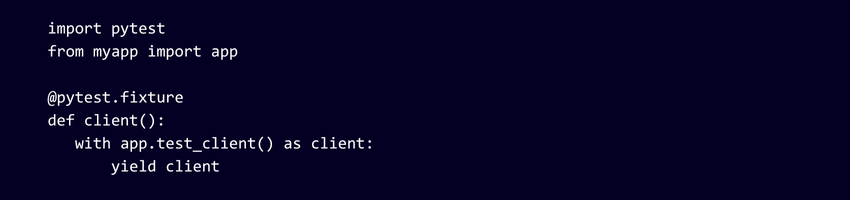
“Fixtures are reusable components that help us set up a consistent testing environment. They typically include things like test clients, database connections or mock data. Fixtures ensure that each test runs in a clean, predictable state. For example, using pytest, you can define a fixture to create a Flask test client:”
How do you manage database setup and teardown during tests?
“I can accomplish it by creating a test DB, running migrations, beginning a transaction per test, and rolling back/tearing down to ensure isolation and repeatability. I can automate this using pytest fixtures or setup hooks.”
How do you ensure Flask tests are maintainable?
I can ensure maintainable Flask test by:
1) Adopting consistent patterns (factories/fixtures)
2) Naming tests clearly
3) Avoiding global state
4) Refactoring duplicated setup into fixtures/utilities
Readable and modular tests save debugging time. Keeping tests small and targeted improves long-term scalability.
How can user authentication be implemented in Flask?
User authentication can be implemented in Flask throuhg the following:
1) Use Flask-Login: Manages user sessions, login/logout, and access control for logged-in users.
2) Token-based Authentication: Use Flask-JWT-Extended for secure token-based auth, ideal for APIs and mobile apps.
3) Password Security: Hash passwords using werkzeug.security or bcrypt to store them securely.
4) Protect Routes: Use decorators like @login_required to restrict access to authenticated users.
5) Third-party Logins: Integrate OAuth (e.g., Google, Facebook) for social login options.
Which databases are compatible with Flask?
“Any DB supported by SQLAlchemy (PostgreSQL, MySQL/MariaDB, SQLite, MSSQL) plus NoSQL via libraries (MongoDB, Redis, etc.) are compatible. Flask doesn’t enforce a database, thus giving freedom to choose. This makes it ideal for hybrid or evolving tech stacks.”
How do you handle form submissions in Flask?
I handle form submissions the following way:
1) Accepting POST data via request.form/request.get_json()
2) Validating with WTForms or pydantic
3) Protecting with CSRF for HTML forms
Proper validation ensures security and data integrity.
What are Flask blueprints and how do they work?
“Flask Blueprints modularise routes/templates/static files. We can register them on the app to keep large projects organised and reusable. They’re perfect for multi-module apps and scalable architectures. Blueprints also simplify unit testing and deployment.”
Learn the framework that makes PHP Development a breeze. Sign up for our Codelgniter Framework Web Development Training now!
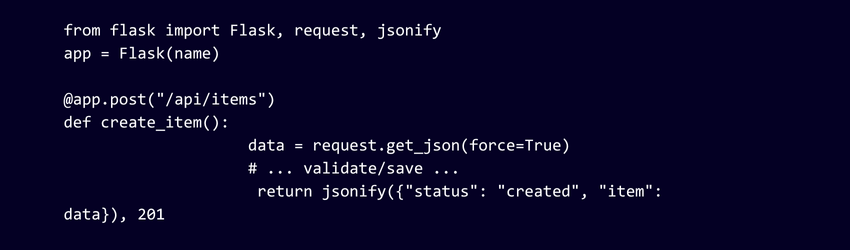
Write a Flask route that handles a POST request with JSON data
Here’s how it can be done:
Write a Flask route using query parameters to filter database results
Here’s how it can be done:

How would you manage multiple routes that use the same function?
“To manage multiple routes that use the same function in Flask, I can simply assign multiple route decorators to a single view function. Alternatively, I can register the function with different routing rules using add_url_rule(). I can also use default parameter values or inspect the incoming request object to branch the logic based on the route, method or query parameters.”
What is the significance of the __name__ variable in Flask?
“The name variable in Flask plays a crucial role in initialising the application. When we pass name to Flask(name), it tells Flask where to find resources like templates and static files relative to the location of the script. This helps Flask set up paths correctly, especially when the app is run directly or imported as a module."
How do you deploy a Flask application to a production environment?
Here are the ideal steps for deployment:
1) Run the Flask app behind a production-grade WSGI server like Gunicorn or uWSGI.
2) Use Nginx as a reverse proxy to handle client requests, serve static files and manage SSL.
3) Configure sensitive settings like FLASK_ENV, SECRET_KEY and database URLs securely. Store credentials and config values in .env files or use cloud-based secrets management tools.
4) Set up structured logging to monitor errors, performance and user activity.
5) Apply database migrations using tools like Flask-Migrate to keep the schema up to date.
6) Tools like Supervisor or systemd can help keep the app running and restart it if it crashes.
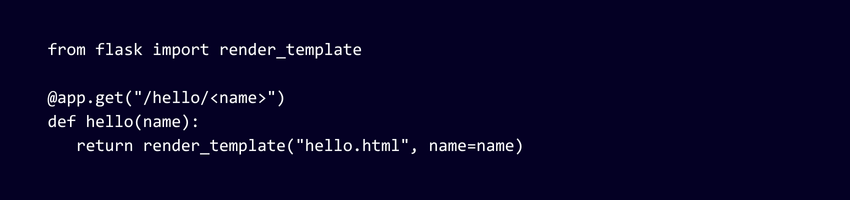
Write a Flask route that returns an HTML page with dynamic content
Here’s how the route goes:
What are Flask extensions, and what are some commonly used ones?
These extensions add features without bloating the core. Popular ones include:
1) Flask-SQLAlchemy (ORM)
2) Flask-Migrate (migrations)
3) Flask-Login (auth)
4) Flask-WTF (forms)
5) Flask-Admin (admin)
6) Flask-Caching (caching)
7) Flask-RESTX/Flask-Smorest (APIs)
How do you create a RESTful app using Flask?
I can create a RESTful app by:
1) Defining the routes per resource
2) Using proper HTTP verbs/status codes
3) Returning JSON via jsonify
4) Adding auth and pagination as needed
Flask’s simplicity makes REST API creation fast and intuitive. I can also use Flask-RESTful or Flask-RESTX for cleaner API Management.

Richard Harris


Senior Full Stack Developer and Technology Educator
Richard Harris is a highly experienced full-stack developer with deep expertise in both frontend and backend technologies. Over his 12-year career, he has built scalable web applications for startups, enterprises and government organisations. Richard’s writing combines technical depth with clear explanations, ideal for developers looking to grow in modern frameworks and tools.


 If you wish to make any changes to your course, please


