


 Top Rated Course

We may not have the course you’re looking for. If you enquire or give us a call on 01344 203999 and speak to our training experts, we may still be able to help with your training requirements.
What is a Data Warehouse? How to Scale Your Data
Lily Turner 22 April 2026A Data Warehouse is a centralised system used to store, merge, and analyse large volumes of structured data from multiple sources for reporting and insights. It typically employs techniques like Extract, Transform, Load (ETL) to prepare and store data in a structured format optimised for querying and reporting.

Training Outcomes Within Your Budget!
We ensure quality, budget-alignment, and timely delivery by our expert instructors.
Table of Contents

In this data-flooded age, businesses are swimming in information. But without a structured approach, processing this much data can be a messy endeavour. This is where the concept of a Data Warehouse comes in. It's like a digital library for organisations, storing vast amounts of information neatly and securely.
Unlike everyday databases, it brings together data from multiple sources, organises it and makes it accessible for more intelligent decisions. This blog explores What is a Data Warehouse, its core components, practical applications and more. So read on and unlock the power of this digital vault!
Table of Contents
1) What is a Data Warehouse?
2) How Does a Data Warehouse Work?
3) Key Components of Data Warehouse
4) Data Warehouse Architecture
5) Practical Applications of Data Warehousing
6) Benefits of Data Warehouses
7) Common Challenges in Data Warehouse Design
8) Data Warehousing Best Practices
9) Data Warehouses vs Other Types of Data Storage
10) Conclusion
What is a Data Warehouse?
A Data Warehouse is an enterprise system that is used for the analysis and reporting of structured and semi-structured data from multiple sources. This can include POS transactions, marketing automation, Customer Relationship Management (CRM), and more.
It is also well suited for ad hoc analysis as well as custom reporting. A Data Warehouse can store both current and historical data in one place. It is also designed to give a long-range view of data over time. This makes it a primary component of Business Intelligence.

How Does a Data Warehouse Work?
A Data Warehouse acts as a repository that aggregates data from multiple sources. This can include internal systems, external feeds, and cloud-based applications. The collected data undergoes Extract, Transform, Load (ETL) processes.

This is done to ensure it is clean, standardised, and ready for analysis. Once it is in the Warehouse, users can access this data. This can be done via various tools for reporting, visualisation, or advanced analytics.
Key Components of Data Warehouse
The key components of a Data Warehouse work together to collect, process, store, and deliver data for analysis. Each of these components are as follows:
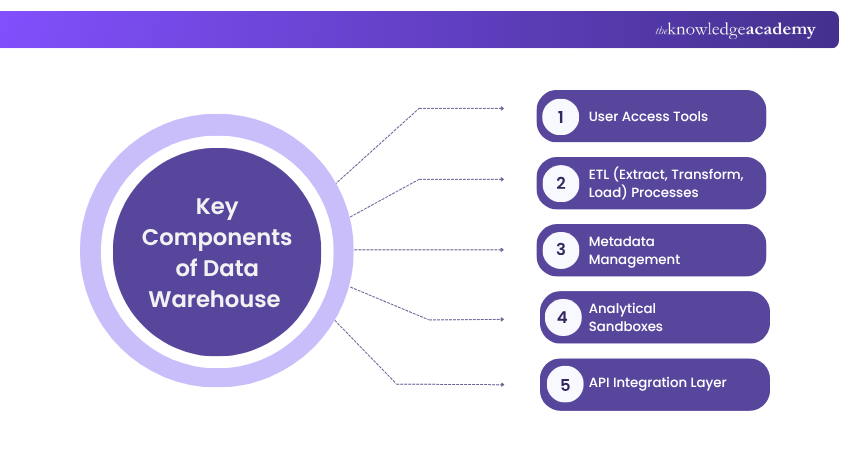
1) User Access Tools
These tools allow business users, analysts, and data scientists to query the Warehouse. They also assist in the building up of reports and visualise trends. Examples of it include Structured Query Language (SQL) clients. It also includes BI platforms like Tableau or Power BI. Custom dashboards are also a part of this.
Want to be an expert in Programming Languages? Sign in for the Big Data Analytics & Data Science Integration Course today!
2) Extract, Transform, Load (ETL) Processes
ETL Pipelines are critical for data warehousing. They pull data from source systems, clean and transform it according to predefined rules. Afterwards, they load it into the Warehouse for analysis.
3) Metadata Management
Metadata acts as a blueprint of the Data Warehouse. This helps in detailing data sources, Data Transformations, and usage. Proper metadata management enhances discoverability, data governance, and compliance.
4) Analytical Sandboxes
An Analytical Sandbox is a testing environment that is used by data analysts. It is used to experiment with data and explore various analytical approaches. All of this is done without affecting the production environment. This is where data teams can experiment with large datasets without disrupting production systems.
5) API Integration Layer
The Application Programming Interface (API) Integration Layer lets programmatic access into the Data Warehouse. This allows integration with external tools, and ML platforms. It also allows the same for custom applications.
Data Warehouse Architecture
A Data Warehouse Architecture defines the structure and flow of data from source systems to end-user tools. It typically includes a centralised data layer, and a semantic layer for easier querying. It also provides an analytical layer for reporting and insights. This layered approach ensures scalability, and good performance. It also brings in clarity in data management.
1) Centralised Data Layer
The centralised data layer is known to be the heart of the Data Warehouse. This is where processed and structured data resides. It also effectively serves as the single source of truth for all analytical processes.
2) Semantic Layer
The semantic layer provides a business-friendly abstraction of complex database schemas. It allows users to query data using familiar terminology instead of technical field names.
3) Analytics and Reporting Layer
This top layer interfaces with BI tools and reporting systems to extract insights. This enables the creation of dashboards, forecasts, and ad hoc queries.
Want to master Data Storage Solutions? Get started with the Data Integration and Big Data Using Talend Course today!
Practical Applications of Data Warehousing
Practical applications of Data Warehousing span across industries. This helps in enabling organisations to turn data into actionable insights. From powering Business Intelligence and AI models to integrating data across systems, Warehouses support smarter decisions. They also support operational efficiency, and industry-specific analytics.

1) AI and Machine Learning
AI is a computer system which is designed to mimic human intelligence. On the other hand, ML is a subset of AI. It focuses on enabling computers to learn from data without explicit programming. These also supply the clean, historical data that AI models require for training and prediction. This helps in improving accuracy and scalability.
2) Business Intelligence
Business Intelligence (BI) is the process of collecting, analysing, and presenting business data accurately. This leads to enable a range of informed decision-making. Plus, on a broad scale, decision-makers use BI tools. This can be especially those that are powered by Data Warehouses. This helps to monitor KPIs and uncover trends. Overall, it can bring in effective strategy.
3) Data Integration
Data Integration is the process of merging data from various sources into a unified view. This helps in enabling organisations to gain an understanding of their data wholly. A Warehouse unifies data from CRM systems, ERP software, social media, and other sources, providing a consolidated view.
4) Industry-specific Uses
Data Warehouses are also known to make tasks easier in industries. Thus, it is quite common for them to have industry-specific applications across various sectors. These are as listed below:
a) Healthcare: Patient records and treatment analytics
b) Finance: Fraud detection and Risk Management
c) Retail: Customer behaviour and inventory optimisation
d) Manufacturing: Quality control and supply chain tracking
Try out theData Science Analytics Course as fast as you can. This will help you to know a lot of things! Join now!
Benefits of Data Warehouses
Data Warehouses offer many benefits. Through centralising and organising data for analysis, they enhance data accuracy. Below given are some of them:

1) Unified View of Data
Centralising data from various departments and systems eliminates silos. This helps in ensuring everyone in the organisation works from the same source of truth. This unified view improves collaboration and enhances transparency. It also supports a holistic understanding of business operations.
2) Smarter Business Insights
With clean, consolidated data readily available, organisations can perform deeper analyses. They can also uncover meaningful patterns. This leads to more informed strategies, and proactive decision-making. It also leads to put forward a competitive edge in dynamic markets.
3) Long-term Historical Analysis
Data Warehouses store a lot of data. This helps in enabling organisations to analyse trends over months or years. This long-term perspective supports forecasting, seasonality analysis, and strategic planning with evidence-based insights.
4) Improved Data Accuracy and Quality
Through standardised ETL processes, data is cleansed, validated, and transformed before entering the Warehouse. This improves data consistency and reliability, reducing the risks of errors in analysis and reporting.
5) Time Efficiency in Data Retrieval
Optimised data structures and indexing allow for faster queries. This goes into significantly reducing the time analysts and business users spend retrieving information. As a result of which, this boosts productivity and accelerates time-to-insight.
6) High-speed Performance
Unlike transactional databases, Data Warehouses are built for high-speed analytical workloads. They handle complex queries efficiently, and this makes it easier to run detailed reports and visualisations without delay.
7) Strengthened Data Security
Data Warehouses incorporate advanced security measures heavily. This can include measures such as encryption, role-based access, and audit logging. These features also help to protect sensitive data and ensure compliance with regulatory requirements.
8) Consistent Data Across Systems
By integrating data from multiple sources into a centralised model, Warehouses ensure consistency in definitions, formats, and metrics. This prevents discrepancies in reports and aligns teams across the organisation.
9) Informed Decision-making Support
Access to accurate, real-time, and historical data allows leaders to make better decisions which is backed by evidence. This reduces guesswork and helps businesses respond more confidently to market changes.
10) Scalable Architecture
Modern cloud-based Data Warehouses can easily rise up or down based on data volume and user demand. This flexibility ensures performance remains stable as the organisation and its data grow.
11) Reduced Operational Costs
By automating data consolidation, reporting, and analytics, Data Warehouses lower the manual effort required for these tasks. This brings in cost savings, better resource allocation, and improved operational efficiency.
Common Challenges in Data Warehouse Design
Data Warehouses offer powerful benefits. So, designing and maintaining them comes with several challenges. Below given are some of them:
1) Managing Large Data Volumes
As organisations grow, the volume of data they generate grows too. This means that a Data Warehouse must be designed to scale without sacrificing performance. Efficient indexing, partitioning, and storage optimisation are critical to handling massive datasets while maintaining fast query response times.
2) Ensuring Data Quality
Poor data quality can lower the value of analytics. So, continuous data cleansing, validation, and quality checks are necessary to ensure data integrity. Also, establishing strong governance practices helps prevent errors. They also prevent inconsistencies, and outdated information from affecting business decisions.
3) Handling Complex Cloud Environments
Modern data architectures often have premises systems and multiple cloud platforms. So, integrating data across these environments introduces complexity in terms of connectivity. It can also show up in latency, and security. So, designing a flexible, cloud-agnostic architecture is essential to manage this complexity effectively.
4) Aligning with the AI Ladder
To unlock the magic of AI, organisations must prepare their data thoroughly. The AI ladder thus emphasises the importance of collecting, organising, analysing, and infusing data into AI systems. A Warehouse must also be designed with these stages in mind to support advanced analytics and ML use cases.
5) Limited Storage Flexibility
Traditional Data Warehouses may struggle with semi-structured or unstructured data formats. This can include JSON, XML, or multimedia. Compared to data lakes, which are more flexible in storage, Warehouses often require data to be pre-structured. This can limit agility and slow down innovation.
Data Warehousing Best Practices
Building an effective Data Warehouse goes beyond just architecture and tools. This is because it requires strategic alignment, collaboration, and disciplined execution. Below given are some of the best practices. Explore them now!
1) Business-level Best Practices
Business-level best practices focus on aligning the Data Warehouse with strategic goals. It helps in ensuring the delivery of real value to the organisation. These practices emphasise collaboration, governance, and user engagement. So, these make sure that the Warehouse supports informed decision-making and drives business success.
2) IT Best Practices
IT best practices focus on the technical aspects of building, maintaining, and securing the Data Warehouse. These practices ensure that the Warehouse operates efficiently, remains secure, and can scale to meet growing data demands. All of this is done while providing reliable and high-performance access to data for users.
Data Warehouses vs Other Types of Data Storage
Data Warehouses are built strictly for analytics unlike transactional databases, which are optimised for real-time operations. Also, compared to data lakes, which store raw, unstructured data, Warehouses store structured, curated data ready for business use. When properly integrated, all three can work together in a modern data ecosystem.
Conclusion
A data warehouse is the engine that transforms scattered data into strategic intelligence. By unifying information, improving accessibility and supporting analytics, it empowers businesses to act with clarity and foresight. In today’s data-driven world, understanding What is a Data Warehouse and embracing this idea is the key to competitive advantage.
Want to make an advancement in your career? Get started with Big Data Architecture Training today!
Frequently Asked Questions
What are the Four Stages of Data Warehouse?

The four stages are: Offline Operational Database, Offline Data Warehouse, Real-time Data Warehouse, and Integrated Data Warehouse. The first stage copies data. The second focusses on periodical updates followed by making them real time. The last stage includes data transactions being passed back to the operational system.
Is SQL a Data Warehouse?
No, SQL is not a Data Warehouse. However, it is a programming language that is utilised to manage and manipulate relational databases. SQL is to create, modify, and query databases which store structured data in tables with rows and columns. It serves as a foundational tool for interacting with data stored in Data Warehouses.
What are the Other Resources and Offers Provided by The Knowledge Academy?
The Knowledge Academy takes global learning to new heights, offering over 3,000+ online courses across 490+ locations in 190+ countries. This expansive reach ensures accessibility and convenience for learners worldwide.
Alongside our diverse Online Course Catalogue, encompassing 17 major categories, we go the extra mile by providing a plethora of free educational Online Resources like Blogs, eBooks, Interview Questions and Videos. Tailoring learning experiences further, professionals can unlock greater value through a wide range of special discounts, seasonal deals, and Exclusive Offers.
What is The Knowledge Pass, and How Does it Work?
The Knowledge Academy’s Knowledge Pass, a prepaid voucher, adds another layer of flexibility, allowing course bookings over a 12-month period. Join us on a journey where education knows no bounds.
What are the Related Courses and Blogs Provided by The Knowledge Academy?
The Knowledge Academy offers various Big Data and Analytics Courses, including the Data Science Analytics, Big Data Architecture, and the Advanced Data Analytics Course. These courses cater to different skill levels, providing comprehensive insights into Raw Data.
Our Data Analytics and AI Blogs cover a range of topics related to Data Warehousing, offering valuable resources, best practices, and industry insights. Whether you are a beginner or looking to advance your Data Analytics skills, The Knowledge Academy's diverse courses and informative blogs have got you covered.

Lily Turner


Senior AI/ML Engineer and Data Science Author
Lily Turner is a data science professional with over 10 years of experience in artificial intelligence, machine learning, and big data analytics. Her work bridges academic research and industry innovation, with a focus on solving real-world problems using data-driven approaches. Lily’s content empowers aspiring data scientists to build practical, scalable models using the latest tools and techniques.
View Detail
Upcoming Data, Analytics & AI Resources Batches & Dates
Date
 Data Warehousing Training on AWS
Data Warehousing Training on AWS
Fri 10th Jul 2026
Data Warehousing Training on AWS
Fri 23rd Oct 2026

 If you wish to make any changes to your course, please


