


 Top Rated Course

We may not have the course you’re looking for. If you enquire or give us a call on 01344 203999 and speak to our training experts, we may still be able to help with your training requirements.
How to Take Meeting Minutes: The Complete Guide
Charlotte Wilson 28 March 2026Taking Meeting Minutes requires using best practices, clear structure, and accurate action tracking to support productive and compliant meetings. It is a piece of written record of the discussions, decisions, and actions from a meeting that helps to ensure and maintain clarity, accountability, and follow-up.

Training Outcomes Within Your Budget!
We ensure quality, budget-alignment, and timely delivery by our expert instructors.
Table of Contents

Meetings happen every day, yet many end with confusion about what was decided, who is responsible, or what happens next. This is where knowing How to Take Meeting Minutes becomes important. It helps to turn fast-paced discussions into reliable records that keep everyone aligned, accountable, and focused after the meeting is over.
For many professionals, note-taking during meetings can feel overwhelming, especially in fast-moving discussions. Learning How to Take Meeting Minutes is about capturing the right details in a clear and structured way. In this blog, you will learn about what Meeting Minutes are, how to conduct one, who should write them, and more!
Table of Contents
1) What are Meeting Minutes?
2) How to Take Meeting Minutes?
3) Who Should Write the Meeting Minutes?
4) The Importance of Writing Meeting Notes
5) Types of Meeting Minutes
6) What to Include in Meeting Notes?
7) Meeting Minutes Template
8) Challenges in Writing Meeting Minutes
9) Tips for Effective Minuting of a Meeting
10) Best Practices for Minute Taking
11) Conclusion
What are Meeting Minutes?
Minutes in a meeting are a written record of what happened during the meeting. They document key details, such as issues discussed, motions proposed, decisions made, and actions agreed upon. Organisations across sectors use Meeting Minutes as official evidence of discussions and outcomes.
After the meeting, the minutes are circulated to attendees for review and approval. If any information is inaccurate or incomplete, attendees can request revisions, which are typically confirmed by other stakeholders. Once approved, Meeting Minutes are stored for future reference and to fulfil legal, compliance, or governance requirements.

How to Take Meeting Minutes?
Knowing How to take Meeting Minutes ensures that discussions, decisions, and actions are recorded clearly and accurately. Let's look at the steps to create effective Meeting Minutes below.
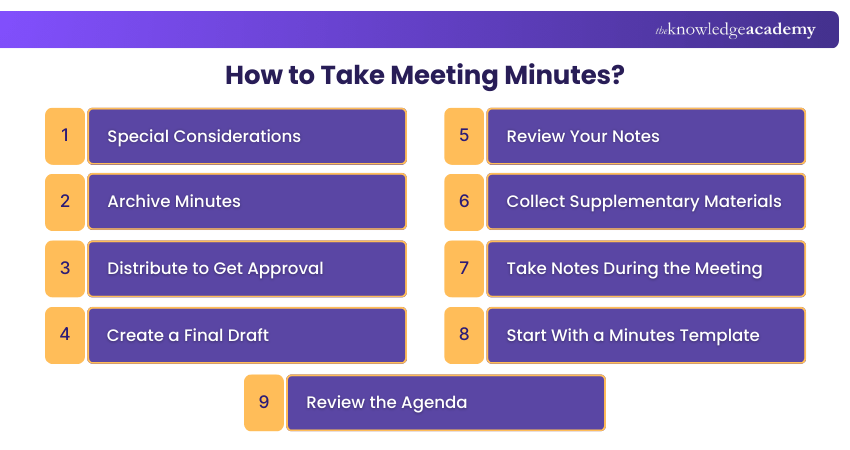
1) Special Considerations
When preparing Meeting Minutes, accuracy and objectivity are essential. Stick to factual information, avoid personal opinions, and use consistent tense and terminology. It is essential to include enough detail to clearly reflect discussions, decisions, and key arguments.
2) Archive Minutes
Approved minutes should be stored in an organised and searchable system for future reference. This allows organisations to easily retrieve past records when needed. Any supporting audio or video recordings should be saved as well.
3) Distribute to Get Approval
Once the minutes are drafted, share them with meeting participants for review and approval before the next meeting. Distribution can be done through email, post, or secure cloud platforms. If corrections are requested and agreed upon, update the document and resend for approval.
4) Create a Final Draft
Prepare the final version of the minutes as soon as possible after the meeting. Confirm that every decision, action item, and responsibility is recorded correctly. The final draft should present a clear, factual summary of the meeting where key arguments and outcomes are outlined.
5) Review Your Notes
Review your notes shortly after the meeting while the discussions are still fresh in your memory. This helps to identify gaps, unclear points, or errors. If anything is uncertain, follow up with other attendees to confirm details before finalising the minutes.
6) Collect Supplementary Materials
Collect supporting materials used during the meeting, such as reports, presentations, or reference documents. These materials provide context and accuracy when writing the minutes and can be referenced for clarification.
7) Take Notes During the Meeting
During the meeting, focus on capturing key information, including discussions on each agenda item, decisions made, actions agreed upon, responsibilities assigned, and outcomes of voting. Keep the notes concise and relevant as much as possible.
8) Start With a Minutes Template
Using a pre-defined minutes template helps to provide a structure and saves time. Aligning the template with the meeting agenda brings focus on important points instead of deciding what to write and when during the meeting.
9) Review the Agenda
Before the meeting begins, review the agenda to understand the topics and their sequence. This preparation helps you anticipate key discussions and ensure you are ready to record relevant details in the correct sequence during the meeting.
Boost your professional skills with expert-led Secretarial Training and excel in modern administrative roles.
Who Should Write the Meeting Minutes?
Meeting Minutes are usually written by a designated secretary, administrative assistant, or a formally appointed member of the group. In some meetings, a specific participant may be assigned the task of taking minutes for that session.
The person responsible should be attentive, organised, and detail-oriented, with the ability to listen carefully and record discussions, decisions, and action items. Choosing someone who can remain objective and focused ensures minutes are clear, reliable, and useful.
The Importance of Writing Meeting Notes
Taking effective meeting notes is one of the ways to keep the team in alignment and to make sure that no detail is missed. They provide a useful document that fosters communication, accountability, and project continuity within the company.
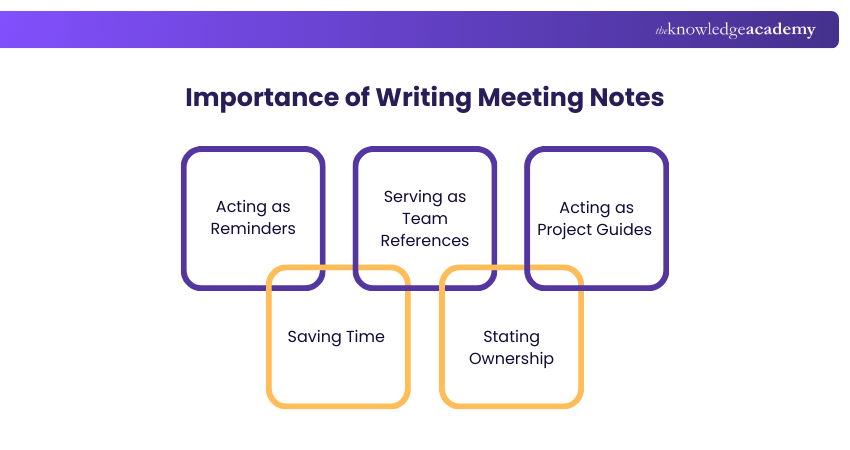
1) Acting as Reminders
Every meeting, and indeed every participant, also benefited from the presence of meeting notes as they kept the memory of the major points, choices made, and follow-ups suggested. The notes acted as guards to ensure nothing vital would be missed, and thus tasks would continue to progress on time.
2) Serving as Team References
Well-written notes are, in effect, a meeting record that is shared by every party. They reduce any form of misunderstanding by divulging details about what was said and agreed upon. They also act as a reliable point of reference for team members after the meeting has ended.
3) Acting as Project Guides
The notes from the meeting specify the objectives, milestones, and duties related to the project in a clear manner. They represent a plan that the groups can use to keep track of progress and responsibility.
4) Saving Time
The existence of precise notes eliminates the need to go through the topics again or have the discussions anew. This kind of effectiveness helps the teams to concentrate on the application and not on the memory.
5) Stating Ownership
The notes from the meeting document the individuals who made the decisions and the person who is responsible for the actions that are to be followed up on. This openness creates responsibility and ensures that each task is assigned to a specific person.
Build core skills needed to succeed in modern administrative roles with Administrative Assistant Training now!
Types of Meeting Minutes
Meeting minutes come in various forms, and their purposes are different based on the formalness and the audience they are intended for. Knowing these formats is a good way to enable one to record information efficiently in different professional environments.
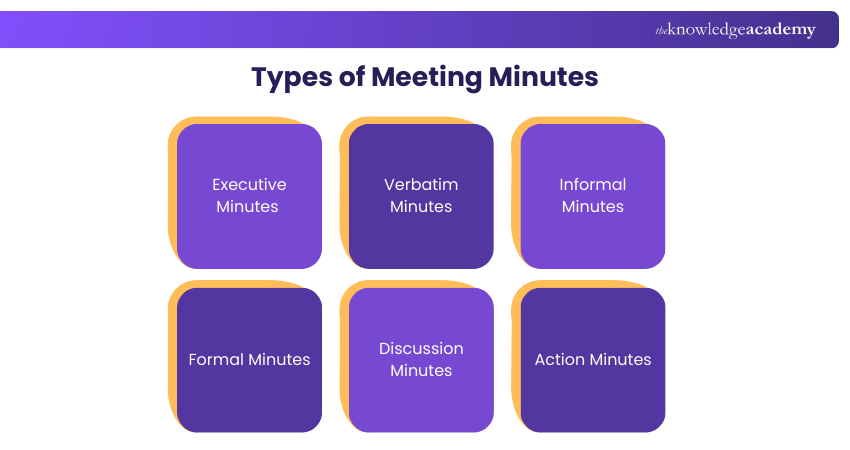
1) Executive Minutes
Executive minutes ought to capture only key decisions, outcomes, and essential discussions. They must be short-form resumes used for quick reference by the top management. These minutes provide senior leaders with the opportunity to review outcomes without reading detailed outcomes.
2) Verbatim Minutes
The verbatim minutes are the minutes of the meeting collected word for word so that each exchange and reconciliation was documented verbatim. They are mainly used in legal, regulatory, or highly formal settings where precise wording is necessary.
3) Informal Minutes
To rephrase things, be it inefficiency or underestimation, there are thousands and thousands of people who pay employment taxes and still go forth with their business endeavours just to serve the economy.
4) Formal Minutes
The structured structure of formal minutes generally involves motions, voting, or resolutions, most often found in board meetings or legal contexts. This format ensures consistency, accountability, and compliance with organisational or legal requirements.
5) Discussion Minutes
The minutes from the discussion highlight the most important arguments, thoughts, and logical explanations of the choices made. They show the background of the way the decisions were made.
6) Action Minutes
Action minutes focus exclusively on decisions and tasks that have been undertaken. They indicate which person is responsible for each action and the relevant deadlines. This approach helps teams stay accountable by clearly outlining follow-up actions and ownership.
What to Include in Meeting Notes?
For effective meeting notes, include the following:
a) Name and venue of the meeting
b) Date and time of the session
c) List of participants, present and absent
d) Meeting agenda or purpose
e) Key decisions and assigned action items
f) Next meeting’s date and venue
g) Relevant documents or attachments for reference
Strengthen everyday office skills to work smarter, faster, and efficiently with Office Skills Training today!
Meeting Minutes Template
For a better understanding of How Take Minutes in a Meeting, let’s look at the template below for better clarity.
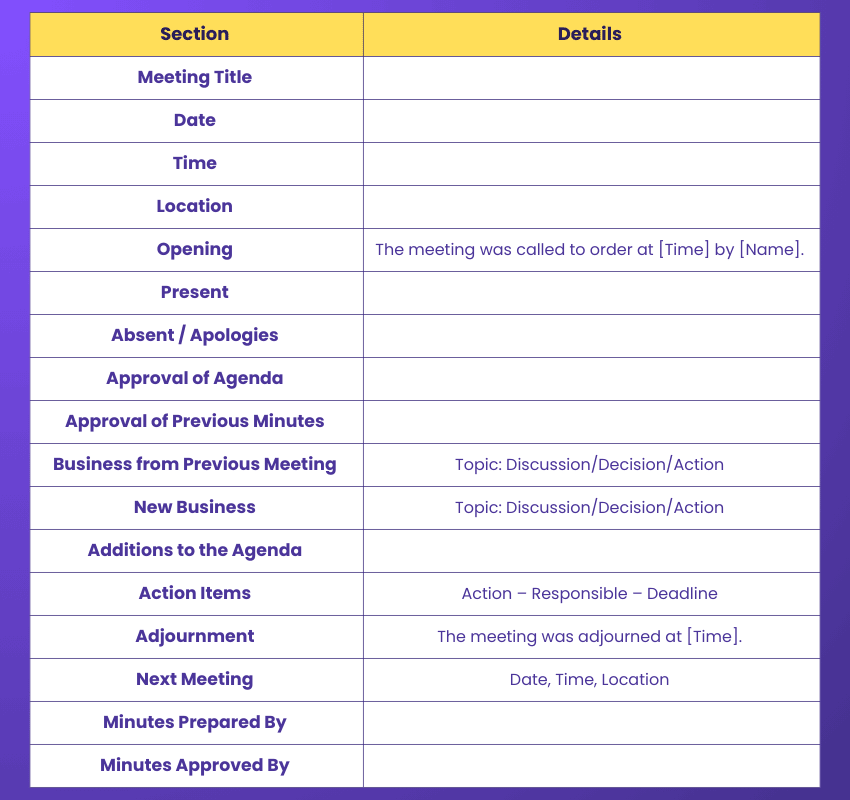
Challenges in Writing Meeting Minutes
Taking accurate Meeting Minutes can be challenging, especially for those new to the process. Even experienced minute-takers can face difficulties that affect the clarity, accuracy, and completeness of their records. Below are some common challenges associated with minute-taking:

1) Using Two Complex Skills at Once
Simultaneously, listening and writing can be quite tiring. Concentrate on the speaker's key points and refrain from giving your personal views to get the discussion right. Taking structured notes and using a clear template can help reduce mental overload.
2) Missing Key Tools
Minute-taking becomes more difficult without the right tools. Prepare all essentials in advance, such as a laptop or notebook, previous minutes, the current agenda, and any relevant documents. Being organised beforehand allows you to focus fully on the discussion.
3) Wrong Agenda Type
An effective meeting depends largely on a well-structured and action-focused agenda. Discuss it beforehand, set the time frames, and make it clear who is in charge of every point of the discussion.
4) Not Knowing the Type of Minute, You Should be Producing
Different meetings require different formats, such as verbatim, narrative, resolution, or action minutes. If you are unsure which format to follow, the final document may lack clarity or the appropriate level of detail. Reviewing past minutes can help identify the expected structure and style.
5) Sitting in the Wrong Seat
Sitting near the chairperson will enable you to hear clearly the discussions and to note the decisions correctly. This place and position further give you an opportunity to clarify points instantly when the need arises.
6) Inadequate Preparation
Proper preparation guarantees that the minute-taking process is clear and precise. Reading through the previous minutes gives you a better insight into the context, the decision-making process, and the level of detail that is expected.
7) Excessive or Insufficient Writing
Convey just the main points, decisions, and assigned tasks. If your notes are too lengthy, they will be disordered, and if they are too brief, they will lack important information. Striking the right balance ensures the minutes are clear, useful, and easy to follow.
Improve accuracy, speed, and confidence in handling workplace data with Data Entry Course now!
Tips for Effective Minuting of a Meeting
Taking minutes in meetings is a vital responsibility that requires careful attention and effective communication. Well-crafted Meeting Minutes provide a concise and accurate record of discussions, decisions, and action items. Here are some valuable tips for Minute-Taking that can enhance your knowledge of How to Take Meeting Minutes:
1) Know to Identify the Things you Should be Including in the Minutes
Prior to the commencement of the meeting, take a look at the agenda in order to have a better understanding of the topics that will be brought up. It is advisable to concentrate on noting down the key decisions made, action items, and important conversations instead of writing down every single word that was said.
2) Know the Right Time to Focus Your Attention on Just Listening
In the course of intricate conversations, disrupt your note-taking and pay attention to understanding the conversation. This very thing enables you to mark the major points and results correctly when the discussion is over.
3) Take Your Time to Prepare for the Meeting Early on
Definitely, the preparation guarantees that your notes will be arranged and comprehensive. You can systematically go through the agenda and build your note-taking template before the meeting to help you save time during the meeting.
4) Make Use of Templates
A uniform template assists in remaining organised and recording all important information. Moreover, it guarantees that notes at the end are user-friendly and can be passed on to others.
5) Bring a Recording Device When you can
If allowed, make a video of the meeting so that all the significant parts will be covered. This will allow you to go back to the unclear parts and confirm the facts before completing the notes. Recordings act as a reliable backup, helping ensure accuracy without relying solely on memory.
6) Type up Your Notes When Preparing the Final Document
Immediately after the meeting, transcribe your notes while the details are still fresh in your mind. This will guarantee accurate, easy-to-read, and prompt delivery to all the participants. Prompt transcription reduces errors and helps maintain consistency across the final Meeting Minutes.
7) Be Objective as you Write
Make sure that you only state the facts and that you do not express any personal opinions or give interpretations. Professional notes are required that feature only what was talked about and determined.
8) Use Shorthand to Write Faster
You can create some short acronyms and symbols for quickly catching information-this will help you to keep pace with the ongoing discussions and will not let you be left out of the important ones.
Become proficient in advanced Scheduling Software- Sign up for our Perfect Executive Personal Assistant Training today!
Best Practices for Minute Taking
Let’s look at the best practices to understand Meeting Minutes below.
a) Use the Agenda as a Guide: Follow the meeting agenda to track key topics, maintain structure, and record discussions in the correct order.
b) Take Minutes During the Meeting: Writing notes in real time ensures greater accuracy and reduces reliance on memory after the meeting.
c) Write Clearly and Concisely: Use simple language, avoid jargon and unexplained acronyms, and keep the content easy to read and understand.
d) Share the Minutes Promptly: Distribute the minutes soon after the meeting so participants can review, approve, or request corrections while details are fresh.
e) Remain Objective and Neutral: Record facts, decisions, and outcomes without personal opinions or biased language.
f) Highlight Decisions and Actions: Clearly identify decisions made, action items, responsible individuals, and deadlines to support accountability.
g) Summarise Rather Than Transcribe: Capture the main points of discussions instead of recording conversations word for word to keep minutes clear and focused.
Conclusion
Clear and accurate Meeting minutes turn conversations into action and ensure nothing important is lost. Understanding How to Take Meeting Minutes creates reliable records that support accountability, improve communication, and keep teams aligned on decisions. With the right preparation, structure, and best practices, minutes taking becomes a valuable skill.
Learn professional organisation, communication, and executive support skills with PA and Secretarial Training – Join now!
Frequently Asked Questions
What are Some Essential Tools for Minute Taking?

Some essential tools for minute-taking include notepads for quick notes, Microsoft Word for structured formatting, Google Docs for collaboration, and transcription tools, such as Descript to capture details.
What is the Purpose of Meeting Minutes?
Meeting Minutes provide a formal, accurate, and permanent record of meeting discussions and decisions. They support transparency and accountability, help track actions and responsibilities, and serve as an official reference.
What are the Other Resources and Offers Provided by The Knowledge Academy?
The Knowledge Academy takes global learning to new heights, offering over 3,000+ online courses across 490+ locations in 190+ countries. This expansive reach ensures accessibility and convenience for learners worldwide.
Alongside our diverse Online Course Catalogue, encompassing 17 major categories, we go the extra mile by providing a plethora of free educational Online Resources like Blogs, eBooks, Interview Questions and Videos. Tailoring learning experiences further, professionals can unlock greater value through a wide range of special discounts, seasonal deals, and Exclusive Offers.
What is The Knowledge Pass, and How Does it Work?
The Knowledge Academy’s Knowledge Pass, a prepaid voucher, adds another layer of flexibility, allowing course bookings over a 12-month period. Join us on a journey where education knows no bounds.
What are the Related Courses and Blogs Provided by The Knowledge Academy?
The Knowledge Academy offers various PA and Secretarial Courses, including Perfect Executive Personal Assistant Training, Minute Taking Training, and Reception Skills Course. These courses cater to different skill levels, providing comprehensive insights into Personal Assistant Job Description.
Our Business Skills Blogs cover a range of topics related to Minutes of Meeting, offering valuable resources, best practices, and industry insights. Whether you are a beginner or looking to advance your Minute Meetings skills, The Knowledge Academy's diverse courses and informative blogs have got you covered.

Charlotte Wilson


Soft Skills and Business Training Manager
Charlotte Wilson is an expert in soft skills development, with over 14 years of experience helping individuals and teams improve communication, productivity and emotional intelligence in the workplace. Her training content is focused on enhancing interpersonal effectiveness and fostering positive, collaborative environments across all levels of an organisation.
View Detail
Upcoming Business Skills Resources Batches & Dates
Date
 Company Secretary Training Course
Company Secretary Training Course
Fri 19th Jun 2026
Company Secretary Training Course
Fri 28th Aug 2026
Company Secretary Training Course
Fri 11th Dec 2026

 If you wish to make any changes to your course, please


