


 Top Rated Course

We may not have the course you’re looking for. If you enquire or give us a call on 01344 203999 and speak to our training experts, we may still be able to help with your training requirements.
Lean Software Development: Principles, Process & Benefits
William Brown 16 July 2026Lean Software Development is an Agile approach focused on eliminating waste, improving efficiency, and delivering value quickly through continuous improvement. It empowers teams to make decisions, adapt later, and build quality from the start, ensuring fast delivery and optimised processes that meet customer needs effectively.

Training Outcomes Within Your Budget!
We ensure quality, budget-alignment, and timely delivery by our expert instructors.
Table of Contents

Ever wondered how apps like Netflix and Spotify keep everything running so smoothly? New shows drop right on time, bugs disappear before you even notice, and your feed feels tailor-made just for you. That magic happens because of Lean Software Development working behind the scenes. By cutting unnecessary steps and delivering frequent, smart updates, teams make experiences fast, seamless, and enjoyable.
In this blog, we will break down Lean Software Development with a clear definition, its core principles, the process behind it, best use cases, benefits, challenges, and how it compares with Agile. You will discover how Lean can transform the way teams build and deliver software.
Table of Contents
1) What is Lean Software Development?
2) Principles of Lean Software Development
3) Lean Software Development (LSD) Process
4) Best Applications for Lean Software Development
5) Benefits of Lean Software Development
6) Limitations of Lean Software Development
7) Lean Software Development vs Agile: Key Differences
8) Conclusion
What is Lean Software Development?
Lean Software Development is a way of building software that focuses on doing only the important work and avoiding waste. The aim is to deliver useful software quickly, improve the process step by step, and make sure the customer gets real value. It works by keeping the development process simple and efficient.
Instead of spending time on tasks that do not add value, teams focus on what customers really need. For example, if a team is building a shopping app, they start by creating only the features that let people browse and buy items. This avoids delays and ensures faster delivery.
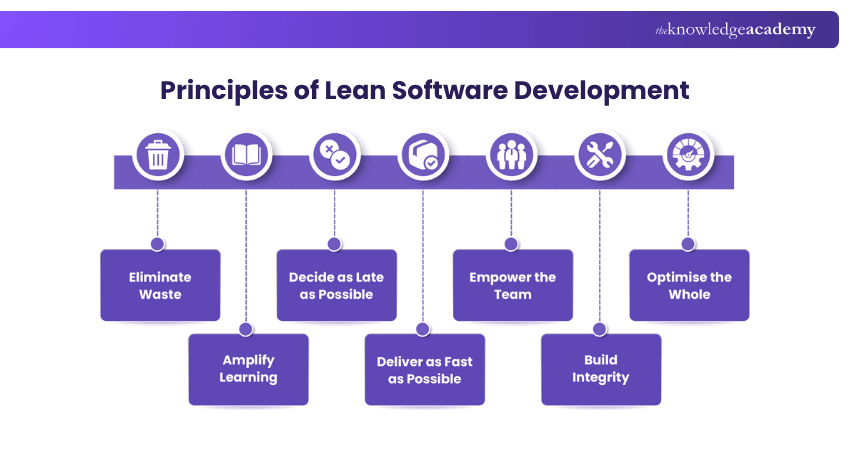
Principles of Lean Software Development
Lean Software Development has seven important principles. Let’s discuss in detail:
1) Eliminate Waste
Software projects often include work that doesn’t help customers. Lean teaches teams to spot and remove waste to work better and faster. Teams should:
1) Identify any task that does not benefit the customer
2) Remove steps that slow down progress
3) Avoid adding unnecessary features or duplicate work
4) Focus only on activities that bring value
5) Deliver software faster by keeping the process simple
2) Amplify Learning
Software projects often require teams to gain new knowledge as they build. Lean encourages continuous learning during the process so teams can improve the product faster. Teams should:
1) Experiment with different ideas and approaches
2) Improve step by step through feedback
3) Fix mistakes early and learn from them
4) Share knowledge openly with teammates
5) Use what they learn to make the software better
3) Decide as Late as Possible
Software projects often start with many unknowns. Lean encourages teams to wait until they have enough information before making key choices. This helps avoid wasted effort and rework. Teams should:
1) Avoid rushing into early decisions
2) Use new information to guide choices
3) Keep options open until the right time
4) Reduce the chance of redoing work
5) Save time and effort by deciding wisely
4) Deliver as Fast as Possible
Customers prefer quick updates instead of waiting for long releases. Lean helps teams deliver software in smaller steps and improve with feedback. Teams should:
1) Release software to customers often
2) Avoid long gaps between updates
3) Collect feedback early and act on it
4) Deliver in small, regular steps
5) Keep customers happy with speed
5) Empower the Team
The people who build the software understand it best. Lean trusts teams to make decisions and act quickly for better results. Teams should:
1) Take ownership of their work
2) Avoid delays waiting for approvals
3) Solve problems as they arise
4) Work independently with proper support
5) Stay motivated and focused
6) Build Integrity
Quality should be built into the product from the start. Lean teaches teams to create software that is reliable, simple, and long-lasting. Teams should:
1) Design software that is easy to use and maintain
2) Test early and fix issues quickly
3) Keep designs simple and clear
4) Build software that lasts over time
5) Ensure customers stay satisfied with quality
7) Optimise the Whole
Large projects involve many people and parts. Lean reminds teams to look at the entire system instead of just their own section. Teams should:
1) Communicate openly across groups
2) Avoid issues caused by working in isolation
3) Focus on the complete product
4) Solve problems that affect multiple teams
5) Improve the whole project, not just parts
Learn load testing, Agile Testing and performance monitoring with our JMeter Training – Join now!
Lean Software Development (LSD) Process
Lean Software Development follows a set of steps that guide teams to build software efficiently and deliver value without waste. The main processes of LSD are:
1) Identify Value
Understand what the customer really wants and focus on building features that meet their needs. This ensures the team works on things that add real value.
2) Map the Value Stream
Look at the entire Software Development process from start to finish. Find and remove any steps that waste time or do not help deliver value.
3) Create Flow
Work should move smoothly through each step of development without delays or interruptions. Lean focuses on removing bottlenecks and reducing waiting time so progress is steady.
4) Establish Pull
Work should be guided by actual customer demand, not by pushing tasks forward without need. This helps avoid unnecessary work and focuses on real demand.
5) Seek Perfection
Keep reviewing and improving the development process. Encourage the team to find ways to work better and make small improvements all the time.
6) Build Quality Into the Process
Include quality checks such as test-driven development and continuous integration during every stage of development. This ensures problems are found early, keeps the software reliable, and saves time by avoiding fixes later.
7) Empower Development Teams
Give teams the tools, resources, and freedom they need to make decisions and solve problems. Trusting teams helps speed up development and improve results.
Best Applications for Lean Software Development
Lean Software Development works best in some situations:

1) Startups
Startups often have little money and time. Lean helps them use their limited resources well and build products quickly. It also helps new workers learn fast and grow their Software Development Skills and confidence.
2) Uncertain Environments
When customers don’t know exactly what they want, Lean works very well. It allows teams to try small versions of the product, get quick feedback, and change quickly until the product is right.
3) Institutions Mired in Inefficiency
Big companies that are slow or wasteful can use Lean to remove waste and work better. Lean can help these companies save money and become more successful by working smarter, like how some car makers improved by copying Toyota’s system.
Understand how to integrate testing into Agile Development processes. Join our Agile Tester Training now!
Benefits of Lean Software Development
Here are the benefits of Lean Software Development:
1) Less Waste: Saves time and money by cutting extra work
2) Faster Delivery: Makes and gives software quickly
3) Better Quality: Builds good software with fewer problems
4) More Flexibility: Let teams change plans when needed
5) Improved Learning: Helps teams learn and get better fast
6) Happy Customers: Gives customers what they want on time
7) Strong Teams: Makes teams feel trusted and happy
Limitations of Lean Software Development
These are the limitations of Lean Software Development:
1) Cultural Resistance: Lean needs team buy-in; resistance slows progress
2) Learning Curve: Learning Lean takes time and effort
3) Leadership Dependency: Success depends on strong guidance from leaders
4) Hard to Measure Waste: Waste is hard to spot without a deep understanding
5) Needs Resources: Lean requires time and money for training and tools
Lean Software Development vs Agile: Key Differences
Here are the differences between Lean Software Development and Agile:

Conclusion
Lean Software Development is a powerful approach that helps software teams eliminate waste, deliver value faster, and improve quality continuously. By focusing on key principles and efficient processes, LSD enables businesses to respond quickly to change and meet customer needs effectively. Embracing LSD can transform your projects, making them more Agile, productive, and aligned with user expectations for lasting success.
Learn to test bugs and vulnerabilities in Agile projects with our Agile Software Testing Training Join now!
Frequently Asked Questions
Does Microsoft use Agile or Waterfall?

Microsoft mainly uses Agile methods for most of its software projects. Agile allows teams to be flexible and deliver software in small parts. However, some projects may still use the Waterfall when requirements are very clear and fixed.
Is Nike Lean or Agile?
Nike uses Lean principles in its manufacturing and some software projects to reduce waste and improve efficiency. They also use Agile methods to stay flexible and respond quickly to customer needs. So, Nike combines both Lean and Agile in their work.

William Brown


Senior Business Analyst and Strategic Advisor
William Brown is a senior business analyst with over 15 years of experience driving process improvement and strategic transformation in complex business environments. He specialises in analysing operations, gathering requirements and delivering insights that support effective decision making. William’s practical approach helps bridge the gap between business goals and technical solutions.
View Detail

 If you wish to make any changes to your course, please


