


 Top Rated Course

We may not have the course you’re looking for. If you enquire or give us a call on 01344 203999 and speak to our training experts, we may still be able to help with your training requirements.
Hadoop Architecture: Components and How to Design Your Hadoop Cluster
Lily Turner 09 February 2026Are you a data analytics aspirant looking to enhance your big data knowledge? Then, Hadoop, a prominent big data tool, is a must-have skill that can elevate your data processing performance. In this blog, we will learn exactly what is Hadoop Architecture, its related principles, construction methods, and benefits and limitations.
Home
 Resources
Data, Analytics & AI
Hadoop Architecture: Components and How to Design Your Hadoop Cluster
Resources
Data, Analytics & AI
Hadoop Architecture: Components and How to Design Your Hadoop Cluster
Resources
Data, Analytics & AI
Hadoop Architecture: Components and How to Design Your Hadoop Cluster

Training Outcomes Within Your Budget!
We ensure quality, budget-alignment, and timely delivery by our expert instructors.
Table of Contents

Ready to master Hadoop for peak data processing? We generate a lot of data daily that comes from various sources, such as online purchases, sign-ups for something, and social media interactions.
Handling so much data on a single computer can be tedious and inefficient. To meet this challenge, the Hadoop tool was introduced by Apache in 2008. In this blog, we will dive deep into Hadoop Architecture, its design principles, benefits and limitations to help you understand its efficient working especially for data professionals. Let's kickstart our knowledge-boosting journey!
Table of Contents
1) What is Hadoop?
2) History of Hadoop
3) Hadoop Architecture
4) Design Principles of the Hadoop Distributed File System (HDFS)
5) Constructing Your Hadoop Cluster Architecture
6) Advantages of Hadoop Architecture
7) Disadvantages of Hadoop Architecture
8) Conclusion
What is Hadoop?
Hadoop, a big data analytic tool, was developed by Apache that helps store and process a massive amount of data across many computers.
You can consider it as a giant virtual warehouse that splits the data into pieces, stores it on different computers, and then gathers the results together post-processing. This approach makes it easy to handle big data without affecting data processing performances and faulty analysis.
To understand it better, let's take an example. Imagine you are an Amazon’s CEO. In Amazon, a large amount of data is generated whenever someone purchases something, looks for the particular product, or adds items to their cart. If Amazon had to store and process all this data on a single system, it would be inefficient and tedious to manage.
However, with the Hadoop application, Amazon can break that data into smaller pieces and store it across several computers, regardless of where that system is located. So, when Amazon wants to analyse things like customer preferences or popular products, Hadoop vs Spark shows that Hadoop quickly gathers data from all these computers, making the analysis faster, more efficient, and more seamless, especially in large-scale data processing scenarios.

History of Hadoop
Early Beginnings (2002-2005)
a) 2002: Doug Cutting and Mike Cafarella launched the Apache Nutch project, aiming to build an open-source web search engine. The project encountered high hardware costs for indexing billions of web pages, leading to a search for more efficient solutions.
b) 2003: Google published papers on the Google File System (GFS) and MapReduce, which inspired the development of the Hadoop framework. The Apache community saw the potential of GFS and MapReduce for applications beyond web crawling.
c) 2005: The Hadoop framework was created as part of the Nutch project, with its name inspired by Cutting’s child’s toy elephant.
Formation and Adoption (2006-2008)
a) 2006: Hadoop became an independent subproject under the Apache Software Foundation. Yahoo! adopted Hadoop to replace its WebMap application, marking one of its first significant adoptions.
b) 2007: Yahoo! expanded its use of Hadoop across a 1,000-node cluster, showcasing its scalability and effectiveness in handling large datasets.
c) 2008: Hadoop was recognised as a top-level project at Apache. By this time, companies like Last.fm, Facebook, and The New York Times had started using Hadoop for their data processing needs.
Interested in gaining a deeper knowledge on Hadoop, refer to our blog on Hadoop Data Types.
Major Releases and Ecosystem Growth (2011-Present)
a) 2011: Apache released Hadoop version 1.0, introducing key features such as security enhancements and support for HBase.
b) 2012: The release of Hadoop 2.0 introduced YARN (Yet Another Resource Negotiator), improving resource management and job scheduling capabilities within the framework.
c) 2017: Hadoop 3.0 was released, further enhancing its capabilities with numerous bug fixes and performance improvements, solidifying Hadoop’s role in big data processing.
Build your future in Big Data with Big Data And Hadoop Solutions Architect Course- join today!
Hadoop Architecture
Hadoop was created to store and process massive amounts of data in an efficient manner. The Hadoop Architecture consists of several key components, each with an important function in handling large amounts of data.

1) MapReduce
MapReduce is a programming model that helps process data in parallel across many computers. It works in two main steps:
a) Map: The data is broken down into smaller pieces, and each piece is processed to extract useful information.
b) Reduce: The results from the map step are combined to produce the final output. This method allows Hadoop to handle huge data sets quickly.
2) HDFS
Hadoop Distributed File System (HDFS) is the storage part of Hadoop. It stores large files by splitting them into smaller blocks and distributing them across different computers in a cluster. This ensures that data is stored securely and can be easily accessible. Furthermore, the application is designed to be fault-tolerant, meaning that even if one computer fails, the information stays secure on other systems.
3) Yet Another Resource Negotiator (YARN)
YARN is Hadoop's resource management layer that manages and allocates resources among the various applications running on the Hadoop cluster. YARN comprises two main components:
a) ResourceManager: It manages the resources for all the applications in the cluster.
b) NodeManager: It runs on each computer in the cluster and takes care of the resource usage and job management on that specific computer.
4) Hadoop Common or Common Utilities
Hadoop Common refers to the shared utilities and libraries that support the other Hadoop modules, which are crucial for the functioning of the entire Hadoop ecosystem. These common tools include file systems and I/O libraries, enabling different parts of Hadoop to work together smoothly. If you're preparing for interviews, understanding Hadoop Common and its components is often covered in Hadoop Interview Questions.
Design Principles of the Hadoop Distributed File System (HDFS)
Hadoop Distributed File System (HDFS) is designed to store big data across numerous computers. Below are its design principles:
1) Data Replication and Fault Tolerance
Data replication is the key feature of the Hadoop Distributed File System (HDFS). This indicates that whenever a new file is saved, multiple copies are created automatically and stored on various cluster computers.
This ensures that even if one computer fails or goes offline, the data remains safe and accessible from other computers. Furthermore, this data replication provides fault tolerance, which means that the system will continue to function even if some components fail.
2) Data Localit
The data locality feature enables users to process big data in its original location without having to move it to different locations. This technique reduces the amount of data transmitted, promoting faster and more efficient processing.
3) Storage Formats
HDFS supports multiple storage formats that allow data to be stored in several ways, making processing more efficient and seamless. For example, some formats allow better compression and faster access times. This versatility in storage format provides flexibility and helps improve the performance of data processing tasks.
Upgrade your data processing skills with Apache Spark Training –book your spot now!
Constructing Your Hadoop Cluster Architecture
Constructing a Hadoop Cluster Architecture requires a series of steps to ensure its efficient operations. Here are the steps explained:
1) Define Cluster Topology
The first step in setting up your Hadoop Cluster is to define the Cluster topology. This means identifying the number of computers and existing nodes (individual units or points in a network) and how you will arrange them. The topology will ensure how effectively your data will be stored and processed. Therefore, it's essential to plan it carefully.
2) Choose Node Types and Sizes
Next, you need to choose the Node type and its size. This means you identify which nodes will store the data (data nodes) and which will process the data (master nodes). You also need to select the right hardware size to store these nodes, such as the memory and storage, to ensure it can handle the loads easily without performance lag.
3) Consider Network and Bandwidth
Another critical factor is assessing the cluster network and bandwidth. You should ensure the network can handle this data transfer between nodes without delay. This aspect is the most critical among all the steps as it maintains the performance of your Hadoop cluster.
4) Establish High Availability
Establishing high availability is important as it ensures that if one or multiple nodes fail, the system will still work through the application of the remaining nodes. To achieve this, you must set up a backup node or use software that automatically switches to backup mode if a primary node goes down. This approach prevents data loss and keeps your application running smoothly throughout.
Advantages of Hadoop Architecture
Hadoop Architecture for big data analysis forms the framework of the system, which may not be possible through conventional methods used by relational data. The other advantages include:
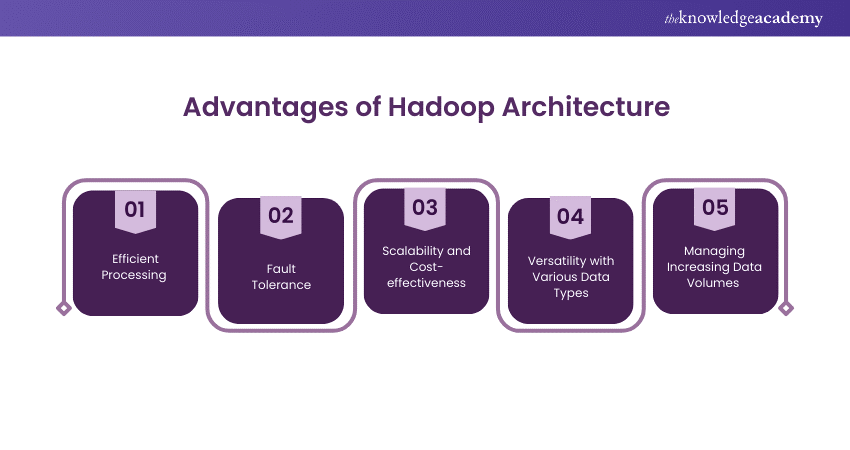
1) Efficient Processing
Hadoop can process large amounts of data quickly by splitting tasks among a wide array of computers. This means that data can be analysed much more quickly, allowing for more insights and informed decisions.
2) Scalability and Cost Effectiveness
Hadoop is designed with scalability into mind through any number of computers attached to the Hadoop cluster, allowing it to handle more data when needed. In addition, the process is cheaper than upgrading existing systems, making it a budget-friendly choice for businesses.
3) Versatility with Various Data Types
Hadoop can work with different types of data, ranging from text to videos. This flexibility allows organisations to use a single platform for all their data needs, further simplifying data management.
4) Managing Increasing Data Volumes
As businesses collect more data daily, Hadoop helps manage these large volumes effectively. It can store and process big data without lag, allowing organisations to keep up with their growing needs.
Sign up for our Big Data Architecture Training to build efficient data analysis frameworks!
Disadvantages of Hadoop Architecture
In addition to the advantages, Hadoop Architecture comes with certain limitations. Below, we have listed those limitations in brief:
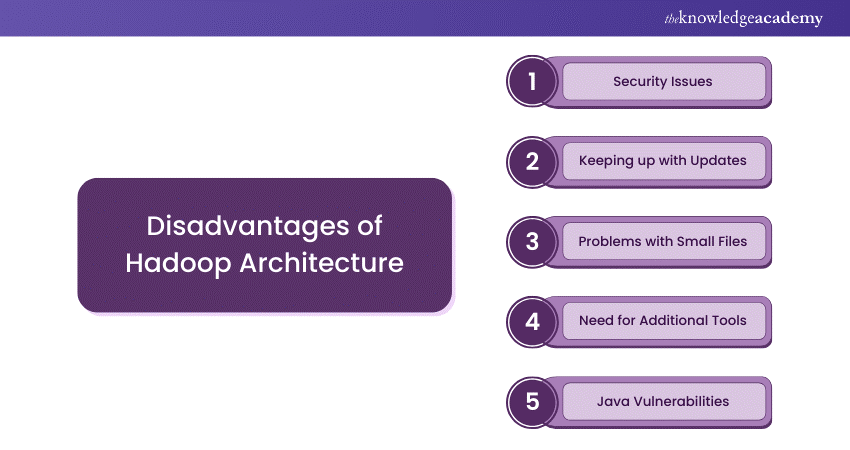
1) Security Issues
Hadoop is an open source, which means anyone can view its code, leading to security risks, as bad actors might find ways to exploit weaknesses, putting important data in danger.
2) Keeping Up with Updates
Hadoop needs regular updates to fix bugs and improve performance. However, keeping track of these updates can be tricky and time-consuming, especially for companies without a dedicated tech team.
3) Problems with Small Files
Hadoop isn’t great at managing many small files. Each small file takes up space and requires its own information for storage, which can slow down the system and make it harder to handle.
4) Need for Additional Tools
While Hadoop is powerful on its own, it often requires other tools for specific tasks like data analysis or management. This can complicate the setup and require extra training for users.
5) Java Vulnerabilities
Since Hadoop is built using Java, it inherits any security flaws that Java might have. If Java has problems, they could also impact Hadoop’s security, potentially exposing sensitive information.
Grab the Hadoop HDFS Commands Cheat Sheetfor a handy guide on essential Hadoop commands.
Conclusion
Understanding Hadoop Architecture is important for anyone looking to make a career in big data analytics. With its efficient large data processing ability, fault tolerance, various data type managements, and other features of Hadoop, it has become a powerful tool with a broader array of exciting capabilities. However, before implementation, it’s important you weigh its limitations as well, including security issues and additional tool requirements.
Transform data into insightful visuals- sign up for our Data Analysis And Visualisation With Python Training today!
Frequently Asked Questions
Which Language Is Used In Hadoop?

Java language is commonly used in Hadoop. However, other languages like Python, R, and Scala are also used for data processing and analysis tasks within the Hadoop ecosystem.
Does Hadoop Use SQL?
Yes, Hadoop uses the Structured Query Language (SQL) for quering data. For this, Apache Hive with SQL-like interface is predominantly used to query data stored in data.
What are the Other Resources and Offers Provided by The Knowledge Academy?
The Knowledge Academy takes global learning to new heights, offering over 3,000+ online courses across 490+ locations in 190+ countries. This expansive reach ensures accessibility and convenience for learners worldwide.
Alongside our diverse Online Course Catalogue, encompassing 19 major categories, we go the extra mile by providing a plethora of free educational Online Resources like Blogs, eBooks, Interview Questions and Videos. Tailoring learning experiences further, professionals can unlock greater value through a wide range of special discounts, seasonal deals, and Exclusive Offers.
What is The Knowledge Pass, and How Does it Work?
The Knowledge Academy’s Knowledge Pass, a prepaid voucher, adds another layer of flexibility, allowing course bookings over a 12-month period. Join us on a journey where education knows no bounds.
What are the Related Courses and Blogs Provided by The Knowledge Academy?
The Knowledge Academy offers various Big Data and Analytics Training, including Hadoop Big Data Certification, Big Data And Hadoop Solutions Architect training, and Data Analysis And Visualisation With Python course. These courses cater to different skill levels, providing comprehensive insights into MapReduce Architecture.
Our Data, Analytics & AI Blogs cover a range of topics related to data science, analytics, and machine learning, offering valuable resources, best practices, and industry insights. Whether you are a beginner or looking to advance your data analysis and visualisation skills, The Knowledge Academy's diverse courses and informative blogs have got you covered.

Lily Turner


Senior AI/ML Engineer and Data Science Author
Lily Turner is a data science professional with over 10 years of experience in artificial intelligence, machine learning, and big data analytics. Her work bridges academic research and industry innovation, with a focus on solving real-world problems using data-driven approaches. Lily’s content empowers aspiring data scientists to build practical, scalable models using the latest tools and techniques.
View Detail
Upcoming Data, Analytics & AI Resources Batches & Dates
Date
 Hadoop Big Data Certification
Hadoop Big Data Certification
Thu 9th Jul 2026
Hadoop Big Data Certification
Thu 8th Oct 2026

 If you wish to make any changes to your course, please


